---
title: "Why Does AI Use Em Dashes? Even OpenAI Can't Say for Sure"
url: https://syntaxradar.com/radar/why-does-ai-use-em-dashes
author: "Abdul Rehman, Lead Systems Architect and Technical Director"
publishedAt: 2026-11-02T17:00:00.000Z
dateModified: 2026-11-02T17:00:00.000Z
category: "#LLM-MODELS"
topic: "why does ai use em dashes"
primarySource: https://gizmodo.com/chatgpt-achieves-a-new-level-of-intelligence-not-using-the-em-dash-2000686253
summary: "Why does AI use em dashes? Even OpenAI can't say. See a six-chatbot dash count, why one dash proves nothing, and how accurate Pangram's AI detector is."
---
# Why Does AI Use Em Dashes? Even OpenAI Can't Say for Sure
**Short answer:** Since GPT-5.1, ChatGPT follows a custom instruction to drop em dashes, but OpenAI has not explained why the habit exists. A six-chatbot test found big differences between tools, and Pangram publishes low error rates with length and genre caveats.
**Takeaway:** No one has confirmed why chatbots favor the em dash, so a dash proves nothing on its own, and even a detector with low published error rates is weakest on short, formatted or AI-edited text.
**Key figures (as reported by the source):**
- Pangram 4 observed false-positive rate (2,046,273 human documents): 0.0041%
- Pangram reported false-negative rate (519,993 AI documents): 0.3396%
- Em dashes in ChatGPT's 573-word test article (Plagiarism Today): 8
Why does AI use em dashes so often that the long dash has become a running joke about chatbot writing? The honest answer is that nobody has published a confirmed explanation, OpenAI included. What has been documented is narrower and more useful: the habit varies a lot from one chatbot to the next, ChatGPT can now be told to stop, and the mark on its own says very little about who wrote a sentence.
That last part matters to anyone whose work gets pasted into an AI em dash checker or a full detector such as Pangram. Students, freelancers and job applicants are the ones who pay when a guess gets treated as proof. Detector makers publish striking accuracy figures, and those figures come with conditions about text length and type.
A quick definition first, because the marks are easy to mix up. According to [Plagiarism Today's guide to dashes and AI writing](https://www.plagiarismtoday.com/2025/06/26/em-dashes-hyphens-and-spotting-ai-writing/), an em dash is roughly the width of a capital M and an en dash roughly the width of a capital N. The hyphen is the short mark most people actually type.
### Why does AI use em dashes?
Nobody has a confirmed answer, including the company behind the most famous offender. [Gizmodo reported](https://gizmodo.com/chatgpt-achieves-a-new-level-of-intelligence-not-using-the-em-dash-2000686253) on November 15, 2025 that OpenAI has not determined why the habit arose or why it persists. The article ties that to large language models being a "black box": the people who build them cannot easily trace a particular quirk in the output back to one cause.
What OpenAI did ship is a workaround. After the GPT-5.1 release, Sam Altman posted on X: "If you tell ChatGPT not to use em-dashes in your custom instructions, it finally does what it's supposed to do!" He called it a "small-but-happy win."
The fix is a personalization setting each user applies for themselves, so the model's default behavior is unchanged. Gizmodo also notes that some people replying to Altman said ChatGPT kept producing em dashes even with the instruction in place.
You will find confident explanations for the habit all over social media. Treat them as theories. None of the sources behind this article confirms a cause, and Gizmodo's report offers no specific theory at all. If you want a reminder that ChatGPT's behavior can surprise even its makers in more serious ways, our breakdown of [three ChatGPT bugs that touched private chats](/radar/is-chatgpt-safe-three-bugs-private-chats) is a useful companion read.
### Why does AI use em dashes so much?
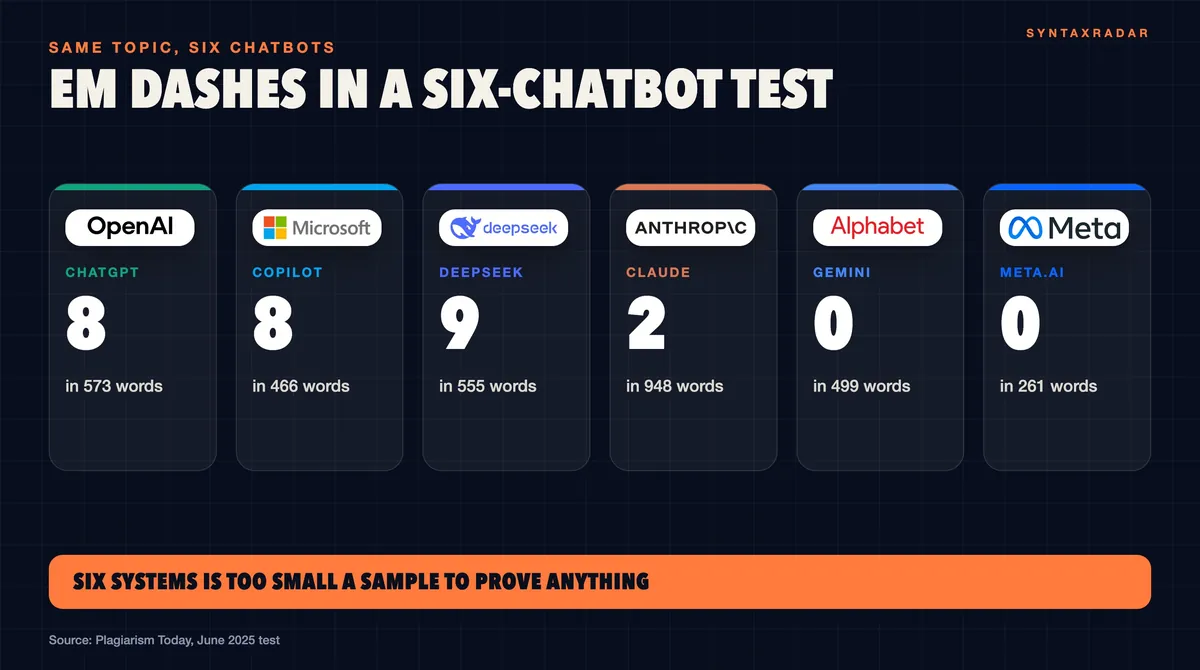
It depends heavily on which chatbot you mean. Jonathan Bailey of Plagiarism Today ran a simple test in June 2025: he asked six systems to write an article on the same topic and counted the dashes in each. Here is an AI em dash example with real numbers, showing how much the habit varies by tool.
| Chatbot | Words written | Em dashes | En dashes |
|---|
| ChatGPT | 573 | 8 | 0 |
| Microsoft Copilot | 466 | 8 | 0 |
| DeepSeek | 555 | 9 | 4 |
| Claude | 948 | 2 | 1 |
| Gemini | 499 | 0 | 0 |
| Meta.ai | 261 | 0 | 0 |
ChatGPT, Copilot and DeepSeek each landed eight or nine em dashes in articles of roughly 450 to 575 words. Claude wrote by far the longest piece and used two. Gemini and Meta.ai used none.
So "AI loves the em dash" describes a few tools, not all of them. Bailey is upfront about the limits: he says six systems is far too small a sample to be statistically significant.
### Em dashes instead of hyphens: why AI output stands out
Mostly it is a question about people, because it explains why the mark stands out. Bailey points out that keyboards have no dedicated em dash key, so most people type a hyphen where a dash belongs. Casual human writing is therefore full of short hyphens doing a long dash's job.
A chatbot's output skips that step and contains the proper character. Why a model picks it is not documented in the sources. The contrast with hyphen-heavy everyday typing is a plausible reason the long mark looks out of place to many readers, though none of the sources measures that.
The missing key does not stop people from using the real thing. A person who types the proper character produces exactly the same mark a chatbot does, and the dash itself carries no record of who typed it.
### Does an em dash mean AI wrote it?
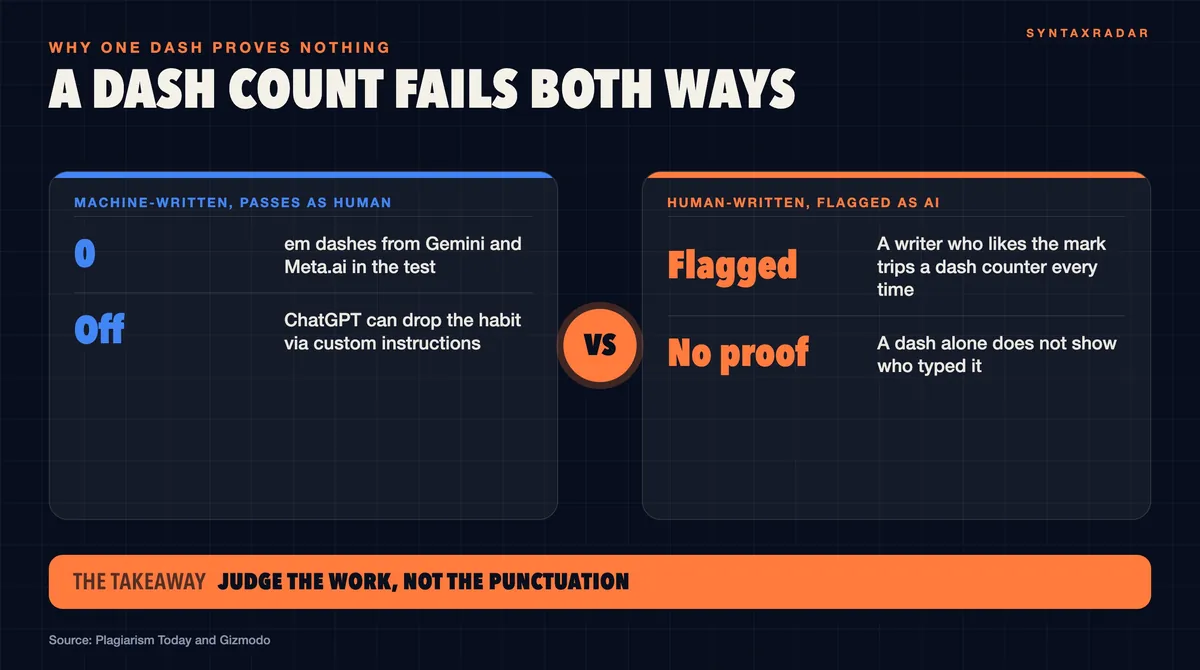
A tool that counts long dashes cannot tell you who wrote a text, and Bailey's own numbers show why. Two of the six chatbots in his test used zero em dashes, so a dash-free essay can still be machine-written. ChatGPT users can also switch the habit off through custom instructions, which removes the signal from the tool that produced it most often.
The reverse fails too. A human who likes the mark will trip a dash counter every time. A test that misses AI text one way and flags people the other way is worse than no test, because it feels like evidence.
Full AI detectors claim to do much better than a punctuation count, and Pangram publishes its error rates in unusual detail.
### How accurate is the Pangram AI detector?
Any Pangram AI detector review should start with the company's own accuracy data, so this section covers Pangram AI detector accuracy as Pangram reports it. It depends on what you measure, and Pangram publishes the breakdown in its post [Is Pangram accurate?](https://www.pangram.com/blog/is-pangram-accurate) Two numbers matter. A false positive is human writing wrongly flagged as AI. A false negative is AI writing that slips through as human.
On false positives, Pangram says its target is 0.01%, or 1 in 10,000. It reports that Pangram 4 observed 0.0041% on a test set of 2,046,273 human-written documents, which works out to about 41 per 1,000,000. Across 25,996 student essays, it reports zero false positives.
On false negatives, Pangram reports 0.3396% across 519,993 AI-generated documents. Its AI test set holds 520,000 samples from 26 models, 20,000 from each.
The numbers shift by type of writing. These are its reported false-positive rates by domain:
| Type of writing | False-positive rate |
|---|
| Poetry | 0.078% |
| Recipes | 0.049% |
| How-to | 0.016% |
| News | 0.003% |
| Creative writing | 0.000% |
Length matters as well. Pangram targets prose of 50 words or more. For texts of 50 to 99 words it reports a false-positive rate of 0.02% and a false-negative rate of 1.29%. For 250 to 499 words, those fall to 0.004% and 0.21%. The company also says code, Markdown, machine translations and highly formatted text such as poetry or recipes may give less reliable results.
Then there is the grey zone of AI-assisted writing. Pangram reports that 99.45% of documents only proofread by AI were detected as human. For substantial AI edits, 55.01% came back as mixed and 3.62% as AI.
### Can AI detectors be trusted?
Start with a simple check: who produced the numbers. Every figure in the previous section comes from Pangram itself. A [news summary of Pangram's detection work](https://www.valuethemarkets.com/cryptocurrency/news/pangram-labs-enhances-ai-detection-capabilities-to-differentiate-between-human-and-machine-writing) points to third-party evaluations citing higher false-positive rates, 0.48% to 2% in one review. We have not been able to verify that range, so treat it as unverified until an independent test confirms it.
If you are deciding how much weight to give a score, Pangram's own data suggests a few practical questions:
- **How long is the text?** Short pieces of 50 to 99 words carry higher error rates in both directions.
- **What kind of writing is it?** Poetry and recipes show the highest false-positive rates in Pangram's table.
- **How much did AI touch it?** Light proofreading mostly reads as human. Heavier editing often lands as "mixed", which is a different claim from "written by AI".
- **How many documents are being checked?** Even 41 false flags per million is not zero. At the scale of a university or a publishing platform, some honest writers will be flagged.
None of this makes detectors useless. Pangram's reported rates on long, ordinary prose are low. The fair reading is that a score is a piece of evidence to discuss with the writer, alongside drafts and version history, and a weaker one for short or heavily formatted text.
### What to watch next
Three open questions will decide how much any of this matters.
- **Will a lab explain it?** Watch whether OpenAI or any other lab says why AI uses em dashes, or changes the default so users no longer need per-user instructions. Gizmodo's report leaves that open, and user replies to Altman suggest the custom-instruction fix is not airtight.
- **Will anyone repeat the count?** Bailey's six-chatbot test is a useful snapshot that its own author calls too small to be statistically significant. A larger, repeated count across models and prompts would show whether the gap between ChatGPT and Gemini is stable.
- **Will outsiders test Pangram 4?** Independent tests at the scale of its own two-million-document human set do not exist yet. Until they do, the safest habit for writers, teachers and editors is the same: judge the work and the process behind it.
## Frequently asked questions
### Does using an em dash make my writing look AI-generated?
Some readers think so, but the mark proves nothing. In Plagiarism Today's six-chatbot test, Gemini and Meta.ai used no em dashes at all, and ChatGPT users can switch the habit off with a custom instruction. People who type the proper character produce the same mark, so judge the writing and the drafts behind it.
### How do I stop ChatGPT from using em dashes?
Add a line to your ChatGPT custom instructions telling it not to use em dashes. Sam Altman said this works after the GPT-5.1 release and called it a small-but-happy win. It is a per-user setting that leaves the default model unchanged, and some users replying to Altman said the dashes still appeared.
### How accurate is the Pangram AI detector on short text?
Pangram AI detector accuracy is lower on short text than on long text. Pangram targets prose of 50 words or more. At 50 to 99 words it reports a 0.02% false-positive rate and a 1.29% false-negative rate, compared with 0.004% and 0.21% at 250 to 499 words. It also warns that code, Markdown, translations, poetry and recipes may give less reliable results.
### Can AI detectors be trusted?
Only with context. Pangram publishes low error rates, but those numbers are its own, and it says short, formatted or AI-edited text is less reliable. A news summary cites third-party reviews with higher false-positive rates, which we could not verify. Treat a score as evidence to discuss with the writer.
### What is the difference between an em dash, an en dash and a hyphen?
Width and use. An em dash is roughly as wide as a capital M and an en dash roughly as wide as a capital N, according to Plagiarism Today. The hyphen is the short mark on every keyboard. Because there is no dedicated em dash key, most people type a hyphen where a dash belongs.
## Source
Based on Gizmodo, Plagiarism Today and Pangram's published accuracy data. https://gizmodo.com/chatgpt-achieves-a-new-level-of-intelligence-not-using-the-em-dash-2000686253
---
Published on SyntaxRadar (https://syntaxradar.com). Canonical URL: https://syntaxradar.com/radar/why-does-ai-use-em-dashes. Last modified 2026-11-02T17:00:00.000Z.