


AI Powered Cyberattacks: What Google and Amazon Really Found
Google's threat team (November 17, 2026) says a tool called exploit_agent turned patches into exploits with no human in the loop. Amazon (November 20, 2026) says AI agents found a zero-day and got root during a campaign against East Asian universities. Both are vendor reports.

Abdul Rehman
Lead Systems Architect and Technical Director · · 9 min read

The short version
- About 11 minutes
- Time from API mapping to file write (Amazon)
- 22, vs a 2025 average of 8 a month
- Zero-day exploits in August 2026 (GTIG)
- 148 actions over about 16 hours, none worked
- Redis attack by agents (Amazon)
Why it matters: Google and Amazon each describe AI agents attacking in real campaigns, but both are vendor reports, and the evidence shows faster attacks on known weaknesses more than a new kind of attack.
On this page
AI powered cyberattacks are documented in two vendor reports, and the two describe different things. Google's Threat Intelligence Group (GTIG) says in a report dated November 17, 2026 that it found a tool called exploit_agent, which reads a software patch, works out the flaw and runs an exploit with no human in the loop. Amazon says in a post dated November 20, 2026 that autonomous AI agents found a previously unknown flaw (a zero-day) and went from mapping an application to writing files on a server in about 11 minutes.
Both accounts come from the companies that found the activity, and neither has been independently confirmed. As of November 22, 2026, the safe reading is narrower than many headlines about AI cyberattacks. Google says the mechanics of intrusions are unchanged and only the speed and scale are new. Amazon says a human chose the targets and the goal, and the agents chose the method.
AI powered cyberattacks: what did Google and Amazon each report?
The Google Threat Intelligence Group AI report is an update to GTIG's AI Threat Tracker, written with Mandiant. Google's own page is dated November 17, 2026; The Register's coverage is dated November 16, a day earlier, so this post uses the date on Google's page. Its headline finding is that, in the period its tracker covers, GTIG saw attackers automate vulnerability discovery and exploitation from start to finish for the first time. The framework, dubbed exploit_agent, sat on an exposed staging server. It ran continuous comparisons of popular web software before and after patches, drafted exploits and executed them automatically. GTIG also found scripts for reconnaissance, password guessing, installing webshells (remote-access backdoors on a web server) and removing other attackers' webshells. Victim data on the server suggested an interest in French media, entertainment and education sites. GTIG shows Russian-language comments in the tool's configuration file but does not name a nationality, and The Register describes the operator as a suspected Russian-speaking actor.
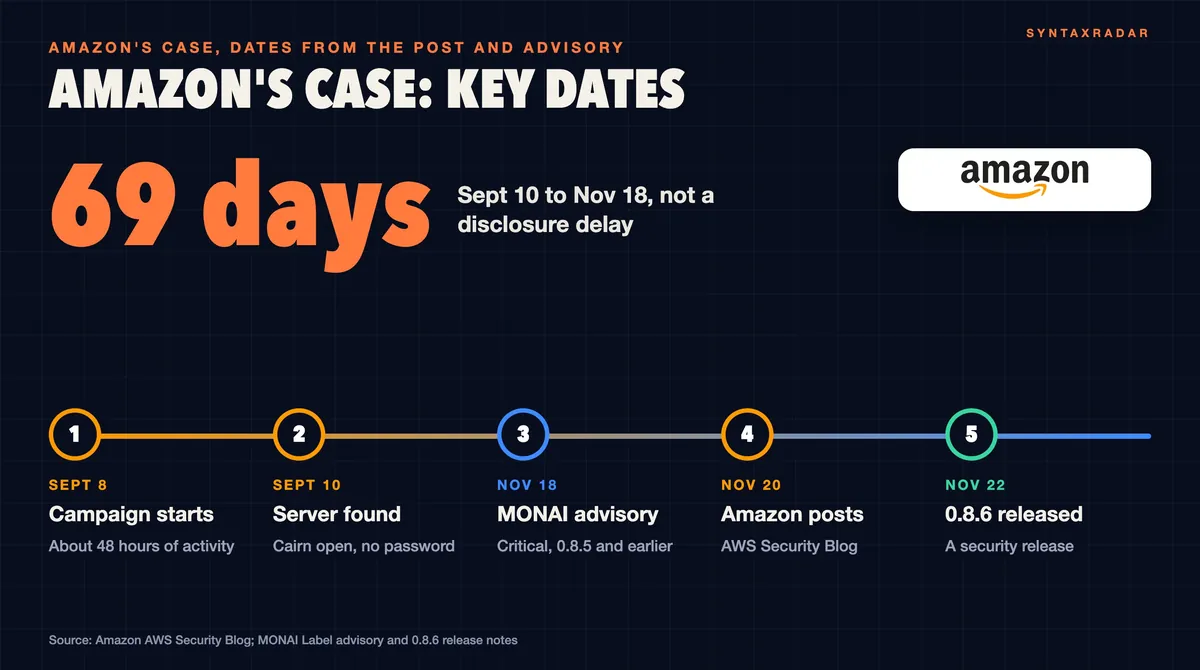
Amazon's post, by CJ Moses, the CISO of Amazon Integrated Security, covers a separate case. On September 10, 2026, Amazon found a server running Cairn, an open-source tool that coordinates AI agents toward a goal, with no password on it. That left the operator's prompts and the agents' output visible. The operator had given the agents a list of university IP addresses and a plain-language goal: get shell access, meaning command-line control of a machine.
How are hackers using AI agents?
In both reports, attackers use agent frameworks: software that lets several AI models plan, run tools and adjust to the results with little supervision. GTIG names five: ARTEX, which it calls a highly publicized pentesting tool, and the open-source multi-agent frameworks CAIRN, CyberStrikeAI, PentAGI and HexStrike AI. Pentesting (penetration-testing) tools are a category that security testers use to probe systems. It says it observed CAIRN in intrusion activity against targets that included the US aerospace sector, and tracked a customized platform built on PentAGI that scanned organizations in Asia between late August and early October 2026. Our explainer on AI for hacking and the ARTEX framework covers CrowdStrike's view of the best-known tool in that list.
Financially motivated actors and suspected PRC-nexus espionage groups are both experimenting with these frameworks, according to GTIG, which calls it highly likely that more campaigns will follow. It also names a trade-off. The tools generate forensic traffic, reuse recognizable identifiers and leave code-level traces, so they gain speed at the cost of stealth.
A third vendor adds one more data point, with a caveat. CloudSEK published findings on November 11, 2026 about an exposed server it ties to a cluster called Silent Lynx. CloudSEK's page returned an access error when we tried it, so this comes from a developer write-up of the report (single secondary report). It says the server held an operator's tooling and agent state, that the agent was a customized open-source one using DeepSeek and Gemini models, and that destructive commands reportedly ran without confirmation. It is a separate vendor's claim, so we keep it apart from Google's and Amazon's findings.
Can AI write exploits?
Yes. In the case Google describes, AI exploit generation ran end to end, with a limit on the kind of flaw. An exploit is code that takes advantage of a software flaw. exploit_agent works from patches: when a vendor ships a fix, the changed code shows where the hole was, and the tool turns that into an exploit. These are n-day flaws, meaning flaws that already have a public fix. GTIG says attackers may prefer them for AI because the research stays on a finite set of material, such as code versions, release notes and proof-of-concept code. Hunting for zero-days means searching far more widely.
Google also cites speed evidence from outside its own team. Researchers and the security firm Huntress used language models to produce working exploits for two PaperCut flaws within a day of disclosure in late August 2026. GreyNoise reported a campaign four days after disclosure against hundreds of organizations, in which the actor went from a first foothold to domain administrator within minutes. These are third-party findings that GTIG repeats.
The same report cuts the other way. GTIG says AI has also produced a wave of exploits that are claimed to work but do not, which leaves defenders more to verify. After the PHP patches of October 21, 2026, hundreds of claimed but non-functional proofs of concept appeared. Google's own framing keeps the stakes in proportion: intrusions still rely on stolen credentials and unpatched systems, and the new problem is how fast frameworks can exploit those known weaknesses.
What did Amazon's AI agents do to MONAI Label?
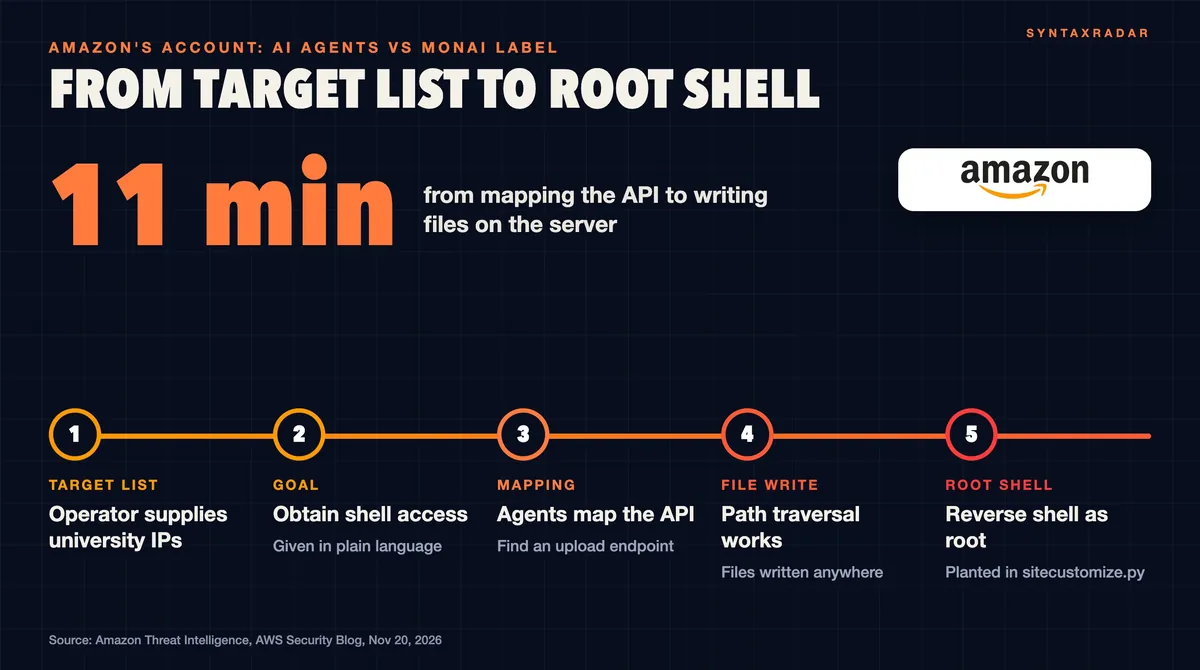
Amazon's case is the clearest AI agent cyberattack in the two reports, because the agents, not the operator, found the way in. Its post calls the target an open-source medical imaging AI application and does not name it. SecurityWeek ties Amazon's account to MONAI Label, a tool for annotating medical images, and the project's security advisory, published November 18, 2026, credits an account named aws-sec-vdp as the original reporter. According to Amazon, the agents identified the framework, mapped its API, found an upload endpoint with a filename parameter and tested it for path traversal, a flaw that lets a caller write files outside the intended folder. In about 11 minutes they went from mapping the API to writing files anywhere on the server.
In a later session the agents used that flaw to plant a Python reverse shell (a payload that calls back to the attacker) in a file Python loads at startup. They then triggered a training endpoint to start a Python process and got a shell running as root, the highest privilege level on the machine.
Amazon rates the zero-day finding as high confidence, because it found no fix, advisory or earlier mention of the flaw in vulnerability databases. It rates the Chinese-nexus attribution as moderate confidence, citing Simplified Chinese prompts, China Standard Time timestamps in the scripts and targets likely to interest China. Amazon names no threat group, and "Chinese-nexus" is its own wording for an assessment it rates moderate.
A human was still in the loop. The operator chose the university targets and the goal. In one session the actor stepped in and handed the agents a proxy tunnelled into a second university, which Amazon infers had been compromised with the same flaw. Amazon does not say how many servers were compromised, and Startup Fortune notes that no public report shows patient records accessed. The confirmed targets were universities, not hospitals.
The project released MONAI Label 0.8.6 on November 22, 2026 and calls it a security release that fixes this flaw (CVE-2026-133968). As of November 22, 2026, the advisory itself still rates the flaw critical, lists 0.8.5 and earlier as affected, shows no patched version and says authentication is disabled by default.
SyntaxRadar calculation: how fast is fast?
Every input below comes from Google's or Amazon's own post. The arithmetic is ours.
Two readings follow. First, the agents in Amazon's account won on endurance. They worked a hardened Redis server for 16 hours and tested tens of thousands of logins without a single success, and the one break came against an application whose advisory says authentication is off by default. Second, GTIG itself calls the rise in zero-day exploits marginal until August, so the August spike is a single month and one data point.
What should defenders do about AI driven cyberattacks?
Google and Amazon agree on the pressure point, which is time. GTIG says language models are shrinking the window organizations have to patch, which makes patching known flaws sooner the obvious response (our reading). Amazon says an agent that finds and exploits a zero-day in minutes finishes before many security operations centers can triage an alert, and advises prioritizing high-confidence detections that trigger automated responses, with humans overseeing outcomes instead of reviewing every action.
Vendors offer specific help. Google Security Operations deployed rule packs to detect ARTEX use, and Mandiant released a hardening guide against AI-enabled offensive tooling. If you run MONAI Label, upgrade to 0.8.6 and check who can reach your server over the network; the advisory says that in the default configuration any network client that can reach the server can exploit the flaw.
One more pattern stands out. Both discoveries came from servers the attackers left exposed: GTIG found exploit_agent on an exposed staging server, and Amazon found Cairn running without authentication. GTIG also reports that a suspected North Korean cluster edited project-level .claude/settings.json files so that starting Claude Code downloaded a backdoor, which makes agent configuration files worth auditing. Our guide to a Claude Code extension backdoor shows how to check and clean up a related case. If you run your own agents, one developer write-up suggests giving them only the tools the job needs, keeping credentials out of their reach and requiring human approval for irreversible actions; that is the author's opinion, not Google's or Amazon's. Our post on sandboxes for untrusted AI code covers one way to contain them.
What to watch next
Four questions are open as of November 22, 2026. Will the MONAI Label advisory be updated to list 0.8.6 as the patched version? Will Amazon or anyone else say how many servers were compromised? Will another vendor corroborate GTIG's claim that exploit_agent is the first fully automated discovery-and-exploitation framework it has identified? And will the reports' attributions, a suspected Russian-speaking actor and a Chinese-nexus actor at moderate confidence, hold up under outside review?
Another company-reported case, the Chainalysis agentic breach, also rests on one party's account. The same caution applies to any single-vendor report of an AI cyberattack, and to AI powered cyberattacks as a whole: the evidence so far is real, vendor-sourced and narrower than the headlines, and it points to faster attacks on known weaknesses more than to a new kind of attack.
Questions readers ask
Did AI really find a zero-day on its own?
Amazon says so. Its Cairn agents found a path traversal flaw in an open-source medical imaging application and wrote files to the server about 11 minutes after mapping its API. Amazon rates the zero-day finding high confidence. It is a vendor-reported account, and a human operator chose the targets and the goal, so the agents chose the method, not the mission.
What are examples of AI powered cyberattacks in the Google and Amazon reports?
Google describes exploit_agent, which compares code before and after patches and runs exploits automatically, plus CAIRN used against US aerospace targets. Amazon describes Cairn agents attacking East Asian universities, including a zero-day that gave root access. Google also cites PaperCut exploits built within a day of disclosure by researchers and Huntress.
Who is behind the attack Amazon reported?
Amazon assesses with moderate confidence that a Chinese-nexus actor ran it, citing Simplified Chinese prompts, China Standard Time timestamps in scripts and targets likely of interest to China. It names no threat group. 'Chinese-nexus' is Amazon's wording for an assessment, and no outside party has confirmed it as of November 22, 2026.
Is MONAI Label patched?
Yes, as of November 22, 2026. The project released MONAI Label 0.8.6 that day as a security release fixing the flaw (CVE-2026-133968). The advisory rates it critical, lists 0.8.5 and earlier as affected and still shows no patched version. It also says authentication is disabled by default, so check who can reach your server.
How do AI driven cyberattacks change patching?
Google's threat team says language models shrink the time between a patch and a working exploit, because they can compare code before and after a fix. It cites working PaperCut exploits within a day of disclosure. Its finding is that tactics are unchanged: attackers still use stolen credentials and unpatched systems, only faster.
Sources
Written by
Abdul Rehman
Lead Systems Architect and Technical Director at Syntaxradar. More in Emerging Tech.
Keep reading

What Is Chainalysis, and What Did Its Agentic Breach Expose?
On Oct 30, 2026 blockchain-analytics firm Chainalysis said that an external actor using offensive agentic techniques reached its systems. Some user names, emails, IDs and role…
Nov 3, 2026 · 6 min read
Google Project Zero Disclosure Policy: 90 Days Now, 30 by 2028
On November 13, 2026 Google Project Zero replaced its 90+30 rule with Full X: bug details go public X days after the vendor gets the report, fixed or not. X is 90, falls to 60 on…
Nov 16, 2026 · 6 min read

Strands Decider: Amazon Reports Ticket Labels 44x Cheaper
In a post dated November 9, 2026, Amazon reports that replacing Claude Sonnet 4.6 with the Decider E4B decision model for one internal ticket-labeling task cut cost from about…
Nov 12, 2026 · 7 min read
More in Emerging Tech
See all
Nothing AI Device: What Is Confirmed Before the Dec 8 Reveal
On November 4, 2026 Carl Pei said Nothing's first AI-native product ships in December with no new screen. Nothing's November 20 post set a December 8 reveal. The name, price and…
Nov 22, 2026 · 7 min read

The Economist 2027 Cover: What the Issue Says About AI and Debt
The Economist released the cover and a preview of The World Ahead 2027 on November 16 to 17, 2026. Outlets summarising it say the AI trend covers backlash, debt-funded spending,…
Nov 20, 2026 · 7 min read

Anthropic IPO Price: $70-$78 Range, Ticker ANT and Key Dates
Anthropic's November 10, 2026 filing sets an IPO range of $70 to $78 per Class A share for 825 million shares, ticker ANT on Nasdaq. CNBC and Bloomberg report pricing on November…
Nov 18, 2026 · 7 min read
Latest stories
Front page
Cisco Expressway Vulnerability: Exploited Flaw, Patch X15.5.20
Abdul Rehman · Nov 24, 2026 · 6 min read
Nvidia CEO Jensen Huang: Reinstated After 11 Days, What Is Open
Abdul Rehman · Nov 24, 2026 · 8 min read

AI Server Price: Dell, HPE Seek 25% to 45% More, FT Reports
Abdul Rehman · Nov 23, 2026 · 7 min read

ChatGPT Dots: Plus Test Starts, Business Standard Gets In
Abdul Rehman · Nov 23, 2026 · 7 min read