


Strands Decider: Amazon Reports Ticket Labels 44x Cheaper
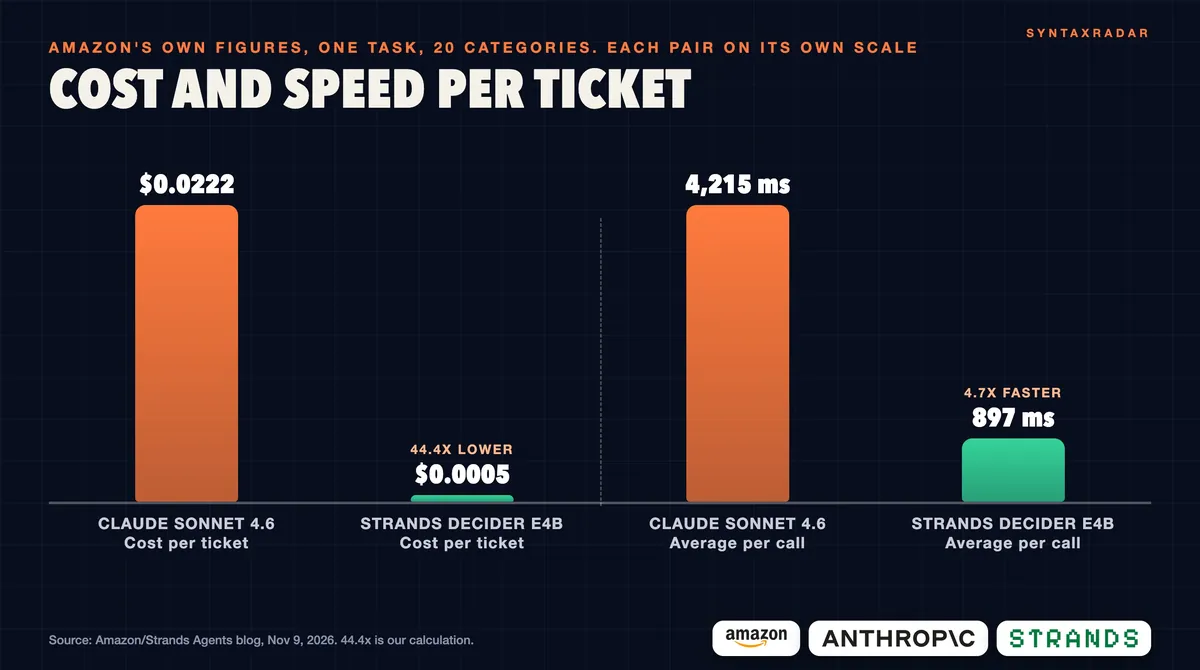
In a post dated November 9, 2026, Amazon reports that replacing Claude Sonnet 4.6 with the Decider E4B decision model for one internal ticket-labeling task cut cost from about $0.0222 to $0.0005 per ticket and average call time from 4,215 ms to 897 ms.

Abdul Rehman
Lead Systems Architect and Technical Director · · 7 min read

The short version
- $0.0222 to $0.0005
- Cost per ticket (Amazon reports)
- 4,215 ms to 897 ms
- Average time per call
- 6,724 to 2,010
- Tokens per ticket
Why it matters: For a closed-choice task at high volume, Amazon's own numbers show a small decision model on one GPU instance labeling tickets about 44x cheaper than Sonnet at list price, but no accuracy figure was published.
On this page
Strands Decider is an open-source AI decision model that returns a probability for each option on a fixed list instead of writing text. Amazon reports it cut ticket-labeling cost from about $0.0222 (Claude Sonnet 4.6) to about $0.0005 per ticket, roughly 44 times cheaper, in one internal system, according to a Strands Agents blog post dated November 9, 2026.
Read those figures for what they are. They are Amazon's own numbers, written by Amazon authors (Carr Onstott, Mehul Jaiswal and the Strands Agents Team), about a single task: sorting tickets in one of Amazon's large internal ticketing systems into 20 category types. They are not an independent benchmark, and the two prices sit on different bases. Sonnet is costed at Bedrock list price per token; the Decider on AWS is costed from the hourly price of a SageMaker GPU instance, not from Bedrock.
Speed moved too. Amazon reports an average of 4,215 milliseconds per call with Sonnet and 897 milliseconds with the Decider. The post also says the day Sonnet was switched off, average Lambda run time (Lambda is AWS's pay-per-run code service) dropped 74%.
What is Strands Decider? An AI decision model explained
A decision model in AI is a model built to choose, not to write. You hand it a state (here, a ticket) and a list of allowed answers (the 20 categories), and it gives back a probability for each answer plus a confidence score, according to the Strands team. A text-generating LLM such as Sonnet writes its answer out as text instead.
The difference shows up in the token counts. Per ticket, Amazon's Sonnet setup read 6,554 input tokens and wrote 170 output tokens. The Decider read 2,009 tokens and produced 1.
The family started with the 2B, launched on October 1, 2026. The launch post describes about 2 billion parameters built on a Qwen3.5-2B torso with the language-model head removed (the part that normally predicts the next word), a "pointer head" of just over 1 million parameters in its place, and a rank-16 LoRA (a small set of add-on weights trained for the task). It reports median times of about 115 ms on an Nvidia RTX 3090 and about 153 ms on an M3 MacBook for small tasks. On JevBench, a public benchmark, the 2B ranked 3rd of 33 in its size class.
Four builds based on Gemma 4 followed on October 15, 2026: E2B, E4B, 12B and 26B-A4B. On JevBench v1, a public set of 231 tasks, they scored 77.9%, 81.0%, 86.6% and 89.6%. That benchmark is not Amazon's ticket data, so those scores say nothing direct about ticket accuracy. The model Amazon put into production was the E4B; the team tested the original 2B first.
The code lives in the strands-labs/strands-decider repository on GitHub under the Apache 2.0 license. Its README calls it a small, fast decision model for agentic AI and a natural fit for decisions inside workflows built with the Strands Agents SDK, such as choosing which tool an agent calls next, and the repository ships a worked example of it inside a Strands agent. It supports three question types (pick one choice, yes or no, and a score), and as of November 11, 2026 it showed 964 stars and 120 forks. The Gemma 4 models sit on the main branch and were not yet on PyPI on that date.
Decider vs Claude Sonnet: the SyntaxRadar calculation
The comparison comes down to four numbers Amazon published. We reran the ratios and checked the Sonnet price from its stated inputs. Every input below comes from the Amazon case study; the right-hand column is our arithmetic.
Amazon rounds the cost result to "98% less" and "about 44 times cheaper"; our 97.7% and 44.4x agree.
Checking the Sonnet price. Amazon prices Sonnet at Bedrock list rates of $3.00 per million input tokens and $15.00 per million output tokens (global endpoint, us-east-1). Inputs: 6,554 input tokens and 170 output tokens. 6,554 x $3 / 1M = $0.01966, plus 170 x $15 / 1M = $0.00255, gives $0.02221. That matches the $0.0222 in the post.
Checking the Decider price. Amazon prices the Decider at $1.408 per instance-hour for a SageMaker ml.g5.xlarge (one A10G GPU with 24 GB; the model uses about 19 GiB), and says one instance handles about 5,600 tickets per hour at about 640 ms per request. Inputs: $1.408 / 5,600 = about $0.00025 per ticket, or about $251 per million, if the instance stays fully busy. Amazon budgets about $500 per million instead, which leaves room for bursts. That is roughly double the full-use figure.
This is why the cost basis matters. Sonnet is billed per token at list price, so its cost follows the tokens used, not how busy the queue is. The Decider is an hourly machine, so its per-ticket cost depends on how busy you keep it. A quiet queue makes each ticket more expensive.
We have not turned any of this into a yearly saving. The post's headline says "millions", but Amazon did not publish its ticket volume or how it reached that figure, so any annual number would be a guess.
What Amazon did not publish about accuracy
The post has no numeric accuracy figure for the ticket task. It says the E4B beat production Sonnet on a separate set of tickets after the team tuned the confidence threshold (the minimum confidence before the model's label is accepted), but it gives no percentage. It also describes the production Sonnet 4.6 it replaced as nine months old.
That gap drove much of the Hacker News discussion, which had 635 points and 221 comments as of November 11, 2026. Commenters raised the thin accuracy data, the hidden cost of collecting and labeling training data, confusion over which base model was used, and calibration (whether a 0.9 confidence really means right nine times in ten).
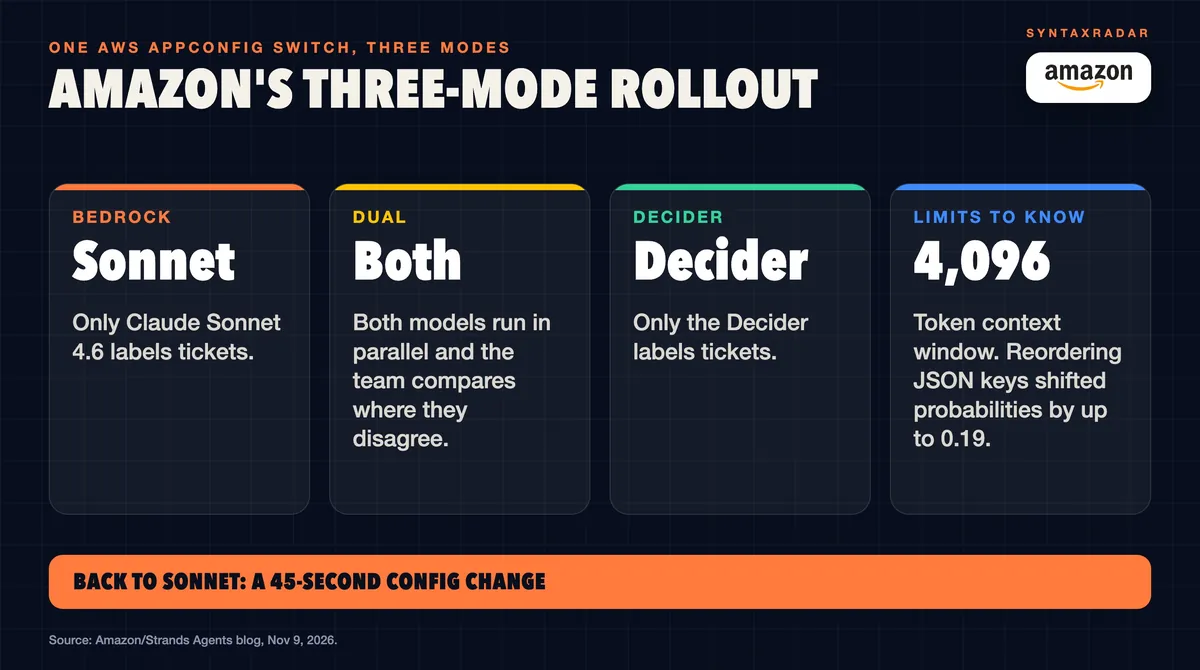
Amazon's own write-up flags one sensitivity worth knowing before you copy it. Changing the order of keys in the JSON sent to the model shifted output probabilities by up to 0.19. The team's fix is to always send sorted keys.
The other constraint is size. The Decider's context window is 4,096 tokens, so Amazon rewrote each label description as one or two sentences of criteria and added a "none" option for tickets that fit no category.
How Amazon ran the Decider on AWS: three modes and a 45-second rollback
The rollout is the most copyable part of the story. Ticket events land in SQS (AWS's message queue), which triggers a Lambda function, which calls a SageMaker AI endpoint hosting the model. AppConfig (AWS's live settings service) holds a switch with three modes:
- BEDROCK: only Sonnet labels tickets.
- DUAL: both models run in parallel and the team compares where they disagree.
- DECIDER: only the Decider labels tickets.
Amazon describes going back to Sonnet as "a 45-second config change". The stack also uses CloudWatch and CDK, with Beta, Gamma and Prod stages. If you are wiring this kind of switch into an agent system, our guide to deterministic state graphs for AI agent workflows covers guardrails that stop agent workflows from burning money in infinite loops.
When should you replace an LLM with a small model?
You should replace an LLM with a small model when the task is a closed choice from a known catalog, it runs at high volume, and latency matters. Those are the conditions Amazon names for its own case.
Amazon also lists when it likely does not fit:
- The label needs explanation text alongside it.
- The catalog of options changes every week.
- The context that matters will not fit in a few thousand tokens.
Our report on AI skin cancer detection, where a 10-year-old model beat GPT-6, covers another case of a small specialist model beating a frontier LLM. For the other side of the bill, our breakdown of LLM API pricing cuts in 2026 covers why per-token prices fell by up to 80% and how to pay less, which matters when you weigh a fixed GPU against a token meter. And our explainer on open weight models covers IBM's claim that cheaper open models come out 90% as good as frontier ones.
Before you switch, budget for the work Amazon does not price: gathering and labeling examples, rewriting labels to fit the context window, and running both models side by side long enough to trust the disagreements.
What to watch next
Three things would make Amazon's claim easier to judge. First, an accuracy figure for the ticket task itself, not only the JevBench scores. Second, the ticket volume behind the "millions" headline, so readers can check the annual math. Third, the Gemma 4 builds reaching PyPI, which would make the E4B as easy to install as the 2B.
Until then, treat Strands Decider as one well-documented case for one kind of job: picking from a short, stable list at high volume, where a sentence of explanation is not needed.
In code
pip install strands-decider
strands-decider serve <model> --port 8000Questions readers ask
What is a decision model in AI, and how does it differ from an LLM?
A decision model in AI chooses instead of writing. The Strands Agents team's Decider is an open-source one under Apache 2.0: it takes a state and a fixed list of options and returns a probability for each option plus a confidence score. The 2B launched on October 1, 2026; four Gemma 4 builds followed on October 15, 2026.
How much cheaper was it than Claude Sonnet 4.6?
Amazon reports about $0.0222 per ticket for Sonnet and about $0.0005 for the Decider, roughly 44 times cheaper, or $22,200 versus $500 per million tickets. Sonnet was priced at Bedrock list rates per token, while the Decider was priced from an hourly SageMaker ml.g5.xlarge instance, so the two figures rest on different cost bases.
Did ticket-labeling accuracy hold up?
Amazon did not publish a numeric accuracy figure for the ticket task. The post says the E4B beat production Sonnet on a separate set of tickets after the team tuned the confidence threshold. The JevBench scores published for the Gemma 4 builds come from a public 231-task benchmark, not from Amazon's ticket data, so they do not answer this question.
Does the Decider run on AWS Bedrock?
In Amazon's setup, Sonnet 4.6 ran through Bedrock at list prices, while the Decider ran on a SageMaker AI endpoint backed by an ml.g5.xlarge instance. Ticket events go through SQS to Lambda, which calls the endpoint, and an AppConfig setting picks BEDROCK, DUAL or DECIDER mode.
Is the Decider on GitHub, and how do you run it?
Yes. The strands-labs/strands-decider repository says to install it with pip install strands-decider and serve a model with strands-decider serve followed by the model name and --port 8000. It supports choice, yes-or-no and score questions. As of November 11, 2026, the Gemma 4 models were on the main branch but not yet on PyPI.
How does the Decider fit into Strands Agents?
The repository README calls it a small, fast decision model for agentic AI and a natural fit for the decisions inside workflows built with the Strands Agents SDK, such as picking which tool an agent calls next or checking a tool call's arguments before it runs. It ships a worked example inside a Strands agent under examples/strands.
Sources
Written by
Abdul Rehman
Lead Systems Architect and Technical Director at Syntaxradar. More in Systems.
Keep reading

AI Agent State Graph: How It Stops Infinite Loops and Runaway Bills
AI agents can loop on a failing step and keep paying for model calls. A state graph, as in LangGraph, fixes the allowed steps in code and adds step limits, counters and…
Oct 25, 2026 · 6 min read

Multi Agent Systems: What Anthropic and Cognition Found
Anthropic reports a multi-agent research system beat a single agent by 90.2% on its internal eval at roughly 15x the tokens of chat, while Cognition says only setups with one…
Oct 24, 2026 · 6 min read

GraphRAG vs Vector RAG: What Each Does Best for AI Agents
Microsoft Research's GraphRAG builds a knowledge graph and community summaries before answering. Its authors report better comprehensiveness and diversity than baseline RAG on…
Oct 25, 2026 · 6 min read
More in Systems
See all
NoisyTCP: The Linux Kernel TCP Flaw and Who Must Patch
NoisyTCP (CVE-2026-99288) is a Linux kernel TCP flaw that lets an unauthenticated attacker crash a server through an open port. The fix merged November 3, 2026 and the advisory…
Nov 23, 2026 · 7 min read
KB5132061: Windows 11 Install Errors Explained, and the Fix
KB5132061, released November 10, 2026, failed on some Windows 11 PCs that had the October preview KB5127936, with errors 0x80070306, 0x800f0989 or 0x800f0993. Microsoft began an…
Nov 22, 2026 · 7 min read

Chase Data Breach: Vendors Hit, Names and Emails at Risk
On November 19, 2026 JPMorgan Chase said third-party vendors were hit by a cyberattack and that marketing data, which may include some customer names and email addresses, was…
Nov 20, 2026 · 7 min read
Latest stories
Front page
US Approves AI Chips to China: 879,868 H200 and MI325X Cleared
Abdul Rehman · Nov 22, 2026 · 6 min read
Nothing AI Device: What Is Confirmed Before the Dec 8 Reveal
Abdul Rehman · Nov 22, 2026 · 7 min read
OpenAI Usage Policies: Gateway Approval and Training Ban
Abdul Rehman · Nov 22, 2026 · 7 min read
When Will SSD Prices Drop? TrendForce Says 2027, Retail Lags
Abdul Rehman · Nov 21, 2026 · 8 min read