

OpenAI Usage Policies: Gateway Approval and Training Ban
OpenAI's usage policies took effect November 20, 2026. Services that give third parties direct model access need prior approval, and OpenAI outputs cannot train substitute models. As of November 21, 2026, we found no approval form.

Abdul Rehman
Lead Systems Architect and Technical Director · · 7 min read
The short version
- November 20, 2026
- Policy effective date
- 30 days
- Notice window (Oct 21 to Nov 20)
- None reported as of Nov 15, 2026
- Approval criteria published
Why it matters: As of November 21, 2026, OpenAI requires prior approval from services that give third parties direct model access and bars using its outputs to train substitute models, but we found no published approval route.
On this page
OpenAI usage policies changed on November 20, 2026: a service that lets third parties reach OpenAI models directly must get OpenAI's prior review and approval first, which outlets describe as covering model routers and AI gateways, and nobody may use OpenAI models or their outputs to build training material for a substitute model. As of November 21, 2026, we found no published approval form, criteria or timeline.
This OpenAI usage policy update was dated October 21, 2026, which is 30 days before it took effect, according to the changelog on OpenAI's usage policies page. It leaves ordinary apps alone: the page says the approval rule does not apply solely because an application uses OpenAI models to power its own features. We read OpenAI's policy page and Help Center article on November 21, 2026 through a fetch tool that returns summaries, so this post paraphrases them and quotes only short phrases.
What are OpenAI usage policies, and what changed on November 20, 2026?
OpenAI's usage policies are the one set of rules that covers its products and services, and the changelog's October 29, 2025 entry says OpenAI updated them then to reflect a universal set of policies across its products and services. The page's effective line reads November 20, 2026, and the Help Center article says the previous version stays in effect until then and that "existing agreements and other applicable terms and policies continue to apply."
The Help Center article lists four changes:
- Clarified restrictions on using OpenAI models and outputs to train other models.
- Clarified protections for children and teens, plus requirements for high-stakes uses.
- National security principles and their approval requirements.
- Approval requirements for model-access intermediaries.
The intermediary approval rule and the training rule matter most to developers, and the next two sections take them in turn. The children and teens, high-stakes and national security changes are outside this post.
Does OpenAI allow AI gateways? What the approval rule says
OpenAI allows an AI gateway to give third parties direct access to its models only after prior review and approval, according to the policy page. The rule applies to anyone who operates a "model-access intermediary platform or other service" that enables third parties to directly access OpenAI models, and that operator "must obtain our prior review and approval."
The wording differs from the headlines. As our fetch tool summarised it, the policy page and the Help Center article use the phrase model-access intermediary and do not use "model router" or "AI gateway". Those two terms come from coverage: Crypto Briefing, published October 21, 2026, reports that operators of model routers and AI gateways need prior review and approval before offering third-party access, effective November 20, 2026.
The exclusion matters as much as the rule. The policy page says the requirement "does not apply solely because" an application integrates OpenAI models to power its features. Crypto Briefing frames that as the difference between being a customer and being a reseller.
The Help Center article does not describe a review process, does not name any router or gateway, and links no application form.
OpenAI model router rules: who is covered and who is not
An OpenAI model router, which outlets also call an OpenAI AI gateway, is a service that sits between an application and AI providers. Multi-provider routing means sending requests to different models based on cost, speed or task. Cost is one of those inputs, and our LLM API pricing cuts post and Gemini API pricing post lay out real price lists for it.
Under the policy text, the trigger is not the product label. It is whether the service enables third parties to directly access OpenAI models. Three groups follow from the sources:
- Covered by the described trigger: services that give customers or other companies direct access to OpenAI models.
- Outside it, per the policy page: applications that use OpenAI models only to power their own features.
- Unconfirmed by OpenAI: a gateway used only by an organization's own employees, which Beri.net calls "likely" out of scope; gateways shared with affiliates, contractors or customers, which the same report calls unclear; and whether cloud partners such as Azure count, which neither Beri.net nor LLM Matchmaker found addressed.
OpenAI has named no companies. One analysis, an October 21, 2026 LLM Matchmaker blog post, names OpenRouter, Vercel's AI Gateway and LiteLLM-style proxies as examples of the category it believes the rule reaches. That is the outlet's reading; OpenAI has not confirmed it, and we found no statement from those companies.
Does OpenAI allow distillation? The training rule in plain English
OpenAI does not allow using its models or their outputs to build training material for a substitute model, according to its usage policies. Outlets call this the OpenAI distillation ban, meaning a limit on training one model on another model's answers, although the policy page does not use that word.
The rule says you must not use OpenAI models or their outputs to "generate, prepare, select, or supply training material or signals" for models intended as alternatives to or substitutes for OpenAI models or services. Three details widen it:
- It covers work done by someone acting on your behalf.
- It applies even if you do not train the resulting model.
- Per BankInfoSecurity, which reported on October 23, 2026, it reaches creating training data, writing reinforcement-learning rubrics, giving feedback and filtering data, plus outputs from product use or evaluation that are later used for training.
What stays allowed: the policy page says research, evaluation, benchmarking and product development are permitted within OpenAI's limits. OpenAI states its reason on the policy page, and BankInfoSecurity relays it: training another model on OpenAI outputs "can transfer capabilities without carrying those safeguards over."
Neither the policy page, as our fetch tool summarised it, nor BankInfoSecurity defines what counts as a substitute, so a team reading the OpenAI distillation policy has no published test to apply to a model built for a different purpose.
What the OpenAI usage policy update leaves open: a SyntaxRadar calculation
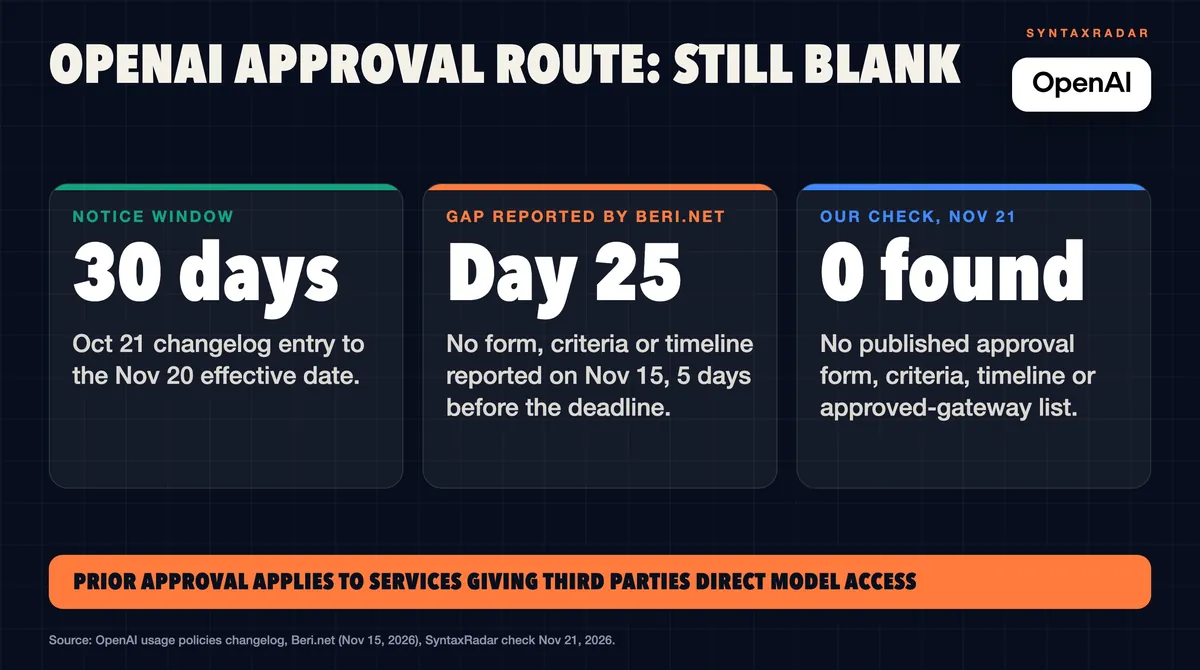
The notice window can be counted from the sources. The table uses OpenAI's October 21, 2026 changelog entry, the November 20, 2026 effective date and the date of the last report we found saying no approval route existed.
By that count, the last report we found of a missing approval route came 25 days into a 30-day window, and 5 days remained. We searched on November 21, 2026 for a published form, criteria, timeline or approved-gateway list and for any statement from a router operator, and found none. Missing search results do not prove nothing exists, and OpenAI may handle requests privately.
What remains unanswered, as of November 21, 2026:
- The criteria OpenAI will use to approve a service, and how long review takes (Crypto Briefing and Beri.net).
- What happens to an unapproved platform. Crypto Briefing says developer access "could be disrupted," and LLM Matchmaker reports no grandfathering for existing routers and gateways.
- Whether any service has been approved. We found no list.
A second check compares wording across OpenAI's pages and the coverage.
Because the tool summarises pages and does not search them literally, read "not found" as likely, not certain.
What should builders check before relying on OpenAI access?
This is our reading of the sources, not legal advice. Anyone whose business depends on the answer should ask counsel and OpenAI directly.
Model changes are a separate risk from policy changes. Our GPT-5 deprecation post covers the December 11 change developers face on the model side.
What to watch next
The OpenAI usage policies have been in force since November 20, 2026, and the open questions concern the approval process. Watch for four things after November 21, 2026:
- A published application form, approval criteria or review timeline.
- Any list of approved intermediaries.
- A public statement from a router or gateway operator about its status.
- OpenAI guidance on what counts as a substitute model.
Until those appear, the narrow reading is the one the text supports: the policy page puts approval on services that give third parties direct access, and puts the training limit on any use of OpenAI outputs that feeds a competing model.
Questions readers ask
What do the OpenAI usage policies require from AI gateways?
Per OpenAI's policy page, a platform or service that enables third parties to directly access OpenAI models must obtain OpenAI's prior review and approval. The rule took effect November 20, 2026. Outlets describe it as covering model routers and AI gateways. As of November 21, 2026, we found no published form, criteria or review timeline.
Does OpenAI allow AI gateways?
Only with approval if the gateway gives third parties direct access to OpenAI models. The policy page says the rule does not apply solely because an application integrates OpenAI models to power its own features. Whether employee-only or shared gateways count is unconfirmed by OpenAI, per Beri.net, so ask OpenAI in writing.
Does OpenAI allow distillation?
Not for substitute models. The policy page bars using OpenAI models or their outputs to generate, prepare, select or supply training material or signals for models intended as alternatives to OpenAI's. Per BankInfoSecurity it applies even if you do not train the resulting model. Research, evaluation and benchmarking stay allowed within OpenAI's limits.
Do apps that use the OpenAI API need approval?
Not for that reason alone. OpenAI's policy page says the intermediary approval requirement does not apply solely because an application integrates OpenAI models to power its features or functionality. The rule is aimed at services that let third parties directly access the models. Crypto Briefing frames the line as customer versus reseller.
Has OpenAI published an approval form for gateways?
We found none. Beri.net reported on November 15, 2026 that no application form, approval criteria, review timeline or list of approved gateways had been published, and our search on November 21, 2026 found nothing newer. OpenAI's Help Center article describes no review process and links no form.
When did the OpenAI usage policy update take effect?
November 20, 2026. OpenAI's changelog entry is dated October 21, 2026, 30 days earlier. The Help Center article says the previous version stayed in effect until the effective date and that existing agreements and other applicable terms and policies continue to apply.
Sources
Written by
Abdul Rehman
Lead Systems Architect and Technical Director at Syntaxradar. More in AI & Models.
Keep reading
ChatGPT Wallet: How OpenAI's Dots Pay With Your Real Card
On November 13, 2026 OpenAI announced a Wallet that lets its dots AI agents pay with Amex, Mastercard or Visa cards via transaction-specific tokens and a per-purchase security…
Nov 16, 2026 · 6 min read

Why Does AI Use Em Dashes? Even OpenAI Can't Say for Sure
Since GPT-5.1, ChatGPT follows a custom instruction to drop em dashes, but OpenAI has not explained why the habit exists. A six-chatbot test found big differences between tools,…
Nov 2, 2026 · 7 min read

Grok Limits: One Weekly Pool, 1x to 50x, No Message Count
Grok has no published message count: paid plans share one weekly pool sized 1x, 4x, 15x and 50x Plus. After meters jumped to 100% over Halloween weekend, Musk cited serving costs;…
Nov 4, 2026 · 8 min read
More in AI & Models
See all
Meta AI Muse Spark: What Privacy Reports Say, Meta's Reply
As of November 20, 2026, Reuters (via TechCrunch) reports Meta employees flagged Muse mixing up accounts. Meta calls them isolated incidents and says users can turn off AI…
Nov 21, 2026 · 7 min read

Anthropic Stock Price: $83 IPO, $111.50 Open, $97.17 Close
Anthropic (ANT) priced its IPO at $83 on November 18, 2026, first traded at $111.50 on November 19 and closed at $97.17. On November 20 it traded near $87 intraday, as low as…
Nov 21, 2026 · 6 min read
Gemini for Mac: What Computer Use Can Do and How to Stop It
On November 19, 2026 Google began rolling out computer use in the Gemini app for Mac, in English in the U.S., for Google AI Plus, Pro and Ultra on Apple Silicon Macs with macOS…
Nov 20, 2026 · 7 min read
Latest stories
Front page
NoisyTCP: The Linux Kernel TCP Flaw and Who Must Patch
Abdul Rehman · Nov 23, 2026 · 7 min read

US Approves AI Chips to China: 879,868 H200 and MI325X Cleared
Abdul Rehman · Nov 22, 2026 · 6 min read

Nothing AI Device: What Is Confirmed Before the Dec 8 Reveal
Abdul Rehman · Nov 22, 2026 · 7 min read
KB5132061: Windows 11 Install Errors Explained, and the Fix
Abdul Rehman · Nov 22, 2026 · 7 min read