


US Approves AI Chips to China: 879,868 H200 and MI325X Cleared
On November 19, 2026 the House Foreign Affairs Committee released BIS records: 879,868 Nvidia H200 and AMD MI325X chips approved for Chinese buyers as of May 11, 2026, out of 3,444,160 requested. Shipments are not shown. Nvidia says it has stopped shipping H200s to China.

Abdul Rehman
Lead Systems Architect and Technical Director · · 6 min read
The short version
- 879,868 across 21 applications
- Chips approved by BIS (as of May 11, 2026)
- 3,444,160 (25.5% approved)
- Chips requested
- $2.4 billion (Reuters)
- Licensed Hopper sales to China, quarter ended Oct 25, 2026
Why it matters: The committee's records show 879,868 H200 and MI325X chips approved for China as of May 11, 2026, but they do not show shipments, and Nvidia says it has stopped shipping H200s there.
On this page
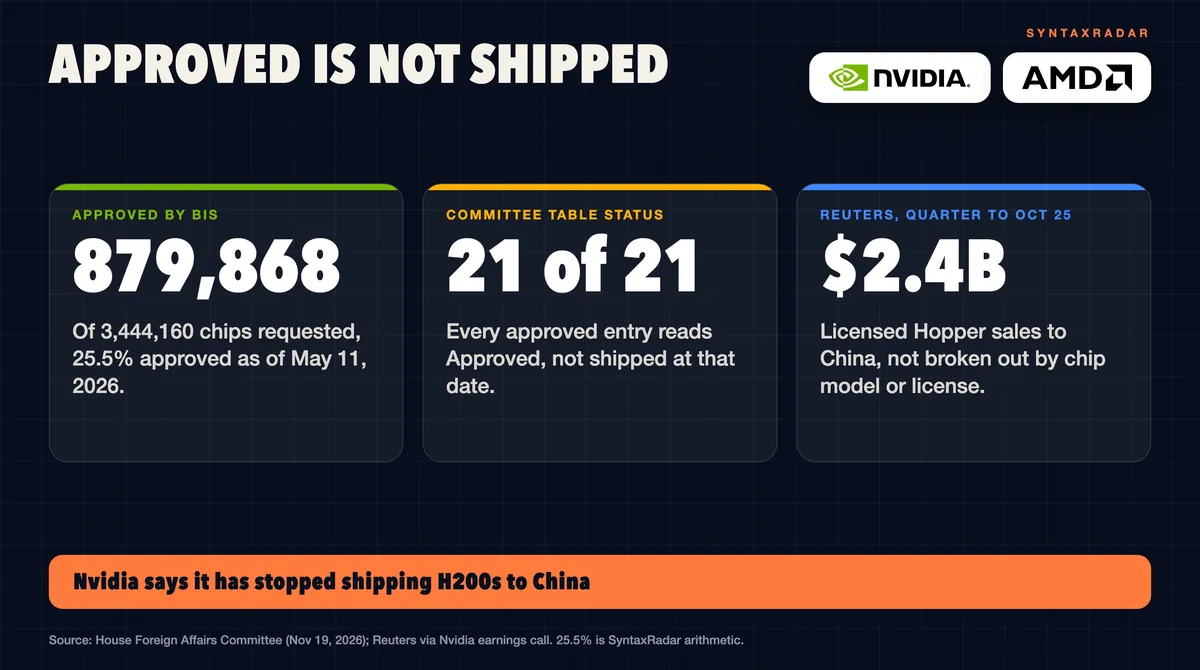
When the US approves AI chips to China, an approval is not a delivery, and the license records the House Foreign Affairs Committee published on November 19, 2026 show the gap. As of May 11, 2026, the Commerce Department's Bureau of Industry and Security (BIS) had approved 879,868 chips, Nvidia's H200 and AMD's MI325X, across 21 applications, out of 3,444,160 chips requested. The committee's own table marks every approved entry "Approved, not shipped" at that date.
As of November 21, 2026, no public source says how many approved chips reached Chinese buyers. Nvidia told CNBC it has since stopped shipping H200s to China, and its interim CEO said on November 17 that Nvidia no longer ships licensed Hopper data center products there.
What the committee released on Nvidia H200 China approvals
Chairman Brian Mast released the records under the Export Control Reform Act, after the committee determined that withholding them was contrary to the national interest. The committee approved the disclosure by unanimous consent, according to Ranking Member Gregory Meeks's remarks. Two documents came out: a committee summary and a BIS license-decisions table.
The data is a snapshot. The summary cites a BIS document dated May 11, 2026, so the figures were about six months old when published. News coverage describes the period as December 2025 through May 2026, and the earliest filing dates in the table are in December 2025.
The summary also warns that the picture is incomplete. The committee says it holds other BIS-provided applications not fully reflected in the May 11 summary, for example a December 19, 2025 Nvidia application to export 445,000 H200 chips to Tencent.
How many Nvidia chips did the US approve for China?
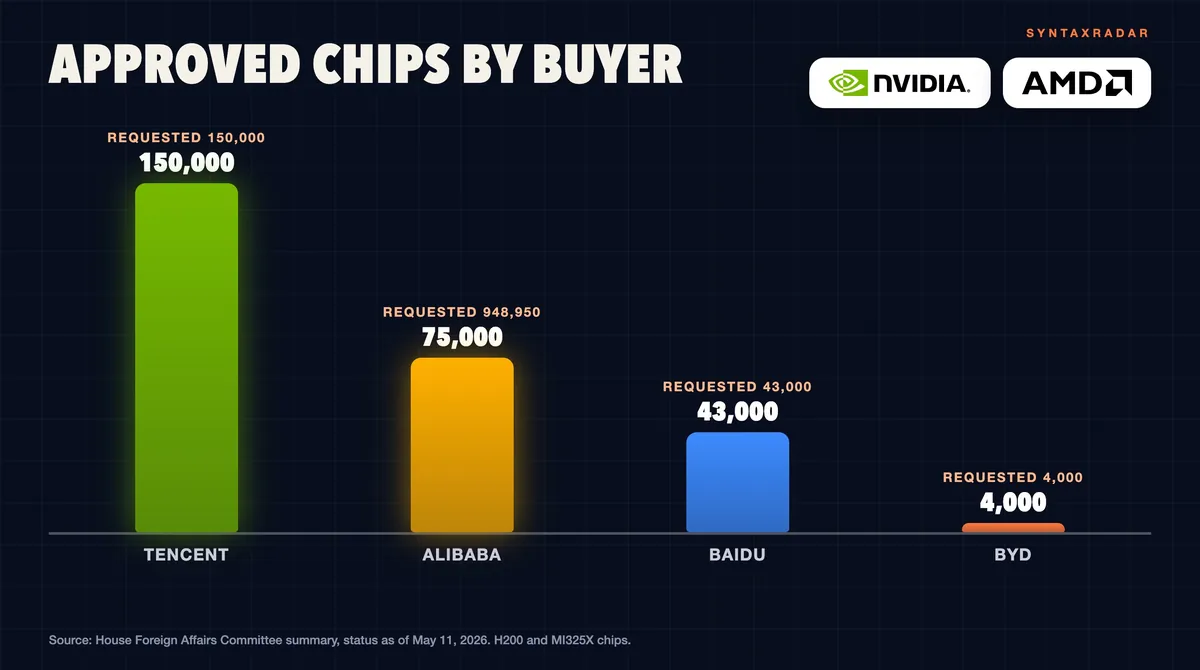
BIS approved 879,868 chips across 21 license applications as of May 11, 2026, against 3,444,160 chips requested, per the committee summary. "Covered" chips are Nvidia's H200 and AMD's MI325X, and "Chinese companies" includes firms headquartered in China or owned by a parent headquartered there. The summary names four groups that the committee says appear on the Pentagon's list of Chinese military companies:
Source: committee summary, status as of May 11, 2026. The "military company" label is the committee's description of a Pentagon list, and the separate 445,000-chip Tencent application is not in these totals. The BIS table shows other approved applicants too, including ByteDance units, and it lists one rejection: an AMD request to supply 75,000 chips to UCloud.
How the US approves AI chips to China
The approvals sit on top of a policy change. On December 8, 2025, President Trump said Nvidia could sell the H200 to "approved customers" in China, and AP reported that Blackwell and Rubin chips were excluded, per PBS. On January 15, 2026, a BIS rule moved chips below set performance thresholds, with the H200 and MI325X as its examples, from a presumption of denial to case-by-case review.
The rule attaches conditions. Shipments to China and Macau may not exceed 50% of the product shipped to US end users, measured by aggregate processing performance. A US-headquartered third-party lab with no financial stake must review every shipment. The applicant must also certify that US supply will not be delayed and that the recipient has adequate security.
BIS reviews each application on those terms. The committee says every Nvidia and AMD application stated a "low" risk of diversion. Our explainer on AI chip export rules and the push for a law covers the separate remote-access rule and the bills in Congress.
Has Nvidia stopped shipping H200 to China?
Nvidia says yes. Spokesperson John Rizzo told CNBC: "Despite receiving some licenses, we have since stopped shipping H200s to China." Nvidia also said the approvals were subject to "strict conditions and limited volumes", per The Standard, and CNBC reports that Nvidia argued it was following the Commerce regulations in effect at the time.
On Nvidia's November 17 earnings call, interim CEO Colette Kress said the company is no longer shipping licensed Hopper data center products to China, and Reuters reported no current plans for further shipments, as carried by The Standard. She did not give a reason, and the halt's duration is unclear. Nvidia's results release says the company is "not assuming any Data Center compute revenue from China" in its outlook. Our post on Colette Kress and the earnings call covers the quarter itself.
The two sets of facts can both be true. The committee's table says "not shipped" on May 11, 2026, and Reuters reported that Nvidia sold $2.4 billion of licensed Hopper-generation products to China in the quarter ended October 25, which is after that date. The H200 belongs to the Hopper family, but the figure is not broken out by chip model or by license, so we cannot say how much of it was H200 or which approvals it covers. Nvidia H200 China shipments also depend on Beijing: Reuters reported earlier in November that about 600,000 H200 chips sat in Hong Kong awaiting mainland approval, which our Hong Kong stockpile report covers. AMD's statement, quoted by CNBC, says only that it complies with applicable US export control laws, and we found no report of AMD MI325X China shipments.
SyntaxRadar calculation: how much of the request was approved
We turned the committee's numbers into ratios. Every input below comes from the committee summary, except the last row, which combines two sources.
The 25.5% says nothing about how the other chips were handled: the remaining 2,564,292 chips include one rejection, returned applications and undecided ones. The 30.9% shows that nearly a third of approved chips went to groups the committee ties to the Pentagon list. The last row uses the $2.4 billion Reuters reported from Nvidia's call and the $115.844 billion revenue in Nvidia's release, and the 2.07% is our arithmetic.
What are the smuggling-front allegations about Maginfra and New Matrix?
These are allegations, and the committee documents make no finding against any company. The summary says all but two Nvidia applications list Maginfra, Beijing New Matrix Information Technologies, ZTE Kangxun Telecom and Lenovo or its subsidiaries as entities that "may install the systems in the datacenter". It adds that public reports have raised questions about diversion risk at Maginfra, Beijing New Matrix and Aivres Systems.
Mast went further. CNBC reports that he called Maginfra and New Matrix suspected smuggling fronts and said, "Both are fake companies." The committee's press release says Nvidia requested to depend on "possible chip-smuggling fronts". CNBC adds that The New York Times reported in November that both companies had empty offices and ties to sanctioned companies, and that neither replied to requests for comment.
Nvidia's position is that it followed the rules in force. BIS told CNBC that licensing decisions are the product of consultation among multiple government agencies. Meeks said the agency "has failed to enforce the rules". Our earlier explainer on Megaspeed, the Nvidia buyer in a reported DOJ probe shows how diversion concerns have followed other Nvidia buyers.
What to watch next for H200 sales to China
The committee data cannot answer the main open question, which is how many approved chips left the United States after May 11, 2026. Four things could change the picture.
- Hearings. Meeks called for public hearings with Commerce Secretary Howard Lutnick and BIS Under Secretary Jeffrey Kessler. We found no hearing date in the committee's November 19 releases.
- Nvidia interviews. CNBC reports that Jensen Huang is due for a closed-door transcribed interview with the committee and two other House panels on December 1, 2026, and that Nvidia general counsel Tim Teter is scheduled to appear on December 2.
- Newer license data. Nothing published covers any date after May 11, 2026.
- Beijing. Reuters reports that China has restricted H200 imports, so Beijing's approval may matter as much as US licenses for Nvidia H200 China sales.
This post uses only the November 19, 2026 releases and the reporting cited above. As of November 21, 2026, the public record of how the US approves AI chips to China stops at May 11, 2026: 879,868 chips approved, with shipments per license unconfirmed.
Questions readers ask
How many Nvidia chips did the US approve for China?
The House Foreign Affairs Committee's summary says BIS approved 879,868 covered chips, Nvidia's H200 and AMD's MI325X, across 21 license applications as of May 11, 2026. Applicants had requested 3,444,160 chips. That is 25.5% by our arithmetic. The figures are a snapshot, and later license decisions are not published.
Has Nvidia stopped shipping H200 to China?
Nvidia says so. Spokesperson John Rizzo told CNBC the company has since stopped shipping H200s to China, and interim CEO Colette Kress said on November 17, 2026 that Nvidia no longer ships licensed Hopper data center products there, per Reuters. No source gives the reason or says how long the halt lasts.
Is Nvidia allowed to sell H200 to China?
Under a BIS rule effective January 15, 2026, H200 exports to China are reviewed case by case instead of presumed denied, with conditions such as a 50% volume cap and third-party lab review of every shipment. Sales need an approved license, and Nvidia says it has stopped shipping them anyway.
Which Chinese companies got approvals?
The committee summary names Tencent (150,000 chips), Alibaba (75,000), Baidu (43,000) and BYD (4,000), and says all four appear on a Pentagon list of Chinese military companies. The BIS table also lists approved entries for other firms, including ByteDance units. The summary does not give a full per-company total.
Are Maginfra and New Matrix proven smuggling fronts?
No finding has been made. Chairman Mast called them suspected smuggling fronts and said both are fake companies. The committee summary only says public reports raise diversion questions, and the documents list them as entities that may install systems. CNBC says neither company replied to requests for comment.
Sources
Written by
Abdul Rehman
Lead Systems Architect and Technical Director at Syntaxradar. More in Chips & Hardware.
Keep reading
H200 China: 600,000 Nvidia Chips Reportedly in Hong Kong
Reuters reported on November 5, 2026 that about 600,000 Nvidia H200 chips are stored in Hong Kong because Beijing has not approved large-volume imports. On November 7 the NYT…
Nov 8, 2026 · 7 min read
AI Chip Export Rules: Commerce Acts, Congress Wants a Law
On November 16, 2026 Commerce posted an interim rule adding chip licences for five countries and curbing data centers serving China-headquartered firms. The House passed the…
Nov 18, 2026 · 9 min read
Megaspeed: The Nvidia Buyer in the Reported DOJ Chip Probe
On Nov 9, 2026, two law-enforcement sources said the DOJ's National Security Division is investigating Singapore's Megaspeed, Nvidia's largest Southeast Asian buyer, over possible…
Nov 10, 2026 · 8 min read
More in Chips & Hardware
See all
When Will SSD Prices Drop? TrendForce Says 2027, Retail Lags
On November 19, 2026 TrendForce forecast NAND contract prices falling 0% to 5% in 1Q27 and all categories declining from 2Q27, after cutting its 4Q26 rise to 8% to 13%. German…
Nov 21, 2026 · 8 min read

Colette Kress: Nvidia's Interim CEO, $115.8B Quarter, $130B Guide
On November 12, 2026 Nvidia named CFO Kress interim CEO after Jensen Huang resigned, giving no reason. On November 17 she reported $115.8B of revenue and guided Q4 to $130.0B,…
Nov 21, 2026 · 6 min read

Black Friday PC Parts: Which 2026 Deals Are Real, Which Are Thin
As of November 16, 2026, TrendForce data and buying guides point to thin Black Friday discounts on RAM and GPUs, mixed signals on SSDs, and more normal ones on CPUs, cases and…
Nov 19, 2026 · 9 min read
Latest stories
Front page
NoisyTCP: The Linux Kernel TCP Flaw and Who Must Patch
Abdul Rehman · Nov 23, 2026 · 7 min read

Nothing AI Device: What Is Confirmed Before the Dec 8 Reveal
Abdul Rehman · Nov 22, 2026 · 7 min read
KB5132061: Windows 11 Install Errors Explained, and the Fix
Abdul Rehman · Nov 22, 2026 · 7 min read

OpenAI Usage Policies: Gateway Approval and Training Ban
Abdul Rehman · Nov 22, 2026 · 7 min read