


H200 China: 600,000 Nvidia Chips Reportedly in Hong Kong
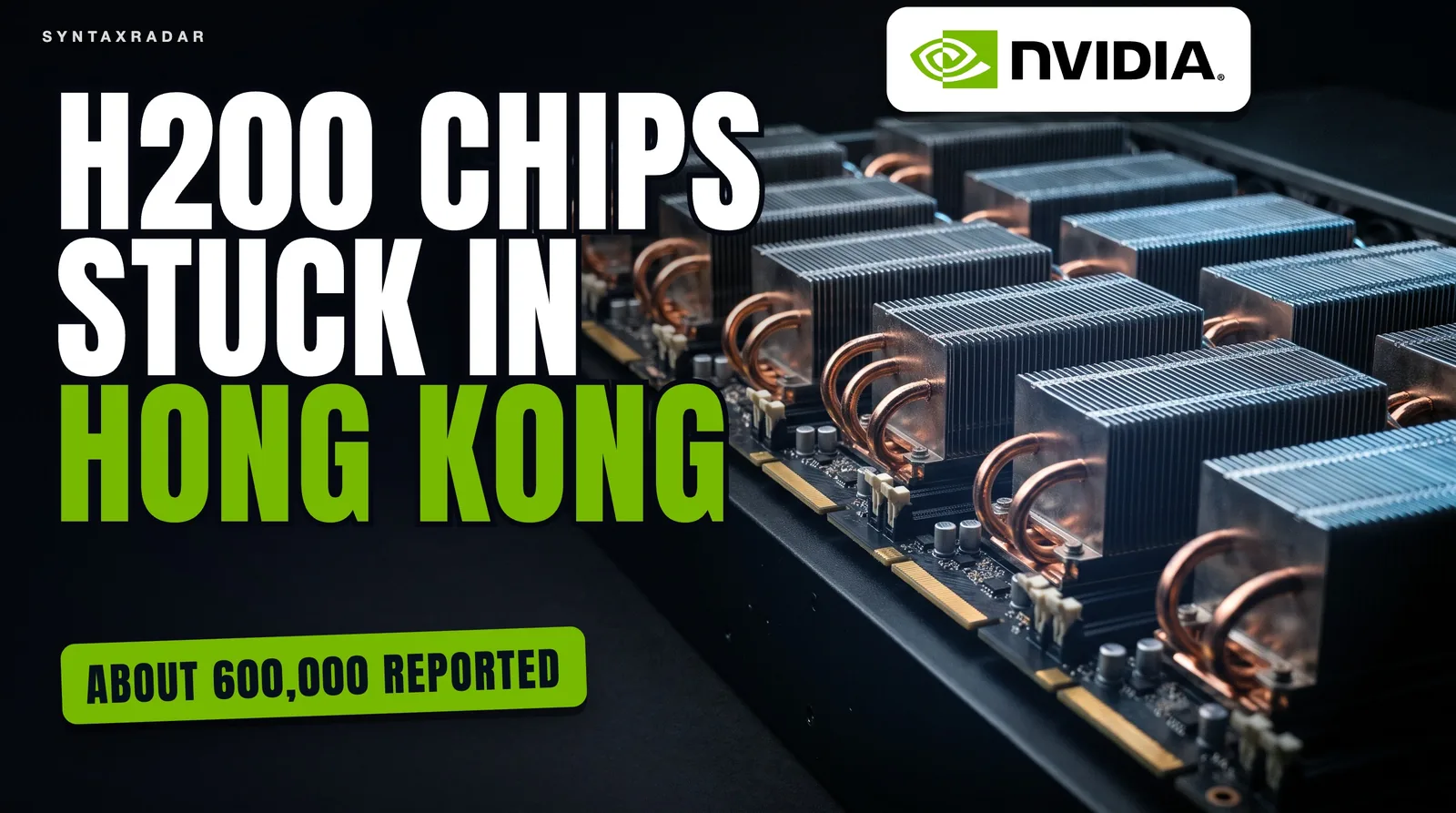
Reuters reported on November 5, 2026 that about 600,000 Nvidia H200 chips are stored in Hong Kong because Beijing has not approved large-volume imports. On November 7 the NYT reported two US-approved buyers had empty offices.

Abdul Rehman
Lead Systems Architect and Technical Director · · 7 min read
The short version
- About 600,000 (single secondary report)
- H200 chips waiting in Hong Kong
- Over 6 million yuan (US$900,000), single secondary report
- 8-card H200 server asking price in China
- 141GB HBM3e, 4.8TB/s
- H200 memory and bandwidth
Why it matters: Washington's January 2026 rule lets H200 licences through case by case, but Beijing has not approved bulk imports, so a stock reported at about 600,000 chips sits in Hong Kong while questions grow about who the US approved.
On this page
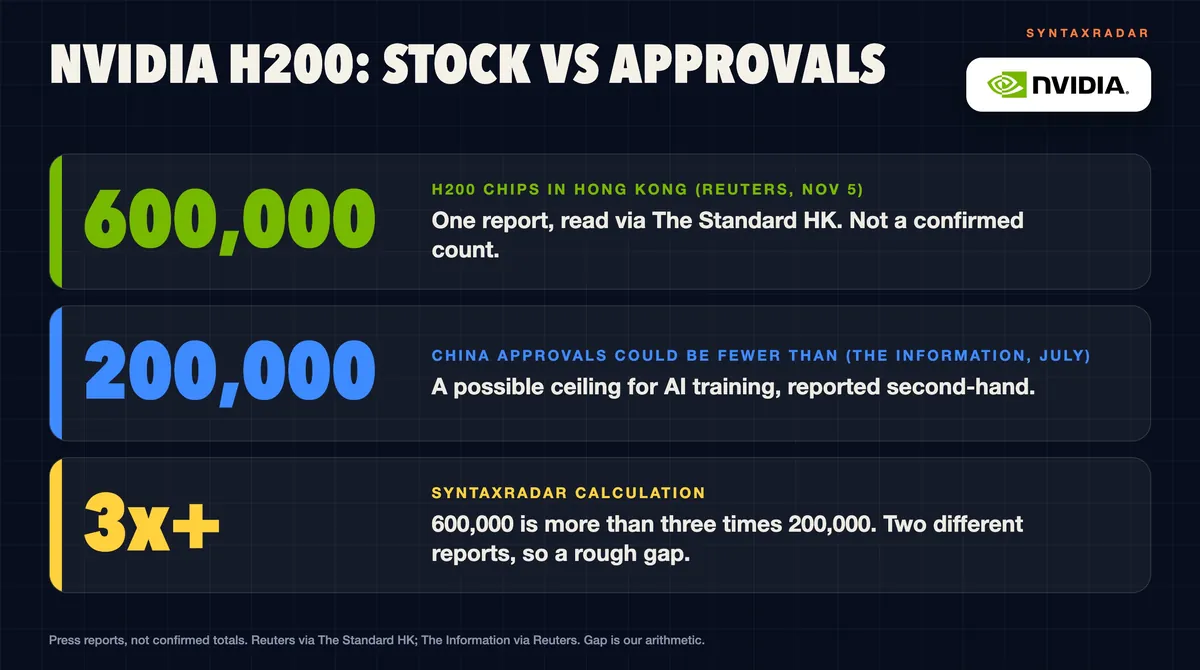
The H200 China standoff turns on one number: about 600,000 Nvidia H200 chips are stored in Hong Kong awaiting shipment to the mainland, and Beijing has not approved large-volume imports. That is the finding of a Reuters report published November 5, 2026, which we read through The Standard HK because the Reuters original could not be opened. The figure comes from two unnamed people familiar with the matter, so treat it as a single report.
Washington moved first. A rule from the Commerce Department's Bureau of Industry and Security (BIS), published in the Federal Register, effective January 15, 2026, switched export licences for selling the H200 to China from a presumption of denial to case-by-case review, with conditions attached. The US gate can open. What is still missing is Beijing's approval for bulk imports.
A second story followed on November 7, 2026. The New York Times reported that two Commerce-approved H200 buyers in China, New Matrix and Maginfra, had empty offices. We could not open the NYT original either, so the details below come from secondary summaries, mainly FourWeekMBA's write-up. None of the coverage we read shows that any chips reached either company.
What is the Nvidia H200?
The Nvidia H200 is a Hopper-generation data-center GPU (a graphics processor built to train and run AI models), and its headline feature is memory. These Nvidia H200 specs come from Nvidia's product page:
- 141GB of HBM3e (high-bandwidth memory stacked right beside the processor, the card's VRAM)
- 4.8TB/s of memory bandwidth, the speed at which data moves between that memory and the chip
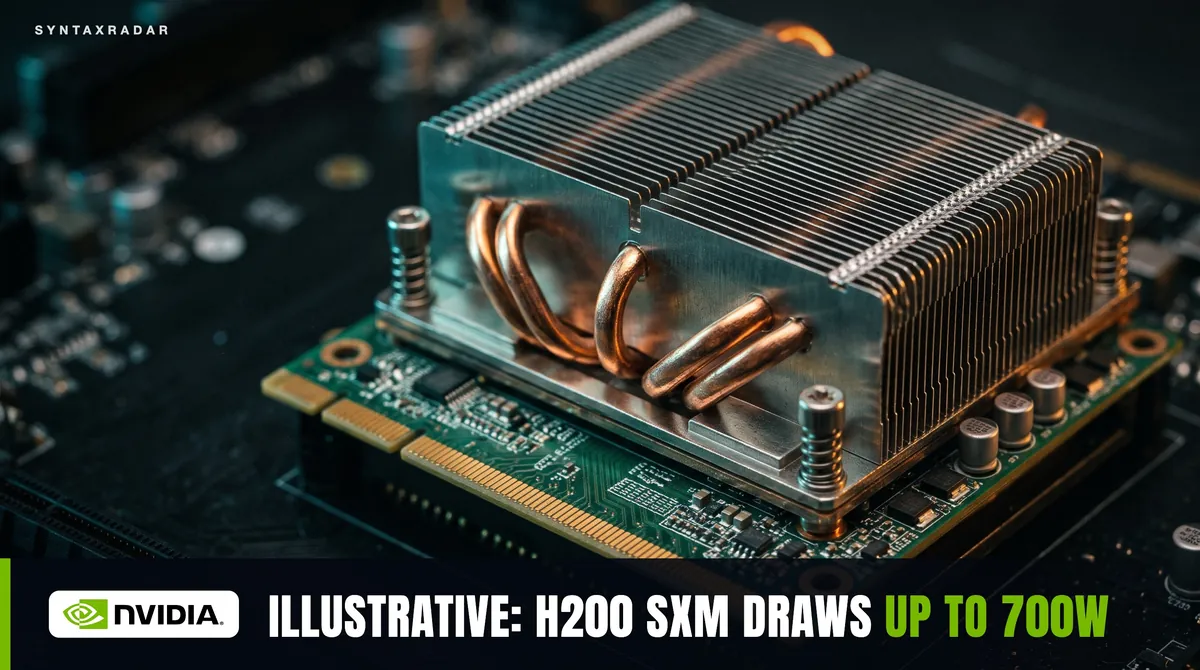
- Up to 700W TDP (thermal design power, the power budget the board is built around) for the SXM version, 600W for the NVL version
- NVLink at 900GB/s, Nvidia's link for wiring GPUs together
- 3,958 TFLOPS (trillions of operations per second) of FP8 compute with sparsity on the SXM version
Nvidia labels these specs preliminary. Memory is the part of AI hardware under the most strain, and our explainer on why RAM prices are going up covers that squeeze, which this story only touches. Storage is hit by the same buying wave, and our piece on SSD prices shows how AI datacenter demand is raising what that hardware costs.
Nvidia H200 vs H100
On performance, Nvidia states that the H200 runs inference (answering requests with an already-trained model) 1.9 times faster than the H100 on Llama2 70B and 1.6 times faster on GPT-3 175B. Both figures are Nvidia's own claims on two named models; we found no independent test in the sources.
The specs matter for the export story too. What we checked: the BIS rule covers chips with a TPP (total processing performance, a compute score the rule defines) below 21,000 and total DRAM bandwidth below 6,500 GB/s, and it names the H200 as an example. Nvidia's 4.8TB/s equals 4,800 GB/s, which sits under that bandwidth line.
Why can't China import Nvidia H200 chips?
China can't import Nvidia H200 chips in large volumes because Beijing has not approved those imports, according to the Reuters report. Every chip has to clear two separate gates, one in Washington and one in Beijing, and the sources describe only the first as open.
Gate one: the H200 China export licence
Under the BIS final rule (91 FR 1684), exports from the US of chips like the H200 and AMD's MI325X to China and Macau get case-by-case review if the exporter meets these conditions:
- Total shipments to China and Macau may not exceed 50% of the product shipped to US end-use customers, measured by aggregate TPP.
- The exporter must certify that US supply is sufficient.
- Every shipment must be reviewed by a US-headquartered third-party lab with no financial stake.
- The exporter must run KYC (know-your-customer checks) to prevent unauthorised remote access.
Two routes stay closed. Reexports and in-country transfers to Macau or Country Group D:5 (a group defined in US export rules), and exports to entities headquartered there, keep the presumption of denial.
Gate two: Beijing's H200 China approval
Beijing has not approved large-volume H200 imports, per the people Reuters spoke to. Some chips have moved: several major Chinese internet companies each obtained about 10,000 H200 chips in the months before the report, according to one source.
The Information reported in July that total Chinese approvals could be fewer than 200,000 chips, for AI training, and that Beijing wants firms to prioritise Chinese processors for inference. That account reaches us second-hand, relayed by Reuters through The Standard. It is the only motive the sources give; Beijing has offered no official reason in the coverage we read.
The licence caps are muddier. The Next Web reported in August that Commerce licences issued in May 2026 were capped at 75,000 units per licence, while the Financial Times cited 100,000 per company. The two figures do not match, and we did not find a Commerce document that settles it. The same report says Hong Kong handled about $124bn of China's chip imports from January to May (single secondary report).
How much does an Nvidia H200 cost?
None of the sources gives an official Nvidia H200 price. The figure on record is a China market asking price: as of the end of October 2026, an 8-card H200 server was offered for more than 6 million yuan (US$900,000), about three times its price a year earlier, per the Reuters report relayed by The Standard (single secondary report). Servers built on Nvidia's Blackwell chips were offered for more than 20 million yuan each.
Dividing by eight gives a rough per-chip view:
- End of October 2026: $900,000 / 8 = $112,500 per GPU
- A year earlier, at about one third of that: roughly $300,000 per server, or about $37,500 per GPU
Both are derived by us, and both overstate the chip alone, since a server price also covers processors, memory, networking and the chassis. They describe China's unofficial market and say nothing about Nvidia's list pricing.
A tripling in a year is the sharpest price signal in the reporting, though the sources do not say what drove it. For how GPU demand ripples through suppliers, our explainer on why chip stocks are down walks through the data center chain, and our piece on what AI capex is shows the spending side through Alphabet's $51.4B bill.
SyntaxRadar calculation: what 600,000 H200 chips add up to
The Hong Kong stock is easier to grasp in servers, dollars and power. Every input below comes from the reports and Nvidia's spec page; the arithmetic is ours. The 600,000 and $900,000 inputs each rest on one secondary report.
The gap is the row to focus on. If The Information's July ceiling held and every approved chip came out of this Hong Kong stock, at least 400,000 chips would sit above that ceiling (600,000 minus 200,000). Both inputs are press reports, so read the result as a sense of scale.
The power rows count GPU boards only, before cooling and the rest of each server, so they work as a floor.
One limit we could not turn into a number: the US rule caps China and Macau shipments at 50% of US end-use shipments by aggregate TPP, but the sources give no US shipment volumes, so we cannot convert that cap into a chip count.
What did the New York Times find about the licensed buyers?
According to the secondary summaries of the New York Times report, the Commerce Department approved New Matrix to assemble H200 chips into servers. Its listed address is an empty industrial-park building on Beijing's northwest edge. The company was created 17 months before the report, and Chinese records link its owners to Wise Road, a private equity fund that has been on the US entity list (a Commerce list of companies facing extra export restrictions) since 2024.
The second company, Maginfra, had a listed office that looked deserted in September. Analysts told the paper it may be an offshoot of Inspur, which is also on the entity list.
The wider picture from the same report: roughly two dozen Chinese firms were approved, each for tens of thousands of chips, and none had reached its quota. Nvidia spokesman John Rizzo said it "makes no sense for the Chinese military to depend on American technology". BIS said it carefully reviews all applications.
What the finding does not prove
The coverage does not establish that chips were shipped to New Matrix or any other flagged buyer, as Hyper.ai's summary notes. No licence revocations or charges have been reported. An empty office raises a question about how a licence was granted. It says nothing yet about where any chips went.
The finding puts the rule's paperwork under a spotlight. The rule asks exporters for KYC checks against unauthorised remote access and for third-party lab review of every shipment, and the coverage does not say how BIS vetted these two companies before approving them.
What to watch next for H200 China
- Beijing's approval. Whether China approves large-volume imports, and whether total approvals land near the reported 200,000 ceiling.
- The Hong Kong stock. Whether later reporting shows the 600,000 figure falling, which would suggest the second gate has opened.
- A BIS response. As of November 8, 2026, no revocations or reviews of New Matrix or Maginfra had been reported. Any action would show how the January rule is enforced.
- The asking price. Reuters put the 8-card server at over 6 million yuan, about three times the year-earlier price; a later reading would show whether that holds.
Questions readers ask
Is the Nvidia H200 banned in China?
Not outright. Since January 15, 2026, the US reviews H200 export licences to China case by case under a BIS rule with conditions, including a 50% volume cap and third-party lab review. The blocker is on the Chinese side: per a Reuters report, Beijing has not approved large-volume imports, though some internet companies each obtained about 10,000 chips.
Where are the 600,000 H200 chips being held?
In Hong Kong, awaiting shipment to mainland China, according to a Reuters report of November 5, 2026, relayed by The Standard HK. The number comes from two unnamed people familiar with the matter and has not been confirmed by Nvidia or either government, so treat it as a single, unconfirmed report.
Did H200 chips reach the companies with empty offices?
The coverage does not show that. The New York Times reported that New Matrix and Maginfra, both approved in the US licensing process, had empty or deserted listed offices. Secondary summaries of that report do not establish that any chips were shipped to them, and no licence revocations or charges had been reported as of November 8, 2026.
Why does the H200 fall under the US export rule?
The BIS rule covers chips with a total processing performance score below 21,000 and total DRAM bandwidth below 6,500 GB/s, and it names the H200 as an example. Nvidia lists the H200's memory bandwidth at 4.8TB/s, which is 4,800 GB/s, below that line. AMD's MI325X is the other example the rule names.
Sources
Written by
Abdul Rehman
Lead Systems Architect and Technical Director at Syntaxradar. More in Chips & Hardware.
Keep reading
Megaspeed: The Nvidia Buyer in the Reported DOJ Chip Probe
On Nov 9, 2026, two law-enforcement sources said the DOJ's National Security Division is investigating Singapore's Megaspeed, Nvidia's largest Southeast Asian buyer, over possible…
Nov 10, 2026 · 8 min read

Xreal Aura: Should You Buy the $1,099 Android XR Glasses?
Xreal launched the Aura, the first glasses built on Google's Android XR, on October 28, 2026. It costs $1,099 (regular $1,279) through December and ships mid-November to the US,…
Oct 31, 2026 · 7 min read

Co-Packaged Optics Explained: What It Changes in AI Networks
Nvidia and Broadcom have announced network switches that put the light-emitting parts inside the switch package instead of plug-in modules. Both claim large power savings for AI…
Oct 25, 2026 · 5 min read
More in Chips & Hardware
See all
Googlebook OS Update: November Patch Frees Up to 6GB of RAM
On November 6, 2026, Google began rolling out the first major Googlebook update (build CL3B.260622.286.R2). Gizmodo reports it frees 3GB to 6GB of RAM by slimming on-device AI on…
Nov 9, 2026 · 6 min read

GrapheneOS Motorola: Signature 27 Costs $1,599, No Install Date
Motorola opened US pre-orders for the $1,599 Signature 27 on November 5, 2026, per 9to5Google. It is the first non-Pixel phone GrapheneOS has committed to support, but it ships…
Nov 6, 2026 · 7 min read
iPad mini 8 Release Date: Nov 6 From $699, and Is It Worth It?
Apple announced the iPad mini (A20 Pro) on Oct 26, 2026, with an 8.5-inch OLED screen and IP67 body. Pre-orders opened Oct 28; it goes on sale Fri Nov 6 from $699. Engadget scored…
Nov 5, 2026 · 8 min read
Latest stories
Front page
Starship Flight 15: The Nov 13 Target and First Ship Catch
Abdul Rehman · Nov 10, 2026 · 6 min read
Claude Fable 5.2: $8 Price, Fast Mode and Whether to Switch
Abdul Rehman · Nov 10, 2026 · 7 min read

Outlook DMARC Requirements: Why Your Email Is Suddenly Bouncing
Abdul Rehman · Nov 9, 2026 · 6 min read

Goldman Sachs Claude Code: Why Bankers and Traders Lost Access
Abdul Rehman · Nov 9, 2026 · 6 min read