


SSD Prices: Why AI Datacenters Are Making Storage Cost More
The contract price of a 256GB TLC SSD hit about $134.20 in Q3 2026, up 303% from $33.30 a year earlier, as AI cloud buildouts absorb NAND flash. TrendForce expects NAND contract prices to rise another 15-20% in Q4 2026.

Abdul Rehman
Lead Systems Architect and Technical Director · · 7 min read

The short version
- $134.20 (from $33.30, +303% YoY)
- 256GB TLC SSD contract price, Q3 2026
- +15-20% QoQ
- TrendForce 4Q26 NAND contract price forecast
- More than 80% YoY
- Enterprise SSD bit demand growth, 2026
Why it matters: AI datacenters are buying up the same NAND flash chips that go into laptops, phones and PCs, so storage is getting pricier and relief probably waits until new factory capacity arrives in mid-to-late 2027.
If you have priced a new laptop, a gaming PC upgrade or a spare drive lately, you have probably noticed that SSD prices no longer behave the way they used to. Drives that were easy to shrug at a year ago now cost noticeably more.
The reason sits in giant server halls. Cloud companies building AI services are buying enormous amounts of NAND flash memory, the storage chip inside every SSD and phone, and the factories that make it have already promised much of their output to those customers. Your next laptop is competing for the same chips.
Why are SSD prices going up?
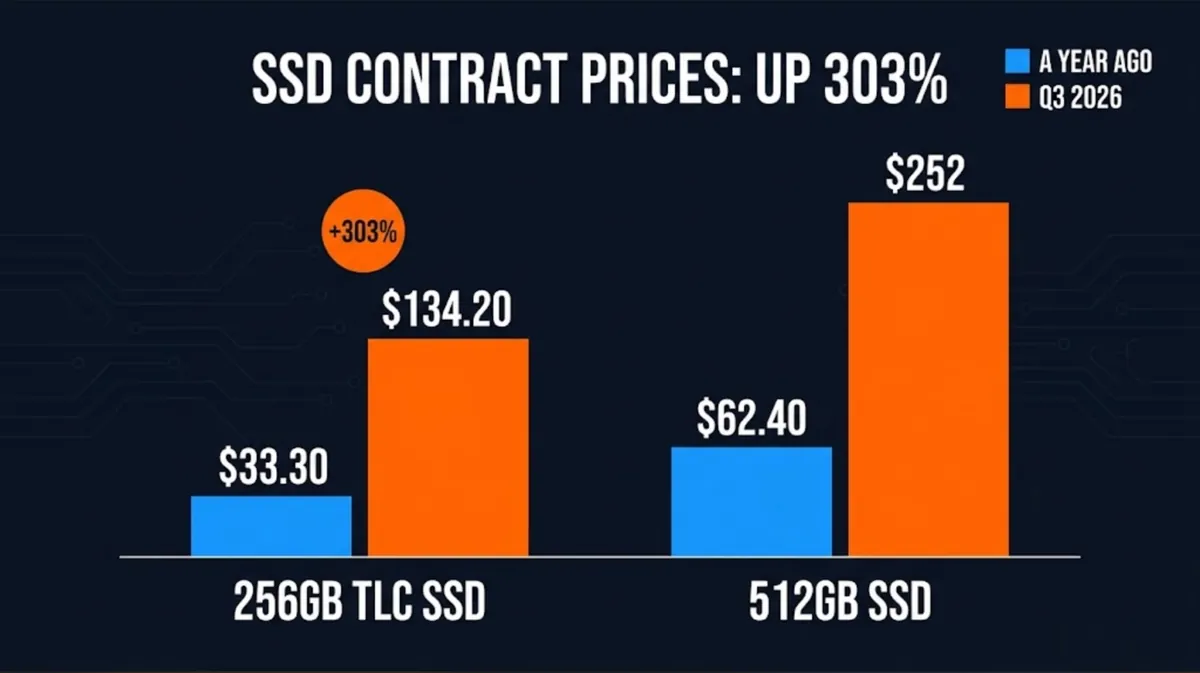
The reason SSDs are so expensive right now starts in the wholesale market, and the sharpest number comes from there. According to Notebookcheck's report on the NAND shortage, the contract price of a 256GB TLC SSD reached about $134.20 in the third quarter of 2026. A year earlier it was about $33.30. That is a 303% rise in twelve months, and roughly 20% above the previous quarter alone.
Bigger drives followed the same path. The 512GB equivalent reportedly went from about $62.40 to $252 over the same period. Further down the supply chain, the price of a 1-terabit TLC NAND flash chip, one of the raw parts drive makers solder onto a circuit board, reportedly rose 123% in the six months to October 21.
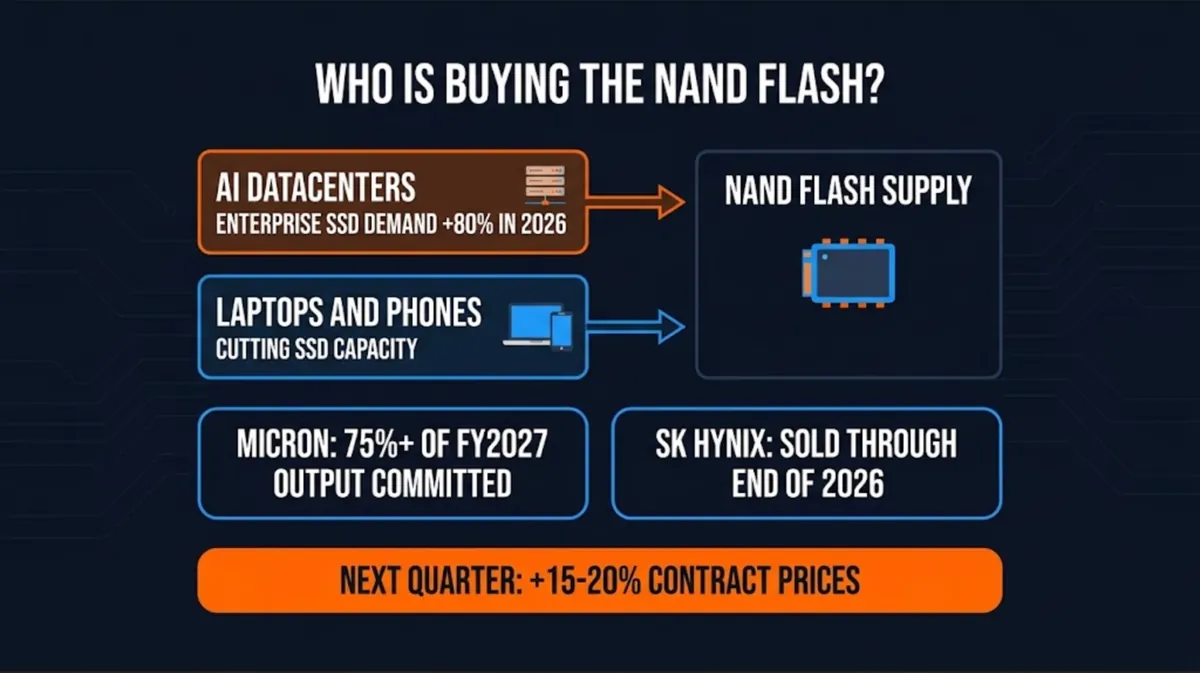
The driver is demand from AI. Market research firm TrendForce projects that enterprise SSD bit demand, meaning the total amount of storage capacity that datacenter drives need, will grow more than 80% year over year in 2026. Cloud providers expanding their AI inference infrastructure, the servers that answer your chatbot prompts, are behind that growth.
What is NAND flash memory?
In plain terms, NAND flash storage is the type of memory that keeps your files when the power is off. Your laptop's SSD, your phone's storage, a USB stick and a memory card all use it. Inside each chip is a dense grid of tiny cells that trap an electrical charge, and the level of that charge encodes your data.
Manufacturers squeeze more data into each cell to cut costs. TLC (triple-level cell) flash stores three bits per cell and is the mainstream choice for consumer SSDs. QLC (quad-level cell) stores one more bit per cell, which makes it cheaper per gigabyte but slower to write and less durable. That trade-off suits huge datasets that are read far more often than they are rewritten.
Phones use the same NAND flash, just packaged differently. Instead of a removable drive, it ships as eMMC or UFS storage soldered to the phone's board. So when NAND gets expensive, laptops, desktops and phones all feel it, even if each product shows the increase at a different time.
Contract prices vs shelf prices: what the 303% figure means for SSD pricing
That 303% number describes contract prices: what big buyers such as PC makers and drive brands pay manufacturers for bulk orders, usually negotiated every quarter. Notebookcheck is explicit that these are contract figures and do not mean every consumer SSD rose by the same amount. The shelf price of an SSD moves later and less evenly, because stores and brands sell from inventory bought at older prices and set margins drive by drive.
Shelf prices are rising too, though unevenly, and for some models the jump is steep. The 1TB drive is the number most buyers feel: Notebookcheck reports that a 1TB Gen4 NVMe SSD averaged about $144 in mid-October. One popular model, the Samsung 990 Evo Plus 1TB, was listed at $237, against a previous low of about $59.
The average tells you what a typical 1TB fast drive costs today. The Samsung listing shows how far an individual model can drift above its previous low when stock runs short. Your own experience will depend on which drive you want, where you shop and how much old inventory that retailer still holds.
How AI datacenters ended up competing with your laptop for NAND flash
AI models need fast access to vast amounts of data, and much of it has to live on flash so it can be fetched in milliseconds. According to TrendForce's fourth-quarter memory outlook, agentic AI, software that takes multi-step actions on its own, is driving data growth for real-time retrieval and caching. Rising use of QLC drives in vector databases, the search systems that help AI find relevant information, adds to the pull.
Those buyers also have deep pockets and long planning horizons. Notebookcheck reports that Micron has committed more than 75% of its expected fiscal 2027 output, and that SK hynix has allocated its NAND production through the end of 2026. When supply is spoken for that far ahead, anyone shopping on a shorter timeline, from a laptop brand to a home builder, pays whatever is left over.
TrendForce says enterprise SSD price growth is expected to accelerate in the fourth quarter, making it the only memory category with a bigger increase than in the prior quarter. Consumer device makers are responding in a different way. PC brands are cutting SSD capacities in mainstream models to hold down costs, and they are leaning on inventory built in the first half of 2026. Smartphone brands, the main buyers of eMMC and UFS storage, are also relying on existing stock, so their new purchases are very limited.
That may be why shelf prices have not fully matched the wholesale numbers yet: device makers are drawing on stock bought earlier.
Will SSD prices drop?
The forecasts say not soon. TrendForce projects NAND flash contract prices will rise another 15-20% quarter over quarter in the fourth quarter of 2026. That is on top of the increases already baked into this year's contracts.
The bigger constraint is factory capacity. Adding flash production is slow, and Notebookcheck reports that new capacity may not meaningfully add supply until mid-to-late 2027. Until then, a drop would need AI demand to cool, and the current forecasts point the other way.
Nothing in the current data says when prices will turn, so plan around rising SSD prices through 2026 and treat any dip before new capacity arrives as a bonus.
What buyers should do now: laptops, phones and PCs
If you need storage soon, waiting is unlikely to pay off. With contract prices still forecast to rise and new supply a long way off, a drive you need this year will probably cost more later in the year. Buy what you need, but there is little reason to stockpile.
Building or upgrading a PC
Check a model's price history before you pay, because finding a cheap SSD right now means comparing options. The gap between the 990 Evo Plus listing and its previous low shows how much individual drives can swing, so compare several brands of similar speed and size. A slightly slower drive at a normal price often beats a premium model at a shortage price, especially for gaming and everyday work where the difference is hard to notice.
Buying a laptop
Read the storage line on the spec sheet carefully. Because PC brands are trimming SSD capacities in mainstream models, this year's version of a laptop may ship with less storage than last year's at a similar price. If you keep lots of photos, games or video locally, paying for the bigger configuration upfront may save you buying more storage later.
Choosing a phone
Phone makers are still drawing on existing storage inventory, according to TrendForce, which may delay price changes. Storage is usually fixed on a phone, so pick the capacity you will need for the whole time you plan to own it, and lean on cloud backup for older photos and videos rather than paying for a top tier you will not fill.
Already own a drive?
If your current SSD works, keep it. Freeing up space and moving old files to an external drive or cloud storage is the cheapest upgrade available while prices are high.
What to watch next
Watch three signals. First, TrendForce's next quarterly outlook, which will show whether contract increases are speeding up or slowing after the forecast 15-20% fourth-quarter rise. Second, laptop and phone launches: smaller default storage or higher prices for the same capacity will show that cheaper inventory has run out. Third, updates from flash makers such as Micron and SK hynix on when new capacity starts shipping, since Notebookcheck's reporting points to mid-to-late 2027 before supply catches up.
Until then, AI datacenters set the pace for SSD prices. Every new wave of AI services needs more fast storage, and TrendForce's demand projections suggest that appetite is still growing.
Questions readers ask
Why are SSD prices going up?
Cloud providers expanding AI inference infrastructure are buying huge amounts of NAND flash, the chip inside every SSD. TrendForce projects enterprise SSD bit demand will grow more than 80% in 2026, and manufacturers such as Micron and SK hynix have committed much of their production in advance, leaving less supply for laptops, PCs and phones.
Did consumer SSDs really rise 303%?
No. The 303% figure is a contract price, what large buyers pay manufacturers in bulk, for a 256GB TLC SSD, which went from about $33.30 to $134.20 in a year. Retail prices move later and unevenly. A 1TB Gen4 NVMe SSD averaged about $144 in mid-October, though some individual models are listed far above their previous lows.
When will SSD costs come down?
Not in the near term on current forecasts. TrendForce expects NAND flash contract prices to rise another 15-20% quarter over quarter in the fourth quarter of 2026, and new factory capacity may not meaningfully add supply until mid-to-late 2027. A drop before then would need AI demand to cool, which the forecasts do not show.
What is NAND flash memory?
NAND flash is the memory that keeps data when the power is off. It sits inside SSDs, phones, USB sticks and memory cards. Each chip holds a dense grid of cells that store data as trapped electrical charge. TLC flash is the mainstream consumer type, while QLC packs more data per cell at lower cost but with slower writes and less durability.
Written by
Abdul Rehman
Lead Systems Architect and Technical Director at Syntaxradar. More in Chips & Hardware.
More in Chips & Hardware
See all
Xreal Aura: Should You Buy the $1,099 Android XR Glasses?
Xreal launched the Aura, the first glasses built on Google's Android XR, on October 28, 2026. It costs $1,099 (regular $1,279) through December and ships mid-November to the US,…
Oct 31, 2026 · 7 min read

MacBook Touch Screen: Which New MacBook Pro Finally Has One
On October 28, 2026, Apple announced the MacBook Pro with PROLED XDR Display, 14- and 16-inch models with M5 Pro or M5 Max and the first touch screen on a MacBook Pro. It ships…
Oct 29, 2026 · 8 min read
MacBook Pro M6 vs M5: Who Should Upgrade, and Who Can Skip It
Apple announced the 14-inch MacBook Pro with M6 on October 27, 2026. It claims up to 25% faster on-device AI than M5 and a Neural Engine up to 1.9x faster. Pre-orders opened…
Oct 28, 2026 · 7 min read
Latest stories
Front page
AI Bubble Pop? 5 Warning Signs Behind Big Tech's $740B Bet
Abdul Rehman · Oct 31, 2026 · 7 min read
Claude Code Extension VSCode Backdoor: How to Check and Clean Up
Abdul Rehman · Oct 31, 2026 · 7 min read
AO3 Outage: Why Is AO3 Down, and Is Your Account Safe?
Abdul Rehman · Oct 30, 2026 · 7 min read

AI for Hacking: CrowdStrike Says ARTEX Targeted 200+ Orgs
Abdul Rehman · Oct 30, 2026 · 7 min read