


Xreal Aura: Should You Buy the $1,099 Android XR Glasses?
Xreal launched the Aura, the first glasses built on Google's Android XR, on October 28, 2026. It costs $1,099 (regular $1,279) through December and ships mid-November to the US, Canada, Japan and South Korea.

Abdul Rehman
Lead Systems Architect and Technical Director · · 7 min read
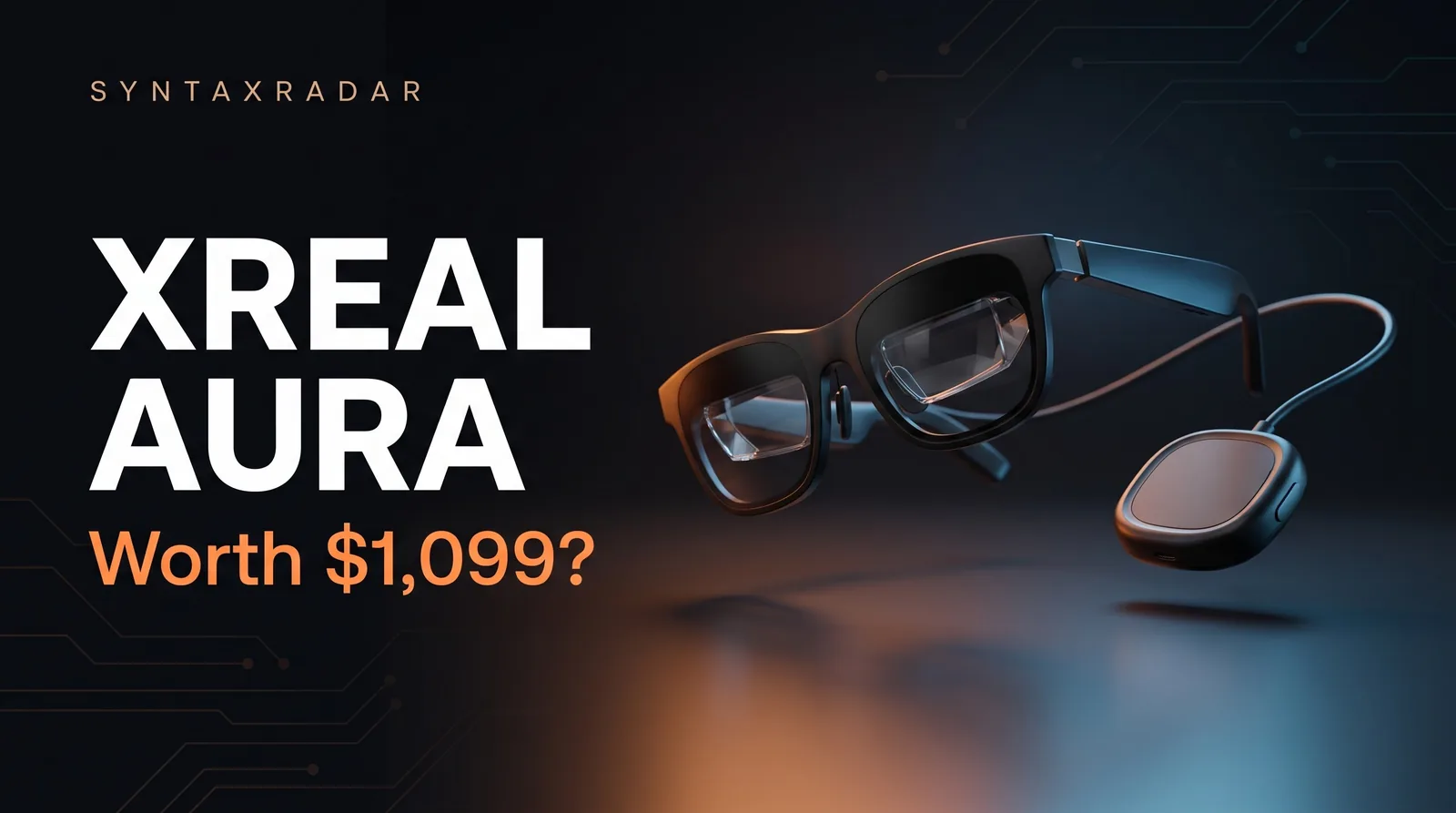
The short version
- $1,099
- Launch price (12GB/256GB)
- 70 degrees
- Field of view
- Under 95 g
- Glasses weight
Why it matters: The Xreal Aura is a see-through Android XR computer for early adopters who want Gemini and spatial apps on the move, while anyone who just wants a big virtual screen should wait or buy simpler display glasses.
The Xreal Aura is the first pair of Android XR glasses, built around Google's operating system for headsets and glasses, and since October 28 you can actually order one. If you came here for the Xreal Aura price and release date, here is the short version: $1,099 for the base model until the end of December (regular price $1,279), with the first units shipping in mid-November.
That is a lot of money for something you wear on your face, so the question is who it is worth it for. The Aura is a self-contained computer split in two: light glasses on your face and a pocket-sized puck that does the thinking.
What is Xreal Aura?
Xreal Aura is a pair of see-through smart glasses that run Android XR, Google's operating system for headsets and glasses, with Gemini built in. Xreal launched it at the Android Developer Summit on October 28, 2026, after announcing prices on October 7.
The design splits the work in two. The glasses themselves weigh under 95 grams, according to Road to VR's launch report, because the heavy lifting happens in a separate puck that sits in your pocket. That puck holds a Qualcomm Snapdragon Reality Elite chip, the battery, two USB-C ports and a trackpad.
Think of it as a laptop where the screen is on your face and the computer is in your pocket. The glasses show you apps floating in the room, track your head and hands, and let you keep seeing the real world through the lenses. Xreal says more than 150 XR experiences are available at launch.
If you want the bigger picture of where this category is heading, our explainer on why smart glasses could replace smartphones covers the long game. The Aura is one of the first products that lets you test that idea for real.
How much is the Xreal Aura?
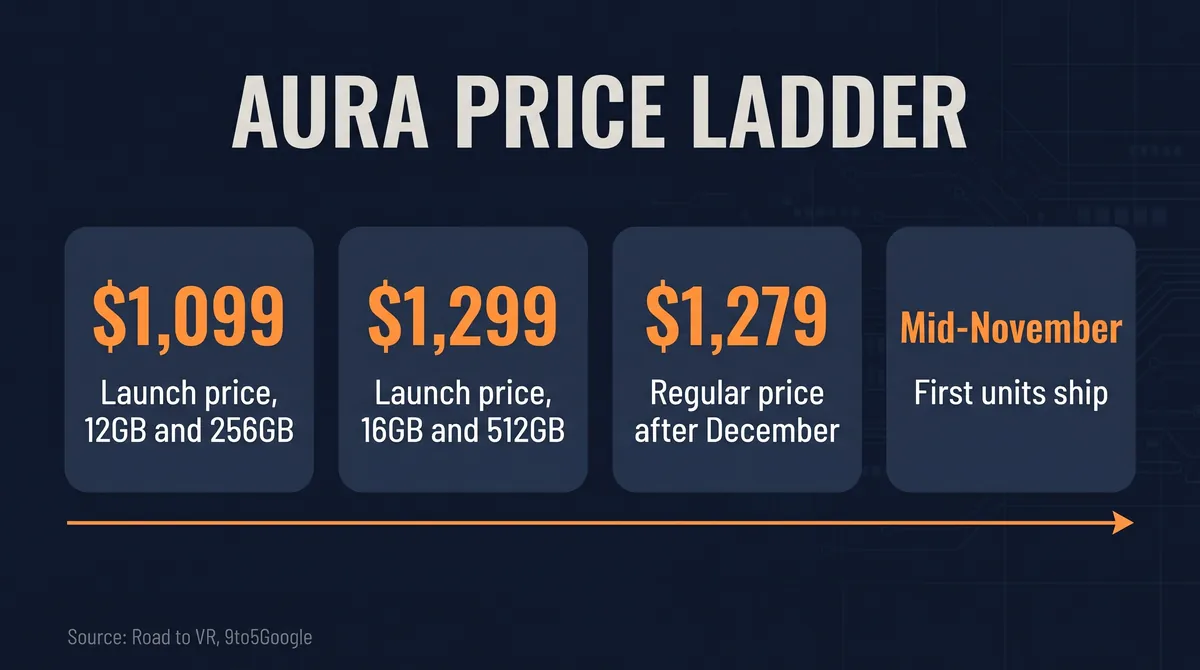
The Aura price is $1,099 for the 12GB RAM and 256GB storage model, and $1,299 for the 16GB and 512GB model, during the launch window that runs through December 2026. After that, the regular prices return: $1,279 and $1,499.
Here is the full ladder, with the launch prices taken from Road to VR and the regular prices from 9to5Google's price report:
So the discount is $180 on the base model and $200 on the bigger one. There is no extra charge for picking the Medium or Large frame size.
Some context on the number. Xreal had promised a price "under $1,500" before it revealed the final figure, so $1,279 landed well below that ceiling. Early buyers who put down the $199 Priority Deposit had that amount counted toward the final price.
Aura release date: when does it ship?
The first batch ships in mid-November 2026 to the US, Canada, Japan and South Korea, according to iDevice. More countries follow in 2027. In the US you can buy it at XREAL.com and Best Buy, and Google Store locations in the US and Japan will carry it in 2027.
Xreal Aura specs: the display, the FOV and the puck
The spec sheet reads like a headset's, squeezed into glasses. Here is what each number means for you.
The display
Each eye gets its own Sony Micro-OLED panel at 1920 x 1200, which works out to 32 pixels per degree (PPD). PPD is the number that matters in glasses: it tells you how sharp text looks at the size you actually see it. The panels run at up to 120Hz and reach 1,050 nits of brightness, a high ceiling for brightness.
Field of view
The field of view is 70 degrees, delivered through prism-style see-through optics. Field of view is how much of your vision the virtual image can fill. At 70 degrees, a virtual screen feels large in front of you, but it does not wrap around your whole view the way a closed VR headset does.
The lenses also have five-level electrochromic dimming, meaning they can darken on command and block up to 99.9% of outside light. Dim them fully and the room mostly disappears. Leave them clear and you can see it.
Tracking
Two cameras on the glasses provide 6DoF inside-out tracking. In plain English, 6DoF (six degrees of freedom) means the glasses know both where you are looking and where you are moving, so a virtual window can stay pinned to a wall while you walk around it. The glasses also support hand tracking, so you are not limited to the trackpad.
Xreal adds its own X1S Spatial Coprocessor to handle display and sensor processing, and the spec sheet lists 3ms motion-to-photon latency. That is the delay between moving your head and the image catching up. Lower is better, because lag is what makes people feel queasy.
The puck
The puck is the brain. It runs Android XR with Gemini on a Snapdragon Reality Elite chip rated at up to 48 TOPS (trillions of operations per second, a common measure of AI processing power). It carries a 4,455 mAh battery, rated at 34.84Wh. Putting the battery and chip in your pocket instead of on your nose is the main reason the glasses stay under 95 grams.
Sizes
There are two frame sizes based on IPD, the distance between your pupils: Medium fits 60 to 66 mm and Large fits 66 to 72 mm. If you do not know your IPD, an optician can measure it in a minute, and picking the right size matters for a sharp image.
Xreal Aura vs Xreal One Pro
The main difference is where the computing happens.
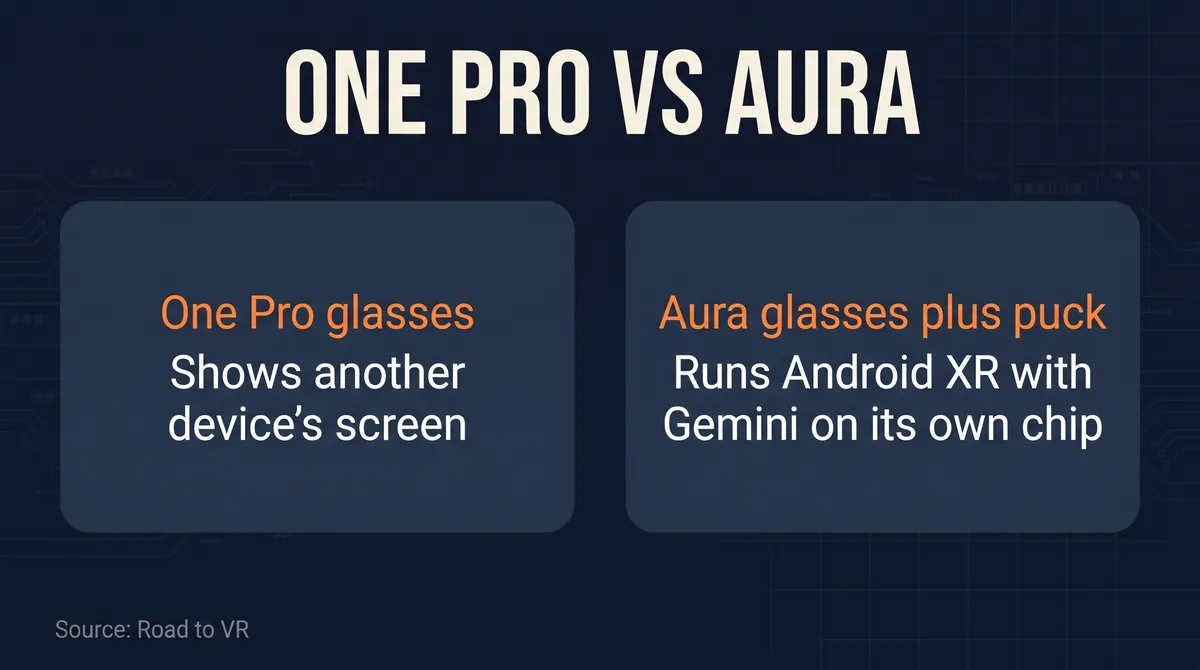
The One Pro is Xreal's display-glasses line: glasses that show another device's screen as a big virtual display, with the connected device doing the computing. Our launch sources focus on the Aura and say little about the One Pro, so treat this as a comparison of the two approaches.
The Aura brings its own computer. The puck runs Android XR and Gemini on its own chip, and the glasses add camera-based 6DoF tracking and hand tracking, so apps can live in your room rather than just floating in front of you. That is the jump from "a monitor on your face" to "a headset you can see through".
The trade-off is cost and complexity. Our sources do not list One Pro pricing, so check Xreal's store before you compare, but display-only glasses have no separate puck to carry or charge. If what you want is a giant screen for movies or a second monitor, that kind of product is built for the job. If you want Android XR apps, Gemini and spatial tracking, only the Aura on this list offers them.
Xreal Aura vs Meta glasses
This comparison is closer than you might expect on price. At its regular $1,279, the Aura is $20 cheaper than Meta's VR Glasses, according to iDevice's report on the launch.
The bigger difference is how each one feels to use. iDevice cites WIRED's hands-on testing, which found Meta's glasses better for sitting down and typing, while the Aura's see-through lenses work better when you are walking around. That lines up with the hardware: the Aura's prism optics let you see the real world clearly, with dimming when you want to shut it out.
So the split is roughly this. If your plan is mostly seated productivity, Meta has the edge in WIRED's testing. If you want something you can wear while moving through a room, glancing at apps without losing track of what is around you, the Aura is the better fit.
There is also the platform question. The Aura runs Android XR, which means Gemini and the Android developer world. Choosing between them is partly choosing which company's ecosystem you want to bet on for the next few years.
Who should buy the Aura, and who should wait?
Here is our verdict, based on the specs and early testing reported so far.
Buy now if:
- You want to try Android XR and Gemini on your face before almost anyone else, and $1,099 is money you can spend on a first-generation device.
- You care more about seeing the real world while you use apps than about a fully immersive view.
- You already live in Google's ecosystem and want the launch discount before it ends in December.
Wait if:
- You mainly want a big virtual screen for films or a laptop. Display glasses like the One Pro are built for that job.
- You need it outside the US, Canada, Japan or South Korea. Those are the only first-batch countries, and others come in 2027.
- You want to see how the 150+ launch experiences grow before paying a first-generation price.
One practical note: measure your IPD before you order. Getting the wrong frame size on a device this expensive is an avoidable mistake.
What to watch next
The Aura is the first real test of whether Android XR can work in glasses people would wear outside the house. Here is what to track.
First, the full Aura reviews once units ship. Units arrive in mid-November, and full reviews will show whether the 70-degree FOV, 32 PPD sharpness and puck battery hold up in daily use.
Second, the price after December. If the $1,279 regular price returns on schedule, the launch window is the cheapest way in. Third, the app count. Launch day brings more than 150 XR experiences, and Android Central's launch coverage is a good place to track what arrives next.
Reviews should start landing when the first units ship in mid-November, and the launch price window closes at the end of December.
Questions readers ask
What is Xreal Aura?
It is a pair of see-through smart glasses that run Google's Android XR with Gemini. The glasses weigh under 95 grams because a pocket puck with a Snapdragon Reality Elite chip, battery and trackpad does the computing. It tracks your head and hands with two cameras and launched on October 28, 2026.
How much is the Xreal Aura?
Through December 2026 it costs $1,099 for the 12GB RAM and 256GB model and $1,299 for the 16GB and 512GB model. After the launch window, regular prices are $1,279 and $1,499. Medium and Large frame sizes cost the same, and it is sold at XREAL.com and Best Buy in the US.
What is the Xreal Aura release date?
The glasses went on sale on October 28, 2026, and the first batch ships in mid-November 2026 to the US, Canada, Japan and South Korea. Xreal says more countries will follow in 2027, when Google Store locations in the US and Japan will also start selling the glasses.
Is the Xreal Aura better than Meta glasses?
It depends on how you plan to use it. At its regular $1,279 price the Aura is $20 cheaper than Meta's VR Glasses. WIRED's testing, as reported by iDevice, found Meta better for sitting and typing, while the Aura's see-through lenses worked better for walking around and staying aware of the room.
What are the Aura specs and field of view?
Each eye gets a Sony Micro-OLED panel at 1920 x 1200 (32 PPD, up to 120Hz, 1,050 nits) with a 70-degree field of view. A pocket puck runs Android XR with Gemini on a Snapdragon Reality Elite chip, up to 48 TOPS, with a 4,455 mAh battery. The glasses weigh under 95 grams.
Written by
Abdul Rehman
Lead Systems Architect and Technical Director at Syntaxradar. More in Chips & Hardware.
More in Chips & Hardware
See all
SSD Prices: Why AI Datacenters Are Making Storage Cost More
The contract price of a 256GB TLC SSD hit about $134.20 in Q3 2026, up 303% from $33.30 a year earlier, as AI cloud buildouts absorb NAND flash. TrendForce expects NAND contract…
Oct 29, 2026 · 7 min read

MacBook Touch Screen: Which New MacBook Pro Finally Has One
On October 28, 2026, Apple announced the MacBook Pro with PROLED XDR Display, 14- and 16-inch models with M5 Pro or M5 Max and the first touch screen on a MacBook Pro. It ships…
Oct 29, 2026 · 8 min read
MacBook Pro M6 vs M5: Who Should Upgrade, and Who Can Skip It
Apple announced the 14-inch MacBook Pro with M6 on October 27, 2026. It claims up to 25% faster on-device AI than M5 and a Neural Engine up to 1.9x faster. Pre-orders opened…
Oct 28, 2026 · 7 min read
Latest stories
Front page
Claude Code Extension VSCode Backdoor: How to Check and Clean Up
Abdul Rehman · Oct 31, 2026 · 7 min read

AO3 Outage: Why Is AO3 Down, and Is Your Account Safe?
Abdul Rehman · Oct 30, 2026 · 7 min read

AI for Hacking: CrowdStrike Says ARTEX Targeted 200+ Orgs
Abdul Rehman · Oct 30, 2026 · 7 min read

Binance Hacked: How One Laptop May Have Led to a $6.36B Theft
Abdul Rehman · Oct 30, 2026 · 8 min read