


AI Bubble Pop? 5 Warning Signs Behind Big Tech's $740B Bet
Alphabet fell 12% on Oct 29, its worst day on record, after a second negative free cash flow quarter. The Nasdaq fell 2.9% the next day, S&P cut Meta's outlook to negative, and the WSJ reported OpenAI raised less than half of its $30B target.

Abdul Rehman
Lead Systems Architect and Technical Director · · 7 min read
The short version
- 12%, about $500B in value
- Alphabet one-day drop (Oct 29)
- $326B, triple last year
- Big Tech debt raised in 2026
- -$42.4B
- Amazon trailing 12-month free cash flow
Why it matters: This week's AI bubble warnings came from cash burn and record borrowing, while the revenue from AI and cloud customers kept growing.
Fear of an AI bubble pop hit hard this week. On Thursday, October 29, Alphabet lost 12% in a single session, its worst day on record, wiping out about $500 billion in market value. On Friday the Nasdaq slid 2.9%, with Nvidia, Broadcom and Qualcomm all falling hard. Is the AI bubble popping right now?
The warning lights this week are about money going out the door faster than it comes in, and about who is lending to cover the gap. The demand side, the part where customers actually pay for AI and cloud services, is still growing. That distinction decides whether this is a crash in the making or a very expensive growing pain.
Here is what the earnings reports and ratings agencies showed this week, what they did not show, and what it would mean for ordinary investors and workers if the boom does crack.
What is the AI bubble, and why did fears spike this week?
The AI bubble is the worry that spending and stock prices tied to AI have run ahead of the money AI actually earns. The trigger was a run of third-quarter earnings from the biggest spenders on AI infrastructure. Alphabet, Amazon, Meta and Microsoft have outlined plans to spend more than $740 billion on capital expenditures this year, according to TechCrunch. Capital expenditure, or capex, is money spent on long-lived things like data centers, chips and other equipment. We explained the term in detail in what AI capex is and why Alphabet's bill spooked Wall Street, so here we will focus on what changed.
What changed is that investors stopped giving the spending a free pass. Alphabet's 12% fall came after it reported another quarter of heavy building. A day later the sell-off spread to the chipmakers that supply the boom: Nvidia dropped 4%, Broadcom more than 5% and Qualcomm 11%.
When the companies buying the chips and the companies selling them fall together, the market is questioning the whole supply chain at once.
Is there an AI bubble? Five warning signs in the numbers
Nobody can prove a bubble until it pops, but you can check the classic symptoms. Five of them showed up this week.
1. Free cash flow turned negative
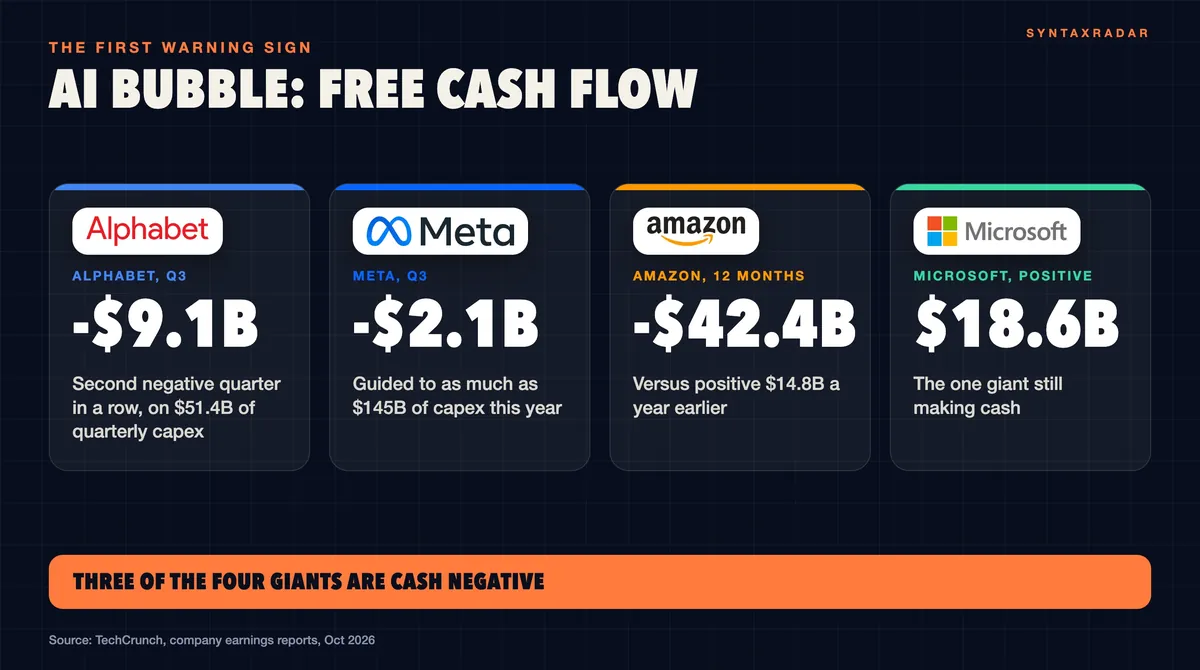
Free cash flow is the cash a company has left after paying for operations and capex. It is the money that funds dividends, buybacks and a cushion for bad years. Three of the four giants reported negative free cash flow.
Alphabet reported negative free cash flow of $9.1 billion in Q3, its second straight negative quarter, on quarterly capex of $51.4 billion. Meta posted negative free cash flow of $2.1 billion. Amazon's trailing 12-month free cash flow was negative $42.4 billion, compared with positive $14.8 billion a year earlier.
2. The spending keeps climbing
Alphabet expects to spend up to $205 billion on capex this year and says spending will keep rising in 2027. Amazon expects about $220 billion. Meta guided to as much as $145 billion.
3. Borrowing hit a record
Microsoft, Alphabet, Amazon, Meta and Oracle raised a combined $326 billion in debt in 2026, triple last year's total, according to S&P Global Market Intelligence data cited by TechCrunch. Meta also said on October 26 it plans to raise $95 billion: $35 billion through underwritten public stock offerings and $60 billion through an at-the-market program, which sells shares gradually into the market.
4. A ratings agency blinked
On October 30, S&P Global Ratings revised Meta's outlook from stable to negative, as CNBC reported. The rating itself stays at AA-, which is still very strong, but S&P cited uncertainty about elevated capex and negative free cash flow. A Meta spokesperson said the company "respectfully disagree[s]" with S&P's assessment of how it will make money from the spending. Meta stock fell 15% in October, its worst month in four years.
5. Private AI money got harder to raise
OpenAI raised less than half of its $30 billion target in its latest round, according to a Wall Street Journal report. Anthropic filed for its IPO the same week, and the Financial Times reported on October 30 that Blackstone warned it may not qualify for an investment-grade rating. We covered the filing in the five numbers that matter in Anthropic's IPO prospectus.
What is not breaking: the demand behind the spending
The bear case runs into trouble here, because the revenue lines still look healthy.
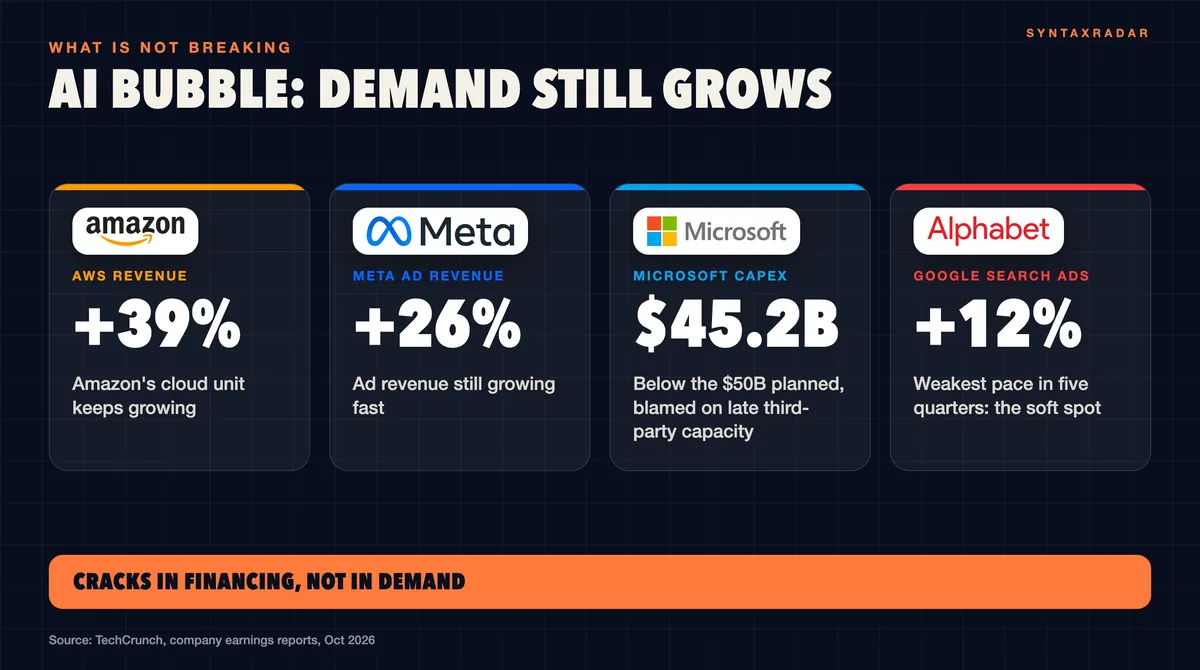
Amazon's cloud unit, AWS, grew revenue 39%. Meta's ad revenue grew 26%. Microsoft posted $18.6 billion in positive free cash flow, and its capex came in at $45.2 billion, below the $50 billion it had projected. Microsoft blamed the shortfall on delays in third-party capacity.
That detail matters. In a classic bubble, companies build capacity nobody wants. Here, one of the biggest buyers blames late third-party capacity for spending less than planned.
There is one soft spot on the demand side. Google Search ad growth slowed to 12%, its weakest pace in five quarters, and Search is roughly half of Google's revenue. If AI answers start eating into the ads that pay for Alphabet's build-out, that would be a real problem. Recheck the number in three months to see whether one quarter becomes a trend.
Are we in an AI bubble? Weighing both sides
Put the two lists side by side and a clearer picture forms. The cracks this week are in financing, while demand holds up.
The bull reading: these are the richest companies on earth, borrowing heavily (Meta still holds an AA- rating) to build something customers are already paying for. Negative cash flow during a build-out is normal, the same way a factory burns cash before it opens.
The bear reading: the build-out has no visible end date, the cash cushion is gone at three of the four, and the companies are now relying on debt markets and stock sales to keep going. A boom that needs outside money to continue is more fragile than one paid for from profits. S&P's own stated worry was elevated capex and negative free cash flow.
Both readings fit the same numbers. The difference is whether AI revenue grows fast enough to cover spending that, by Alphabet's own guidance, will be even higher in 2027.
Will the AI bubble pop?
Nobody can time it. This week's data shows demand holding and the margin for error narrowing.
Three things would turn an expensive build-out into an AI bubble pop. First, revenue growth stalling while capex keeps rising, for example if AWS growth slowed sharply. Second, lenders demanding much higher rates or refusing to lend, which Blackstone's warning on Anthropic and OpenAI's short round hint at. Third, a big buyer cutting its spending plans, which would ripple straight down to Nvidia, Broadcom and the rest of the chip supply chain.
None of those has happened yet. All three are now being watched by investors who, until recently, were not watching closely at all.
What happens if the AI bubble bursts?
What happens if the AI bubble bursts depends on who you are. For investors, this week's slide is a small preview: Alphabet alone lost about $500 billion in value in a day, and Nvidia, Broadcom and Qualcomm fell with it.
For tech workers, a spending pullback would likely hit the jobs closest to the build-out first: data center construction, chip supply chains and the startups whose business depends on cheap computing.
For everyday users, the effect would be slower and quieter. AI features that cost a lot to run could be priced higher, limited or dropped. The tools would not vanish, because the data centers already built do not disappear, but the pace of new free features would likely slow.
What to watch next
Whether this week becomes the start of an AI bubble pop or a scare that fades will show up in a few specific places:
- Next quarter's free cash flow at Alphabet, Meta and Amazon. A third negative quarter for Alphabet would harden the bear case.
- Google Search ad growth. A second slowdown below 12% would suggest AI is cannibalizing the business that pays for it.
- Debt and equity raises. Watch whether Meta completes its $95 billion plan and whether other hyperscalers follow.
- Credit ratings. S&P changed its outlook on Meta, and the rating itself is unchanged. A real downgrade would raise borrowing costs across the sector.
- The Anthropic IPO. How public investors price it will show whether private AI valuations hold up in the open market.
For now, the evidence points to a boom that is straining its wallet while its customers keep paying.
Questions readers ask
Is there an AI bubble right now?
There are bubble-like warning signs. Alphabet, Meta and Amazon reported negative free cash flow, and five big tech firms raised $326 billion in debt in 2026, triple last year. But demand is still growing: AWS revenue rose 39% and Meta's ad revenue rose 26%. The strain is in financing the build-out, while customers keep paying.
What is the AI bubble?
The AI bubble is the worry that spending and share prices tied to AI have run ahead of the revenue AI brings in. This week's evidence: Alphabet, Meta and Amazon reported negative free cash flow, and five big tech firms raised $326 billion in debt in 2026. Against that, AWS revenue rose 39% and Meta's ad revenue rose 26%.
Why did Alphabet stock fall 12%?
Alphabet fell 12% on October 29, its worst day on record, after third-quarter results showed negative free cash flow of $9.1 billion, its second negative quarter in a row, on $51.4 billion of quarterly capex. Search ad growth also slowed to 12%, its weakest pace in five quarters, and the company expects spending to keep rising in 2027.
Why did S&P change Meta's outlook to negative?
S&P Global Ratings moved Meta's outlook from stable to negative on October 30, citing uncertainty about its elevated capex and negative free cash flow. Meta's AA- rating did not change. Meta posted negative free cash flow of $2.1 billion in the third quarter and plans to raise $95 billion through stock offerings. Meta said it respectfully disagrees with the assessment.
What happens if the AI bubble bursts?
Investors would feel it first: this week Alphabet lost about $500 billion in value in one day. Jobs tied to data center construction and chip supply would likely be next. Everyday users could see fewer free AI features or higher prices, but the data centers already built would remain. This is a scenario, and this week's data shows strain in how the build-out is financed while demand keeps growing.
Will the AI bubble pop?
Nobody can time it, and this week's data shows demand holding up. Three things would turn the build-out into a real crash: revenue growth stalling while capex keeps rising, lenders demanding much higher rates or refusing to lend, or a big buyer cutting its spending plans. None of those has happened yet.
Written by
Abdul Rehman
Lead Systems Architect and Technical Director at Syntaxradar. More in Emerging Tech.
More in Emerging Tech
See all
Binance Hacked: How One Laptop May Have Led to a $6.36B Theft
On Oct 29, 2026, attackers drained Binance hot wallets across ten blockchains. TRM Labs counts about $6.36B stolen and links it to North Korea's TraderTraitor; Binance blames a…
Oct 30, 2026 · 8 min read

Is a Computer Science Degree Worth It? What the 8.1% Drop Means
US undergraduate computer science enrollment at four-year colleges fell 8.1% in fall 2025 and 8.4% in spring 2026, per the National Student Clearinghouse, as overall enrollment…
Oct 29, 2026 · 7 min read

Anthropic IPO Prospectus: The 5 Numbers That Actually Matter
Anthropic's S-1 went public on SEC EDGAR and hit the Hacker News front page on October 27, 2026. It shows 2025 revenue of about $4.6 billion, a roughly $42 billion net loss and…
Oct 27, 2026 · 7 min read
Latest stories
Front page
Xreal Aura: Should You Buy the $1,099 Android XR Glasses?
Abdul Rehman · Oct 31, 2026 · 7 min read

Claude Code Extension VSCode Backdoor: How to Check and Clean Up
Abdul Rehman · Oct 31, 2026 · 7 min read
AO3 Outage: Why Is AO3 Down, and Is Your Account Safe?
Abdul Rehman · Oct 30, 2026 · 7 min read
AI for Hacking: CrowdStrike Says ARTEX Targeted 200+ Orgs
Abdul Rehman · Oct 30, 2026 · 7 min read