
What Is AI Capex? Why Alphabet's $51.4B Bill Spooked Wall Street
Alphabet's Q3 2026 capex hit $51.4B, more than double a year earlier, pushing free cash flow to negative $9.1B for a second straight quarter. Shares fell about 12% on Oct. 29, its worst trading day on record.

Abdul Rehman
Lead Systems Architect and Technical Director · · 7 min read
The short version
- $51.4B (vs $24B a year earlier)
- Q3 2026 capex
- -$9.1B
- Free cash flow
- $195B-$205B
- 2026 capex guidance
Why it matters: AI capex is the money spent on chips, datacenters and power, and Alphabet's quarter shows that bill can outrun even Google's cash machine while the payoff is still arriving.
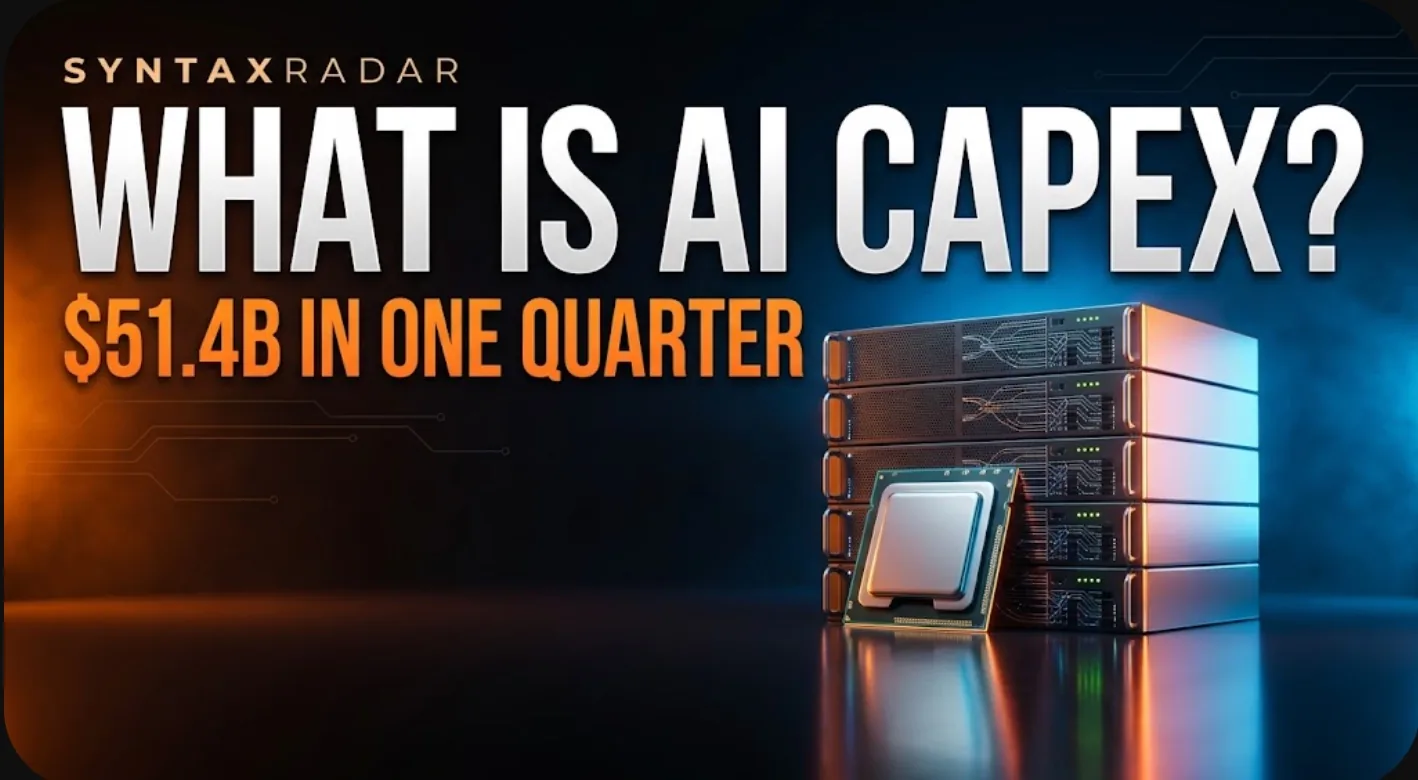
On October 29, Alphabet had its worst single trading day on record. The company behind Google lost roughly $500 billion in market value in one session, after a quarterly report showing $51.4 billion of capital spending in three months. That spending has a name you will hear a lot this year: AI capex, short for AI capital expenditure.
AI capex is the money tech giants pour into the physical stuff that runs artificial intelligence: datacenters, the specialized chips inside them, and the power and cooling that keep them alive. Alphabet's Q3 2026 numbers are one of the clearest real-world lessons in how AI capex spending works, and why it can make even a fast-growing company look stretched.
What happened in Alphabet's Q3 2026 earnings
Alphabet reported third-quarter results on October 28. On the surface, plenty went right. Total revenue reached $127.6 billion, up 25% from a year earlier, according to The Tech Portal's breakdown of the results. Google Cloud more than doubled its revenue to $30.7 billion.
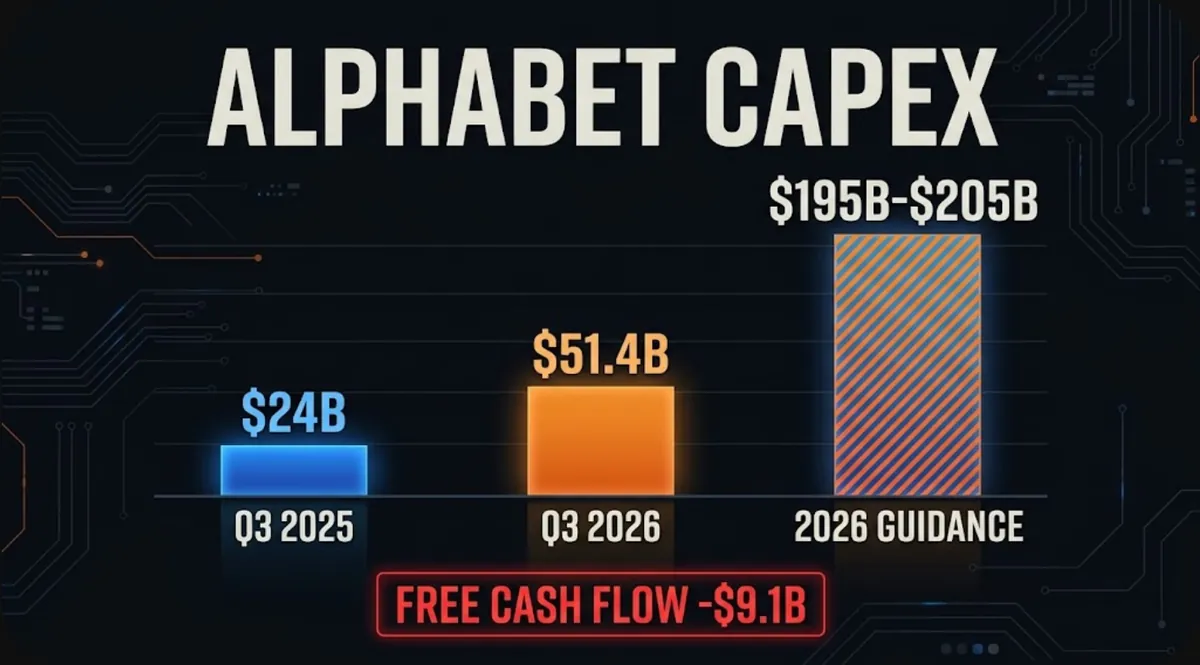
Three things spoiled the mood. Revenue came in about $640 million short of Wall Street's expectations. Search, Google's oldest money machine, grew 12% to $63.35 billion, below the $64.96 billion analysts had pencilled in. And the spending line was enormous: capital expenditures of $51.4 billion, more than double the $24 billion Alphabet spent in the same quarter of 2025.
Shares fell more than 10% after hours. The next day they were down about 12%, and NBC News reported it was the company's worst trading day on record. Even after the drop, Alphabet was worth about $3.42 trillion at midday, the fourth-largest US company.
What is AI capex?
AI capex is capital spending aimed at artificial intelligence. To see what that means, start with plain capex.
What does capex mean?
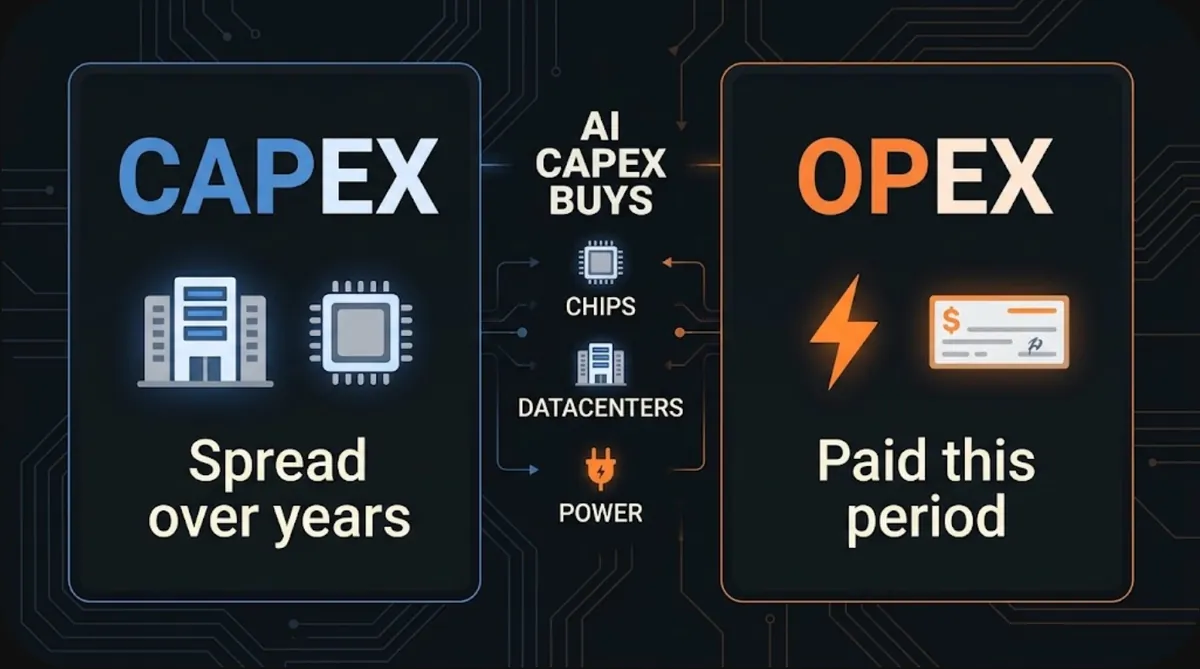
Capex, short for capital expenditure, is money a company spends on assets it expects to use for years. Typical capex examples are buildings, land, servers and network gear. A datacenter keeps working for a long time, so accountants spread its cost across its useful life instead of charging it all at once.
Capex vs opex: what is the difference?
The difference between capex and opex comes down to timing. Opex, or operational expenditure, covers ordinary running costs such as salaries, electricity bills and marketing, which are used up in the period they are paid. Capex buys things that last, so its cost is spread over the years the asset is used, and that split decides how an expense shows up in the accounts.
What AI capex buys
AI capex is that same capital spending aimed at artificial intelligence. For a company like Alphabet, the shopping list looks roughly like this:
- Chips. AI models are trained and run on specialized processors.
- Datacenters. The warehouses that hold those chips, along with the land, construction, racks and networking that tie thousands of machines together.
- Power and cooling. AI hardware draws a lot of electricity and produces a lot of heat. Securing reliable power and keeping machines cool is part of the bill.
Every Gemini answer, every AI Mode search and every cloud customer renting AI compute runs on this hardware. Executives say the Gemini app and AI Mode have reached 1 billion users. Serving that many people with large models takes a lot of physical infrastructure, and that is what the spending buys.
It also ripples outward. When hyperscalers (the handful of companies that run giant cloud networks) buy hardware at this scale, they compete with everyone else for the same parts. Hyperscaler capex, the combined capital spending of those cloud giants, therefore reaches well beyond their own balance sheets. We covered one example of that in our explainer on why AI datacenters are making SSD storage cost more.
Why is Alphabet free cash flow negative?
Free cash flow is the cash a business has left after paying to run itself and paying for its capital spending. The free cash flow formula is simple: take the cash the business brings in from operations, then subtract what it spent on buildings and equipment. Whatever remains is "free" to pay dividends, buy back shares, pay down debt or sit in the bank.
In Q3, that number went below zero. Alphabet's free cash flow was negative $9.1 billion, according to CNBC's earnings report, which put the precise figure at negative $9.07 billion. It was the second straight negative quarter.
So what does negative free cash flow mean? It means the business spent more cash than it collected. A company can have negative free cash flow and still be profitable, because capex is paid in cash up front while the accounts spread its cost over years. Alphabet's adjusted earnings per share of $2.67 shows the profit is there.
Alphabet still makes a lot of money from ads and cloud. The capex bill is simply larger than the cash those businesses throw off right now.
That gap has to be filled somehow, and part of the answer shows up on the balance sheet. Alphabet's long-term debt rose to $125.1 billion, up from $46.5 billion at the end of 2025. The coverage does not say what the borrowing paid for, but the jump arrived alongside the spending surge.
Two negative quarters in a row and a debt load that more than doubled in under a year show how much the AI race is costing, even for one of the richest companies on earth.
How much do big tech companies and hyperscalers spend on AI capex in 2026?
Start with Alphabet's capex guidance, which doubles as its AI capex forecast for 2026. The company kept its full-year capex at $195 billion to $205 billion, and it flagged a significant further increase for 2027.
To put that in perspective, the $51.4 billion Alphabet spent in Q3 alone is more than twice what it spent in the same quarter a year earlier. And the company is telling investors that next year will be bigger still.
Alphabet is one hyperscaler among several, so treat its numbers as one company's AI capex outlook for 2026. If you follow AI capex, the useful habit is to look at each company's capex line next to its free cash flow, because that pairing tells you whether the spending is being paid for by the business or by borrowing.
Why is AI capex so high? One piece of evidence is demand. Google Cloud's backlog, the value of contracted work customers have committed to but Google has yet to deliver, crossed $514 billion.
If Google Cloud doubled, why did investors still react so badly?
On paper, Cloud was the star of the quarter. Revenue more than doubled to $30.7 billion, and its operating margin jumped to 35.6% from 20.7%. That means Cloud is keeping far more of each dollar it earns, which is exactly what a business selling AI compute hopes to show.
The trouble is that Cloud's success sits next to two less comfortable facts, and both bear on whether AI capex is paying off.
The first is Search. Growth slowed from 19% in Q1 to 17% in Q2 to 12% in Q3. Schindler attributed part of that slowdown to AI Mode, Google's AI-powered search experience. JPMorgan analysts called the search slowdown "steeper than expected," according to NBC News.
The second is the profit picture. Adjusted earnings per share came in at $2.67 against a consensus of $3.02. Put that next to a doubling capex bill and negative free cash flow, and the market's question becomes simple: when does all this spending start paying for itself? The bill arrives first and the payoff still has to be proven, which is where AI capex ROI concerns come from.
Is AI capex paying off?
A booming Cloud unit and a $514 billion backlog are evidence that the bet could work. Slower Search growth, a profit miss and rising debt are evidence of what it costs while everyone waits to find out. Anyone asking whether there is an AI capex bubble is asking this same ROI question, and the numbers so far point both ways.
What AI capex means for you
You use the output of a datacenter every day, even if you never see one, and this spending reaches you in four ways.
AI features are the payoff. A company spending $195 billion or more in a year needs people to use what it built, and usage is how that hardware earns its keep.
Search is changing shape. Alphabet linked part of its Search slowdown to AI Mode, so how you find information, and how websites get visits, is already part of this story.
AI pricing is tied to the bill. Cheap AI access and a huge infrastructure bill pull in opposite directions, a tension we touched on in why LLM API pricing fell sharply in 2026. How providers balance the two is an open question.
Hardware competition touches consumer gear. When giant buyers soak up chips, memory and storage, those parts can get scarcer or pricier for everyone else.
What to watch next
If you follow hyperscaler capex news, these signals tell you whether the spending is paying off:
- Alphabet's 2027 capex number. The company has already flagged a significant increase. The size of that jump will show how far it plans to push the build-out.
- Free cash flow. After the second straight negative quarter, watch whether it returns to positive free cash flow or stays below zero.
- Search growth. The slide from 19% to 12% is the trend to follow, along with any detail on how AI Mode affects ads.
- Cloud backlog and margins. If the $514 billion backlog keeps converting into revenue at strong margins, the capex case gets stronger.
- Debt. Long-term debt of $125.1 billion is a new feature of Alphabet's finances. Watch how fast it grows.
Alphabet's quarter showed what AI capex looks like when the bill arrives before the payoff: $51.4 billion spent in three months, free cash flow below zero for a second straight quarter, and a cloud backlog of more than $514 billion waiting to be delivered.
Questions readers ask
What is AI capex in simple terms?
AI capex is capital expenditure on the physical infrastructure behind artificial intelligence: datacenters, specialized chips, networking, power and cooling. Companies spread the cost of these long-lived assets over years instead of treating them like everyday expenses. For Alphabet, that spending reached $51.4 billion in Q3 2026, more than double the $24 billion it spent a year earlier.
Why is Alphabet's free cash flow negative, and what does it mean?
Free cash flow is cash from operations minus capital spending. In Q3 2026 Alphabet's capex was so large that it exceeded the cash its businesses generated, leaving free cash flow at negative $9.1 billion, according to CNBC. It was the second straight negative quarter, and long-term debt rose to $125.1 billion from $46.5 billion at the end of 2025.
How much is Alphabet spending on AI capex in 2026?
Alphabet kept its full-year 2026 capital expenditure guidance at $195 billion to $205 billion, according to The Tech Portal. The company also flagged a significant further increase for 2027. In the third quarter alone it spent $51.4 billion, more than double the $24 billion from the same quarter a year earlier.
Why did Alphabet stock fall if Google Cloud doubled?
Google Cloud revenue more than doubled to $30.7 billion with a 35.6% operating margin, but other numbers worried investors. Search growth slowed to 12%, total revenue missed expectations by about $640 million, adjusted earnings per share missed, and capex more than doubled. Shares fell about 12% on October 29, Alphabet's worst trading day on record.
Is AI capex paying off yet for Alphabet?
It is too early to say, and the evidence points both ways. Google Cloud revenue more than doubled to $30.7 billion and its backlog crossed $514 billion. Against that, Search growth slowed to 12%, adjusted earnings per share missed, free cash flow was negative $9.1 billion and long-term debt rose to $125.1 billion.
What does capex mean, and what is the difference between capex and opex?
Capex, short for capital expenditure, is money spent on long-lived assets such as buildings, land, servers and network gear, with the cost spread over the asset's useful life. Opex covers everyday costs such as salaries and electricity, which are used up when paid. Alphabet's capex reached $51.4 billion in Q3 2026.
Written by
Abdul Rehman
Lead Systems Architect and Technical Director at Syntaxradar. More in Future Compute.
More in Future Compute
See all
Google Genie 4: DeepMind's Playable AI Worlds Now Have Sound
On October 27, 2026, Google DeepMind announced Genie 4, a real-time world model it says is the first to generate audio natively. It is a research preview for trusted testers,…
Oct 28, 2026 · 8 min read

Meta Orion Glasses: What the Prototype Can and Cannot Do
Meta's Orion AR glasses are a prototype that will not be sold. The Ray-Ban Display, a simpler product with one small screen, reached Germany on 13 October 2026 at 899 euros and…
Oct 25, 2026 · 5 min read

Answer Engines: What Perplexity and ChatGPT Do to Search
Pew Research found Google users clicked a regular result in 8% of visits with an AI summary, versus 15% without. A separate Tow Center test found AI search tools often…
Oct 25, 2026 · 5 min read
Latest stories
Front page
Xreal Aura: Should You Buy the $1,099 Android XR Glasses?
Abdul Rehman · Oct 31, 2026 · 7 min read
Claude Code Extension VSCode Backdoor: How to Check and Clean Up
Abdul Rehman · Oct 31, 2026 · 7 min read
AO3 Outage: Why Is AO3 Down, and Is Your Account Safe?
Abdul Rehman · Oct 30, 2026 · 7 min read
AI for Hacking: CrowdStrike Says ARTEX Targeted 200+ Orgs
Abdul Rehman · Oct 30, 2026 · 7 min read