


Anthropic IPO Prospectus: The 5 Numbers That Actually Matter
Anthropic's S-1 went public on SEC EDGAR and hit the Hacker News front page on October 27, 2026. It shows 2025 revenue of about $4.6 billion, a roughly $42 billion net loss and about $518 billion in planned compute commitments.

Abdul Rehman
Lead Systems Architect and Technical Director · · 7 min read

The short version
- ~$4.6B (about 12x prior year)
- 2025 revenue
- ~$42B (~$34B non-cash)
- 2025 net loss
- ~$518B
- Planned compute commitments
Why it matters: Anthropic grew revenue roughly twelvefold in 2025, but its S-1 shows a business still losing billions in cash terms and betting roughly $518 billion of commitments on that growth continuing.
The Anthropic IPO prospectus is public. The S-1, the document a company must file before it sells shares to the public, is now readable on SEC EDGAR, and on October 27 it climbed to the front page of Hacker News with 1,573 points.
The headline numbers pull in opposite directions. Anthropic, the company behind Claude, grew revenue roughly twelvefold in 2025, to about $4.6 billion. Over the same year it reported a net loss of roughly $42 billion. Both figures are true, and the gap between them is the single most useful thing to understand about this filing.
This guide reads the prospectus the way a friend with an accounting habit would: five numbers, what each one actually means, and why they matter if you use or build on Claude. It is an explainer, not stock advice.
What does the Anthropic S-1 say?
An S-1 is the registration statement a US company files with the Securities and Exchange Commission before it lists on a stock exchange. It has to lay out audited financials, how the business makes money and everything management thinks could go wrong. Anthropic first filed a confidential draft in June 2026, according to The Next Web. The version now on EDGAR is the one anyone can read.
The short version: revenue is soaring, costs are soaring too, and the company has signed up for an enormous computing bill. The Decoder's breakdown of the Anthropic IPO filing pulls out the figures that matter most:
- Revenue: about $4.6 billion in 2025, roughly twelve times the year before
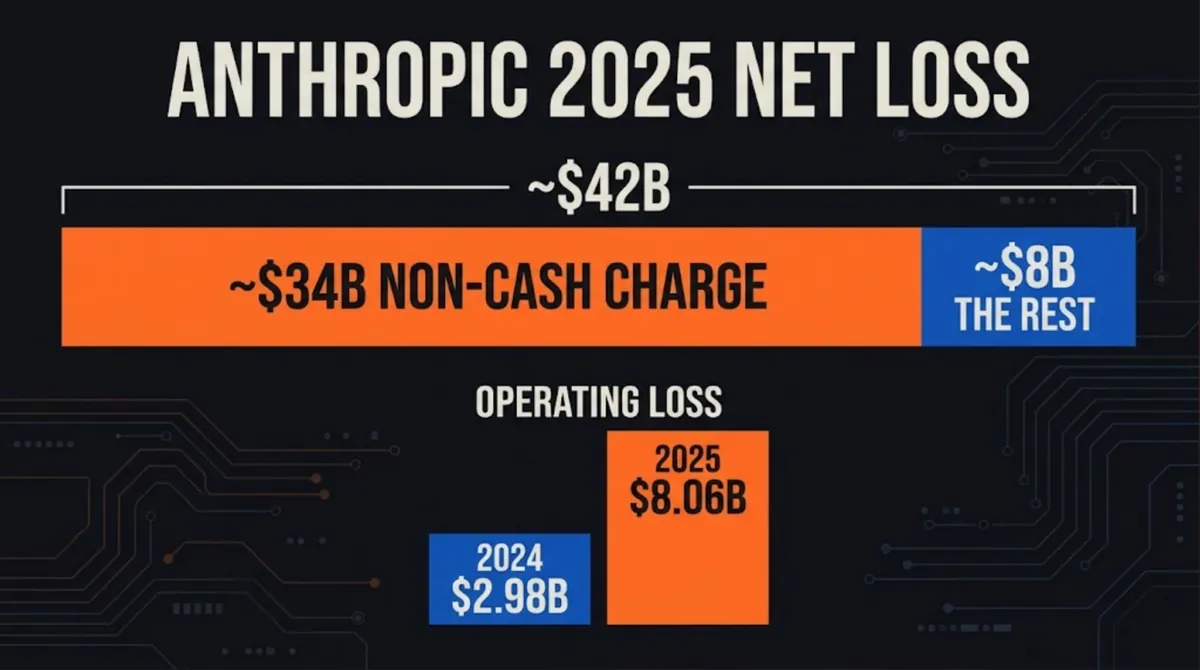
- Operating loss: $8.06 billion in 2025, up from $2.98 billion
- Net loss: roughly $42 billion, about $34 billion of it a non-cash accounting charge
- Compute commitments: about $518 billion planned over the coming years
- Customer concentration: two customers made up nearly a quarter of 2025 revenue
The tone stands out as much as the numbers. Nearly a third of the prospectus is risk factors, and they go well past the usual warnings about competition and regulation. Anthropic flags existential risks to humanity and the possibility that AI models could manipulate, blackmail or act unpredictably.
Few companies would put that in a document meant to sell shares, but a prospectus exists to disclose risk, and Anthropic has chosen to disclose a lot of it.
How much revenue does Anthropic make?
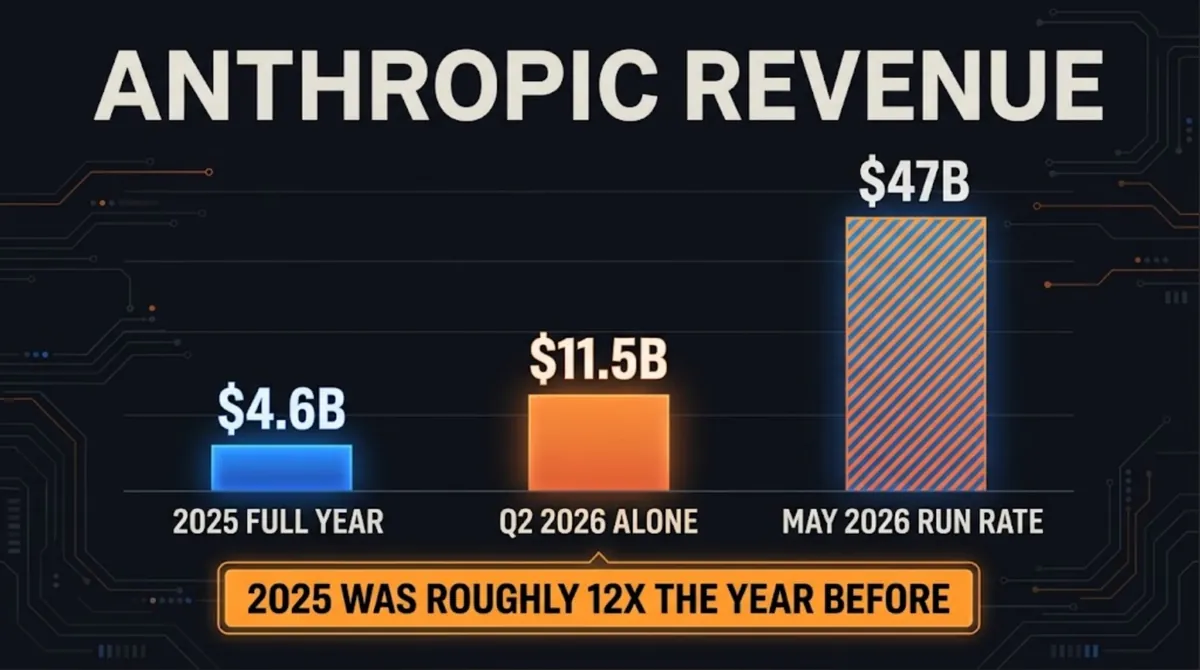
Far more than a year ago, and the pace has accelerated since. Revenue for 2025 came in around $4.6 billion, roughly twelve times the prior year, per The Decoder.
The 2026 figures are on a different scale. Revenue for the second quarter of 2026 alone was $11.5 billion, more than double all of 2025 in a single quarter. When Anthropic raised its Series H, NPR reported that run-rate revenue had passed $47 billion in May 2026, up from $9 billion at the end of 2025.
Run-rate deserves a sentence of explanation, because you will see it everywhere in coverage of the Anthropic IPO. It takes recent revenue and projects it across a full year, assuming the latest pace holds. For a company growing this fast it is a fair way to show momentum, and a flattering one, because it assumes nothing slows down.
The $11.5 billion quarter is the sturdier number. That is money actually booked in three months, not a projection.
Is Anthropic profitable?
Not by standard accounting. By one narrower, company-chosen measure, it recently has been. Both answers sit in the same filing.
Start with the operating loss, which measures the cost of actually running the business against what it earns. That loss widened from $2.98 billion to $8.06 billion in 2025. Revenue grew twelvefold, and the operating loss still nearly tripled. Growth this fast is expensive.
The roughly $42 billion net loss looks far worse, but most of it is not cash leaving the building. About $34 billion is a non-cash accounting charge tied to financing that could convert into stock. Charges of this kind typically arise when a company has raised money through instruments that can turn into shares: as the company's value climbs, those instruments are worth more on paper, and the increase is booked as a loss. Nobody wrote a $34 billion check.
Take that charge out and what remains is in the same territory as the $8.06 billion operating loss. Still large, but a very different story from $42 billion.
Now the better news. According to The Decoder, Anthropic is on track for a second consecutive quarter of operating profit in 2026, but only on an adjusted basis. Adjusted means the company decides which costs to leave out, often items like stock-based pay or one-off charges. Read it as a direction of travel, not as proof the business model is settled.
The compute bill inside the Anthropic IPO prospectus
Here is where the money goes. Compute and infrastructure cost $7.33 billion in 2025, about three times the year before and more than half of all operating costs. That is the price of the chips and data centers that train Claude models and answer every prompt you send.
The forward commitment is the number that makes people stop scrolling. Anthropic plans roughly $518 billion in cloud, compute and infrastructure commitments over the coming years. An analysis by Let's Data Science estimates about 80 percent of that is non-cancelable, meaning Anthropic owes it whether or not demand keeps climbing.
For scale, $518 billion is more than ten times the $47 billion run rate. The bet is simple to state: lock in capacity now, at a size that only makes sense if revenue keeps compounding for years.
Customer concentration is the second pressure point. Two customers accounted for nearly a quarter of 2025 revenue, and many large customers have no long-term contracts. If either of those two shifted spending to a rival model, a big slice of revenue would leave with them, and customers without long-term contracts can walk quickly. Pair that with a mostly non-cancelable compute bill and you see why investors read this section closely.
When is the Anthropic IPO?
There is no confirmed Anthropic IPO date yet. Reuters sources put the listing in November 2026, while The Next Web has reported October. Morgan Stanley, Goldman Sachs and JPMorgan reportedly lead the offering, according to Quartz as cited in TNW's coverage. Making the S-1 public is a strong signal the listing is close, since companies that file confidentially must publish the document before they start pitching the shares to investors.
The Anthropic IPO valuation talk starts at $965 billion, the post-money valuation (what the company was worth right after the round) from the $65 billion Series H, per NPR. Six backers told the Financial Times they expect an IPO valuation of $2 trillion or more, TNW reports. That would be roughly 43 times the $47 billion run rate. Listed AI peers have traded at about 55 times revenue, so by that yardstick $2 trillion would be a discount. Anthropic has not confirmed any figure.
The wider context matters. SpaceX listed in June at roughly $1.77 to $1.8 trillion, and OpenAI confidentially filed its own IPO paperwork the same month. A $2 trillion debut would put Anthropic above SpaceX's listing valuation.
What about the Anthropic IPO ticker and Anthropic IPO share price? The reporting this guide relies on does not cite either. A price range usually arrives in an amended filing once the banks have gauged demand, so treat any site quoting a share price before that appears on EDGAR with suspicion.
What the Anthropic IPO filing means if you build on Claude
If you pay for Claude or ship products on its API, three things in the filing are worth your attention.
Pricing will be watched by shareholders. With compute above half of operating costs, every pricing and rate-limit decision becomes a margin decision that gets reported every quarter. API prices across the industry have been falling fast, as we covered in our look at LLM API pricing cuts. A listed Anthropic will have to balance that price race against investors who want losses to shrink.
More capacity, and more pressure to sell it. The $518 billion commitment should mean more compute coming online, which helps availability. It also means Anthropic needs demand to grow into it. Given that many large customers have no long-term contracts, expect a harder push toward multi-year enterprise deals.
Far better visibility into your vendor. A public company reports results every quarter and has to disclose material risks. If you are betting a product on one model provider, that is more information than you have ever had. It is also a reminder to keep your code able to switch providers, the same advice any team relying on a single supplier should follow.
What to watch next
- The amended S-1. This is where a price range, share count and ticker should appear.
- The next quarter. Whether adjusted operating profit holds for a third quarter, and whether the gap to standard accounting profit narrows.
- The valuation gap. Whether the market accepts roughly 43 times run-rate revenue, or prices Anthropic closer to its $965 billion private mark.
- OpenAI's filing. Its confidential paperwork will eventually go public too, and it will give investors the first direct comparison between the two labs.
- Concentration. Whether the share of revenue from the two biggest customers shrinks as Claude's customer base widens.
Questions readers ask
When is the Anthropic IPO?
Anthropic has not confirmed a date. Reuters sources point to November 2026, while The Next Web reported October. Morgan Stanley, Goldman Sachs and JPMorgan reportedly lead the offering. The S-1 becoming public on SEC EDGAR is a strong sign the listing is close, but the exact day depends on the investor roadshow (the pitch tour before shares go on sale) and an amended filing with a price range.
How much revenue does Anthropic make?
About $4.6 billion in 2025, roughly twelve times the year before. Growth then accelerated: second-quarter 2026 revenue alone was $11.5 billion, and NPR reported run-rate revenue passed $47 billion in May 2026, up from $9 billion at the end of 2025. Run-rate projects recent revenue over a year, so the quarterly figure is the firmer number.
Is Anthropic profitable?
Not under standard accounting. Its 2025 operating loss was $8.06 billion, and the net loss was roughly $42 billion, though about $34 billion of that is a non-cash charge tied to financing that could convert into stock. The Decoder reports Anthropic is on track for a second straight quarter of operating profit, but only on an adjusted basis.
Where can I read the Anthropic S-1 filing?
The full prospectus is public on the SEC's EDGAR database under the filing anthropicpbc-sx1.htm. Nearly a third of it is risk factors, including warnings about existential risks and models that could act unpredictably. If you want the numbers without reading the whole filing, the financial statements and the risk factors section are the two parts that matter most.
Written by
Abdul Rehman
Lead Systems Architect and Technical Director at Syntaxradar. More in Emerging Tech.
More in Emerging Tech
See all
AI Bubble Pop? 5 Warning Signs Behind Big Tech's $740B Bet
Alphabet fell 12% on Oct 29, its worst day on record, after a second negative free cash flow quarter. The Nasdaq fell 2.9% the next day, S&P cut Meta's outlook to negative, and…
Oct 31, 2026 · 7 min read

Binance Hacked: How One Laptop May Have Led to a $6.36B Theft
On Oct 29, 2026, attackers drained Binance hot wallets across ten blockchains. TRM Labs counts about $6.36B stolen and links it to North Korea's TraderTraitor; Binance blames a…
Oct 30, 2026 · 8 min read

Is a Computer Science Degree Worth It? What the 8.1% Drop Means
US undergraduate computer science enrollment at four-year colleges fell 8.1% in fall 2025 and 8.4% in spring 2026, per the National Student Clearinghouse, as overall enrollment…
Oct 29, 2026 · 7 min read
Latest stories
Front page
Xreal Aura: Should You Buy the $1,099 Android XR Glasses?
Abdul Rehman · Oct 31, 2026 · 7 min read

Claude Code Extension VSCode Backdoor: How to Check and Clean Up
Abdul Rehman · Oct 31, 2026 · 7 min read

AO3 Outage: Why Is AO3 Down, and Is Your Account Safe?
Abdul Rehman · Oct 30, 2026 · 7 min read

AI for Hacking: CrowdStrike Says ARTEX Targeted 200+ Orgs
Abdul Rehman · Oct 30, 2026 · 7 min read