


Is a Computer Science Degree Worth It? What the 8.1% Drop Means
US undergraduate computer science enrollment at four-year colleges fell 8.1% in fall 2025 and 8.4% in spring 2026, per the National Student Clearinghouse, as overall enrollment grew. A Hoover study found CS's share of enrollment fell for the first time in about 20 years.

Abdul Rehman
Lead Systems Architect and Technical Director · · 7 min read

The short version
- -8.1%
- Four-year CS enrollment, fall 2025
- -8.4%
- Four-year CS enrollment, spring 2026
- 122,000
- CS bachelor's degrees awarded, 2024
Why it matters: CS enrollment is falling after a decade of growth, for several reasons including AI, so the degree still pays off for students who build deep fundamentals and real experience, and less for those who only wanted a guaranteed job.
Is a computer science degree worth it? That question sits under a fresh wave of headlines about students walking away from the major, and the numbers are smaller, and more interesting, than the panic suggests. According to the National Student Clearinghouse, undergraduate computer science enrollment at four-year US colleges fell 8.1% in fall 2025 and 8.4% in spring 2026, while overall enrollment grew.
That is a real drop. By one long-running measure, it is the first time in about two decades that computer science has lost ground as a share of what students take. Whether AI caused it is a separate question, and the economist behind that measure says his data cannot answer it.
For a student comparing majors, a parent paying for one, or a career changer eyeing a return to school, the useful question is narrower than the headlines: is computer science worth it in 2026, and which parts of a CS education still pay off, and for whom.
What the computer science enrollment decline actually shows
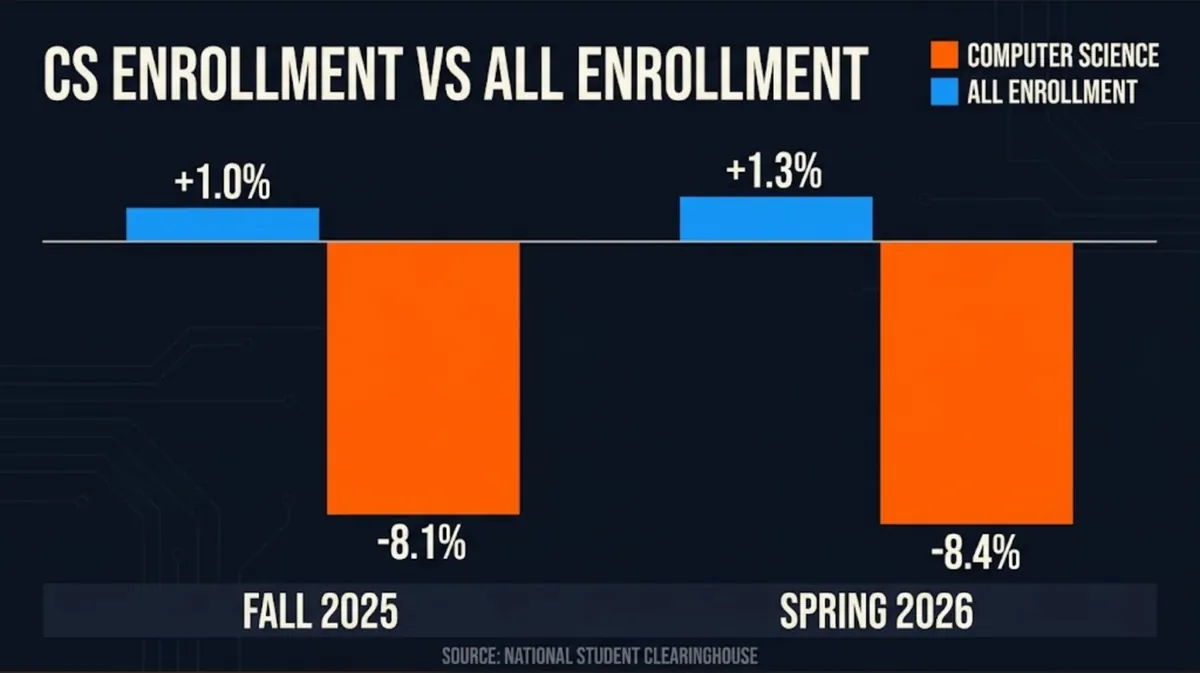
In fall 2025, four-year colleges had about 606,100 undergraduates in computer science, down from about 659,700. That is the 8.1% figure.
The drop was not even. Depending on the type of institution, fall 2025 declines ranged from 3.6% at primarily associate-granting colleges that also award bachelor's degrees to 14.0% at the graduate level. Over the same period, total US postsecondary enrollment grew 1.0% while computer science shrank.
The spring 2026 follow-up showed the trend holding:
A second dataset points the same way. Stanford Hoover Institution economist Jacob Light analysed more than 50 million course sections across 1,019 US colleges going back to 1996, as reported by The Next Web. In the 2025-26 school year, computer science's share of enrollment fell for the first time in about 20 years, and average CS class enrollment at a school dropped about 4.6%.
National Science Foundation data cited in the same report shows CS bachelor's degrees more than doubling, from about 56,000 in 2014 to 122,000 in 2024. Enrollment remains above its 2022 level. The field has a long history of booms followed by busts, and an 8% dip is still a lot of students.
Why is computer science enrollment dropping?
Anyone wondering why fewer students pick the major should start with Light's list. He names several likely drivers, and only one of them involves AI directly. They are a weaker job market for junior developers, growing doubts about the value of the degree, weaker maths preparation among incoming students, and the rise of data science as a separate major that pulls in people who once would have picked CS.
Where the students are going is clearer than why. The Clearinghouse reports significant spring 2026 gains in engineering and health professions, though it gives no figures. Moneywise, via Yahoo Finance, reports mechanical and electrical engineering enrollment growing about 11% and 14%. At Princeton, the Class of 2028 had 74 computer science B.S.E. declarations, down from 117 and 150 in the prior years.
Students who start in CS are also less likely than peers in other big majors to still be enrolled a year later. Among the ten most popular bachelor's majors, computer science had the lowest second-fall persistence, at 85.0%, which is 1.3 points below the fall 2022 cohort. Engineering had the highest, at 93.1%.
The job market backdrop explains some of the nerves. New college graduates have had an unemployment rate above the overall US rate for five straight years, according to the New York Times as cited by Moneywise. That is a problem for every major, but CS had long been seen as the safe one, so the disappointment lands harder.
Is computer science enrollment really down because of AI?
Not provably. Light calls his numbers descriptive, not causal, and makes no claim that AI caused the decline. AI is the easy headline, but the other drivers on his list (a tighter junior hiring market, maths preparation, data science) would push numbers down with or without chatbots.
What AI plausibly does is sharpen the doubt. When the boss of JPMorgan says AI has erased a third of jobs in some units, as TNW reports, an 18-year-old choosing a major hears that every programming job is next. The enrollment data cannot tell you whether that fear is accurate. It can only tell you that fewer students are acting on the old assumption that CS is a sure thing.
The boom-and-bust history is the other reason to be careful. CS enrollment has risen and fallen before as the job market swung. This drop follows a decade of growth, and totals are still above 2022. It could be a cycle turning or the start of a longer slide. One year of data cannot settle which.
Is a CS degree worth it with AI?
The argument for the degree still holds with AI, on new grounds. Google DeepMind's chief argues that a STEM degree still makes people far more effective with AI, according to TNW. AI tools write code quickly, but someone has to decide what to build, check whether the output is right, and fix it when it fails in ways the tool did not predict.
That work leans on the parts of a CS education that are hardest to shortcut. Algorithms, data structures, operating systems, networking, probability and linear algebra are what let you read AI-generated code and spot the subtle bug, the security hole or the design that will not scale. Those fundamentals keep their value as the tools change.
The pressure is real at the entry level. Light points to a weaker junior developer market, and that is where entry-level graduates feel it first. So whether a CS degree is worth it now turns on one question: will you leave school able to do work a tool cannot do alone?
Is a computer science degree worth it? A practical way to decide
Are computer science degrees worth it for everyone? No, and they never were. If you are deciding whether to major in computer science, five questions about your own situation do most of the work.
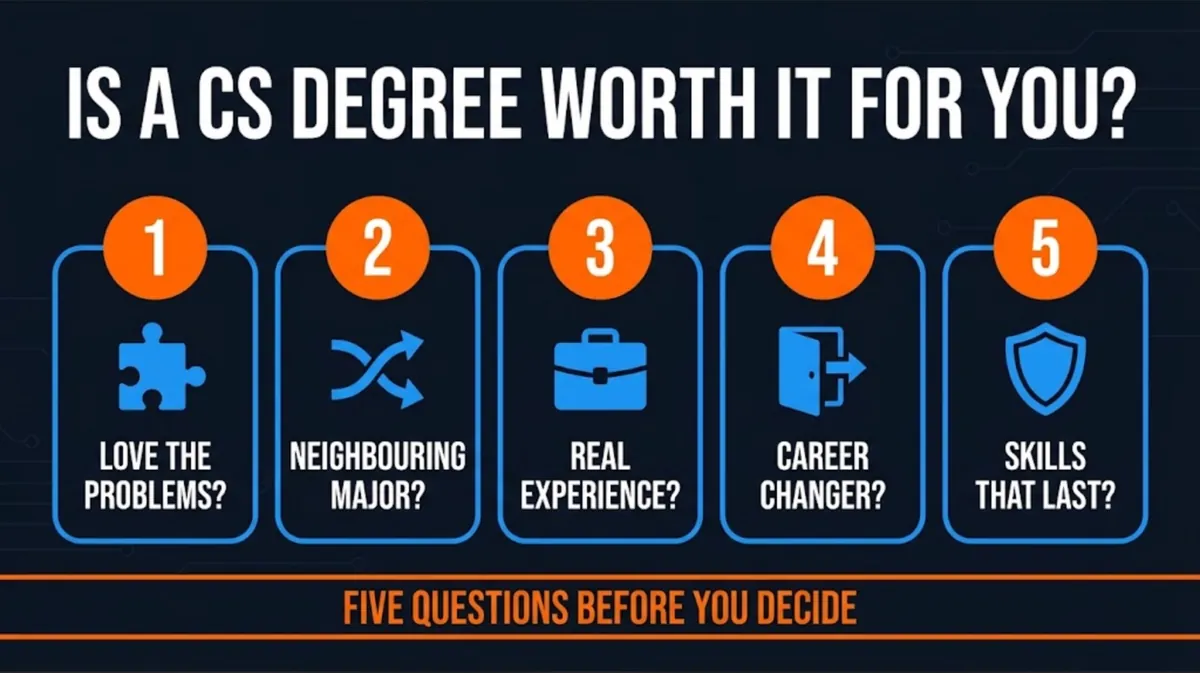
Do you like the problems, or the old paycheck story?
If you mostly want the salary, the return on a computer science degree depends on finishing it and on landing real work afterwards. The 85.0% persistence figure means about 15 in every 100 CS bachelor's starters were not still enrolled by their second fall, the worst rate among the big majors. If the attraction was a guaranteed job rather than the work itself, that story is weaker now. If you enjoy logic, maths and building things, a computer science major is worth it, because the degree still trains exactly that.
Would a neighbouring major open the same doors?
Students are already moving to electrical engineering, mechanical engineering and data science. Many careers draw on all of them, and computing is rarely the only route in. Electrical engineering sits close to hardware and chips, and data science sits close to AI work. Pick the field whose hard problems you want to own, then add programming on top.
Can you get real experience before you graduate?
Does a computer science degree guarantee a job? It never did, and with entry-level hiring tighter the degree alone carries less weight. Internships, research with a professor, open-source contributions and shipped side projects are what separate graduates. If your school makes those hard to get, factor that in.
Are you a career changer?
Is computer science worth it if you already have a degree and a job? Sometimes. The full degree makes most sense if you want roles that lean on deep fundamentals, such as systems, security or machine learning research. If you want to apply software to a field you already know, targeted coursework plus a portfolio may get you further, faster.
Which skills hold their value either way?
Maths and statistics, systems thinking, the ability to review and test code you did not write, and clear writing about technical trade-offs. None of these get easier for a chatbot to replace just because it can produce code. All of them make you better at using one.
What to watch next
The Clearinghouse's fall 2026 numbers will show whether this was a one-year correction or the start of a longer slide. Watch three other signals alongside them: whether the engineering and data science gains continue, whether junior developer hiring recovers, and whether new graduate unemployment keeps running above the national rate.
For students who build fundamentals and real experience, the evidence still says a computer science degree is worth it, with less certainty than before. If fewer students enter CS this year, fewer will graduate into the market four years from now. The field has a history of booms and busts, though nobody can promise that pattern repeats.
Questions readers ask
Is a computer science degree worth it in 2026?
For students who enjoy maths, logic and building software, yes, as long as they pair the degree with internships, research or shipped projects. Enrollment fell 8.1% in fall 2025, but CS bachelor's degrees still more than doubled between 2014 and 2024. The degree pays off most as training in fundamentals AI tools cannot replace.
How much has computer science enrollment dropped?
According to the National Student Clearinghouse, undergraduate CS enrollment at four-year US colleges fell 8.1% in fall 2025, from about 659,700 to 606,100 students, and 8.4% in spring 2026. Two-year colleges saw an 11.2% spring drop. Overall undergraduate enrollment grew 1.3% over the same spring period, so the decline is specific to computing.
Is AI the reason fewer students study computer science?
The data cannot prove it. Hoover economist Jacob Light, who analysed more than 50 million course sections, calls his numbers descriptive, not causal. He lists a weaker junior developer job market, doubts about the degree's value, weaker maths preparation and the rise of data science as likely drivers. AI may sharpen those doubts, but it is not the only factor.
What are students studying instead of computer science?
Engineering and health professions posted significant gains in spring 2026, according to the Clearinghouse. Moneywise reports mechanical and electrical engineering enrollment growing about 11% and 14%. Data science is also drawing students who might once have chosen CS. Many of these fields still involve heavy programming, so the skills overlap more than the major names suggest.
Is computer science still a good major with AI?
It can be, for students who build deep fundamentals. Google DeepMind's chief argues a STEM degree still makes people far more effective with AI, according to TNW. Entry-level hiring is tighter, with a weaker junior developer market, so internships, research and shipped projects matter as much as the degree itself.
Written by
Abdul Rehman
Lead Systems Architect and Technical Director at Syntaxradar. More in Emerging Tech.
More in Emerging Tech
See all
AI Bubble Pop? 5 Warning Signs Behind Big Tech's $740B Bet
Alphabet fell 12% on Oct 29, its worst day on record, after a second negative free cash flow quarter. The Nasdaq fell 2.9% the next day, S&P cut Meta's outlook to negative, and…
Oct 31, 2026 · 7 min read
Binance Hacked: How One Laptop May Have Led to a $6.36B Theft
On Oct 29, 2026, attackers drained Binance hot wallets across ten blockchains. TRM Labs counts about $6.36B stolen and links it to North Korea's TraderTraitor; Binance blames a…
Oct 30, 2026 · 8 min read

Anthropic IPO Prospectus: The 5 Numbers That Actually Matter
Anthropic's S-1 went public on SEC EDGAR and hit the Hacker News front page on October 27, 2026. It shows 2025 revenue of about $4.6 billion, a roughly $42 billion net loss and…
Oct 27, 2026 · 7 min read
Latest stories
Front page
Xreal Aura: Should You Buy the $1,099 Android XR Glasses?
Abdul Rehman · Oct 31, 2026 · 7 min read

Claude Code Extension VSCode Backdoor: How to Check and Clean Up
Abdul Rehman · Oct 31, 2026 · 7 min read

AO3 Outage: Why Is AO3 Down, and Is Your Account Safe?
Abdul Rehman · Oct 30, 2026 · 7 min read
AI for Hacking: CrowdStrike Says ARTEX Targeted 200+ Orgs
Abdul Rehman · Oct 30, 2026 · 7 min read