


Why Are Chip Stocks Down? The Data Center Chain, Explained
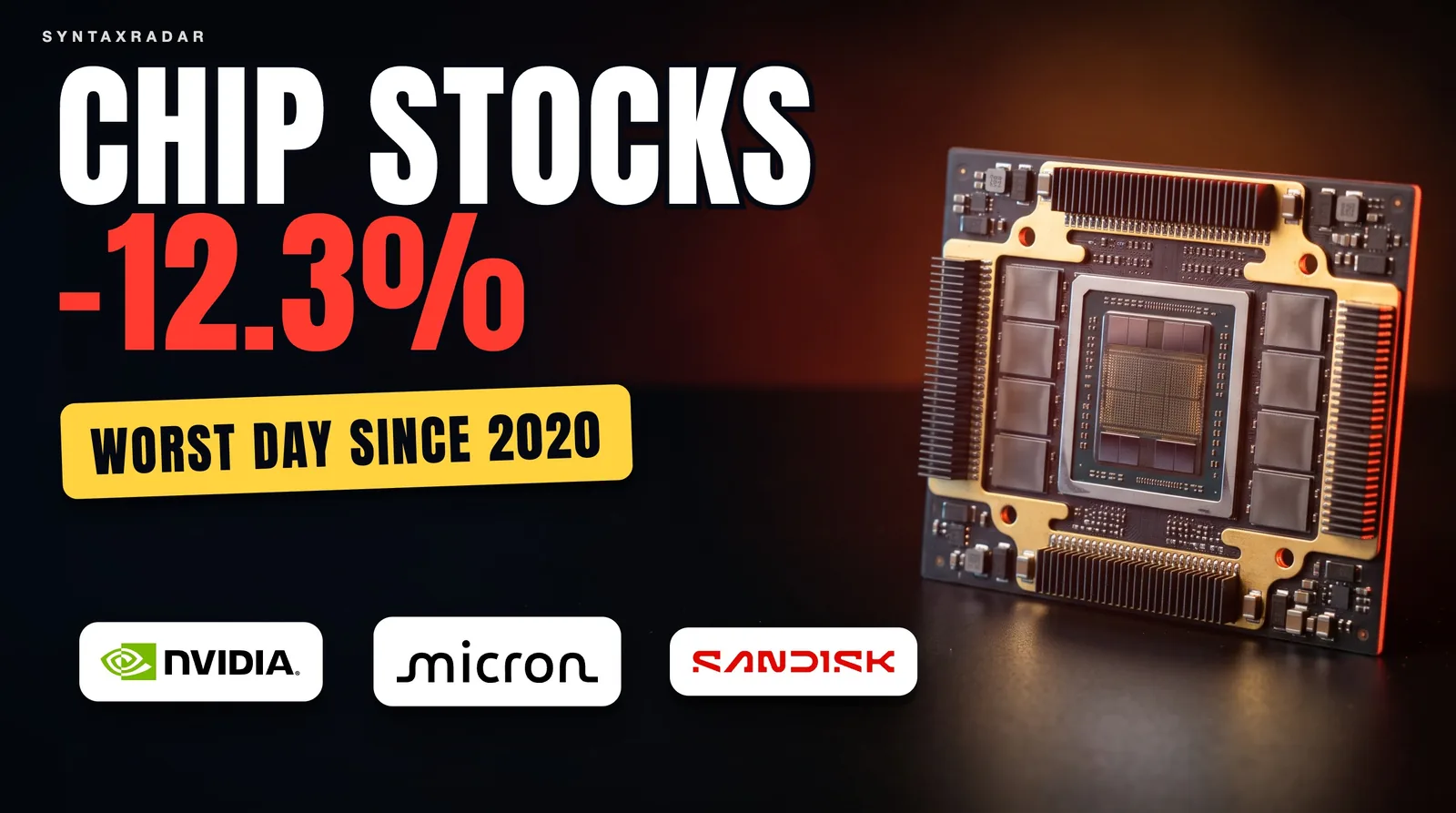
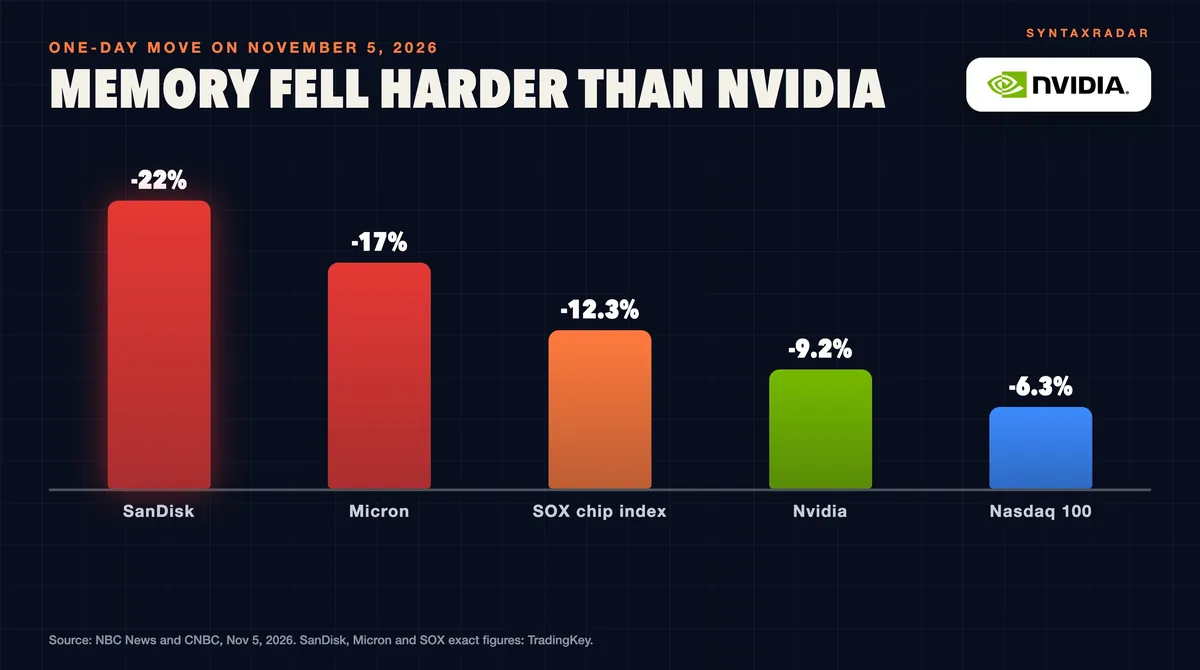
On November 5, 2026 the SOX chip index fell 12.3% and Nvidia 9.2%, NBC reports, after US midterm results raised fears of slower AI data center building. Memory and storage makers fell hardest: SanDisk -22%, Micron -17%.

Abdul Rehman
Lead Systems Architect and Technical Director · · 7 min read
The short version
- -12.3%
- SOX chip index, Nov 5, 2026
- $2.3 trillion (-6.3%)
- Nasdaq 100 value erased
- -9.2%
- Nvidia one-day drop
Why it matters: Chip stocks fell on November 5, 2026 because reports tied the midterm results to slower AI data center building, and the makers of the memory and storage that fill those buildings fell hardest.
On this page
Why are chip stocks down? Traders feared that the US midterm results of November 3, 2026 could slow data center construction, which would cut demand for AI chips and infrastructure, CNBC reports. On November 5 the Philadelphia semiconductor index (SOX) fell 12.3%, Nvidia fell 9.2% and memory maker Micron fell 17%, according to NBC News.
The reports say investors marked down the companies whose parts fill AI data centers. Below is that chain in plain English, from a ballot box to a GPU, a stick of RAM and an SSD. This is not investment advice: no recommendation on any stock and no price prediction.
Why are chip stocks down?
Chip stocks are down because of one very bad session on November 5, 2026, and the reports blame data centers first. NBC News says the SOX (the Philadelphia semiconductor index, a basket of 30 chip stocks) had its worst day since March 2020, and that a DRAM ETF (a fund that tracks memory chip makers) fell almost 18%.
The damage went well past chips. The Nasdaq 100 fell 6.3% and erased $2.3 trillion in market value, NBC reports. The S&P 500 fell 4.4% and erased $2.8 trillion, and both indexes had their worst day since April 2025. CNBC adds that all 11 S&P 500 sectors closed lower.
The Nasdaq Composite is a separate, broader index. CNBC puts its fall at 5.5% and says it closed in correction territory (more than 10% below its recent high). TradingKey's closing tally has the SOX down 12.25% at 9,011.14, with all 30 members lower (single secondary report for the closing levels).
Asia followed on November 6, 2026. Nikkei Asia reports that Taiwan's Taiex fell around 9% in morning trading, its steepest fall ever, and that South Korea halted trading. NBC says South Korea's Kospi fell more than 8% and Japan's Nikkei as much as 6%.
Why are semiconductor stocks falling? Reports differ on the trigger
No one source pins the drop on one cause. NBC calls the midterm results, which favored Democrats, a major cause because of pledges to slow or halt AI data center construction, and it singles out Texas, Ohio, Michigan and Georgia as large data center markets. The same NBC report also says Qualcomm and Arm earnings, released on November 4, triggered the selloff. Qualcomm fell 9.5% and Arm 13%.
TradingKey adds two more threads. It says Micron reportedly paused construction of a roughly $4.5 billion memory plant in Taoyuan, Taiwan over a local labor dispute. It also cites Cleveland Fed President Beth Hammack saying interest rates need to enter restrictive territory (high enough to slow the economy).
Data center backlash: the chain from ballot box to GPU
The data center backlash showed up in local votes first. Of 41 local data center ballot measures across 10 states on November 3, 2026, voters backed restrictions or rejected pro-development measures in all but one, CNBC reports, citing Ballotpedia.
Here is why a local permit vote reaches a chipmaker's share price. An AI data center is a building full of servers. Each server holds GPUs (the chips that do the AI math), memory chips such as DRAM and HBM (high-bandwidth memory, stacked next to the GPU so it can be fed data fast) and SSDs for storage. If a building is delayed, the order for everything inside it can slip too. That is the logic CNBC describes: slower construction would reduce demand for AI chips and infrastructure.
The size of the exposure matters. Goldman Sachs estimates that the states likely to tighten data center oversight account for about 45% of planned new US capacity, according to TradingKey (single secondary report). Our explainer on the data center moratorium covers the governor races and permit fights that these votes escalated.
One of the biggest builders put out commitments of its own. OpenAI's own post says every future compute campus it owns and operates will have a local compact that includes covering the full electricity and infrastructure costs of that campus, with financial assurances before major spending begins. CNBC reports OpenAI published those commitments on November 5, 2026, that it told investors in February 2026 it targets $600 billion in total compute spend by 2030, and that it has announced large projects in Georgia and Ohio, two of the states NBC named.
Why is Nvidia stock down?
Nvidia stock is down for the same reported reason as the rest of the group: its GPUs are the core part of an AI data center. It fell 9.2% on November 5, 2026, its largest one-day drop since April 2025, and was the biggest drag on the Dow, NBC News reports. The shares were already down 15% over the previous three months.
CNBC says Nvidia lost more than $440 billion in market value that day and turned negative for 2026, down 2.6% for the year. The Magnificent Seven (the largest US tech stocks, Nvidia among them) together lost more than $1 trillion.
Why is Micron stock down more than Nvidia?
Micron stock is down 17%, and NBC reports that memory and storage makers fell harder than Nvidia. SanDisk fell 22%, Western Digital 17% and Seagate 16%, with chipmaker AMD also down 17%. The NBC and CNBC reports we reviewed do not explain why memory stocks are down more than Nvidia, so we will not guess at a reason.
The spending on the other side of this chain is large. Alphabet reported third-quarter 2026 capital spending of $51.4 billion, more than double the $24 billion of a year earlier, The Tech Portal reported. Our guide to AI capex explains what that money buys and why data centers are where chipmakers' demand comes from.
Why are chip stocks down so much? A SyntaxRadar calculation
We ran the numbers from the reports above to see how big the day was next to the wider market. Every input comes from NBC News, CNBC or TradingKey, and the results are our own rounded arithmetic.
Two cautions. The Nvidia share mixes two outlets (CNBC for Nvidia's loss, NBC for the index loss), so treat it as a rough scale. And the TradingKey figures (Micron at $656.39, SanDisk down 22.26%, the SOX close) come from a single secondary report.
One more comparison puts the day in scale. Alphabet's $51.4 billion quarter of capital spending is roughly 2.2% of the $2.3 trillion the Nasdaq 100 lost on November 5. That compares one quarter of one company's spending with one day of index value, so read it as a sense of size only.
What happens to GPU, RAM and SSD prices after the chip selloff?
Our sources do not say whether RAM prices will drop after the chip selloff. As of November 6, 2026, none of them reports any change in GPU, RAM or SSD prices. A share price is what investors will pay for a slice of a company. The price of a RAM kit or an SSD in a shop is a different market, and nothing in the November 5 reports links the two yet.
What we can point to is the trend that existed before the drop. Our explainer on why RAM prices are going up covers the AI memory squeeze that pushed DRAM costs higher, and our piece on SSD prices explains how AI data centers pulled on NAND flash supply. If new price data appears, it belongs next to those trends.
Is the AI bubble bursting?
None of the reports cited here says the AI bubble is bursting on November 5. What they document is narrower: the worst day for the Nasdaq 100 and S&P 500 since April 2025, with the Nasdaq Composite in correction territory, according to CNBC.
Are AI stocks crashing? The reports describe a sharp one-day fall, and they give more than one reason for the AI stock crash: the data center policy fear after the midterms, plus the Qualcomm and Arm earnings NBC also points to. A correction is a measured fall of more than 10% from a recent high; it is not the same thing as a bubble bursting, and no source here makes that call.
If you want the longer view, our breakdown of AI bubble warning signs lays out the five signals behind Big Tech's AI bet, so you can judge for yourself which ones the November 5 drop touched.
Why are chip stocks down? What to watch next
The answer is still arriving, so here are the threads to follow:
- State permits. Whether the data center backlash turns into tighter rules in Texas, Ohio, Michigan and Georgia, the markets NBC named, after the November 3 votes.
- Asian markets. How Asian markets trade after Taiwan's record fall and South Korea's trading halt on November 6, 2026.
- Micron's Taoyuan plant. Whether the reported pause on the roughly $4.5 billion memory plant is confirmed or lifted.
- Builder responses. Whether other AI companies copy OpenAI's pledge to pay the full power and infrastructure cost of new campuses.
- Hardware prices. Any shop-level change in GPU, RAM or SSD prices; as of November 6, 2026 none had been reported in our sources.
Questions readers ask
Why are chip stocks down so much?
On November 5, 2026 the SOX chip index fell 12.3%, its worst day since March 2020, per NBC News. CNBC says traders feared the midterm results could slow data center construction and cut demand for AI chips. NBC also points to Qualcomm and Arm earnings, and TradingKey cites a reported Micron plant pause and interest-rate comments.
Why are semiconductor stocks down, and is it only chips?
CNBC says traders feared the midterm results could slow data center construction, which would cut demand for AI chips. It was not only chips: CNBC reports all 11 S&P 500 sectors closed lower on November 5, 2026, and NBC News reports the Nasdaq 100 fell 6.3%.
Did the Nasdaq fall 6.3% or 5.5%?
Both figures are right because they describe two different indexes. NBC News reports the Nasdaq 100 fell 6.3% and erased $2.3 trillion in market value. CNBC reports the broader Nasdaq Composite fell 5.5% and closed in correction territory, more than 10% below its recent high.
Why are memory stocks down more than Nvidia?
NBC News reports SanDisk fell 22%, Micron 17%, Western Digital 17% and Seagate 16%, against 9.2% for Nvidia. The NBC and CNBC reports we reviewed do not explain the gap. By our arithmetic, SanDisk fell about 13 percentage points more than Nvidia and Micron about 8 points more, using the exact figures from a single TradingKey report.
Will RAM prices drop after the chip stock selloff?
As of November 6, 2026, none of our sources reports any change in GPU, RAM or SSD shop prices after the selloff. Share prices and hardware prices are different markets. Our earlier explainers on rising RAM prices and SSD prices cover the trend that existed before the drop, and we do not predict where prices go next.
Sources
Written by
Abdul Rehman
Lead Systems Architect and Technical Director at Syntaxradar. More in Future Compute.
Keep reading

Data Center Moratorium: Why Governors Are Fighting Over It
New York signed the only statewide data center moratorium in July 2026, a one-year pause on projects of 50 MW or more. Governor candidates in at least a dozen states now promise…
Nov 2, 2026 · 7 min read

Megaspeed: The Nvidia Buyer in the Reported DOJ Chip Probe
On Nov 9, 2026, two law-enforcement sources said the DOJ's National Security Division is investigating Singapore's Megaspeed, Nvidia's largest Southeast Asian buyer, over possible…
Nov 10, 2026 · 8 min read

Why Is RAM Prices Going Up? The AI Memory Squeeze Explained
TrendForce raised its Q4 2026 DRAM contract price outlook on Sept 23, citing tight supply and cloud providers' AI buying. Suppliers favor HBM and server DRAM, leaving less RAM for…
Nov 1, 2026 · 7 min read
More in Future Compute
See all
What Is the Exponential Time Hypothesis? AI Claims It's False
On October 26, 2026, OpenAI said an internal model disproved the exponential time hypothesis, a 25-year-old assumption about how hard 3-SAT is. Anthropic published a rival paper…
Nov 8, 2026 · 7 min read

What Is AI Capex? Why Alphabet's $51.4B Bill Spooked Wall Street
Alphabet's Q3 2026 capex hit $51.4B, more than double a year earlier, pushing free cash flow to negative $9.1B for a second straight quarter. Shares fell about 12% on Oct. 29, its…
Oct 30, 2026 · 7 min read

Google Genie 4: DeepMind's Playable AI Worlds Now Have Sound
On October 27, 2026, Google DeepMind announced Genie 4, a real-time world model it says is the first to generate audio natively. It is a research preview for trusted testers,…
Oct 28, 2026 · 8 min read
Latest stories
Front page
Starship Flight 15: The Nov 13 Target and First Ship Catch
Abdul Rehman · Nov 10, 2026 · 6 min read
Claude Fable 5.2: $8 Price, Fast Mode and Whether to Switch
Abdul Rehman · Nov 10, 2026 · 7 min read

Outlook DMARC Requirements: Why Your Email Is Suddenly Bouncing
Abdul Rehman · Nov 9, 2026 · 6 min read
Googlebook OS Update: November Patch Frees Up to 6GB of RAM
Abdul Rehman · Nov 9, 2026 · 6 min read