


What Is the Exponential Time Hypothesis? AI Claims It's False
On October 26, 2026, OpenAI said an internal model disproved the exponential time hypothesis, a 25-year-old assumption about how hard 3-SAT is. Anthropic published a rival paper credited to Claude. Neither claim was independently verified as of November 2, 2026.

Abdul Rehman
Lead Systems Architect and Technical Director · · 7 min read
The short version
- 67 pages vs 49 pages
- OpenAI paper vs Anthropic paper
- 10 days
- Reported discovery to announcement
- $5m
- OpenAI gift to the Simons Foundation
Why it matters: Two AI labs claim a faster-than-exponential 3-SAT algorithm that would topple a core complexity assumption, but the result is unverified, does not settle P vs NP and does not make practical solvers faster.
On this page
What is the exponential time hypothesis? It is a bet, made about 25 years ago, that one famous logic puzzle cannot be solved much faster than by checking almost every possible answer. On October 26, 2026, OpenAI announced that an internal AI model had disproved it, and Anthropic published a rival paper credited to Claude that claims the same result and also reportedly refutes the strong exponential time hypothesis. Neither claim had been independently verified as of a November 2, 2026 report, and the details below are based on reporting by TNW and LetsDataScience; the primary papers have not yet been independently reviewed.
That caveat matters more than usual here. If the proofs hold, a foundation stone under hundreds of studies in computer science and biology moves. If they do not, this becomes a story about how AI labs announce results. Either way, it helps to know what the hypothesis actually says.
What is the exponential time hypothesis?
The exponential time hypothesis (ETH) is the claim that a problem called 3-SAT has no algorithm that is meaningfully faster than exponential time (running time that doubles, roughly, each time the puzzle gets one variable bigger). Russell Impagliazzo and Ramamohan Paturi of UC San Diego proposed it with Francis Zane, according to TNW's report on OpenAI's announcement.
It is a hypothesis, not a theorem, and nobody proved it. Researchers widely believed it was true and used it as a starting assumption, the way an engineer assumes steel has a certain strength. TNW reports that ETH has been used to show that problems in graph theory, computational biology and databases are hard to solve quickly.
The pattern runs: "if ETH is true, then this database or biology problem cannot be solved fast either." Those results were always conditional. Their strength came from how few people doubted the condition.
Emergent Mind's explainer on the exponential time hypothesis collects the research built on it, which gives a sense of how much depends on that one assumption.
Strong and gap versions
The strong exponential time hypothesis (SETH) is a tougher version of the same bet: it says that as the clauses in a SAT puzzle get longer, the best possible algorithm gets ever closer to plain brute force. SETH implies ETH, so if ETH is false, SETH has to be false too. That is consistent with coverage saying both papers reportedly refute SETH as well.
The gap exponential time hypothesis is another stronger variant, about telling apart puzzles that can be fully solved from puzzles where many conditions must fail. It also implies ETH, so by the same logic it would fall if the claim holds. The coverage does not discuss it, so that follows from the definitions rather than from a reported finding.
What is the SAT problem and the 3-SAT problem?
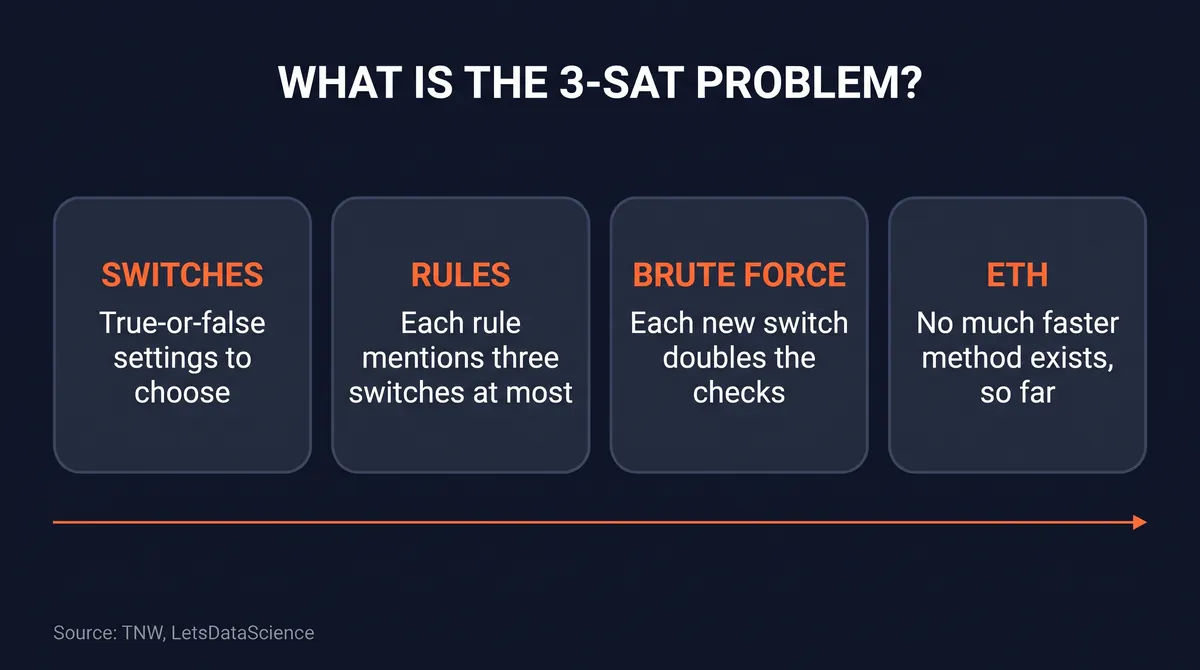
The SAT problem (short for Boolean satisfiability problem) asks a yes-or-no question: given a list of true-or-false switches and a set of rules connecting them, is there any way to set the switches so every rule is satisfied? A rule might say "switch A is on, or switch B is off." The puzzle is to find one setting that keeps every rule happy, or to show that none exists.
The obvious method is to try every combination. With 3 switches there are 8 settings to check. Each added switch doubles the count, which is why brute force becomes hopeless for large puzzles.
The 3-SAT problem is the version where every rule mentions at most three switches. That sounds like a small restriction, but 3-SAT is still hard enough to stand in for a huge family of problems, which is why ETH is stated in terms of it. If you can solve 3-SAT quickly, you can solve many other problems quickly by translating them into it.
That translation is the reason a claim about one logic puzzle reaches graph theory, biology and databases. The satisfiability problem is a kind of common currency in computer science.
What OpenAI and Anthropic say they found
According to TNW, OpenAI says an internal model found its disproof of the exponential time hypothesis on October 16, 2026, and checked it in Lean (a programming language for writing proofs that a computer can verify step by step) on October 17. OpenAI announced the result in a blog post on October 26 and published the write-up and the Lean proof on GitHub. This account of the blog post and the GitHub repository is based on TNW's reporting; the primary sources have not yet been independently reviewed.
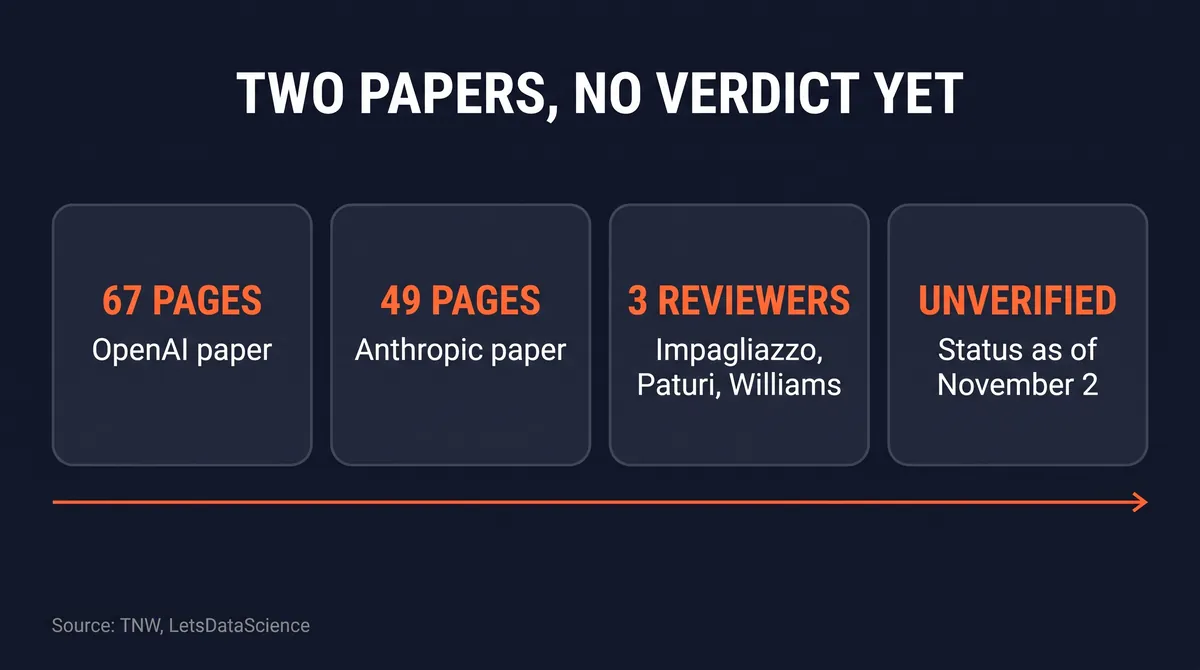
LetsDataScience's report on both claims says OpenAI's paper runs 67 pages under the title "The Exponential Time Hypothesis is False." Anthropic's paper is 49 pages, titled "A 2^o(n) Time Algorithm for 3-SAT," and credited to Claude.
That title is the whole claim in compact form. The notation 2^o(n) means a running time whose exponent grows more slowly than the number of switches, n. ETH says 3-SAT cannot be solved in that kind of time. An algorithm that does it would break the hypothesis.
According to the same report, Anthropic reaches a bound of 2^O(n log log n / sqrt(log n)) using tensor network contraction (a technique for breaking a large calculation into a network of smaller linked pieces and combining them efficiently). In plain terms, the exponent is n multiplied by a factor that shrinks slowly as n grows. That shrinking factor is what makes the bound sub-exponential, even though it is still enormous.
OpenAI also gave $5m to the Simons Foundation for workshops and conferences on AI-produced results, and agreed to release the raw data behind its ETH work, TNW reports.
Has the exponential time hypothesis really been disproved?
Not yet, as far as anyone can say in public. The exponential time hypothesis has been claimed disproved by two AI labs, but LetsDataScience reported on November 2, 2026 that neither claim had been independently verified.
A review is under way. TNW reports that Impagliazzo and Paturi, two of the three people who proposed ETH, will lead an independent examination with Ryan Williams of MIT. They signed no NDAs (non-disclosure agreements), will not be paid, and say their involvement is not an endorsement. Having the hypothesis's own authors check the work is about as direct a test as the field could set up.
Early reactions differ in tone. Williams said he felt vindicated, according to LetsDataScience. Impagliazzo said he would much rather the result had come from a human who could explain their thought process.
A Lean check is strong evidence that each step of a proof follows from the ones before it. It does not replace the field's own reading of whether the statement proved is the one everyone means by ETH, and whether the argument holds up. That is the job the reviewers have taken on.
Does this solve P vs NP?
No. Coverage of both papers says the result does not settle P vs NP, the famous open question of whether every problem whose answer is easy to check is also easy to solve.
The reason is in the numbers. P vs NP asks about polynomial time (running time that grows like n squared or n cubed, not like 2 to the power of n). The new bound is sub-exponential, but LetsDataScience reports it is still far slower than polynomial. Beating exponential by a slowly shrinking factor is a long way from the kind of speed that would make SAT easy.
Your laptop's SAT solvers and the software built on them do not suddenly get faster either. LetsDataScience reports that Anthropic says its result says nothing about solving formulas in practice. The change, if it holds, is to theory: which problems researchers can prove are hard, and on what assumption.
For a sense of how AI labs have been pushing on mathematics more broadly, our post on GPT-6 Astra's math results covers a different OpenAI claim and the benchmark numbers behind it.
SyntaxRadar calculation: the timeline and the two papers
We worked out a few numbers from the dates and page counts in the coverage. The inputs are shown so you can check them.
The gaps tell a simple story. The machine check came a day after the reported discovery, and the public announcement 10 days after it. Human review, by contrast, had not reached a verdict a week after the announcement. Page count says nothing about correctness, but it does tell you the reviewers have more than a hundred pages of dense mathematics across the two papers to get through.
The money is a different kind of signal. The coverage does not tie the $5m Simons Foundation gift to the review itself; TNW describes it as funding for workshops and conferences on AI-produced results.
What to watch next
So what is the exponential time hypothesis today? Still a working assumption, and one that now waits on people, not models. Three things will decide how this story ends.
- The review verdict from Impagliazzo, Paturi and Williams. As of the November 2, 2026 report, no verdict had been published.
- Whether the two papers turn out to use the same idea or different ones, which will only be clear once experts compare them in detail.
- Which conditional results in graph theory, biology and databases researchers begin to restate on new assumptions.
If you follow how the AI boom is being paid for, our explainer on what AI capex is covers the spending side of the labs making claims like this one, and our report on the data center moratorium covers the political fight over where that computing gets built.
Questions readers ask
What is the exponential time hypothesis in simple terms?
It is the assumption that the 3-SAT logic puzzle cannot be solved meaningfully faster than exponential time, where the work roughly doubles with each added variable. Impagliazzo, Paturi and Zane proposed it about 25 years ago. It was never proved, but researchers widely believed it and used it to show that many other problems are hard.
Did OpenAI and Anthropic prove the exponential time hypothesis false?
They claim to have. OpenAI announced its disproof on October 26, 2026, with a Lean-checked proof, and Anthropic published a 49-page 3-SAT algorithm paper credited to Claude. As of a November 2, 2026 report, neither claim had been independently verified. A review led by Impagliazzo, Paturi and Ryan Williams is under way.
Does disproving the exponential time hypothesis solve P vs NP?
No. Coverage of both papers says the result does not settle P vs NP. P vs NP is about polynomial-time algorithms, and the new 3-SAT bound is reported to be sub-exponential but still far slower than polynomial. So SAT remains hard in the sense that matters for P vs NP, even if the claim holds.
Will SAT solvers or everyday software get faster because of this?
Not according to the coverage. LetsDataScience reports that Anthropic says its result says nothing about solving formulas in practice. If the proofs hold, the change is to theory: researchers would need new assumptions for hardness results in graph theory, computational biology and databases that rested on ETH.
What is the 3-SAT problem?
It is the version of the SAT problem where every rule mentions at most three true-or-false switches. The question is whether some setting of the switches satisfies every rule. It is hard enough to stand in for a huge family of problems, which is why the exponential time hypothesis is stated in terms of it.
What is the satisfiability problem?
The satisfiability problem, or SAT problem, asks whether a set of rules linking true-or-false switches can all be satisfied at once. The obvious method is to try every combination, and each added switch doubles the count. Many other problems can be translated into it, so it works as a common currency in computer science.
Sources
Written by
Abdul Rehman
Lead Systems Architect and Technical Director at Syntaxradar. More in Future Compute.
Keep reading

Zelda Ocarina of Time Switch 2: Out Now, From $59.99
Nintendo's Ocarina of Time remake launched November 5, 2026 as a Switch 2 exclusive at $59.99 digital and $69.99 physical on the Nintendo US store, with a 96 Metascore. The Zelda…
Nov 4, 2026 · 6 min read

Starship Flight 15: The Nov 13 Target and First Ship Catch
SpaceX VP of Launch Kiko Dontchev named November 13, 2026 as the target for Starship's 15th flight, which would attempt the first tower catch of the ship and booster on one…
Nov 10, 2026 · 6 min read

Why Is RAM Prices Going Up? The AI Memory Squeeze Explained
TrendForce raised its Q4 2026 DRAM contract price outlook on Sept 23, citing tight supply and cloud providers' AI buying. Suppliers favor HBM and server DRAM, leaving less RAM for…
Nov 1, 2026 · 7 min read
More in Future Compute
See all
Why Are Chip Stocks Down? The Data Center Chain, Explained
On November 5, 2026 the SOX chip index fell 12.3% and Nvidia 9.2%, NBC reports, after US midterm results raised fears of slower AI data center building. Memory and storage makers…
Nov 6, 2026 · 7 min read

Data Center Moratorium: Why Governors Are Fighting Over It
New York signed the only statewide data center moratorium in July 2026, a one-year pause on projects of 50 MW or more. Governor candidates in at least a dozen states now promise…
Nov 2, 2026 · 7 min read
What Is AI Capex? Why Alphabet's $51.4B Bill Spooked Wall Street
Alphabet's Q3 2026 capex hit $51.4B, more than double a year earlier, pushing free cash flow to negative $9.1B for a second straight quarter. Shares fell about 12% on Oct. 29, its…
Oct 30, 2026 · 7 min read
Latest stories
Front page
Megaspeed: The Nvidia Buyer in the Reported DOJ Chip Probe
Abdul Rehman · Nov 10, 2026 · 8 min read
Claude Fable 5.2: $8 Price, Fast Mode and Whether to Switch
Abdul Rehman · Nov 10, 2026 · 7 min read

Outlook DMARC Requirements: Why Your Email Is Suddenly Bouncing
Abdul Rehman · Nov 9, 2026 · 6 min read

Googlebook OS Update: November Patch Frees Up to 6GB of RAM
Abdul Rehman · Nov 9, 2026 · 6 min read