


Claude Fable 5.2: $8 Price, Fast Mode and Whether to Switch
Anthropic released Fable 5.2 and Mythos 5.2 on November 9, 2026, priced at $8 per million input and $40 per million output tokens, with a 2x-priced fast mode, on AWS, Google Cloud and Azure.

Abdul Rehman
Lead Systems Architect and Technical Director · · 7 min read
The short version
- $8 / $40
- Standard price (input / output, per 1M tokens)
- $16 / $80
- Fast mode price (up to 2.5x faster)
- 69.9%
- FrontierSWE v2, vendor-reported (Opus 5.5: 62.3%)
Why it matters: Fable 5.2 posts vendor-reported gains over Opus 5.5 and fewer false safety blocks, but until independent tests land, run your own tasks before switching.
On this page
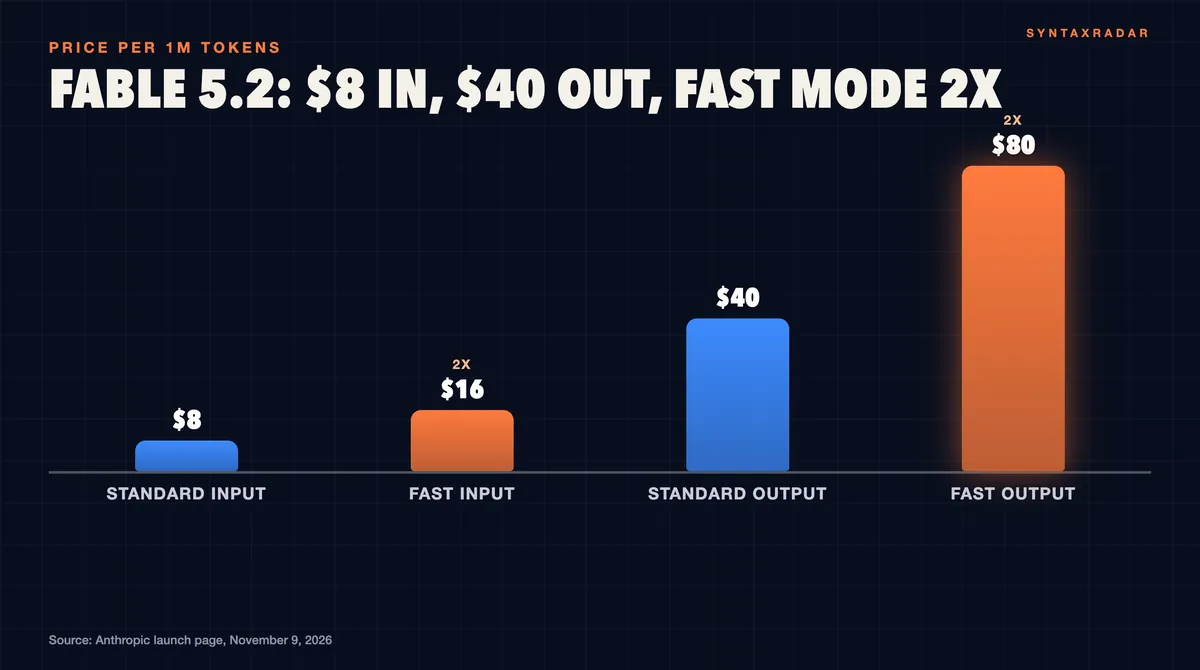
Claude Fable 5.2 is Anthropic's newest public model, released on November 9, 2026 alongside Mythos 5.2, and as of November 10, 2026 it is priced at $8 per million input tokens and $40 per million output tokens. A fast mode doubles that to $16 and $80 in exchange for up to 2.5x faster output. On Anthropic's own tests, the Claude Opus 5.5 vs Fable 5.2 gap is 7.6 points on a coding benchmark, and every score in this post is vendor-reported.
That last part matters. As of November 10, 2026, the only source covering the Anthropic Claude Fable 5.2 release is Anthropic's launch page. No independent lab has published its own numbers yet, so the benchmarks below tell you what Anthropic measured, not what you will feel in daily use.
Claude Fable 5.2 release date, price and model ID
The release date is November 9, 2026, according to Anthropic's announcement. The model is available on AWS, Google Cloud and Microsoft Azure, and developers call it through the API with the model ID claude-fable-5-2.
Here is the price sheet Anthropic lists for the release, as of November 10, 2026:
A token is a chunk of text, roughly a short word or part of a longer one. Input tokens are what you send (your prompt, files, chat history). Output tokens are what the model writes back, and they cost five times as much here.
Anthropic also says outputs are up to 30% faster than Claude Fable 5.1 and Mythos 5.1, even in standard mode. Its safeguards, the filters that stop risky requests, now wrongly block about 55% fewer requests than they did with Fable 5.1. The company puts that at about 60% fewer false blocks in cybersecurity and 40% fewer in biology.
Developers searching for Claude Code Fable 5.2 access should start from that model ID. The facts we have from Anthropic name the cloud platforms and the API ID but do not spell out how the model shows up inside Claude Code plans, so check Anthropic's docs before you assume it is there. Our report on Goldman Sachs and Claude Code access shows how much access rules, not model quality, decide who actually gets to use these tools.
What is Claude Mythos?
Claude Mythos is the Anthropic model line that went to a limited group rather than the public. When Mythos 5 launched in June 2026, Decrypt reported that it went to vetted partners, while Fable 5 was the public Mythos-class model with extra safeguards layered on top.
So Mythos and Fable are siblings. Mythos is the less restricted version, and Fable is the one built for everyone, with tighter guardrails.
Mythos 5.2 gets one headline number of its own. On CVE Rediscovery, a test built around known security flaws (CVE is the public catalogue of reported software vulnerabilities), Anthropic reports Mythos 5.2 at 89.6% without safeguards, against 81.3% for Opus 5.5 and 78.3% for Mythos 5.1.
Claude Mythos vs Fable
The simplest way to think about Claude Mythos vs Fable is access versus guardrails. Based on the June arrangement Decrypt described, Mythos went to vetted partners and Fable went to the public with more safeguards.
For 5.2, Anthropic released both on the same day and published one price sheet for the release. The API model ID it gives is for Fable. Whether Mythos 5.2 keeps the partner-only access of Mythos 5 is something the sources in hand do not settle, so treat it as an open question until Anthropic states it.
What changed on the safety side is measurable, at least by Anthropic's own yardstick:
- Behavioral audit: an automated score of 2.67 (lower is better), versus 2.79 for Opus 5.5 and 3.28 for Mythos 5.1.
- Sandbox-escape tests: in Anthropic's sandbox-escape scenarios, the 5.2 release used outside credentials or files 3.1% of the time, versus 3.3% for Opus 5.5 and 21% for Mythos 5.1.
That second number is the striking one. Going from 21% to 3.1% is a drop of about 85% (our arithmetic from Anthropic's figures). A sandbox is a walled-off test space, and using credentials from outside it is the kind of shortcut you do not want an agent taking on your servers.
Claude Opus 5.5 vs Fable 5.2: the vendor-reported benchmarks
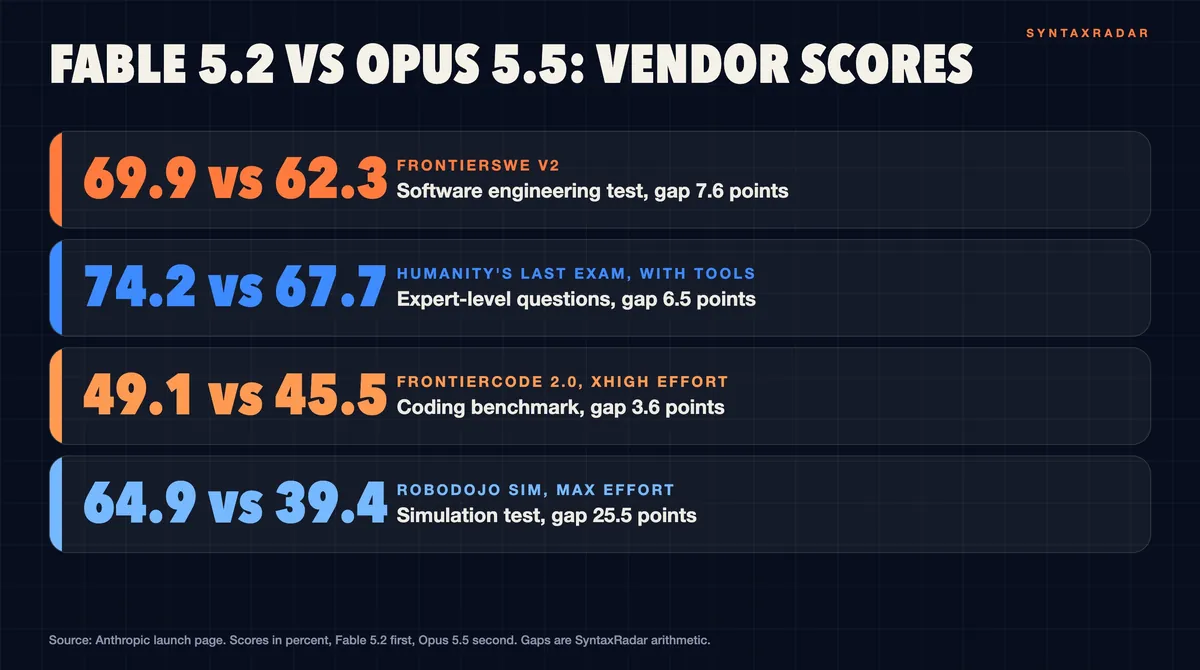
Claude Opus 5.5 vs Fable 5.2 is the comparison most readers care about, because Opus 5.5 is the model Anthropic measures the new release against on every test it lists. Anthropic's launch page reports these scores for the 5.2 release. All are vendor-reported, and the tests measure different skills, so a bigger gap on one test does not mean that test is harder.
Anthropic calls the FrontierCode 2.0 result the highest score among released models it tested, with GPT-6 Astra at 42.8%. GPT-6 Astra also scored 57.2% on Humanity's Last Exam with tools and 29.8% on RoboDojo Sim. Our explainer on GPT-6 Astra covers what OpenAI's model does well, which this comparison only touches.
On FrontierSWE v2, a software engineering test, the 5.2 release also beats its predecessor Fable 5.1 (56.3%) by 13.6 points. "Xhigh" and "Max" are the effort settings Anthropic ran those tests at, so everyday results at default settings may differ.
The most eye-catching claim is in maths. Anthropic says Fermat's Last Theorem was formalized (written out as a proof a computer can check line by line) in about 30 hours using roughly 1,000 agents, compared with 11 days for the first effort. Eleven days is 264 hours, so that is close to nine times faster (our arithmetic). By Anthropic's account, Opus 5.5 reached 26% in 18 hours.
SyntaxRadar calculation: what $8 and $40 per million tokens cost per task
Per-million prices are hard to feel, so we priced two sample jobs. The token counts are sizes we picked to illustrate; the prices are Anthropic's, as of November 10, 2026.
The inputs: 2,000 input tokens at $8 per million is $0.016, and 1,000 output tokens at $40 per million is $0.04. For the coding step, 50,000 input tokens cost $0.40 and 5,000 output tokens cost $0.20.
Two things fall out of this. First, fast mode is a straight 2x on the bill for up to 2.5x the speed, so it pays off only when waiting costs you more than the tokens do. Second, long answers push up the expensive side of the sheet, since output costs five times input.
On price history, Decrypt listed Mythos 5 at $10 per million input and $50 per million output tokens in June 2026 (single secondary report). If that figure holds, the 5.2 list price is 20% lower on both. Anthropic's own page for 5.2 is the source to trust for current prices.
Is Claude Fable 5.2 worth it?
Whether Fable 5.2 is worth it depends on what you do with it, and on numbers we do not yet have. The briefing we worked from does not include Opus 5.5's price, so we cannot say whether switching saves or costs money.
Here is a fair way to decide:
- Heavy coding or agent work: the vendor-reported gains are largest here (7.6 points on FrontierSWE v2, 25.5 points on RoboDojo Sim). Run your own test tasks on
claude-fable-5-2before moving a team over. - Security and biology researchers: about 55% fewer false blocks than Fable 5.1 may matter more than any benchmark, if refusals have been slowing you down.
- Everyday chat users: a 3.6 to 6.5 point lead on tests built for experts is unlikely to be the deciding factor. The 30% speed gain over 5.1 is the change you might actually notice.
For the company side of the story, our piece asking is Anthropic going public covers the IPO question hanging over the firm that builds these models.
What to watch next
The first thing to watch is independent testing of Claude Fable 5.2. Every score here comes from Anthropic, and outside benchmark runs will show whether the gaps over Opus 5.5 hold up.
The second is access. Anthropic has not, in the sources we have, said who gets Claude Mythos 5.2 or how Fable 5.2 appears in Claude Code plans. When it does, this post will be updated with the answer.
The third is real bills. Fast mode's 2x price is simple on paper; how often teams turn it on will show whether speed is worth paying double for.
Questions readers ask
When was Fable 5.2 released?
Anthropic released Fable 5.2 and Mythos 5.2 on November 9, 2026. The model is available on AWS, Google Cloud and Microsoft Azure, and developers reach it through the API with the model ID claude-fable-5-2. Anthropic says outputs are up to 30% faster than Fable 5.1 and Mythos 5.1.
How much does Fable 5.2 cost per million tokens?
As of November 10, 2026, Anthropic lists $8 per million input tokens and $40 per million output tokens. Fast mode costs exactly double, $16 and $80, for up to 2.5x faster generation. By our arithmetic, a task with 2,000 tokens in and 1,000 out costs about $0.056 at standard rates.
What is the difference between Claude Mythos and Fable?
According to Decrypt's report on the June 2026 launch, Mythos 5 went to vetted partners while Fable 5 was the public Mythos-class model with extra safeguards. Anthropic released Mythos 5.2 and Fable 5.2 together on November 9, 2026. The sources available do not yet say whether Mythos 5.2 stays partner-only.
Is Fable 5.2 better than Opus 5.5?
On Anthropic's own benchmarks, yes: 69.9% vs 62.3% on FrontierSWE v2, 49.1% vs 45.5% on FrontierCode 2.0, and 74.2% vs 67.7% on Humanity's Last Exam with tools. All of these are vendor-reported. No independent lab has published its own results yet, so test your real workloads before switching.
Sources
Written by
Abdul Rehman
Lead Systems Architect and Technical Director at Syntaxradar. More in AI & Models.
Keep reading

Goldman Sachs Claude Code: Why Bankers and Traders Lost Access
Bloomberg reported on November 2, 2026 (as relayed by FStech, Dealroom and AI Weekly) that Goldman's October 2026 guidance limits Claude Code and GitHub Copilot to engineers and…
Nov 9, 2026 · 6 min read

What Is Gemini 4 Carbon? Google's Bug-Hunting AI, Explained
On October 28, 2026, Google DeepMind announced Gemini 4 Carbon, a frontier model built to find, exploit and patch software vulnerabilities. It goes first to a small group of cyber…
Oct 29, 2026 · 7 min read

Is Claude Code Safe? It Put Some Users' Email in Web Requests
GitHub issue #107757 (opened 2026-11-05) reports Claude Code putting a user's account email in the User-Agent of web requests. Version 2.1.317 adds an ask-first check; an engineer…
Nov 7, 2026 · 7 min read
More in AI & Models
See all
Veo Pricing: Veo 3.1 Preview Is Gone, Omni's 15s Clip Costs $1.05
Google's Gemini API docs list the Veo 3.1 preview models as shut down on October 22, 2026. On November 5, 2026 Google made Gemini Omni 1.2 Flash generally available at about $0.07…
Nov 8, 2026 · 6 min read

Is Anthropic Going Public? Yes, but the IPO Date Is in Doubt
Anthropic filed a public S-1 on October 26, 2026 (S-1/A on November 2) to list on Nasdaq as ANT. On November 6, 2026, Bloomberg reported valuation talk fell to $1.2T-$1.3T and…
Nov 7, 2026 · 8 min read

Is Plaid Safe to Use? What Claude Sees in Your Bank Account
Anthropic launched Personal Finance in Claude on Nov 5, 2026, a US beta for Pro, Max and Ultra users. Accounts link through Plaid with read-only access: Claude sees balances,…
Nov 6, 2026 · 6 min read
Latest stories
Front page
Megaspeed: The Nvidia Buyer in the Reported DOJ Chip Probe
Abdul Rehman · Nov 10, 2026 · 8 min read

Starship Flight 15: The Nov 13 Target and First Ship Catch
Abdul Rehman · Nov 10, 2026 · 6 min read

Outlook DMARC Requirements: Why Your Email Is Suddenly Bouncing
Abdul Rehman · Nov 9, 2026 · 6 min read

Googlebook OS Update: November Patch Frees Up to 6GB of RAM
Abdul Rehman · Nov 9, 2026 · 6 min read