


Veo Pricing: Veo 3.1 Preview Is Gone, Omni's 15s Clip Costs $1.05
Google's Gemini API docs list the Veo 3.1 preview models as shut down on October 22, 2026. On November 5, 2026 Google made Gemini Omni 1.2 Flash generally available at about $0.07 per second at 720p, 30% below Omni 1.1, with clips up to 15 seconds.

Abdul Rehman
Lead Systems Architect and Technical Director · · 6 min read

The short version
- $0.07 per second
- Gemini Omni 1.2 Flash, 720p
- 30%
- Price cut vs Omni 1.1 (720p)
- October 22, 2026
- Veo 3.1 previews shut down (Gemini API)
Why it matters: Veo 3.1 previews are gone from the Gemini API, and its replacement, Gemini Omni 1.2 Flash, makes a 15-second 720p clip about $1.05.
On this page
Veo pricing in the Gemini API comes with a twist as of November 8, 2026: there is no current Veo 3 price to pay there. Google's video generation docs list the Veo 3.1 preview models as shut down on October 22, 2026, and point developers to Gemini Omni 1.2 Flash. On Google's Gemini API pricing page, the Gemini Omni Flash price is about $0.07 per second at 720p, so a full 15-second clip costs about $1.05.
Google announced Gemini Omni 1.2 Flash as generally available on November 5, 2026. The 720p rate is 30% lower than Gemini Omni 1.1, and clips now run up to 15 seconds instead of 10. Many Veo price tables still circulating online describe models the Gemini API no longer serves, which is why the numbers below come from Google's own pages.
Veo pricing after the Veo 3.1 preview shutdown
Google's Gemini API docs list three model IDs as shut down on October 22, 2026: veo-3.1-generate-preview, veo-3.1-fast-generate-preview and veo-3.1-lite-generate-preview. The same page recommends migrating to gemini-omni-1.2-flash. For teams that still want Veo, it points to the generally available (production, not preview) Veo models on the Gemini Enterprise Agent Platform.
As of November 8, 2026, neither Google's Gemini API pricing page nor its video docs list a per-second Veo price. That leaves a hole for anyone looking for a first-party Veo 3 pricing number per second. Third-party price pages, such as BenchLM's, report figures for Veo 3.1 (Lite at $0.05 per second at 720p, Fast at $0.10, Standard at $0.40), but those trace back to reseller blogs, not to Google. Read them as unverified third-party numbers for preview models that are now shut down, not as a current Veo 3 cost per second.
How much does Gemini Omni Flash cost
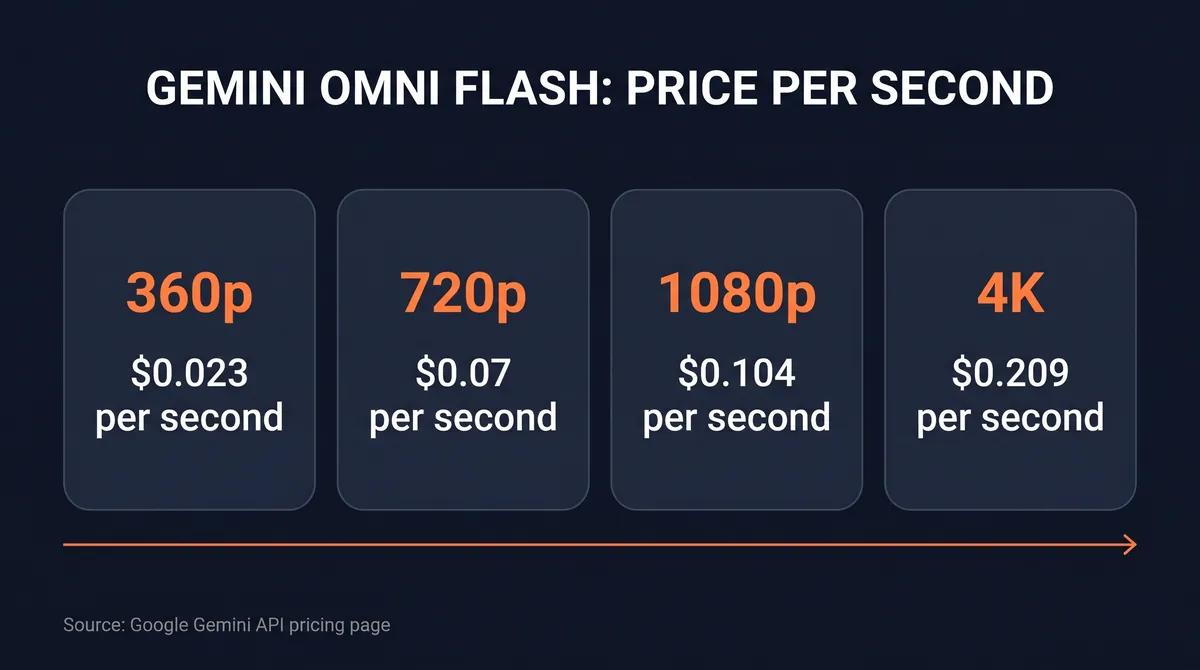
Gemini Omni Flash costs $12.00 per 1 million video output tokens, according to Google's pricing page, and it is sold on the paid tier only. Tokens are the units the API counts and bills. Higher resolutions use more tokens per second, so the price per second climbs with resolution:
The previous model, Gemini Omni 1.1 Flash, is billed at $17.50 per 1 million video output tokens, about $0.10 per second at 720p. Google's pricing page says that from December 3, 2026, requests to Omni 1.1 Flash route automatically to Omni 1.2 Flash and are billed at 1.2 rates. Google also offers Provisioned Throughput (capacity reserved in advance) for the new model.
Text model prices have been falling too; our explainer on LLM API pricing covers why those rates fell and how to pay less.
Gemini Omni vs Veo
In the Gemini API, Gemini Omni vs Veo is no longer a choice between two live options. Google's docs list the Veo 3.1 previews as shut down and name Omni 1.2 Flash as the migration target, while GA Veo models stay available on the Gemini Enterprise Agent Platform. Google does not publish a side-by-side comparison of the two on the pages it links developers to.
What Google and press coverage do describe is how Omni Flash works for the user. According to The Decoder, conversational editing lets you change a clip's background, lighting or aspect ratio without regenerating it, and inputs can include character images, product photos, motion clips and audio cues. Google's announcement says reference motion clips can run up to 3 seconds each, and every output carries an imperceptible SynthID watermark (Google's invisible marker for AI-made content). The Decoder also notes that Google gives no figures for its claimed improvements to drift, lip-sync and jump cuts.
For a developer, the practical difference shows up in two places: the model ID in your request and the page you check for prices. Omni 1.2 Flash rates sit on the Gemini API pricing page; Google's Gemini API pages do not list a per-second rate for the GA Veo models they point to.
If your code still calls a veo-3.1 preview ID in the Gemini API, it needs a new target: either gemini-omni-1.2-flash in the same API, or GA Veo on the Enterprise Agent Platform. For how creators are already using rival tools such as Sora and Kling, see our piece on AI video generation.
How long can Gemini Omni videos be
Gemini Omni 1.2 Flash videos can be 3 to 15 seconds long, set in one-second steps, up from a 10-second maximum in Omni 1.1, according to Google's announcement. You draft at 360p or 720p and then upscale to 1080p or 4K.
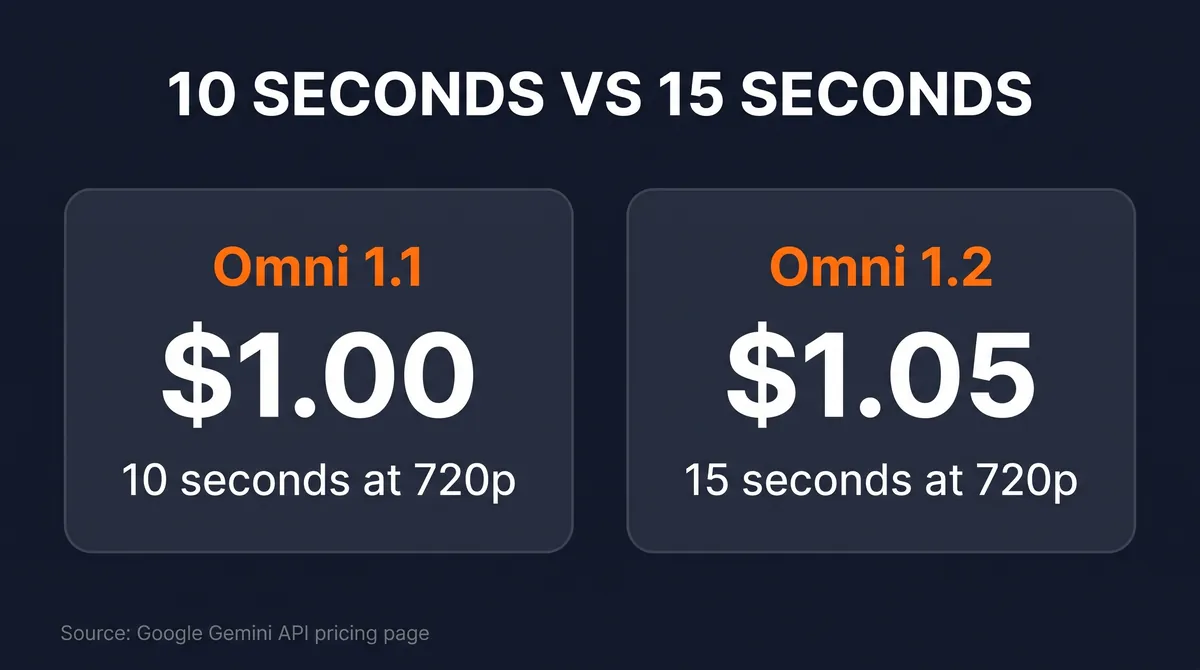
Longer clips change the math per clip, not just per second. A 10-second Omni 1.1 clip at 720p costs 10 x $0.10 = $1.00. A 15-second Omni 1.2 clip at 720p costs 15 x $0.07 = $1.05. That is about 5% more money for 50% more footage (SyntaxRadar calculation from Google's listed rates).
SyntaxRadar calculation: what a draft-then-upscale workflow costs
Because 360p costs about a ninth of the 4K rate, the cheapest habit is to iterate small and render big once. Using Google's per-second rates for 15-second clips:
The draft-first route costs roughly a quarter of rendering every take in 4K. One assumption sits under this: that the final 4K clip is billed at the listed 4K-with-upsampling rate. Google's pricing page gives rates per second but does not spell out how an upscaled draft is billed, so check your first invoice before you scale up.
The same rates scale to a minute of finished footage, which is four 15-second clips. At 360p a minute costs about $1.38 (60 x $0.023). At 720p it is $4.20 (60 x $0.07), at 1080p about $6.24 (60 x $0.104) and at 4K about $12.54 (60 x $0.209). Those are output costs only for clips you keep; every discarded take adds its own cost at whatever resolution you rendered it.
A one-minute product video, then, is a budget question about how many takes you expect to throw away, more than about the final resolution. If you expect five rejects per keeper, the draft-first route above is where most of the saving sits.
Google's headline 30% cut is the per-second 720p change, $0.10 to $0.07. Measured per token, $17.50 to $12.00, the cut is about 31%. Google's page does not explain the one-point gap between the two measures.
Is Gemini Omni Flash free
Gemini Omni Flash is not free in the Gemini API: Google's pricing page lists it on the paid tier only, with no free tier. Outside the API, the picture differs. Google's announcement says Google Vids gets 15-second clips at no additional cost with a Google account or Workspace subscription, and 15-second videos in the Gemini app are rolling out to Google AI Ultra subscribers. The model is also generally available in Gemini for business.
That split matters for who pays what. A developer building video into an app pays per second through the API from the first clip. Someone making a short clip for a slide deck in Google Vids does not see a per-second bill at all, according to Google's announcement.
Google is staging its other Gemini releases differently too; our explainer on Gemini 4 Carbon covers why that model went to defenders first.
What to watch next
December 3, 2026 is the date to mark: Omni 1.1 Flash requests start routing to Omni 1.2 Flash and billing at the lower rate. Watch, too, whether Google adds per-second Veo pricing for the GA models on the Gemini Enterprise Agent Platform to the pages it links from the Gemini API, which would give developers a first-party Veo number to compare. And watch for Google publishing figures behind its claimed gains in drift, lip-sync and jump cuts, which The Decoder notes are missing.
Questions readers ask
What is the current Veo pricing in the Gemini API?
As of November 8, 2026, Google's Gemini API pricing page and video docs list no per-second Veo price. The docs say the Veo 3.1 preview models were shut down on October 22, 2026, and recommend Gemini Omni 1.2 Flash. GA Veo models remain on the Gemini Enterprise Agent Platform. Third-party Veo price tables are unverified.
How much does a Veo 3 video cost?
Google's Gemini API pages list no current per-second Veo price, and the Veo 3.1 preview models were shut down on October 22, 2026. Third-party Veo figures online are unverified. Google's recommended replacement, Gemini Omni 1.2 Flash, costs $0.07 per second at 720p, so a 15-second clip is about $1.05 (SyntaxRadar calculation).
How much does a 15-second Gemini Omni 1.2 Flash clip cost?
Using Google's listed per-second rates, a 15-second clip costs about $0.345 at 360p, $1.05 at 720p, $1.56 at 1080p and $3.135 at 4K. These are SyntaxRadar calculations from Google's pricing page, which bills video output at $12.00 per 1 million tokens on the paid tier only.
What happens to Gemini Omni 1.1 Flash on December 3, 2026?
From December 3, 2026, requests to Gemini Omni 1.1 Flash route automatically to Omni 1.2 Flash and are billed at the 1.2 rates, according to Google's pricing page. Omni 1.1 Flash costs $17.50 per 1 million video output tokens, about $0.10 per second at 720p, against $0.07 for 1.2.
Can I make Gemini Omni videos without paying for the API?
Google's announcement says Google Vids gets 15-second clips at no additional cost with a Google account or Workspace subscription. In the Gemini app, 15-second videos are rolling out to Google AI Ultra subscribers. The Gemini API itself has no free tier for Gemini Omni 1.2 Flash; it is paid tier only.
Sources
Written by
Abdul Rehman
Lead Systems Architect and Technical Director at Syntaxradar. More in AI & Models.
Keep reading

LLM API Pricing Fell Up to 80%: Why, and How to Pay Less
Between June and September 2026, OpenAI cut its small Luna model by 80% and both OpenAI and Anthropic launched cheaper flagships: GPT-6.1 Sol at $2/$10 and Claude Opus 5.5 at…
Oct 26, 2026 · 7 min read
What Is Gemini 4 Carbon? Google's Bug-Hunting AI, Explained
On October 28, 2026, Google DeepMind announced Gemini 4 Carbon, a frontier model built to find, exploit and patch software vulnerabilities. It goes first to a small group of cyber…
Oct 29, 2026 · 7 min read
Gemini 4 Carbon: Why Google's New AI Goes to Defenders First
Google announced Carbon on Oct 28, 2026, a security-focused Gemini 4 model that scores 88.2% on SEC-bench Pro and 0.0% prompt-injection success. It goes to a subset of cyber…
Oct 29, 2026 · 6 min read
More in AI & Models
See all
Claude Fable 5.2: $8 Price, Fast Mode and Whether to Switch
Anthropic released Fable 5.2 and Mythos 5.2 on November 9, 2026, priced at $8 per million input and $40 per million output tokens, with a 2x-priced fast mode, on AWS, Google Cloud…
Nov 10, 2026 · 7 min read

Goldman Sachs Claude Code: Why Bankers and Traders Lost Access
Bloomberg reported on November 2, 2026 (as relayed by FStech, Dealroom and AI Weekly) that Goldman's October 2026 guidance limits Claude Code and GitHub Copilot to engineers and…
Nov 9, 2026 · 6 min read

Is Anthropic Going Public? Yes, but the IPO Date Is in Doubt
Anthropic filed a public S-1 on October 26, 2026 (S-1/A on November 2) to list on Nasdaq as ANT. On November 6, 2026, Bloomberg reported valuation talk fell to $1.2T-$1.3T and…
Nov 7, 2026 · 8 min read
Latest stories
Front page
Megaspeed: The Nvidia Buyer in the Reported DOJ Chip Probe
Abdul Rehman · Nov 10, 2026 · 8 min read

Starship Flight 15: The Nov 13 Target and First Ship Catch
Abdul Rehman · Nov 10, 2026 · 6 min read

Outlook DMARC Requirements: Why Your Email Is Suddenly Bouncing
Abdul Rehman · Nov 9, 2026 · 6 min read
Googlebook OS Update: November Patch Frees Up to 6GB of RAM
Abdul Rehman · Nov 9, 2026 · 6 min read