
AI Video Generation in 2026: Sora Is Gone, Kling 4.0 Is Here
OpenAI announced on 24 March 2026 that it was shutting down Sora, and Kuaishou launched Kling 4.0 on 15 October 2026. Creators still stitch short AI clips together to make longer films.

Abdul Rehman
Lead Systems Architect and Technical Director · · 6 min read
The short version
- 24 March 2026
- Sora shutdown announced
- Up to 30 seconds
- Kling 4.0 single-pass length
- 3.33M to 1.13M
- Sora downloads, Nov to Feb (Appfigures)
Why it matters: AI video tools can produce convincing short clips, but longer films still depend on stitching shots together and on human editing, and the market is shifting fast.
AI video generation can now turn a written prompt into a short, realistic clip, but no tool makes a finished feature film in one go. The field also looks different from a year ago: OpenAI announced on 24 March 2026 that it was shutting down Sora, its video app, and Kuaishou's Kling launched a 4.0 model on 15 October 2026.
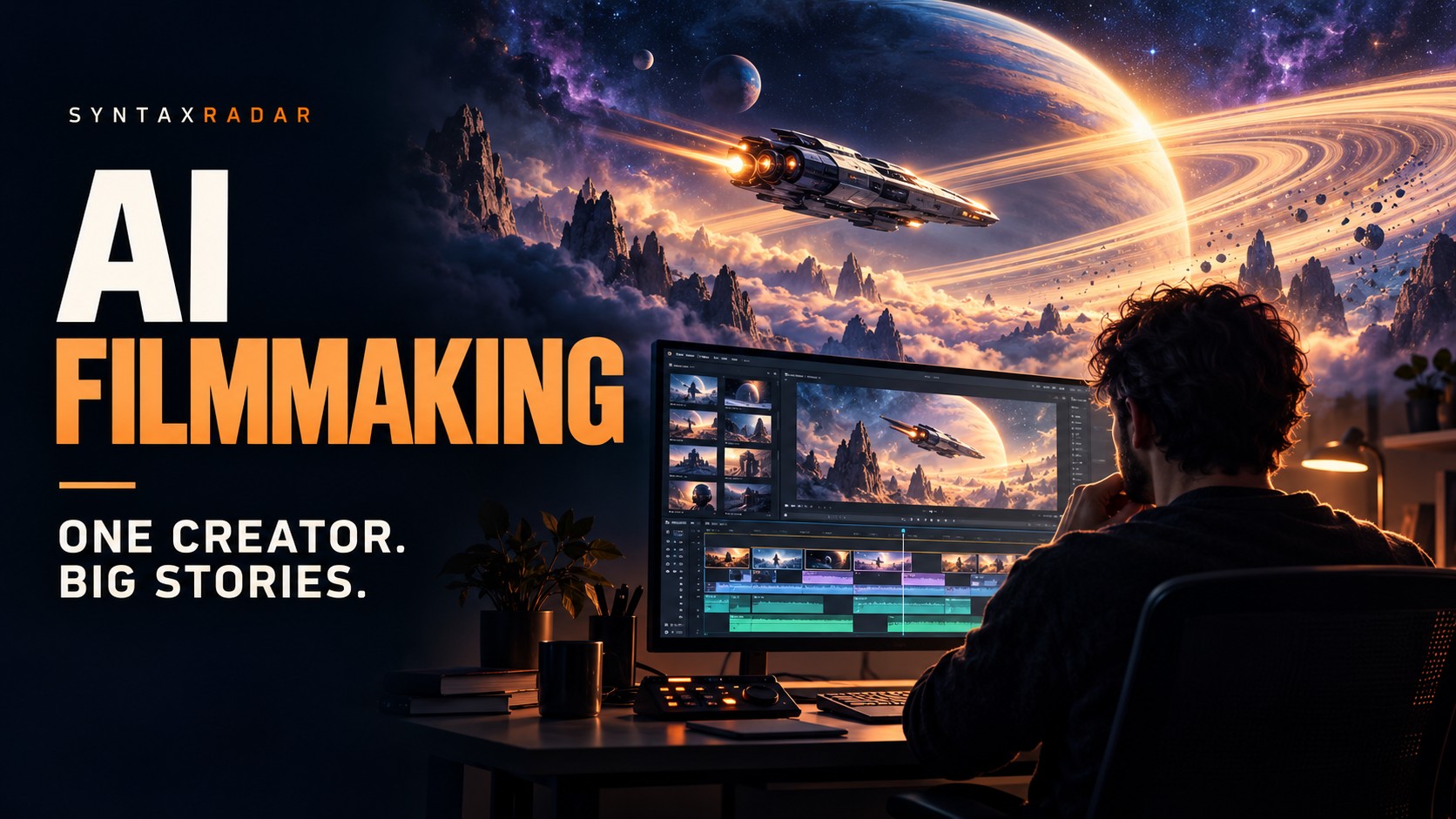
Creators who want to make films with AI today stitch many short clips together and edit them like ordinary footage.
Is Sora still available?
Sora is no longer a consumer app. TechCrunch reported that OpenAI announced the shutdown of the Sora app on 24 March 2026, about six months after launch, and gave no reason. The company said it would share timelines for the app and its API later.
According to TechCrunch, citing the analytics firm Appfigures, Sora downloads peaked at about 3.33 million in November and fell to about 1.13 million by February. Appfigures estimated that the app earned about $2.1 million from in-app credit purchases over its lifetime.
A planned Disney partnership went away with it. Euronews reported that the three-year deal would have let Sora users make videos with more than 200 licensed Marvel, Pixar and Star Wars characters. Disney said it respected OpenAI's decision to exit the video generation business and would keep working with AI platforms.
For developers, a secondary site reports that OpenAI's Sora API was scheduled to close on 24 September 2026, with no replacement named. OpenAI has said that ChatGPT's image generation is unaffected.
How does AI video generation work?
Most current video generators are built on a design called a diffusion transformer. A diffusion model starts from random noise and removes it step by step until a picture or clip emerges that matches the text prompt. A transformer is the type of neural network that lets the model weigh how every part of the clip relates to every other part.
Wikipedia's summary of Kling says Kling uses this kind of architecture, plus a self-developed 3D variational autoencoder. That component compresses video across both space and time, so the model works on a small summary of the clip instead of every raw pixel.
The model does not film anything. It predicts what plausible footage looks like, based on patterns learned from huge amounts of training video. That is why results can look convincing and still break physical rules, such as a glass that does not shatter the way glass should.
Companies sometimes describe this as learning a "world model", an internal sense of how objects and scenes behave. The label is an aspiration. No independent benchmark shows that any generator reliably simulates physics.

What does Kling 4.0 add?
Kling 4.0 is the newest model from the Chinese short-video company Kuaishou. According to an S&P Capital IQ article republished by MarketScreener, it launched on 15 October 2026 and generates up to 30 seconds of video in a single pass. Longer extensions of up to two minutes were described as coming soon.
The same report describes a feature called Omni Reference. It lets a creator supply up to 15 reference items, such as images, video clips and voices, so that a character or style stays consistent. It also accepts up to 10 keyframes, which are images that mark where a shot should pass through key moments.
Kling 4.0 is also connected to Kling's MCP and command-line tools, which means AI agents can call it automatically.
Kling is not new to this. Wikipedia lists its first public beta as 10 June 2024, with a 3.0 release in early 2026. Almost all Kling 4.0 specifications come from Kuaishou's own materials.
Can AI make a whole movie?
AI can contribute to a whole movie, but no documented tool produces a feature-length film in one generation. Comparison guides disagree about per-clip limits for Veo, Runway and Kling, and they range from a few seconds to roughly half a minute for typical single generations. Those guides are mostly vendor-comparison blogs, so the figures are best treated as rough.
Making a longer film therefore means generating hundreds of separate clips, choosing the best, and keeping characters and settings looking the same from shot to shot. Consistency across shots is the main technical hurdle, which is why reference tools like Kling's Omni Reference exist.
Studios are also experimenting, with humans still in charge. Lionsgate announced in September 2024 that it would build a custom model with Runway, trained on its own catalog of more than 20,000 titles and restricted to affiliated filmmakers. OpenAI backed an animated feature called Critterz, announced with a budget under $30 million, a nine-month production schedule and a planned Cannes debut in 2026. Reports describe it as combining AI tools with human voice acting and hand-drawn elements. Whether it premiered as planned is unconfirmed.
Who actually benefits from AI video tools?
The clearest winners are people who need short, inexpensive footage: advertisers testing ideas, teachers illustrating a lesson, and independent filmmakers drafting a scene before a real shoot. Lionsgate's stated interest in using generated clips to decide whether to shoot a scene points the same way. In those cases the clip stands in for a rough sketch.
The risks are also documented. TechCrunch reported that Sora's guardrails against videos of public figures were easy to evade, and that deepfakes of Martin Luther King Jr. and Robin Williams appeared. The daughters of both men asked users to stop. Users also made videos with copyrighted characters.
Euronews noted that critics warned open-ended prompts enabled nonconsensual images, realistic deepfakes and low-quality "AI slop." OpenAI limited content featuring public figures only after pushback from family estates and an actors' union.
Control over content varies by provider. Wikipedia says Kling follows strict content rules aligned with Chinese government regulations, and that it blocks topics such as politics and protests. It also records that fake Kling websites and ads were used in May 2025 to spread infostealer malware, so creators should reach the tool only through its official site.
How should a creator approach AI video tools today?
The evidence supports a modest approach. Start with short clips for one purpose, such as a storyboard test, a social post or a lesson illustration, and keep the edit in ordinary editing software so no single vendor holds the project.
Keep original files and prompts for every clip, since a service can change or close. Sora is the example: users were told to export their content because it was going away.
Check the rules on likenesses and copyrighted characters before publishing anything. The Sora reporting shows that guardrails can fail, and a clip that breaks a family's wishes or a studio's rights lands on the creator.
What to watch next
Whether any tool can deliver reliable character consistency across a whole film is the open question. Watch for independent tests of Kling 4.0 once more people have used it, and for the two-minute extension that Kuaishou says is coming.
Also watch how studios handle licensing. The Disney and OpenAI deal collapsed along with Sora, yet Disney said it will keep talking to AI platforms. Related world-building research is covered in Google's Genie 4 explainer, which looks at models that generate interactive scenes instead of fixed clips.
Finally, check each tool's current documentation before building a workflow around it, since Sora's exit shows how quickly an AI video service can disappear.
Questions readers ask
Is Sora still available?
No. OpenAI announced on 24 March 2026 that it was shutting down the Sora app and gave no reason. A secondary site reports the Sora API was scheduled to close on 24 September 2026. OpenAI says ChatGPT image generation is unaffected. Check OpenAI's own documentation for the current status of any Sora feature.
What is Kling 4.0?
Kling 4.0 is the latest video model from Kuaishou's Kling AI. According to an S&P Capital IQ report, it launched on 15 October 2026 and can generate up to 30 seconds of video in one pass. It adds an Omni Reference feature for keeping characters and styles consistent, using images, clips and voices as references.
Can AI make a whole movie?
Not in one generation. Creators generate many short clips, pick the best and edit them together, while working to keep characters consistent. Studios such as Lionsgate are testing custom models with Runway, and the OpenAI-backed film Critterz planned a 2026 Cannes debut, but both still involve people.
How does AI video generation work?
Most systems use a diffusion transformer. The model starts with random noise and removes it step by step until a clip matching the text prompt appears. Kling also uses a 3D variational autoencoder that compresses video across space and time. The model predicts plausible footage from training data, so it can still break physical rules.
Written by
Abdul Rehman
Lead Systems Architect and Technical Director at Syntaxradar. More in Emerging Tech.
More in Emerging Tech
See all
AI Bubble Pop? 5 Warning Signs Behind Big Tech's $740B Bet
Alphabet fell 12% on Oct 29, its worst day on record, after a second negative free cash flow quarter. The Nasdaq fell 2.9% the next day, S&P cut Meta's outlook to negative, and…
Oct 31, 2026 · 7 min read

Binance Hacked: How One Laptop May Have Led to a $6.36B Theft
On Oct 29, 2026, attackers drained Binance hot wallets across ten blockchains. TRM Labs counts about $6.36B stolen and links it to North Korea's TraderTraitor; Binance blames a…
Oct 30, 2026 · 8 min read
Is a Computer Science Degree Worth It? What the 8.1% Drop Means
US undergraduate computer science enrollment at four-year colleges fell 8.1% in fall 2025 and 8.4% in spring 2026, per the National Student Clearinghouse, as overall enrollment…
Oct 29, 2026 · 7 min read
Latest stories
Front page
Xreal Aura: Should You Buy the $1,099 Android XR Glasses?
Abdul Rehman · Oct 31, 2026 · 7 min read
Claude Code Extension VSCode Backdoor: How to Check and Clean Up
Abdul Rehman · Oct 31, 2026 · 7 min read

AO3 Outage: Why Is AO3 Down, and Is Your Account Safe?
Abdul Rehman · Oct 30, 2026 · 7 min read
AI for Hacking: CrowdStrike Says ARTEX Targeted 200+ Orgs
Abdul Rehman · Oct 30, 2026 · 7 min read