


GPT-6 Astra Rewrote 0.016% of a Model and Lifted Math to 48.1%
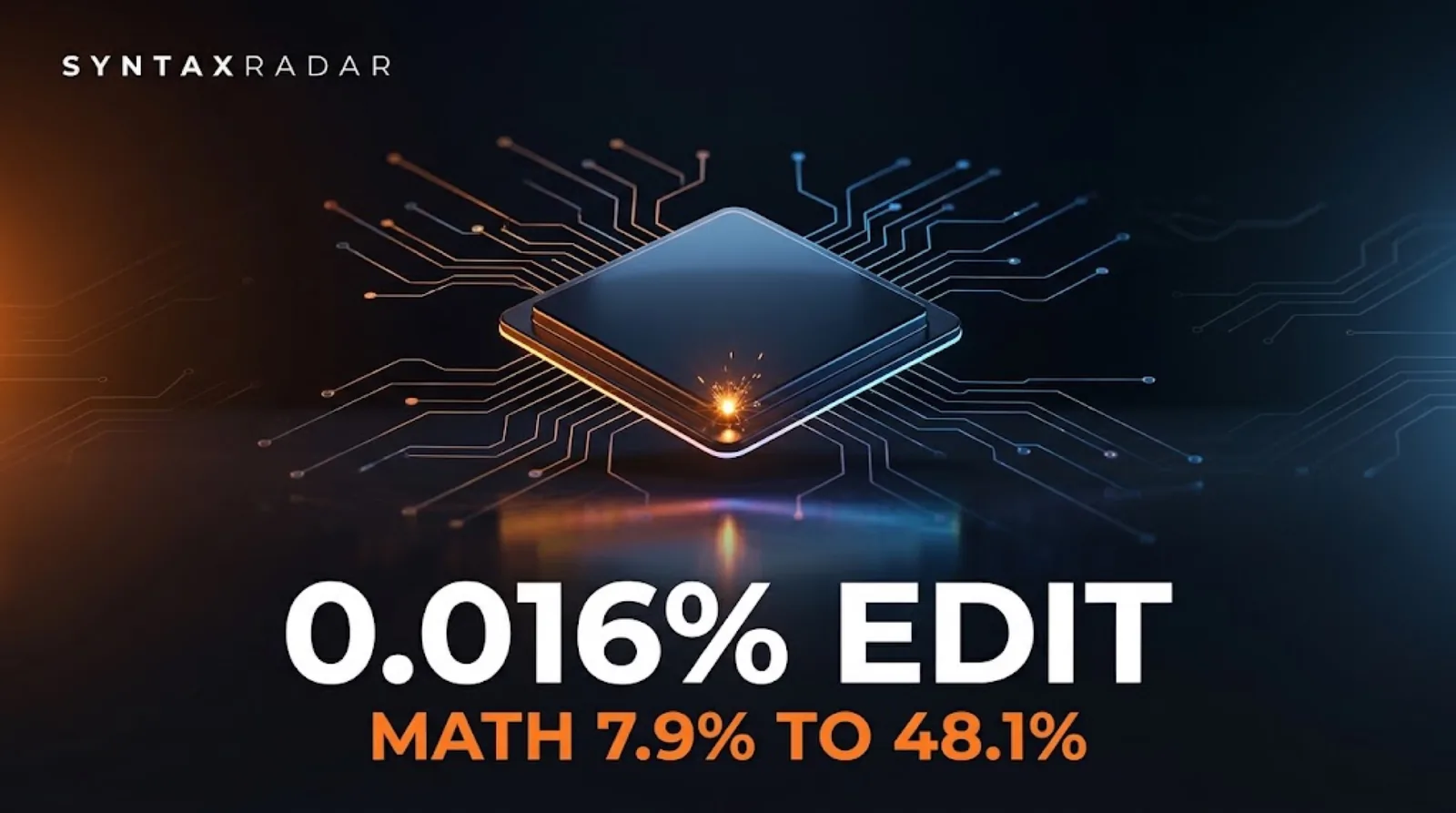
MIT CSAIL researchers report that their AI model Astra read and directly rewrote neural network weights. Editing 0.016% of Qwen3.5-0.8B lifted MATH-500 from 7.9% to 48.1%, but the same approach failed to improve math on Gemma 3 270M.

Abdul Rehman
Lead Systems Architect and Technical Director · · 7 min read
The short version
- 7.9% to 48.1%
- Qwen3.5-0.8B MATH-500, before vs after edit
- 0.016% (131,072 weights)
- Share of Qwen weights changed
- 517.4 vs 25.3
- Astra-written Breakout net vs PPO at 500M steps
Why it matters: According to its MIT CSAIL authors, Astra can read and patch a network's weights directly, removing obstacles like Qwen's runaway answers, but it could not add skills a model lacked, and the results are not yet independently checked.
Astra, the AI model at the center of a new MIT CSAIL experiment, looked at the raw numbers inside another AI model, changed 0.016% of them, and that model's score on a hard math test rose from 7.9% to 48.1%. That is the headline result in a blog post by four MIT CSAIL researchers, published on November 2, 2026. They call the approach weight-space programming.
If you came here for GPT-6 release news, this is a different story, and arguably a stranger one. It is about what this model could do when handed another network's internals. The name signals the idea: treat a trained network's weights like a program that can be read, patched and even written from scratch.
The results are striking, and they carry a caveat worth keeping in mind for every number below. All of it comes from the authors' own write-up. It is a blog post, not a peer-reviewed paper, and when we checked we found no independent coverage testing the claims.
What is weight space programming?
Weight space programming is the researchers' term for having an AI read and directly rewrite a neural network's weights. Weights in a neural network are the numbers inside it. Training adjusts them over and over until the network does its job, so nobody writes them by hand, and on their own they look like noise.
The experiments in the post fall into three kinds of task. Astra was asked to read networks (work out what a network does from its weights alone), to edit them (change some weights to fix a behavior), and to write them (produce the weights of a working network with no training).
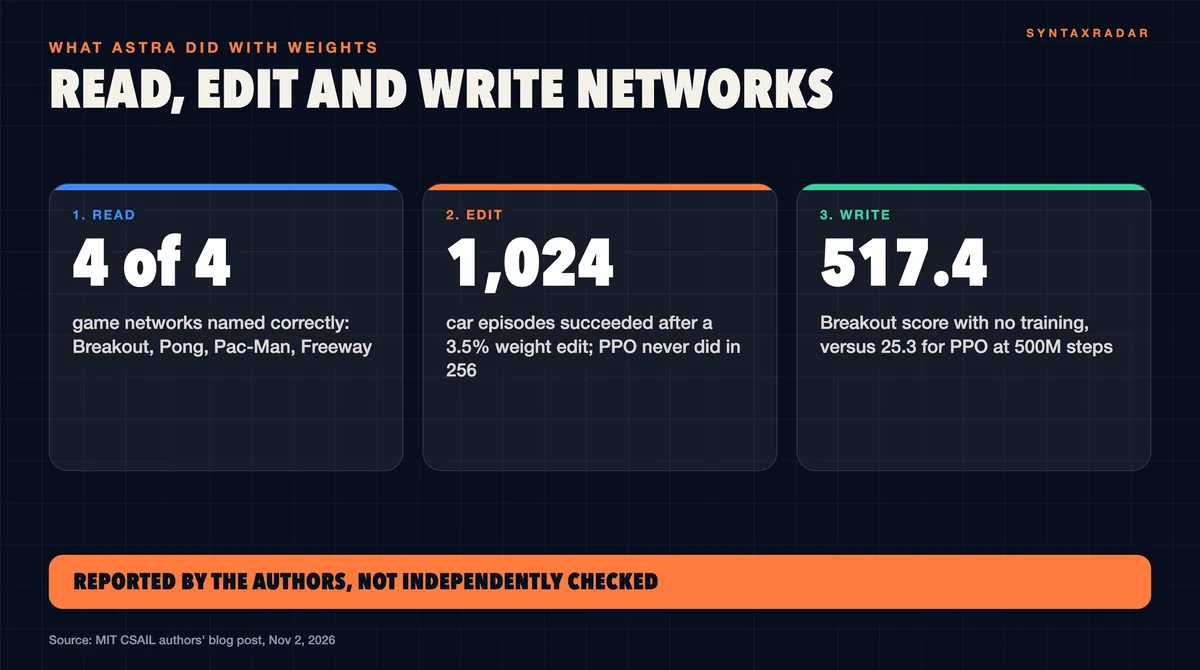
The reading tests set the tone. The authors gave Astra four game-playing networks trained with PPO (proximal policy optimization, a standard reinforcement learning method), each a small 500-32-32-5 MLP (a basic stack of fully connected layers) holding 17,253 weights. According to the post, Astra named the correct game for all four: Breakout, Pong, Pac-Man and Freeway.
It also looked at three character-level transformers (language models that predict text one character at a time), each with 7.16 million weights. One was trained on Python, one on romaji (Japanese written in Latin letters) and one on English. The authors report that Astra named the training language of each in both attempts.
Astra's biggest result: a math fix inside Qwen3.5-0.8B
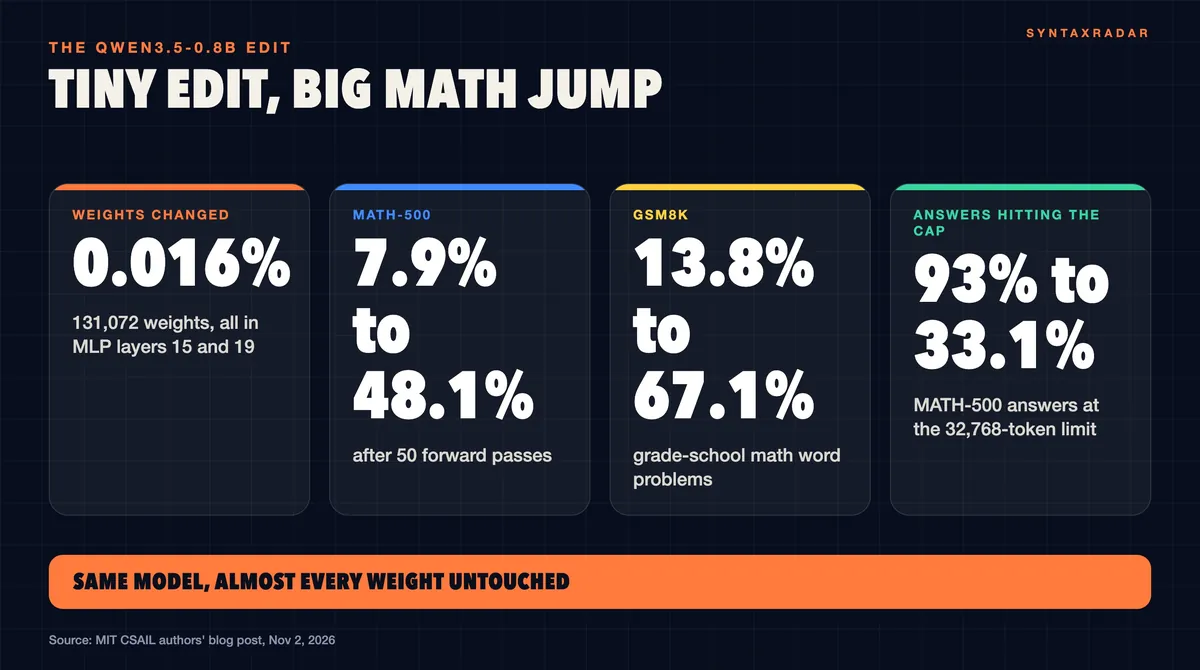
The result getting the most attention is an edit to Qwen3.5-0.8B, a small open language model. Before the edit, the researchers measured it on three standard tests: MATH-500 (competition-style math problems), GSM8K (grade-school math word problems) and IFEval (following formatting and instruction rules).
That last row matters. Before the edit, 93% of the model's MATH-500 answers ran into the 32,768-token cap, meaning the model was still generating when it ran out of room. After the edit, that share fell to 33.1%.
The edit itself was small. Per the post, Astra changed 131,072 weights, which is 0.016% of the model, all in two places: MLP layers 15 and 19. Everything else stayed as it was.
Budget made a big difference. A forward pass is one run of the network on an input, and the authors report results at three budgets. With 10 forward passes, MATH-500 reached only 12.3%. With 25, it reached 14.1%. The jump to 48.1% came at 50.
One possible reading of the numbers, ours and not the authors': the base model's main problem on these tests may have been finishing its answers rather than knowing the math, and the edit cleared that block. That would fit the authors' own conclusion, covered below, that weight editing can remove an obstacle but not add a missing skill.
Can AI edit its own weights?
Not in this work. Astra edited and wrote the weights of other, much smaller networks; nothing in the results the authors report describes Astra changing its own weights. What the post does show is an AI editing and writing another network's weights with results that beat ordinary training in several tests.
A car task. On a Kinetix policy (a control network for a physics-based task) with 171,664 weights, a single Astra edit changed 3.5% of the weights. The car then succeeded in all 1,024 episodes. The original PPO policy, according to the post, never succeeded in 256 episodes.
Breakout, written from scratch. Astra also wrote MinAtar networks (MinAtar is a set of simplified Atari-style games) zero-shot, meaning with no training at all. Its Breakout network scored 517.4. For comparison, the authors report PPO scoring 15.8 after 100 million training steps and 25.3 after 500 million.
A Go player with no training. The most ambitious claim is a 9x9 Go network with 1,480,274 weights that Astra wrote with no training and no search. Given 50 forward passes, it beat an equal-sized PPO network that had been trained on 20 million games, the researchers write.
So the honest answer to whether an AI can rewrite a network's weights directly is yes, according to this post, for the networks tested. Whether a model can safely rewrite its own weights is a separate question the post's reported results do not address.
What is GPT-6 Astra?
Astra is the model the MIT CSAIL researchers used for every experiment in the post. Beyond that, we can tell you very little with confidence. OpenAI's Astra page refused our request when we tried to read it, so we could not verify the model's specs, pricing or availability, and we are not going to guess at them.
That also means this article cannot tell you when GPT-6 is coming out: none of the material we could verify gives a release date. What we can describe is what one model did inside a research project, as reported by the people who ran it.
The post is specific about the people. Its authors are Rikiya Takehi, Jayden Teoh, Alex Zhang and Omar Khattab, all at MIT CSAIL, and the full write-up includes the experiments summarized here.
Where weight editing failed: Gemma 3 270M
The post is just as clear about failures, and they are useful. On Gemma 3 270M, a smaller model, Astra could not improve math at all. MATH-500 stayed between 6.8% (the base score) and 7.7% across budgets of 5 to 50 forward passes.
A second Gemma test targeted sycophancy (a model going along with what the user suggests instead of giving its own answer). Working from the weights alone, Astra failed in all four attempts. With attention inspection added (watching which parts of the input each attention head focuses on while the model runs), it found the culprit: head 10.2 attended to the user's suggested answer 85.7% of the time, against 0.75% in the honest model.
That contrast is telling. Reading raw weights was not enough here; Astra needed to watch the model run.
The authors draw the line themselves. Weight editing, they say, can remove an obstacle but could not add a capability the model lacked. They also point to context-length limits and inefficiencies in their harness (the software setup that feeds the model data and runs its tools) as current constraints, and say they are building a benchmark for this kind of work.
Fine-tuning vs weight editing
Fine-tuning vs weight editing comes down to how a change gets made. Fine tuning means further training a model on new examples, and it changes weights indirectly: you show the model data and the training process decides which numbers move. Weight editing, as this post describes it, has an AI decide which weights to change and set them directly.
The post's numbers make the case for editing in narrow situations. The Qwen fix touched 0.016% of the weights. The Breakout network Astra wrote outscored a PPO agent trained for 500 million steps. The Go network beat one trained on 20 million games.
The same post also marks the limits. By the authors' account, editing could not add a capability the model lacked, the Gemma math attempt went nowhere, and the sycophancy fix needed more than the weights alone. Small budgets of 10 or 25 forward passes produced small gains. On this evidence, weight editing looks like a tool for removing specific blocks, not a replacement for training.
There is also a practical requirement: you need the weights in hand to edit them. That is why tests like these run on models whose weights are published. For background on that category, see our explainer on open weight models.
What to watch next
The benchmark. The authors say they are building one for weight-space programming. That will be the first way to compare approaches on equal terms, rather than reading one team's best runs.
Independent checks. Every number here comes from the researchers' blog post. Replication by other groups, or a peer-reviewed version, would tell us how well the Qwen, Breakout and Go results hold up.
Official details. Readers tracking GPT-6 will want OpenAI's own description of GPT-6 Astra and any release information once it can be verified. Until then, treat the model's name as the label the researchers used, and the results as theirs.
Questions readers ask
What are weights in AI?
Weights are the numbers inside a neural network. Training adjusts them until the network does its job, so nobody writes them by hand and they look like noise. In this research, Astra read, edited and wrote those numbers directly, for example changing 0.016% of Qwen3.5-0.8B's weights.
What is GPT-6 Astra?
GPT-6 Astra is the AI model MIT CSAIL researchers used to read, edit and write neural network weights in their weight-space programming experiments. OpenAI's page for the model was not readable when we checked, so we could not verify its specs, pricing or availability. Everything we report about it comes from the researchers' own blog post.
When will GPT-6 be released?
None of the material we could verify gives a release date. The research covered here describes what Astra did in a lab setting, reported by the MIT CSAIL authors. OpenAI's Astra page refused our request, so for availability and timing, check OpenAI's own announcements rather than this research post.
Did weight editing work on every model?
No. The Qwen3.5-0.8B edit lifted MATH-500 from 7.9% to 48.1%, but on Gemma 3 270M Astra could not improve math, which stayed between 6.8% and 7.7%. In a sycophancy test, Astra failed in all four attempts from weights alone and only found the responsible attention head once it could inspect attention while the model ran.
Is weight editing better than fine tuning?
Not as a general replacement, on the authors' own account. They say weight editing can remove an obstacle but could not add a capability the model lacked. It produced big gains in specific cases, such as changing 0.016% of Qwen's weights, but small forward-pass budgets gave small gains and the work has not been independently checked.
Written by
Abdul Rehman
Lead Systems Architect and Technical Director at Syntaxradar. More in AI & Models.
More in AI & Models
See all
Why Does AI Use Em Dashes? Even OpenAI Can't Say for Sure
Since GPT-5.1, ChatGPT follows a custom instruction to drop em dashes, but OpenAI has not explained why the habit exists. A six-chatbot test found big differences between tools,…
Nov 2, 2026 · 7 min read

AI Chatbots Election Misinformation: Wrong Districts, Fake Races
The Washington Post had six chatbots build voter guides for addresses in every US county. Of 3,000+ guides, those naming a district were wrong 22% of the time, including a…
Nov 1, 2026 · 6 min read

Is ChatGPT Safe? How Three Small Bugs Could Expose Your Chats
Parameter researchers chained three ChatGPT web flaws so injected code ran in a signed-in session and could read up to 20 recent private chats. Reported Oct 18, fixed Oct 26,…
Nov 1, 2026 · 7 min read
Latest stories
Front page
How to Reinstall Windows 11: 4 Ways, and Which Keep Your Files
Abdul Rehman · Nov 3, 2026 · 8 min read
Postgres 19 Release Date: Why AI Bug Hunters Pushed It Back
Abdul Rehman · Nov 3, 2026 · 7 min read

What Are Flock Cameras? Why Police Chiefs Are Unplugging Them
Abdul Rehman · Nov 2, 2026 · 6 min read

Linux Kernel Vulnerability CVE-2026-98432: Are You Exposed?
Abdul Rehman · Nov 2, 2026 · 6 min read