


What Are Flock Cameras? Why Police Chiefs Are Unplugging Them
Plymouth, MN voted Sept. 22 to drop Flock's license plate cameras. With no reply from Flock after more than a week, the police chief had the power cords pulled. Dayton, Crystal and others hit similar walls.

Abdul Rehman
Lead Systems Architect and Technical Director · · 6 min read
The short version
- ~110,000
- Flock cameras on DeFlock's US map
- 5,000+
- Flock law-enforcement customers
- 30 days to 7
- Default data retention (from Jan. 1, 2027)
Why it matters: Flock cameras form a privately owned, searchable network of plate readers, and Minnesota's cancellations show leaving the network is far harder than joining it.
If you have asked "what are Flock cameras" after spotting an unfamiliar camera on a pole near an intersection, here is the short answer: they are automated license plate readers, built and owned by a company called Flock Safety, that log every passing car into a searchable database police can query. The real question in late 2026 is a different one. Several Minnesota cities voted to drop Flock, and in Plymouth the police chief had the cameras unplugged after the company did not answer.
That story, first reported by The Drive and picked up by Tom's Hardware on Nov. 2, is part of a wider pattern. Privacy worries, uneven contracts and a vendor that keeps ownership of the hardware are colliding in town after town.
What are Flock cameras?
Flock cameras are license plate readers (the industry calls them ALPRs, for automated license plate recognition) that photograph vehicles as they pass and turn those images into records anyone with access can search later. Flock sells them to police departments, and also to businesses and homeowners associations.
The scale is bigger than most people assume. According to SlashGear, as of Aug. 20, 2026, two crowdsourced projects counted 132,225 (FlockHopper) and 133,607 (DeFlock) ALPR cameras in the contiguous US. About 82% of the cameras on DeFlock's map, roughly 110,000, are Flock units.
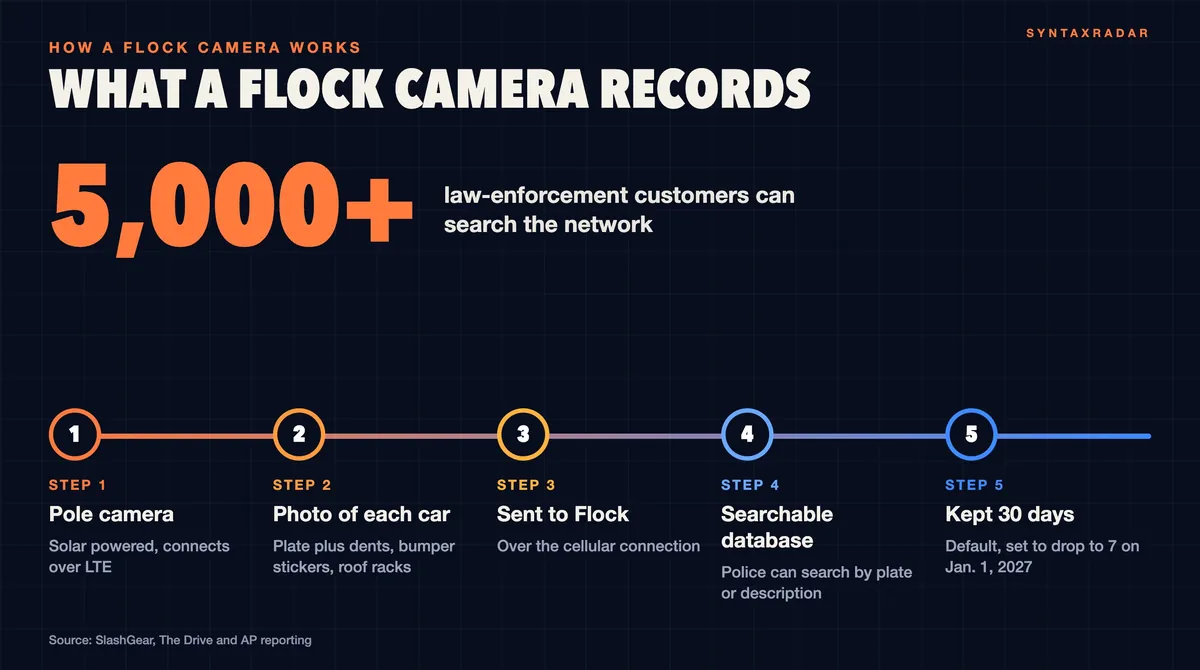
Those counts come from volunteers and are unofficial. Flock does not publish its deployment numbers, so nobody outside the company knows the exact total. What is public: Flock has more than 5,000 law-enforcement customers.
How do Flock cameras work?
Flock cameras are mounted on poles, are generally solar powered and connect over LTE, a cellular connection.
Flock cameras transmit data over the cellular connection. They send what they capture over the cellular connection to Flock's system, where police and other customers log in to search it. The camera on the pole is just the eye. The database is the product.
How do Flock cameras read license plates?
The camera takes an image of each passing vehicle, and software reads the plate characters from the picture so the record can be searched by plate. But Flock goes further than the plate. Its system also logs details like dents, bumper stickers and roof racks, which Flock calls a "Vehicle Signature."
That matters because it means a car can be found even without a clean plate read. Flock's FreeForm feature lets users search in natural language, typing a description of a car instead of a plate number, according to SlashGear's reporting.
What are Flock cameras used for, and who can search the data?
Police use Flock cameras to find vehicles by searching the plates and details the network has logged. Supporters point to results. Ramsey County Sheriff Bob Fletcher told FOX 9 he saw a "marked decline" in carjackings and stolen vehicles over three years of using Flock.
Access is where it gets complicated. Non-police customers, like a business or HOA, do not share their data with police by default, but they can choose to share it with anyone. And the ACLU found that Flock keeps the right to share data even when police departments opt out, SlashGear reports.
Retention is the other lever. Flock keeps data for 30 days by default. The AP reported that Flock plans to cut standard retention to 7 days starting Jan. 1, 2027, with longer storage for evidence tied to a case number. Keeping data up to one year requires approval from an elected official or governing body.
State law can be stricter than the vendor's default. In Minnesota, police must destroy ALPR data within 60 days unless it is tied to an active investigation.
Why Flock cameras raise privacy concerns
Flock cameras are controversial because a network this large turns individual snapshots into a record of where people go. One photo at one intersection is not much. Thousands of cameras, all searchable from one login, can sketch out someone's routine.
The documented misuse is the sharpest argument. More than a dozen cases of officers using Flock to stalk people have been documented, according to SlashGear. In one case brought by the Institute for Justice, two Virginia residents were tracked 526 and 849 times over four months.
Then there is the sharing problem described above. If a camera owner can share with anyone, and the vendor keeps its own sharing rights, a city council that thinks it controls its data may control less than it believes.
None of this means the cameras do nothing useful. The Ramsey County numbers are the case for them. The argument now is over who gets to see that data, and it is being settled one city council vote at a time.
Can a city cancel Flock?
Yes, a city can cancel Flock, but the Minnesota cases show that ending the contract and getting the cameras off the poles are two very different things. The key detail in Plymouth: its police chief said the cameras belong to Flock, not the city.
Plymouth: the chief unplugs the cameras
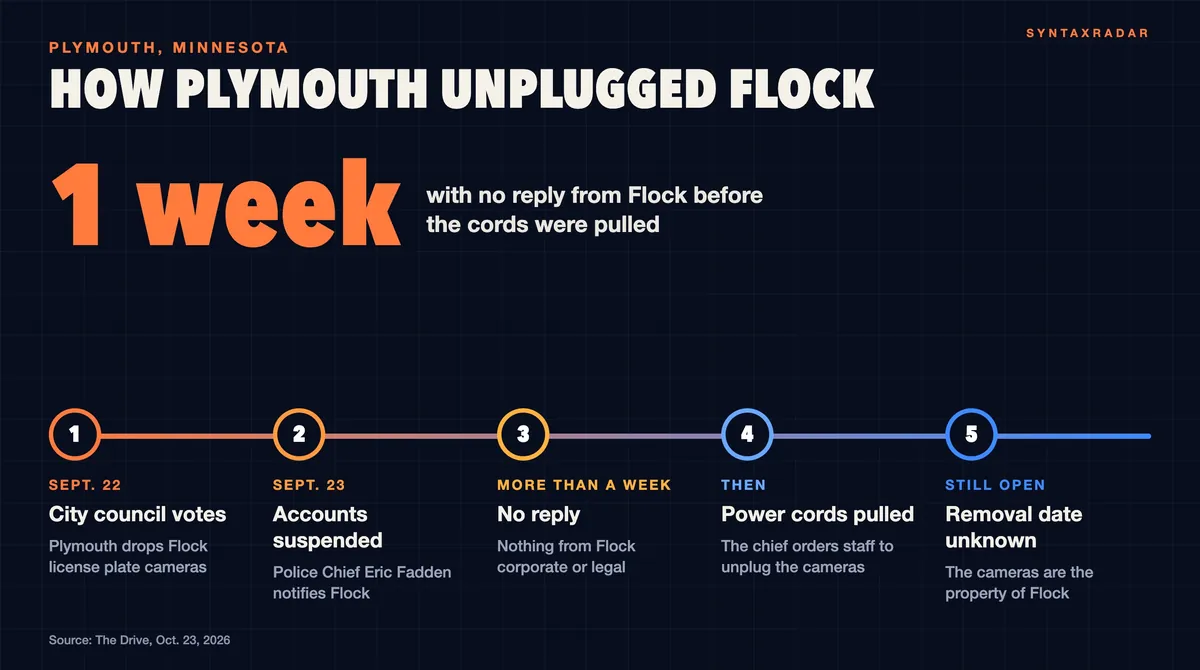
Plymouth's city council voted to discontinue Flock at its Sept. 22 meeting. On Sept. 23, Police Chief Eric Fadden suspended every Plymouth user account and notified Flock, according to The Drive.
Fadden said the city heard nothing back from Flock corporate or legal. After more than a week, he ordered staff to disconnect the cameras' power cords. "The cameras are the property of Flock," he said, and he had no firm timeline for their removal. The Drive's reporter, Joel Feder, checked two Plymouth cameras and found the cords unplugged. Flock did not respond to multiple requests for comment.
Dayton, Crystal and beyond
Dayton went a different way. On Sept. 18 the city told Flock the program was on hold and no work orders should be completed, BroBible reports. A camera was later found back in service, and a second location was identified. City Administrator Zach Doud told KARE 11 that Flock said removal would take 60 days.
In Crystal, Police Chief Pete Underthun personally removed the cameras and poles after the city voted to discontinue the service. Elsewhere in Minnesota, Columbia Heights voted in June to cancel and remove 12 cameras, and St. Paul removed two cameras in August, per FOX 9.
It is not only cities. Elgin Community College in Illinois covered its six Flock cameras with zip ties and black trash bags after the company reportedly refused to remove them.
The practical lesson for any council: who owns the poles and what the removal clause says matter as much as the vote itself.
How to find Flock cameras near you on a map
To check whether any are near you, the best public tools are the crowdsourced projects SlashGear cited: DeFlock and FlockHopper. Each keeps a Flock cameras map built from volunteer reports, and together they account for the 132,000-plus camera counts above.
Treat them as a strong guide that is probably incomplete. Because Flock does not publish its deployment numbers, volunteers can miss units, and cameras move or get unplugged, as Plymouth shows.
Your other route is local government. Plymouth's cancellation, for example, was a council vote on Sept. 22. If your city uses Flock, the contract, the retention setting and the sharing rules are fair questions to ask a council member.
What to watch next
So, what are Flock cameras in one line? A privately owned, cellular-connected network of plate readers that more than 5,000 law-enforcement customers can search, and that cities are now learning is harder to leave than to join.
Three things are worth watching. First, Jan. 1, 2027, when Flock's default retention is set to drop from 30 days to 7. Second, whether Flock removes the Plymouth and Dayton cameras or answers the cities publicly. Third, whether more councils copy Minnesota, and whether new contracts start spelling out who removes the hardware and how fast.
Questions readers ask
What are Flock cameras and why are they controversial?
Flock cameras are automated license plate readers that log passing cars, plus details like dents and bumper stickers, into a searchable database. Critics point to more than a dozen documented cases of officers using Flock to stalk people, and to an ACLU finding that Flock keeps the right to share data even when police departments opt out.
How long do Flock cameras keep data?
Flock keeps data for 30 days by default. The AP reported it plans to cut standard retention to 7 days starting Jan. 1, 2027, with longer storage for evidence tied to a case number. Keeping data up to a year needs approval from an elected official or governing body. Minnesota law separately requires police to destroy ALPR data within 60 days.
Can a city cancel Flock?
Yes, cities can vote to cancel, but removal is another matter. Plymouth, Minnesota canceled in September, heard nothing from Flock for more than a week, and its police chief had the cameras unplugged. In Dayton, a camera came back into service after the city paused the program, and Flock said removal would take 60 days.
How can I find Flock cameras near me?
Use crowdsourced maps such as DeFlock and FlockHopper, which counted about 133,000 and 132,000 ALPR cameras in the contiguous US as of August 2026. They are volunteer-built, so they can miss units. Flock does not publish its deployment numbers, so asking your city about its contract is the other route.
Written by
Abdul Rehman
Lead Systems Architect and Technical Director at Syntaxradar. More in Emerging Tech.
More in Emerging Tech
See all
Is Instacart Better Than DoorDash? What the $17B Deal Changes
DoorDash agreed on Oct 29, 2026 to buy Instacart for $65 a share, a 26% premium and about $17 billion in equity value, at least 75% in cash. Closing is expected at the end of 2027…
Oct 31, 2026 · 7 min read

AI Bubble Pop? 5 Warning Signs Behind Big Tech's $740B Bet
Alphabet fell 12% on Oct 29, its worst day on record, after a second negative free cash flow quarter. The Nasdaq fell 2.9% the next day, S&P cut Meta's outlook to negative, and…
Oct 31, 2026 · 7 min read

Binance Hacked: How One Laptop May Have Led to a $6.36B Theft
On Oct 29, 2026, attackers drained Binance hot wallets across ten blockchains. TRM Labs counts about $6.36B stolen and links it to North Korea's TraderTraitor; Binance blames a…
Oct 30, 2026 · 8 min read
Latest stories
Front page
Linux Kernel Vulnerability CVE-2026-98432: Are You Exposed?
Abdul Rehman · Nov 2, 2026 · 6 min read

Data Center Moratorium: Why Governors Are Fighting Over It
Abdul Rehman · Nov 2, 2026 · 7 min read

DeepSeek Harness vs Claude Code: Is the Free Rival Ready?
Abdul Rehman · Nov 1, 2026 · 7 min read
AI Chatbots Election Misinformation: Wrong Districts, Fake Races
Abdul Rehman · Nov 1, 2026 · 6 min read