


Is Instacart Better Than DoorDash? What the $17B Deal Changes
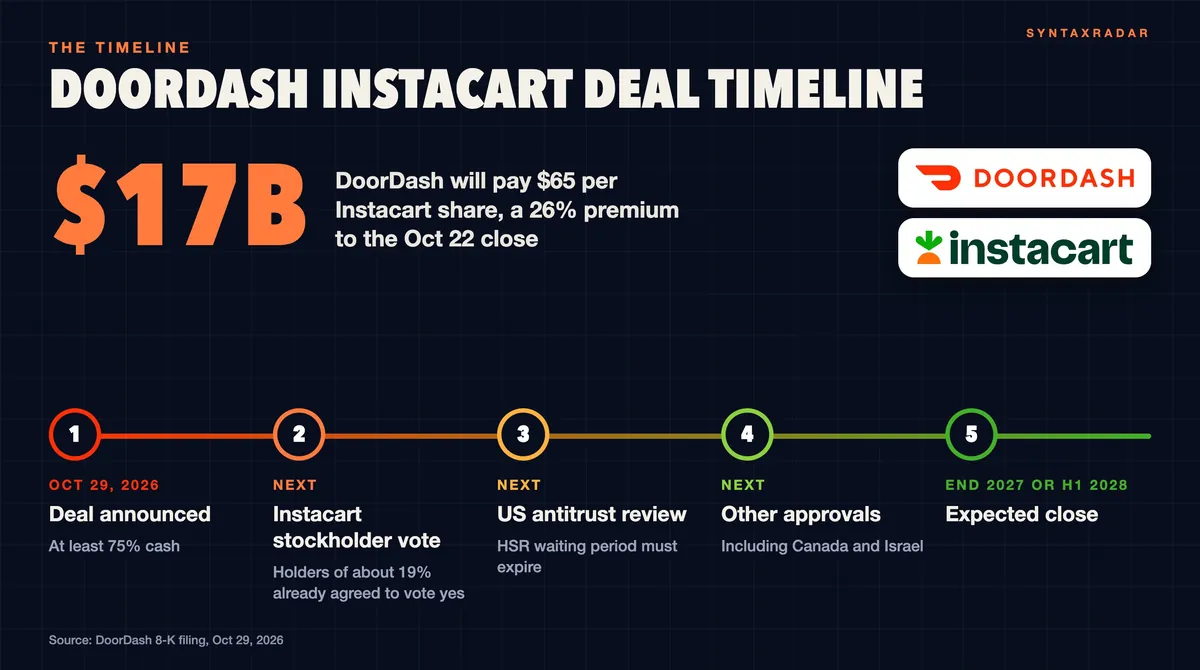
DoorDash agreed on Oct 29, 2026 to buy Instacart for $65 a share, a 26% premium and about $17 billion in equity value, at least 75% in cash. Closing is expected at the end of 2027 or first half of 2028, after a stockholder vote and antitrust review.

Abdul Rehman
Lead Systems Architect and Technical Director · · 7 min read
The short version
- $65.00 (26% premium)
- Price per Instacart share
- About $17 billion
- Equity value
- About $100M per year
- Est. member savings from one membership
Why it matters: Nothing changes in either app until the deal closes in late 2027 or 2028, so keep comparing baskets; the real shopper questions are what a combined DashPass and Instacart+ membership costs and whether fees move after regulators sign off.
Is Instacart better than DoorDash? For years that was a simple shopping question: which app gets your groceries to the door cheaper and with fewer missing items. Now there's a bigger reason to ask. DoorDash has agreed to buy Instacart for about $17 billion, so the choice between Instacart or DoorDash may eventually disappear.
The DoorDash Instacart acquisition was announced on October 29, 2026, in a press release DoorDash filed with the SEC. Nothing changes in either app today. The deal isn't expected to close until the end of 2027 or the first half of 2028, and regulators get a say first.
What happened: DoorDash agreed to buy Instacart
DoorDash will pay $65.00 for each Instacart share. According to the filing, that is a 26% premium over Instacart's closing price on October 22, 2026, and it values Instacart's equity at roughly $17 billion. Semafor first reported on October 26 that the two companies were in exclusive talks, and TechSpot and others picked up the story before the signed agreement landed three days later.
Most of the price is cash. At least 75% of the total will be paid in cash, and DoorDash stock is capped at 25%. Instacart shareholders can pick one of three options: $65 in cash, 0.3372 DoorDash shares, or a mix of $48.75 in cash plus 0.0843 DoorDash shares. If too many people pick the stock option, the elections get prorated so the overall split stays within that 75/25 limit.
DoorDash is paying with cash on hand plus new debt, backed by a 364-day senior unsecured bridge commitment from JPMorgan Chase. A bank has promised to lend the money if DoorDash needs it, so the deal does not depend on raising financing later. The filing says there is no financing condition.
Instacart's board approved the deal unanimously, and holders of about 19% of Instacart's shares have already agreed to vote in favor. The two leaders on either side are DoorDash co-founder and CEO Tony Xu and Instacart CEO Chris Rogers. Centerview advised DoorDash and Goldman Sachs advised Instacart.
Is Instacart better than DoorDash?
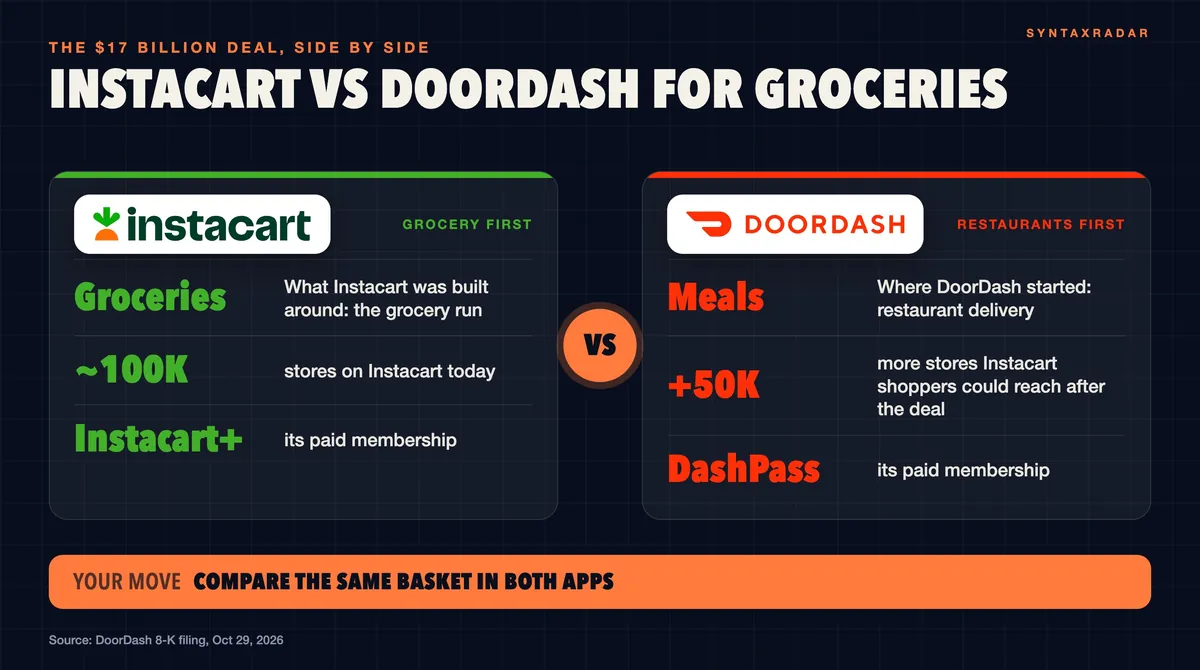
Which is better, Instacart or DoorDash? For groceries it depends on what you buy and where you live right now, because the two apps started from opposite ends of the market. Instacart was built around the grocery run: a shopper walks the aisles of a store you choose, picks your items, messages you about swaps and brings the bags to you. According to the deal filing, Instacart works with nearly 100,000 stores today.
DoorDash grew up delivering restaurant meals and later added groceries, convenience stores and other retail to the same app. Many people already open it for dinner, so adding milk and eggs to that routine is an easy step.
That leads to a practical rule of thumb for Instacart vs DoorDash for groceries today:
- A full weekly shop: Instacart's grocery focus and store selection make it the natural place to start, especially if you care about a specific supermarket.
- A few items fast: DoorDash can make sense for a small top-up order, particularly if you already pay for its membership.
- Price: fees, item prices and promotions change by store, city and membership, so whether DoorDash is cheaper than Instacart for your groceries depends on the basket; the only reliable test is to build the same basket in both apps and compare the total at checkout, tip included.
Neither app is better in every case, and the deal is partly a bet that you won't have to choose much longer.
DoorDash Instacart merger: what changes for shoppers
The filing makes two concrete promises for customers. Both are the buyer's own estimates.
Instacart vs DoorDash subscription: one membership instead of two
DoorDash and Instacart each sell a paid membership: DashPass and Instacart+. The companies plan to combine them into one fee, and they estimate that this would save members about $100 million per year in total. For anyone paying for both today, that is the most direct benefit in the announcement.
Keep the scale in mind. That $100 million is a combined figure across all members, so how much an individual household saves depends on whether it pays for one membership or two today. The filing does not say what the combined membership will cost or which perks it will keep.
More stores in the Instacart app
The second promise is about choice. According to the filing, Instacart customers could shop at more than 50,000 additional stores on top of the nearly 100,000 they can reach today. The filing does not spell out the mechanics, but the likely reading is that DoorDash's merchant network would show up inside Instacart.
What the filing does not promise matters too. It doesn't say the two apps will merge into one, whether the Instacart brand stays, or how shopper and driver pay will change. Those details tend to come later, and they are the ones that will shape your day-to-day experience.
Why is DoorDash buying Instacart?
Why is DoorDash buying Instacart? The short answer from the filing is scale in groceries. Instacart brings the deepest grocery network of the two, with nearly 100,000 stores, and DoorDash brings the 50,000-plus additional stores the filing says Instacart customers could reach.
Put them together and you get the logic of the two promises above. One membership gives customers a reason to stay inside a single company's ecosystem for both dinner and the weekly shop. A bigger store list makes that ecosystem harder to leave, because whatever you need, it is probably in there.
Technology matters here too. Both companies run the same basic machine: an app that takes the order, software that matches it to a nearby shopper or driver, and routing that tries to get the bags to you while the ice cream is still frozen. Owning both networks means one company could, over time, plan grocery and restaurant deliveries together instead of running two separate fleets that compete for the same couriers on the same streets. The filing does not lay out an engineering plan, so this is an obvious opportunity, not a stated plan.
The price tells you how much DoorDash wants this. Paying a 26% premium, mostly in cash, and lining up a bank bridge commitment so financing can't derail the deal are all signs of a buyer that wants certainty. For another example of pulling key numbers from a long filing, see our breakdown of the Anthropic IPO prospectus.
Will grocery delivery prices go up?
Will grocery delivery prices go up because of this deal? Not in the short term, because nothing has merged yet. Until the deal closes, DoorDash and Instacart remain separate companies, setting their own fees and promotions, and they keep competing for your orders.
After closing, nobody can tell you yet. The companies point to the roughly $100 million a year that members would save from a single combined membership. That is a real saving on the membership side, but it says nothing about delivery fees, service fees or item markups, which are the parts of a grocery bill most people notice.
This is exactly the question regulators are there to ask. The deal needs the waiting period under the Hart-Scott-Rodino Act to expire, which is the US process that gives antitrust agencies time to review large mergers before they close. It also needs other approvals, including in Canada and Israel, plus a vote by Instacart stockholders. That long list is why the expected closing date stretches to the end of 2027 or the first half of 2028.
For now, prices are set by the same competition you already see. If the deal clears, the combined membership price and the fees on your receipts are what to check.
Instacart or DoorDash: what to do right now
Instacart or DoorDash, the decision you make this week is the same one you made last month. Here's how to approach it while the deal works through review:
- Keep comparing baskets. Build the same order in both apps at checkout. Prices differ by store and city, and they can change from one week to the next.
- Don't rush into an annual plan. If you are deciding between DashPass and Instacart+, a monthly plan keeps you flexible while the companies work out what a combined membership looks like.
- Use the store you trust. If your favorite supermarket is only on one app, that settles it. The promise of 50,000 more stores in Instacart only applies after the deal closes.
- Watch your email. Membership and fee changes usually reach members by email, and that notice will tell you what changes for your wallet.
If you work as a shopper or driver on either platform, the same patience applies. The filing does not describe changes to how either company pays its workers, so any claim you hear about that today is speculation.
What to watch next
The next big step is the Instacart stockholder vote, which looks likely to pass given the unanimous board approval and the roughly 19% of shares already committed in favor. After that, the HSR antitrust review in the US and the approvals in Canada and Israel set the pace, and they explain why the close is expected at the end of 2027 or in the first half of 2028.
For shoppers, watch three details as they emerge: the price and perks of the combined DashPass and Instacart+ membership, whether both apps survive as separate brands, and whether the extra 50,000-plus stores really show up in Instacart. Until then, the question of whether Instacart is better than DoorDash still has the same answer it did last week: compare your own basket, because the cheaper app is the one that wins your order.
Questions readers ask
Is Instacart better than DoorDash for groceries?
It depends on the order. Instacart is built around the grocery run and works with nearly 100,000 stores, so it suits a full weekly shop at a specific supermarket. DoorDash started with restaurant delivery and often suits a quick top-up order. Because fees and item prices vary by store and city, build the same basket in both apps and compare the checkout total.
Will grocery delivery prices go up after DoorDash buys Instacart?
Nothing changes before the deal closes, expected at the end of 2027 or the first half of 2028, and the two companies keep competing until then. After that, nobody knows yet. The companies estimate members would save about $100 million a year from one combined membership, but the filing says nothing about future delivery fees, service fees or item prices.
Why is DoorDash buying Instacart?
The filing points to scale in groceries. Instacart brings nearly 100,000 stores and DoorDash adds more than 50,000 others, and the plan is to merge DashPass and Instacart+ into one membership. Together that gives one company a stronger hold on both restaurant and grocery orders, which is why DoorDash is paying a 26% premium, mostly in cash.
Will DashPass and Instacart+ become one membership?
That is the plan. The companies say they will combine DashPass and Instacart+ into one fee, which they estimate would save members about $100 million per year in total. The filing does not yet say what the combined membership will cost or which perks it keeps, and nothing changes until the deal closes and regulators approve it.
Does DoorDash own Instacart?
Not yet. DoorDash agreed on October 29, 2026 to buy Instacart for $65 a share, about $17 billion in equity value, but closing is expected at the end of 2027 or the first half of 2028, after a stockholder vote and antitrust review. Until then the two remain separate companies.
Is DoorDash cheaper than Instacart?
There is no single answer. Fees, item prices and promotions change by store, city and membership, and the deal filing gives no price comparison. Build the same basket in both apps and compare the checkout total, tip included, because that is the only reliable way to see which is cheaper for your order.
Written by
Abdul Rehman
Lead Systems Architect and Technical Director at Syntaxradar. More in Emerging Tech.
More in Emerging Tech
See all
AI Bubble Pop? 5 Warning Signs Behind Big Tech's $740B Bet
Alphabet fell 12% on Oct 29, its worst day on record, after a second negative free cash flow quarter. The Nasdaq fell 2.9% the next day, S&P cut Meta's outlook to negative, and…
Oct 31, 2026 · 7 min read
Binance Hacked: How One Laptop May Have Led to a $6.36B Theft
On Oct 29, 2026, attackers drained Binance hot wallets across ten blockchains. TRM Labs counts about $6.36B stolen and links it to North Korea's TraderTraitor; Binance blames a…
Oct 30, 2026 · 8 min read
Is a Computer Science Degree Worth It? What the 8.1% Drop Means
US undergraduate computer science enrollment at four-year colleges fell 8.1% in fall 2025 and 8.4% in spring 2026, per the National Student Clearinghouse, as overall enrollment…
Oct 29, 2026 · 7 min read
Latest stories
Front page
Xreal Aura: Should You Buy the $1,099 Android XR Glasses?
Abdul Rehman · Oct 31, 2026 · 7 min read
Claude Code Extension VSCode Backdoor: How to Check and Clean Up
Abdul Rehman · Oct 31, 2026 · 7 min read
AO3 Outage: Why Is AO3 Down, and Is Your Account Safe?
Abdul Rehman · Oct 30, 2026 · 7 min read
AI for Hacking: CrowdStrike Says ARTEX Targeted 200+ Orgs
Abdul Rehman · Oct 30, 2026 · 7 min read