


DeepSeek Harness vs Claude Code: Is the Free Rival Ready?
DeepSeek released DeepSeek Harness (dsh), an MIT-licensed open-source coding agent, as a developer preview on August 13, 2026, added desktop apps on October 2, and starts billing its agent Search and Fetch calls today.

Abdul Rehman
Lead Systems Architect and Technical Director · · 7 min read
The short version
- 267.7k
- GitHub stars (Nov 1, 2026)
- $1.20 per 1M tokens
- deepseek-flash peak output price
- $0.75 per 1,000 requests
- Search and Fetch billing from Nov 1
Why it matters: DeepSeek Harness is free software, but the model it runs on is billed, and with no published head-to-head the only trustworthy comparison with Claude Code is one you run on your own code.
DeepSeek Harness vs Claude Code is the comparison developers are searching for since DeepSeek put its own coding agent on GitHub. DeepSeek Harness (you run it with the command dsh) is free, open-source software under the MIT license, and DeepSeek presented it as an open alternative to Anthropic's Claude Code. So what does DeepSeek Harness do, what does it really cost, and should you switch?
The software costs nothing, the model behind it does, and nobody has yet published a measured head-to-head between the two tools. What exists are vendor benchmark scores for the underlying models, a pricing change that lands today, and a neat trick that lets Claude Code itself run on DeepSeek's engine.
This post covers what DeepSeek shipped, what it will cost you, and how to run a fair test on your own code before you trust anyone's leaderboard.
What is DeepSeek Harness?
DeepSeek Harness is an agent harness: the layer of software that sits around a language model and gives it hands. The model on its own can only read and write text. The harness hands it a codebase to open, a terminal to run commands in and external tools to call, then loops: the model proposes an action, the harness carries it out, and the result goes back to the model for the next step. That is the same job Claude Code does for Anthropic's models.
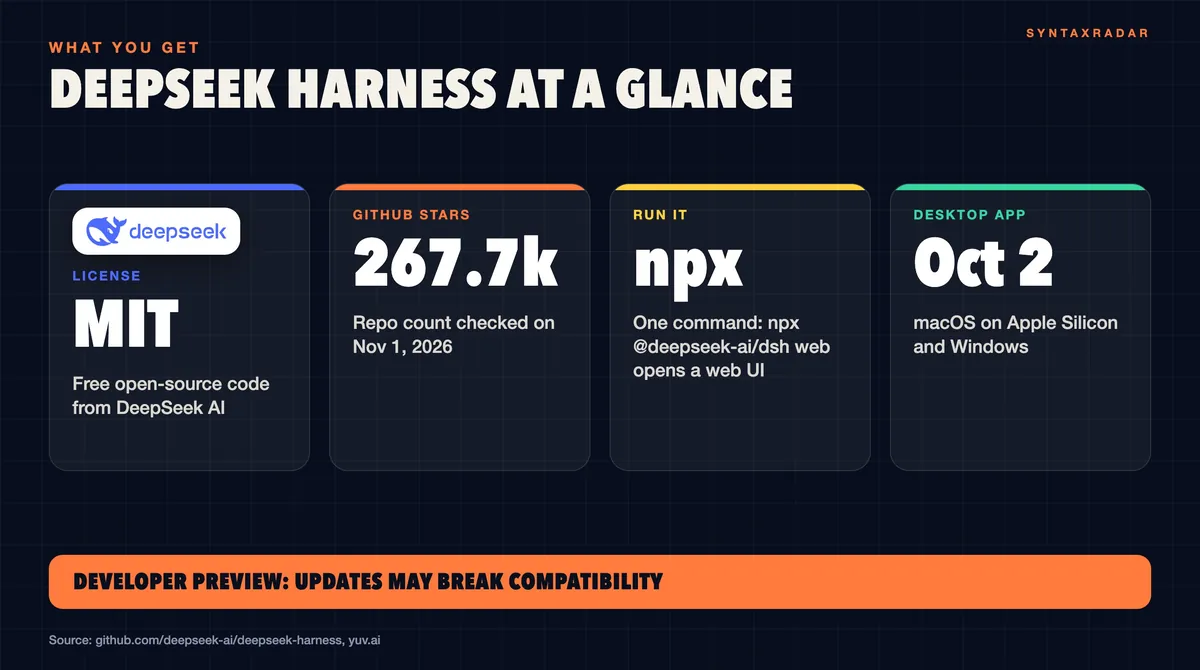
According to the deepseek-harness repository on GitHub, the project uses an "everything-is-a-plugin" architecture, so tools, commands and behaviors are add-ons you can swap. It is labeled a developer preview, and the README warns that updates may break compatibility. When we checked on November 1, 2026, the repo showed 267.7k stars, 32.5k forks and 24,922 commits, which is a lot of attention for a tool that is less than three months old.
The timeline is short. DeepSeek reportedly formed a team to build Harness in May 2026. On August 12, Bloomberg reported that DeepSeek was preparing to compete with Claude Code, and the company set up a "DeepSeek Harness Team" WeChat account, according to PYMNTS. The next day DeepSeek announced Harness v0.1 alongside its V4 Pro model, as Forklog reported.
What is Cordis in DeepSeek Harness?
Cordis is the engine underneath. The README says Harness is powered by Cordis, which is described in a paper titled "A Programming Paradigm for Spatiotemporal Composability" (arXiv 2608.25512). The repo does not say much more than that, so if you want the theory, the paper is the place to read it.
How to install DeepSeek Harness and the desktop app
You need Node.js. One command starts it: npx @deepseek-ai/dsh web opens a web interface at http://127.0.0.1:3080 in your browser. Add --no-open if you would rather open the page yourself. To build from source, clone the repo, then run pnpm install, pnpm run build and pnpm dsh web.
If you prefer an app window over a browser tab, DeepSeek Harness desktop builds shipped on October 2, 2026 for macOS on Apple Silicon and for Windows, per yuv.ai's write-up. The sources list no other desktop platforms; the npx route above is the documented way to run it elsewhere.
As for whether DeepSeek Harness is safe to run, the same caution applies as to every coding agent: it can run commands on your machine. Start it in a throwaway project, read what it asks to execute, and check any plugin before you install it. Our guide on the Claude Code extension backdoor walks through why add-ons for coding tools deserve that scrutiny.
Is DeepSeek Harness free?
Yes, the harness is free: MIT-licensed open-source code you can download, modify and run. What you pay for is the model it talks to, billed per token through DeepSeek's API.
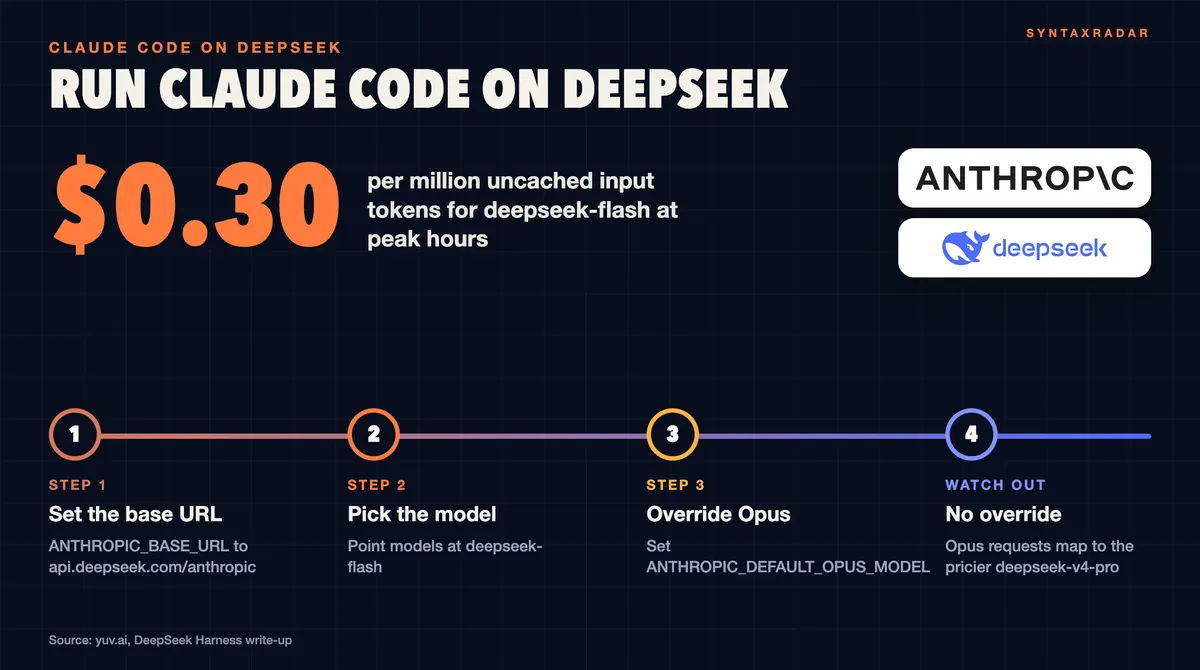
The yuv.ai article lists peak-hour pricing for the deepseek-flash model at $0.30 per million uncached input tokens, $1.20 per million output tokens and $0.006 per million cached input tokens, with off-peak hours at half price. That model is tied to DeepSeek-V4.1-Flash-1017, which the article describes as 763 billion total parameters with a 1 million token context window and open weights under MIT.
The peak and off-peak split itself is newer than many users realize. It took effect on August 16, 2026, according to Forklog, and one X user called it "basically a 2x price increase." That is one person's reading, not a DeepSeek figure, but it is a reminder to check what hours your team actually works.
The bigger change starts today. Search and Fetch calls (the tools an agent uses to look things up on the web) have been free through the DeepSeek API whether you called them from DSH, Claude Code or Codex. From November 1, 2026 at midnight Beijing time, they are billed at $0.75 per 1,000 successful requests. An agent that searches often during a long task can rack those up quickly, so watch your first invoice.
Can Claude Code run on DeepSeek's engine?
It can, and this is what most people looking for a DeepSeek Harness Claude Code plugin actually want. You do not need a plugin at all: DeepSeek exposes an Anthropic-compatible endpoint, so Claude Code keeps its familiar interface while DeepSeek's model does the thinking.
Per yuv.ai, you set ANTHROPIC_BASE_URL to https://api.deepseek.com/anthropic and point the models at deepseek-flash. There is a catch. Requests for "claude-opus" models are mapped to the pricier deepseek-v4-pro unless you also set ANTHROPIC_DEFAULT_OPUS_MODEL. The snippet below shows only the settings the sources name; DeepSeek's and Anthropic's docs list the rest, including authentication. If you forget the override, any step that asks for the heavyweight model quietly bills at the higher rate.
export ANTHROPIC_BASE_URL="https://api.deepseek.com/anthropic"
export ANTHROPIC_DEFAULT_OPUS_MODEL="deepseek-flash"
claude
This setup is useful for testing, because it separates two questions that usually get tangled. Swapping the model inside Claude Code tells you how much the model matters. Running DSH on the same model tells you how much the harness matters.
DeepSeek Harness vs Claude Code benchmark: what the numbers say
No one has published a benchmark that measures both tools on the same tasks. Neither Forklog nor yuv.ai reports one. The scores circulating online describe models, and they come from the companies selling them, so they cannot settle whether DeepSeek is better than Claude for coding.
For V4 Pro, DeepSeek reports 87.9 on Terminal Bench 2.1, 62.7 on DeepSWE and 74.1 on Toolathlon-Verified, according to Forklog. V4 Pro also launched with native Responses API support, Codex integration and three reasoning levels (low, high and max). For the Flash model, yuv.ai cites vendor-published Terminal-Bench 4.0 results rising from 31.2 to 42.3, against 51.8 for Anthropic's Opus 5.
Read those numbers with care. They are self-reported, they use different benchmark versions, and a model score says little about how a particular harness plans work, recovers from errors or asks before deleting files. On the figures we have, Flash trails Opus 5 on that one test. Whether the gap matters depends on what you pay and what you build, which only your own test can show.
DeepSeek Harness vs Claude Code vs OpenCode: how to run a fair test
The same gap applies if you add OpenCode or Codex to the comparison: we found no sourced test of DeepSeek Harness vs Claude Code vs Codex, or of any three-way lineup. You can still run a useful one in an afternoon, because Claude Code and Codex can both talk to DeepSeek's API.
A fair test keeps everything constant except the thing you are measuring:
- Same model. Point every harness at
deepseek-flashfirst, so differences come from the harness. Then rerun Claude Code on Anthropic's own model to see what the model adds. - Same tasks. Pick five to ten real tickets from your own repo: a bug fix, a small feature, a refactor, a failing test. Public benchmarks may already sit in a model's training data.
- Same starting point. Reset the repo to the same commit before each run, with identical instructions.
- Score what matters to you. Did the tests pass? How many times did you have to step in? How many tokens and Search or Fetch calls did it use, now that those are billed?
- Note the rough edges. DSH is a developer preview, so log crashes and breaking updates separately from bad answers.
If you want a broader sense of where these tools are heading, our explainer on computer-use AI agents covers the next step: agents that operate whole desktops.
What to watch next
The DeepSeek Harness vs Claude Code question will look different in a few months. Watch for an independent benchmark that runs both harnesses on the same model and tasks, since that is the missing piece today. Watch the first bills under the new Search and Fetch pricing, which will show whether DeepSeek's low token prices hold up for agents that browse a lot.
Watch, too, how quickly DSH leaves developer preview. Breaking changes are acceptable in a side project and costly in a team workflow, and a stable release is the signal that it is ready for the second kind of use.
In code
export ANTHROPIC_BASE_URL="https://api.deepseek.com/anthropic"
export ANTHROPIC_DEFAULT_OPUS_MODEL="deepseek-flash"
claudeQuestions readers ask
Is DeepSeek Harness better than Claude Code?
Nobody has published a measured comparison of the two tools on the same tasks, so there is no evidence either way yet. The scores you see online describe the underlying models and come from the vendors. The most reliable answer comes from running both on the same model and the same real tickets from your own repository.
Is DeepSeek Harness free?
The harness is free, open-source software under the MIT license. You pay for the model it calls through DeepSeek's API. At peak hours deepseek-flash costs $0.30 per million uncached input tokens and $1.20 per million output tokens, with off-peak at half price. Search and Fetch calls cost $0.75 per 1,000 successful requests from November 1, 2026.
How do I install DeepSeek Harness?
Install Node.js, then run npx @deepseek-ai/dsh web. That opens a web interface at http://127.0.0.1:3080, and adding --no-open stops it from launching your browser. You can also clone the repo and build it with pnpm. Desktop apps for Apple Silicon Macs and Windows have been available since October 2, 2026.
What is Cordis in DeepSeek Harness?
Cordis is the framework that powers DeepSeek Harness, according to the project's README. It is described in a research paper titled "A Programming Paradigm for Spatiotemporal Composability", published as arXiv 2608.25512. The README gives few further details, so the paper is the best place to learn how it works under the hood.
Written by
Abdul Rehman
Lead Systems Architect and Technical Director at Syntaxradar. More in Developer Tools.
More in Developer Tools
See all
Claude Code Extension VSCode Backdoor: How to Check and Clean Up
Phorion reports that Claude Code for VS Code 2.1.313 on the Cursor Marketplace hid a backdoor that planted an SSH key, opened a reverse tunnel and beaconed system details. Cursor…
Oct 31, 2026 · 7 min read
AO3 Outage: Why Is AO3 Down, and Is Your Account Safe?
AO3 went offline on Oct 29, 2026 under a maintenance notice, and OTW estimated 2 to 4 weeks to restore it. On Oct 30 OTW said it had detected evidence of a security incident, that…
Oct 30, 2026 · 7 min read
Tmux Ghostty Guide: What 1.4 Changes and Who Should Switch
Ghostty 1.4.0 shipped on October 27, 2026 after seven months of work by 172 contributors. It parses plain text up to 5.7x faster, cuts idle scrollback memory by 70% to 90%, adds…
Oct 28, 2026 · 7 min read
Latest stories
Front page
AI Chatbots Election Misinformation: Wrong Districts, Fake Races
Abdul Rehman · Nov 1, 2026 · 6 min read
Is ChatGPT Safe? How Three Small Bugs Could Expose Your Chats
Abdul Rehman · Nov 1, 2026 · 7 min read
Why Is RAM Prices Going Up? The AI Memory Squeeze Explained
Abdul Rehman · Nov 1, 2026 · 7 min read

Is Instacart Better Than DoorDash? What the $17B Deal Changes
Abdul Rehman · Oct 31, 2026 · 7 min read