


Is ChatGPT Safe? How Three Small Bugs Could Expose Your Chats
Parameter researchers chained three ChatGPT web flaws so injected code ran in a signed-in session and could read up to 20 recent private chats. Reported Oct 18, fixed Oct 26, $5,000 bounty. No in-the-wild exploitation reported.

Abdul Rehman
Lead Systems Architect and Technical Director · · 7 min read
The short version
- Up to 20
- Recent chats the proof of concept could list
- 8 (Oct 18 to Oct 26)
- Days from report to full fix
- $5,000
- Bug bounty paid
Why it matters: A researcher-found bug chain could have let a malicious page read your private ChatGPT chats, but OpenAI fixed it before disclosure and no real-world attacks are reported.
Is ChatGPT safe? Mostly yes, but a researcher write-up published on October 28 shows how close it came to not being. Security researchers at Parameter say they chained three small web bugs in ChatGPT so that code they controlled could run inside a victim's signed-in session and read that person's private conversations. OpenAI fixed it on October 26, before the details went public.
There is no sign anyone used it against real users. The researchers' write-up describes a proof of concept they ran themselves, and it reports no in-the-wild exploitation. Still, it is a sharp answer to the question people keep typing into Google: is ChatGPT safe to use when you pour your work, health questions and half-finished ideas into it?
By the end of this piece you will understand how three harmless-looking flaws added up to account-level access, what was and was not exposed, what OpenAI changed, and a short checklist for opening and sharing ChatGPT links without worrying.
What happened: three ChatGPT bugs, one chain
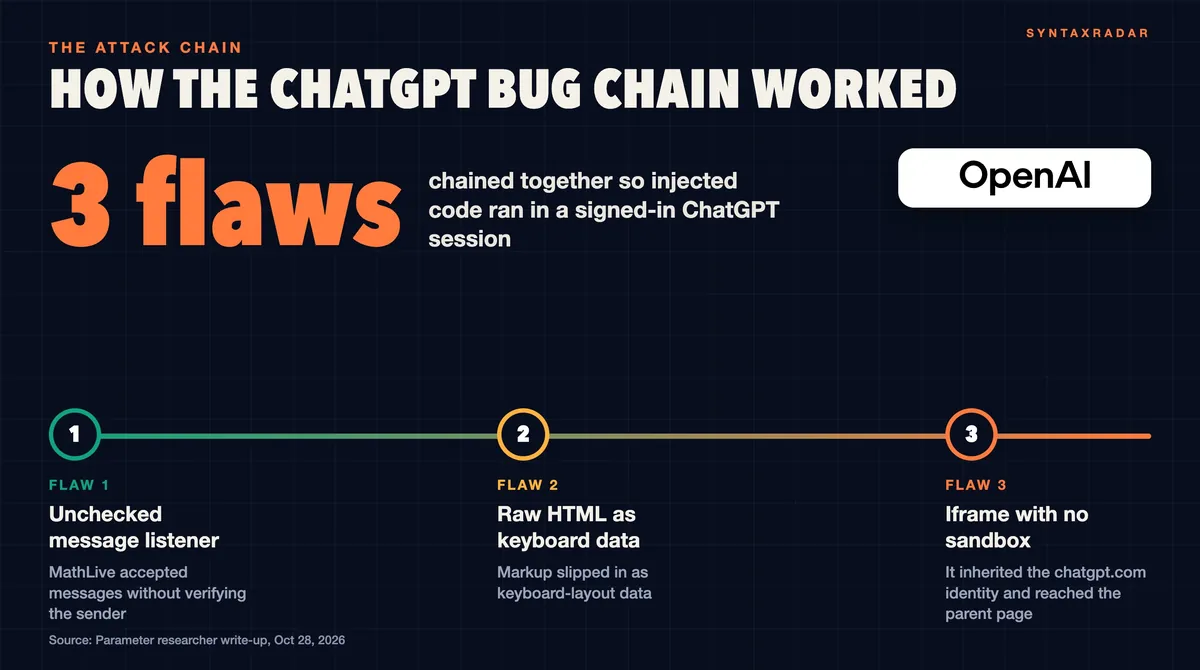
Each of the three ChatGPT security issues looks minor on its own. According to the write-up, one lived in MathLive, a math editor component. One was about how that editor accepted data. One was about how an embedded frame on the page was set up.
Chained together, they let injected code run with "the same authenticated access as the normal frontend," in the researchers' words. In plain terms, the code could do what the ChatGPT website itself does on your behalf while you are logged in.
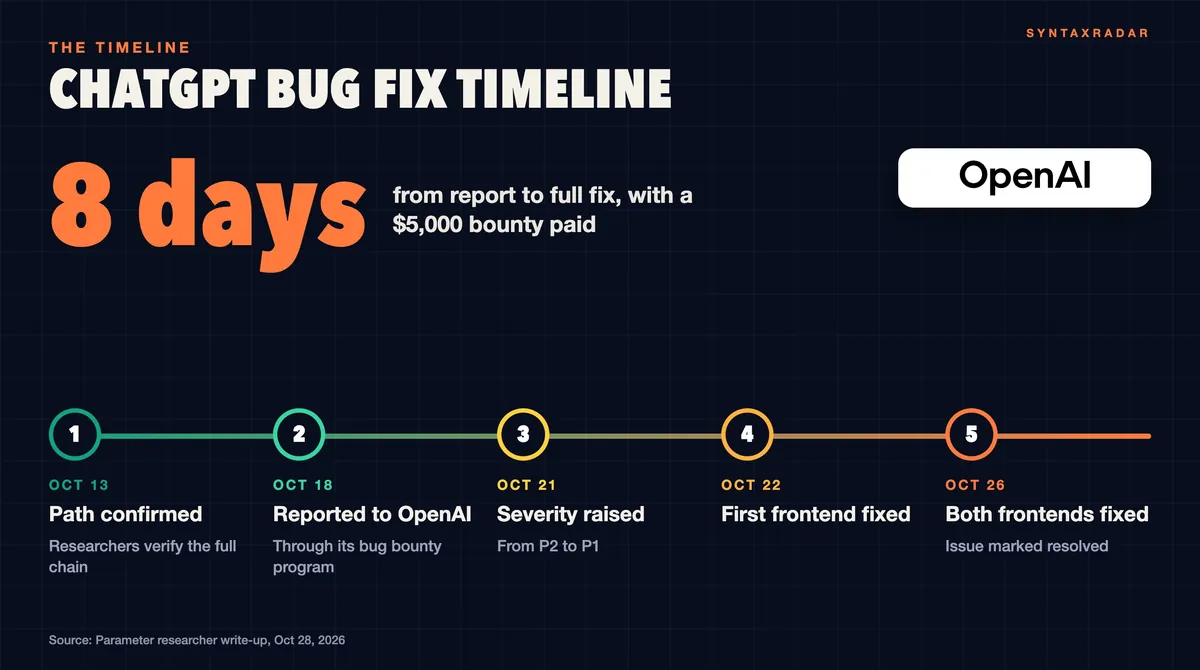
The researchers confirmed the full path on October 13 and reported it to OpenAI's bug bounty program on October 18. Ten days later, with the fix in place, they published the details.
How the attack worked, in plain English
Think of the ChatGPT page in your browser as an office building. Different parts of the page are rooms, and they pass notes to each other. The security of the building depends on every room checking who wrote a note before acting on it, and on visitors being kept in a lobby instead of wandering into the offices.
The chain broke both rules.
Flaw 1: a mailbox that accepted notes from anyone
Web pages can send each other messages. The safe pattern is to check where a message came from before doing anything with it. According to the researchers, MathLive's message listener accepted messages that changed its state without verifying the sender's origin or the window it came from. So a page the attacker controlled could send it instructions, and it would follow them.
Flaw 2: raw HTML hiding inside keyboard settings
The second problem was what those messages could carry. The write-up says the message format allowed raw HTML to be supplied as keyboard-layout data. A keyboard layout should be a boring list of keys. Accepting raw HTML there meant an attacker could slip in markup, and with it, code.
Flaw 3: a frame with no walls
Browsers let a page embed another document in an iframe, a box within the page. Developers can add a sandbox attribute that strips that box of powers, like keeping a visitor in the lobby. According to the researchers, one iframe was created without a sandbox attribute, so it inherited the chatgpt.com identity. That let the injected code reach the parent page, the real ChatGPT interface.
Put the three together and you get the chain: an unchecked mailbox, a payload smuggled in as keyboard data, and a frame that let the payload walk straight into the signed-in app.
Is ChatGPT safe for privacy? What an attacker could actually see
The biggest of the ChatGPT security concerns here is privacy. According to the write-up, the injected code could list up to 20 of the victim's recent conversations and pull out private conversation content the victim had never shared with anyone.
That matters because of what people put in chats. Drafts of contracts, code from work, symptoms they would not tell a coworker, salary numbers. A recent-chats list is a fairly complete picture of someone's week.
The researchers go further in one claim: they say the code could perform any action on the victim's account, because it ran with the same access as the website itself. But they are careful to say their proof of concept was limited to conversation data. So the demonstrated harm is reading chats. Anything beyond that is the researchers' assessment of what was possible, not something they showed.
It is also worth being clear about what the write-up does not say. It does not report that any real user was attacked, and the flaws sat in the ChatGPT web page itself. For another recent look at how attackers operate, see our piece on AI for hacking and the ARTEX campaign.
Is ChatGPT secure now? What OpenAI fixed and when
Yes, as far as this bug goes. The researchers' timeline, as published in their disclosure, runs like this:
Eight days from report to full fix is a reasonable turnaround, and the bump from P2 to P1 tells you OpenAI judged it more serious after reproducing it. The researchers say they were paid a $5,000 bounty in total.
So how secure is ChatGPT? No large web app is ever finished being secure. What this episode shows is a working process: an outside team found a real flaw, reported it to the bug bounty, OpenAI confirmed it within days, and the fix shipped before the public write-up. That is how responsible disclosure is supposed to work.
There is a fair critique, too. By the researchers' description, the missing pieces were ordinary web-security checks: an origin check, HTML filtering and a sandbox attribute. If you follow developer-tool security, our write-up on the Claude Code VS Code extension backdoor covers a different kind of risk.
Is ChatGPT safe to use? A short checklist
For most people the honest answer is the same as for email or cloud documents: safe enough for everyday work, as long as you treat it like an account that holds sensitive data. That is exactly what this bug showed it is.
How safe is ChatGPT for you specifically depends on what you put in it. A few habits cut the risk a lot:
- Be wary of unexpected links while signed in. According to the researchers, the attack ran in the victim's logged-in session. Opening odd links in a separate browser profile, or a window where you are not logged in to ChatGPT, limits what any similar bug could reach.
- Review your chat history. If a conversation holds something you would hate to see leaked, consider deleting it rather than keeping it forever.
- Think before pasting secrets. Passwords, API keys and client data are better kept out of any chat tool.
- Secure the account itself. A strong, unique password and multi-factor authentication are sensible protection for any account that holds private chats.
None of these would have been required to stay safe here, since the bug was fixed before it was public. They are the habits that make the next bug matter less.
How to share a ChatGPT conversation safely
To be clear, the researchers do not tie this bug to a ChatGPT share link or to ChatGPT shared links in general. Their chain ran through the math editor and an iframe, as described above. Still, the attack was built around a crafted link opened in a signed-in session, so link habits are worth a moment of thought:
- Check where a link goes. If someone sends you a link that claims to be a shared chat, confirm it points to chatgpt.com before you click while signed in.
- Strip private details before you share. Names, figures and internal notes do not belong in anything you pass along. Start a fresh chat with only what you want to show.
- Share with people, not the public web. Post a link only where you are comfortable with anyone who finds it opening it.
For the exact steps to share a conversation, use ChatGPT's own help pages, since the interface changes.
What to watch next
Three things are worth tracking. First, whether OpenAI publishes its own note on the bug; so far the researcher write-up is the only detailed account, so every claim here rests on it. Second, whether other apps that embed the same math editor find the same unchecked-message pattern. Third, whether the industry moves toward sandboxing every embedded frame by default.
So, is ChatGPT safe? Safer since October 26. The bug was real, the fix is in, and nobody is reported to have been hit. The lesson for users is simple: treat your chat history like your inbox, because to an attacker it is worth about the same.
Questions readers ask
Can I keep using ChatGPT after this bug?
Yes, for this specific issue. According to the researchers, OpenAI fixed both ChatGPT frontends by October 26, before the write-up was published, and the write-up reports no in-the-wild exploitation. Treat ChatGPT like any account holding sensitive data: use a strong password and multi-factor authentication, and keep secrets such as passwords and API keys out of your chats.
Were my ChatGPT chats exposed?
There is no report that they were. The write-up describes a proof of concept the researchers ran themselves, which could list up to 20 recent conversations and read private content. It reports no attacks on real users. If you are still worried, review your chat history and delete conversations that hold anything you would not want leaked.
Can ChatGPT chats expose my personal information?
The bug put personal information at risk in one specific way. According to the researchers, injected code could list up to 20 recent conversations and read private content. OpenAI fixed it on October 26, and the write-up reports no in-the-wild exploitation. Keep personal details out of chats you would not want leaked, and delete old conversations.
Is chat GPT safe to use for work data?
It can be, with care. This bug showed that your chat history is valuable to attackers because it ran with the same access as the ChatGPT website itself. Avoid pasting passwords, API keys or confidential client data, follow your employer's policy on AI tools, and delete sensitive conversations you no longer need instead of keeping them forever.
Are ChatGPT shared links part of this bug?
No. The researchers do not tie this bug to ChatGPT shared links. Their chain ran through the MathLive math editor, raw HTML hidden in keyboard-layout data and an iframe without a sandbox attribute. Links still deserve care: confirm a link goes to chatgpt.com before opening it while signed in, and strip private details from anything you share.
Written by
Abdul Rehman
Lead Systems Architect and Technical Director at Syntaxradar. More in AI & Models.
More in AI & Models
See all
AI for Hacking: CrowdStrike Says ARTEX Targeted 200+ Orgs
On Oct 29, 2026, CrowdStrike reported that VAPOR PANDA used ARTEX, an AI agent framework running mainly on DeepSeek, to target 200+ organizations in at least 14 countries over 11…
Oct 30, 2026 · 7 min read

Mistral Large 4: What a 1-Trillion-Parameter Open Model Means
Mistral published the weights of Mistral Large 4, a 1-trillion-parameter mixture-of-experts model, on October 29 under a modified MIT license that lets anyone use and fine-tune it…
Oct 30, 2026 · 8 min read

What Is Gemini 4 Carbon? Google's Bug-Hunting AI, Explained
On October 28, 2026, Google DeepMind announced Gemini 4 Carbon, a frontier model built to find, exploit and patch software vulnerabilities. It goes first to a small group of cyber…
Oct 29, 2026 · 7 min read
Latest stories
Front page
Why Is RAM Prices Going Up? The AI Memory Squeeze Explained
Abdul Rehman · Nov 1, 2026 · 7 min read

Is Instacart Better Than DoorDash? What the $17B Deal Changes
Abdul Rehman · Oct 31, 2026 · 7 min read

AI Bubble Pop? 5 Warning Signs Behind Big Tech's $740B Bet
Abdul Rehman · Oct 31, 2026 · 7 min read

Xreal Aura: Should You Buy the $1,099 Android XR Glasses?
Abdul Rehman · Oct 31, 2026 · 7 min read