


Mistral Large 4: What a 1-Trillion-Parameter Open Model Means
Mistral published the weights of Mistral Large 4, a 1-trillion-parameter mixture-of-experts model, on October 29 under a modified MIT license that lets anyone use and fine-tune it but requires a separate license for Model-as-a-Service providers.

Abdul Rehman
Lead Systems Architect and Technical Director · · 8 min read
The short version
- 1 trillion
- Total parameters
- $0.70 / $2.10 per 1M tokens
- API price (input / output)
- 48%
- Coding Agent Index (Mistral-reported)
Why it matters: Mistral Large 4 gives anyone a downloadable frontier-scale model with commercial rights, but its 2 TB-class memory footprint and hosting-service license clause mean most people will use it through an API rather than at home.
Mistral just put a trillion-parameter AI model on the internet for anyone to download. On October 29, Mistral published the weights of Mistral Large 4, three weeks after opening a public preview through its API, according to Mistral's announcement. That means anyone can download it, inspect it and fine-tune it themselves.
But "open" is doing a lot of work in that sentence. The license has a catch for one kind of business, the trillion parameters are not all used at once, and every impressive benchmark in the launch post was measured by Mistral itself.
Below: what the model is, what the license lets you do, what it costs per token, and whether your own computer can run it.
What is Mistral Large 4?
It is a general-purpose large language model that Mistral describes as natively multimodal, meaning it was built to handle more than plain text from the start rather than having image support bolted on later. It is the successor in the line that includes the Mistral Large 3 model. Its scale is what makes this release stand out, and the release date for the weights, October 29, followed a public preview that opened on October 6.
The headline figure for the model's parameters is 1 trillion. Parameters are the numbers a model learns during training; more of them usually means more knowledge and skill packed inside, at the cost of more memory and compute to run.
The model has three reasoning modes: Low, Medium and High, with High as the default. In practice that is a dial between speed and care. Low answers quickly and spends fewer tokens thinking; High works through a problem more carefully and costs more per answer.
For developers, Mistral says the model can be served with the popular open serving tools vLLM and SGLang, and it mentions an NVIDIA NIM container and TensorRT LLM for high-throughput deployments.
How can a 1-trillion-parameter model use only about 50 billion at a time?
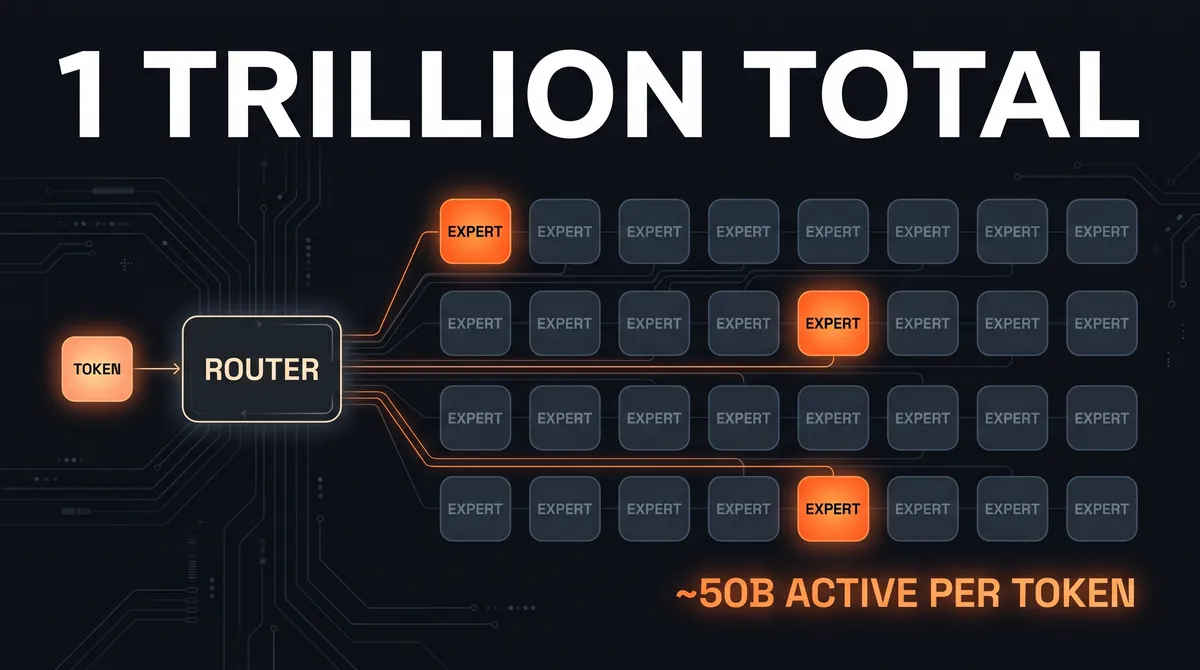
Large 4 is a mixture-of-experts model. Instead of one giant network where every parameter fires for every word, it contains many smaller specialist sub-networks, called experts, plus a router that picks a few of them for each token it processes.
So there are two numbers that matter:
- Total parameters: everything stored in the model, about 1 trillion. This decides how much memory you need to hold it.
- Active parameters: the slice actually used to produce each token. This decides how much computing each word costs.
Mistral's own launch post does not spell out the active count. The clue is in the name of the Hugging Face repository, Mistral-Large-4-1T-A52B, which by the usual naming convention reads as 1 trillion total and 52 billion active. Some earlier reports cited 49 billion, so the safe summary is roughly 50 billion active parameters per token.
A useful analogy is a large hospital. It employs thousands of specialists (total parameters), but any single patient sees only a handful of them (active parameters). The hospital still needs a building big enough for everyone, which is why the memory bill stays huge even when the work per patient is modest.
The payoff is that you get the knowledge of a very large model while paying the compute cost of a much smaller one on each token, which helps explain the API prices below.
Is Mistral Large 4 open source?
Not in the strict sense, and the difference matters if you plan to build a business on it.
Mistral released the model under what it calls the Mistral Ecosystem Open-Weight license, a modified MIT license. MIT is one of the most permissive licenses in software, and this version keeps most of that freedom: according to Mistral, you may use, modify and fine-tune the model, including for commercial purposes.
The modification is the catch. Businesses that run a Model-as-a-Service offering, meaning they host the model and sell access to it to others, must get a separate commercial license from Mistral. On that reading, a startup that builds a legal research tool on top of the model is fine, while a cloud company that wants to sell access to the model itself needs to talk to Mistral first.
That is why the accurate label is "open weights" rather than "open source," a distinction that applies to most open weight models today. Classic open source licenses do not restrict who may offer the software as a service. When people search for the best open source LLM, they often mean "a model I can download and run," and on that practical test Large 4 qualifies. On the stricter definition it does not.
If the distinction feels fuzzy, our explainer on what open weight models are and why they matter walks through it in more detail. The short version: you get the finished model, and the license still limits how you can compete with its maker. That holds for open weight AI models in general, so read the license before you read the benchmark table.
Mistral Large 4 vs GLM-5.3: what do the benchmarks say?
Every number in this section comes from Mistral's announcement and has not been independently verified. Treat it as the company's own scorecard.
The comparison Mistral leans on hardest is with GLM-5.3, another large open-weight model. On the Coding Agent Index, which tests how well a model works through programming tasks on its own, Mistral reports a score of 48%, effectively tied with GLM-5.3. The interesting claim is efficiency: Mistral says its model uses 47% fewer tokens per task on average. Fewer tokens means faster answers and smaller bills for the same result.
A few of these deserve a plain-English gloss. Terminal-Bench measures whether a model can get real work done in a command-line environment, and the jump from 28% to 41% between preview and final release is the biggest improvement Mistral reports. BrowseComp tests whether a model can hunt down hard-to-find facts on the web. FinWorkBench focuses on financial work tasks, where Mistral places itself second among open models behind Kimi K3.
On safety, Mistral cites a 51% score on Artificial Analysis's Cyber Index, a 96.6% average refusal rate on malicious cyber requests, and the 97.1% attack-resistance figure in the table.
What this adds up to: on Mistral's numbers, Large 4 is competitive with the strongest open-weight models rather than clearly ahead of them, and its main selling point is doing similar work with fewer tokens. Independent testers such as Vals AI, which lists the model, are the place to check whether that holds up.
What does Mistral Large 4 cost to use?
If you do not want to host anything, you can call the model through Mistral's API. According to the announcement, pricing is:
- $0.70 per million input tokens (what you send in)
- $0.07 per million cached input tokens (repeated input the system has already seen, such as a long instruction prompt reused across requests)
- $2.10 per million output tokens (what the model writes back)
A token is roughly a short word or a chunk of one. As a simple illustration of our own, sending a million tokens in and getting a million tokens back would cost $2.80 in total. The cached rate is a tenth of the normal input price, which rewards apps that reuse the same long system prompt over and over.
Output costs three times as much as input, so a chatty model gets expensive. That is why Mistral's claims about using fewer tokens per task matter beyond bragging rights: if they hold up, they translate directly into a lower bill. For the wider picture on how these prices have been falling, see our breakdown of LLM API pricing cuts in 2026.
Can you run Mistral Large 4 locally?
For almost everyone, no. Mistral does not publish hardware requirements, so here is our own back-of-envelope arithmetic, not a Mistral figure.
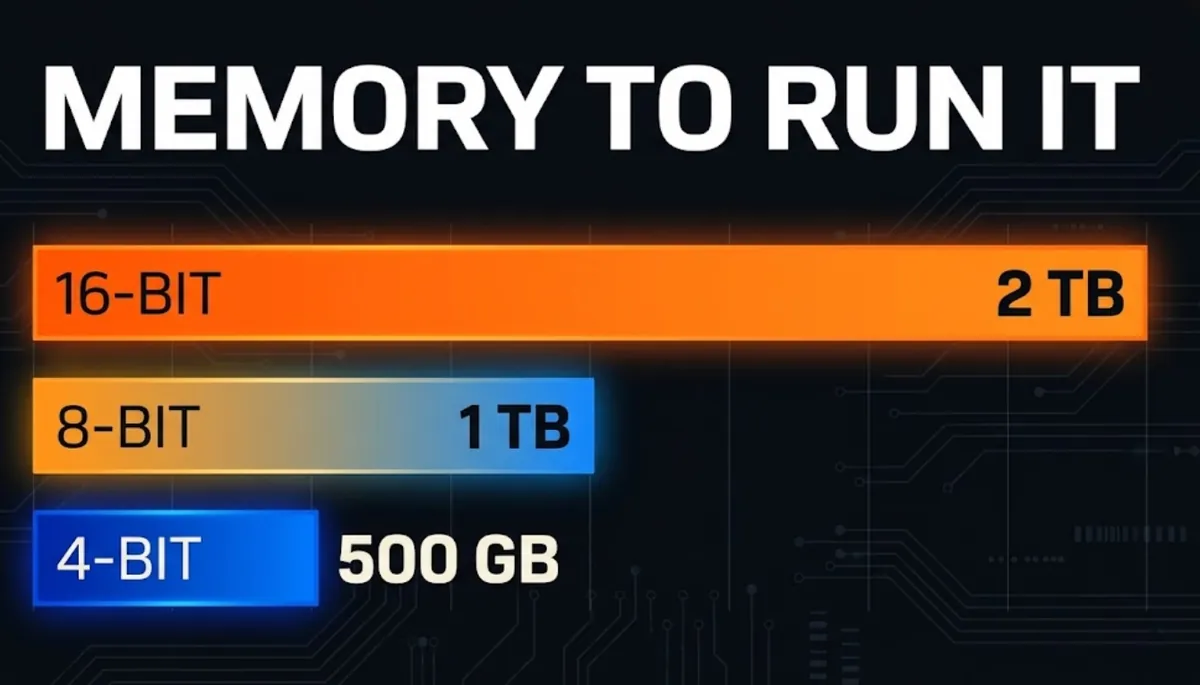
Every parameter has to sit in memory. At 16-bit precision, each parameter takes 2 bytes, so 1 trillion parameters works out to about 2 terabytes of weights. A high-end gaming graphics card has a small fraction of that, and so does a well-equipped laptop. Even compressed versions (quantized to 8 or 4 bits per parameter, which shrinks the file at some cost in quality) would by the same arithmetic still need roughly 1 TB or 500 GB.
Remember the mixture-of-experts point: only about 50 billion parameters are active per token, which keeps the compute per word manageable. But the router can pick any expert for any token, so the whole model still has to be loaded and ready. Each token uses only the active parameters, but the full set still has to sit in memory.
Realistically, this is a model for companies and research groups with multi-GPU servers, which fits with Mistral pointing to vLLM, SGLang and NVIDIA's serving stack. For an individual, the practical routes are the API or a hosting provider that has sorted out the license. If you want something on your own machine, smaller open source LLMs remain the better fit.
The real winners from the weight release are mid-sized companies that want a frontier-scale model on their own infrastructure, for privacy, compliance or customization, without sending data to someone else's API.
What to watch next
- Independent benchmarks. Every score so far is Mistral's own. Third-party results will show whether the token-efficiency claims survive outside the company's tests.
- The context window. Sources disagree: Mistral's documentation lists 1 million tokens, while Vals AI lists 512,000. Expect clarification as people test it.
- License fights. Watch how hosting companies respond to the Model-as-a-Service clause, and whether Mistral licenses resellers or keeps the API business to itself.
- Fine-tunes. With weights public, specialized versions built on it should start appearing. Early coverage from The New Stack tracked the preview; the full release is where the community takes over.
Questions readers ask
What is Mistral Large 4?
Mistral Large 4 is a natively multimodal large language model from Mistral with about 1 trillion total parameters. It uses a mixture-of-experts design, so roughly 50 billion parameters are active for each token. It offers Low, Medium and High reasoning modes and is available through Mistral's API and as downloadable weights released on October 29.
Is Mistral Large 4 open source?
It is open weights rather than classic open source. The Mistral Ecosystem Open-Weight license, a modified MIT license, allows use, modification, fine-tuning and commercial use. However, businesses that run a Model-as-a-Service offering, hosting the model and selling access to others, need a separate commercial license from Mistral.
Can you run Mistral Large 4 locally?
Not on normal consumer hardware. Mistral does not publish requirements, but by our own arithmetic 1 trillion parameters at 16-bit precision is about 2 TB of weights, and even 4-bit compression would leave roughly 500 GB. It is built for multi-GPU servers running tools like vLLM or SGLang, so individuals are better off using the API.
How does Mistral Large 4 compare with GLM-5.3?
According to Mistral, Large 4 scores 48% on the Coding Agent Index, effectively tied with GLM-5.3, while using 47% fewer tokens per task on average. These figures come from Mistral itself and have not been independently verified, so check third-party benchmark sites before treating the comparison as settled.
Written by
Abdul Rehman
Lead Systems Architect and Technical Director at Syntaxradar. More in AI & Models.
More in AI & Models
See all
AI for Hacking: CrowdStrike Says ARTEX Targeted 200+ Orgs
On Oct 29, 2026, CrowdStrike reported that VAPOR PANDA used ARTEX, an AI agent framework running mainly on DeepSeek, to target 200+ organizations in at least 14 countries over 11…
Oct 30, 2026 · 7 min read
What Is Gemini 4 Carbon? Google's Bug-Hunting AI, Explained
On October 28, 2026, Google DeepMind announced Gemini 4 Carbon, a frontier model built to find, exploit and patch software vulnerabilities. It goes first to a small group of cyber…
Oct 29, 2026 · 7 min read
Gemini 4 Carbon: Why Google's New AI Goes to Defenders First
Google announced Carbon on Oct 28, 2026, a security-focused Gemini 4 model that scores 88.2% on SEC-bench Pro and 0.0% prompt-injection success. It goes to a subset of cyber…
Oct 29, 2026 · 6 min read
Latest stories
Front page
AI Bubble Pop? 5 Warning Signs Behind Big Tech's $740B Bet
Abdul Rehman · Oct 31, 2026 · 7 min read

Xreal Aura: Should You Buy the $1,099 Android XR Glasses?
Abdul Rehman · Oct 31, 2026 · 7 min read
Claude Code Extension VSCode Backdoor: How to Check and Clean Up
Abdul Rehman · Oct 31, 2026 · 7 min read

AO3 Outage: Why Is AO3 Down, and Is Your Account Safe?
Abdul Rehman · Oct 30, 2026 · 7 min read