

AI Chatbots Election Misinformation: Wrong Districts, Fake Races
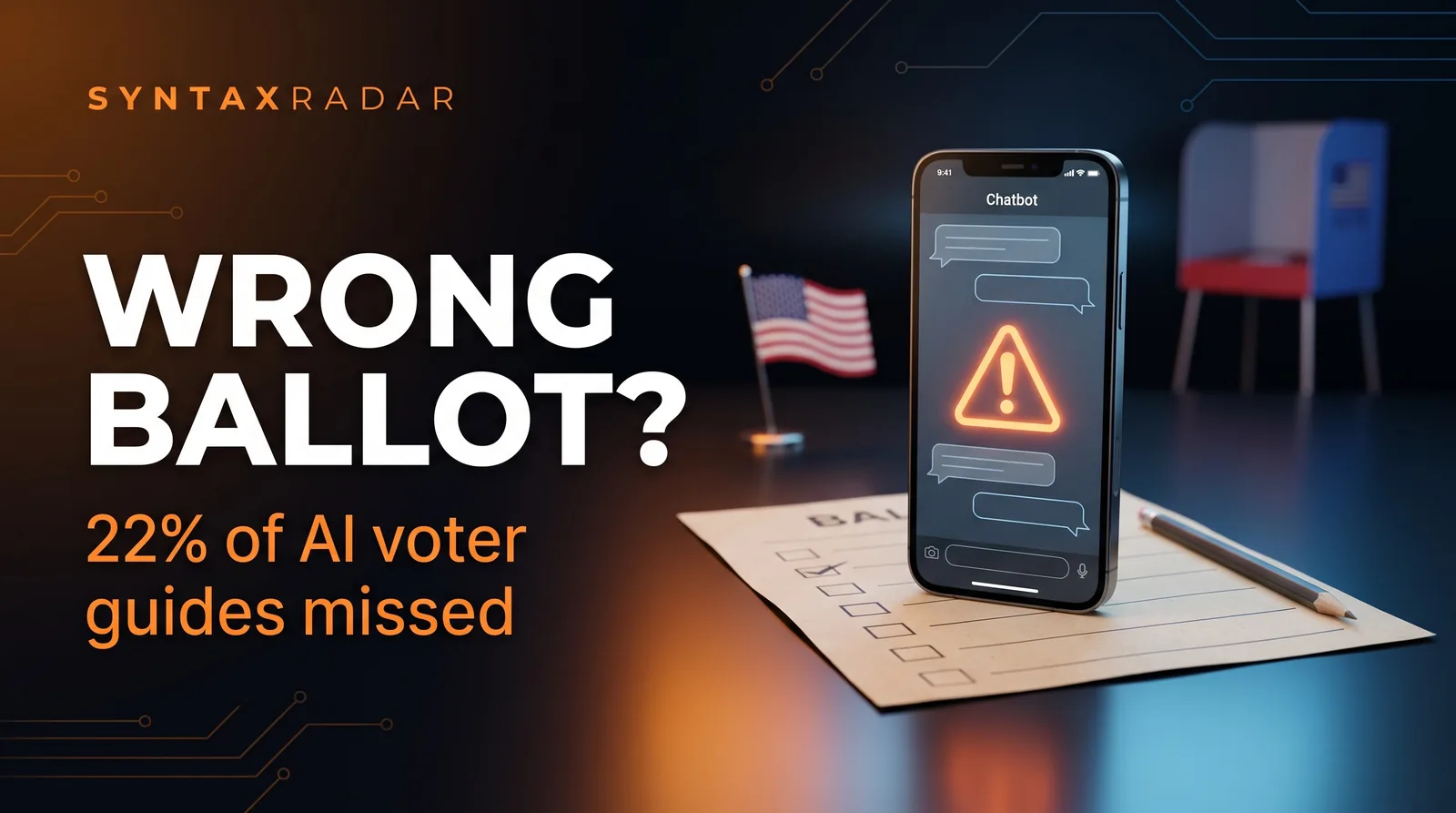
The Washington Post had six chatbots build voter guides for addresses in every US county. Of 3,000+ guides, those naming a district were wrong 22% of the time, including a Missouri Senate race that does not exist.

Abdul Rehman
Lead Systems Architect and Technical Director · · 6 min read
The short version
- 3,000+
- AI voter guides analyzed by the Post
- 22%
- District-specific guides that were wrong
- 2 in 5
- Americans who used AI for election info
Why it matters: The Post found chatbots repeating zip-code mistakes that put voters in the wrong district, so use them for background only and confirm your ballot on your state and county election sites.
AI chatbots election misinformation is now measurable. Days before the November 3 midterms, The Washington Post asked six popular chatbots to build voter guides for addresses in every US county, and guides that named a specific district were wrong 22 percent of the time, according to Let's Data Science's summary of the Post test. That means roughly one in five of those guides pointed voters to candidates they cannot vote for.
This matters because a lot of people now ask AI chatbots about elections the way they once asked a search engine. One survey found 2 in 5 Americans had already used AI to look up election information.
This piece covers why the bots get ballot details wrong, what other tests of AI chatbots have found, and exactly where to check your own ballot in the two days left.
What did the Washington Post's AI chatbots election misinformation test find?
The Post's test was big by the standards of these studies. Reporters generated and analyzed more than 3,000 AI-made voter guides, one for an address in every county in the country, across six chatbots.
The errors were specific. One guide described a Missouri Senate race that does not exist. Another listed a Washington House candidate who is not on the ballot. And whenever a guide committed to a specific district, it got that district wrong 22 percent of the time, which means the whole list of candidates that followed was for somebody else's ballot.
Most of the chatbots hedged. The guides typically carried a disclaimer that they could be wrong, or pointed voters to state-run tools. OpenAI also appeared to change its responses after the Post contacted the company, and coverage suggests Amazon did the same, though that detail is less firmly reported.
The catch is that a disclaimer at the bottom of a confident, well-formatted voter guide is easy to skim past. The guide looks finished and reads like an official document, which is why the mistakes are dangerous.
Why do AI chatbots get ballot details wrong?
The short answer: a chatbot does not look up your address. It predicts plausible text based on what it has read, and sometimes on web pages it fetches, so its answers can sound right and still be wrong.
Here is the chain that breaks.
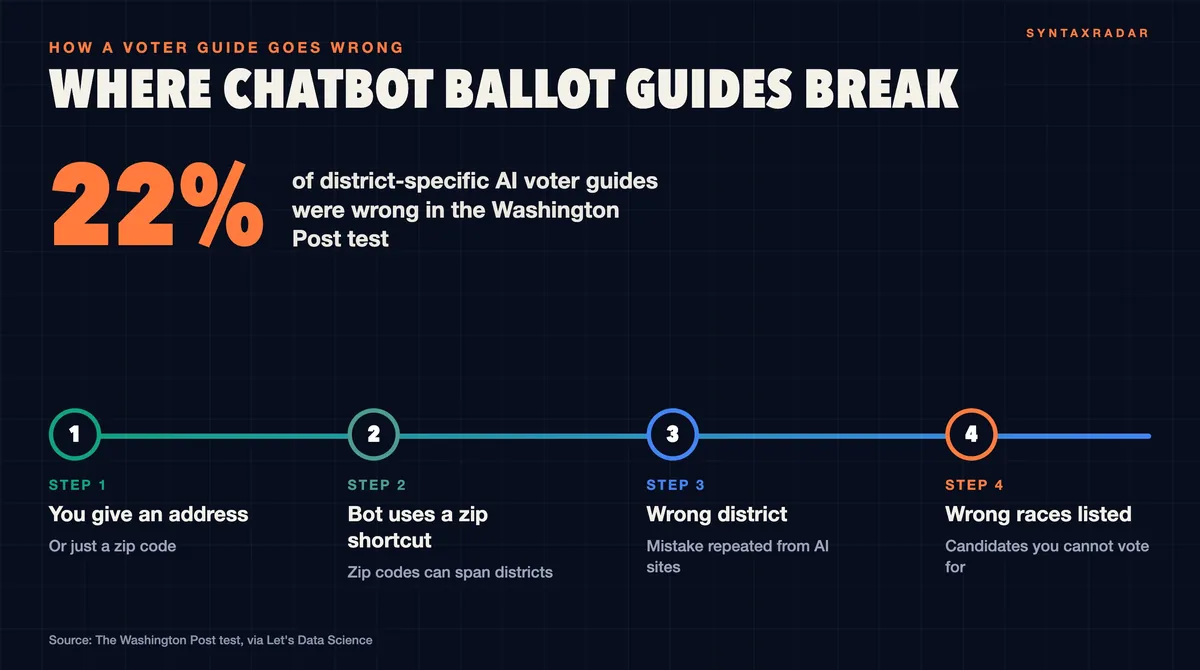
- You give it a zip code or address. A real election office matches your exact street address to the exact districts you live in: congressional, state legislative, county, school board.
- The bot leans on a shortcut. Zip codes were designed for delivering mail, and a single zip code can be split across more than one district. The Post found AI-powered websites translating zip codes into the wrong congressional districts.
- The bot repeats the mistake. The chatbots then repeated those mistakes, according to the Post's findings. The error was not even original; it echoed another automated source.
- Everything downstream inherits it. Once the district is wrong, every candidate, every race and every summary built on top of it is wrong too, no matter how well written.
There is a second, newer pressure. Isabel Linzer of the Center for Democracy and Technology told CyberScoop that campaigns now shape their material to rank in AI answers, a practice known as generative engine optimization. In other words, some of what a chatbot "knows" about a race may have been written specifically to be picked up by chatbots.
Are AI chatbots accurate about elections?
Sometimes, but AI chatbots are not reliable enough for something as specific as your ballot. The Post test is the latest of several studies of AI chatbots and elections, and they point in the same direction.
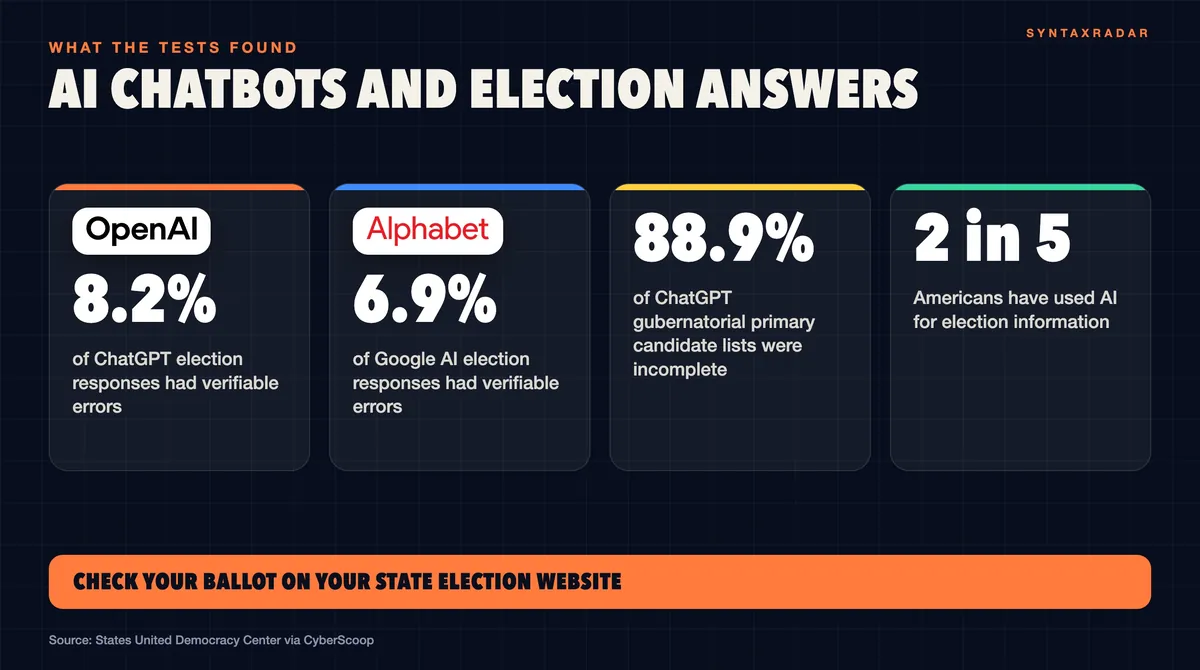
The States United Democracy Center collected nearly 1,000 chatbot responses across six swing states. In its 2025 round, 6.9 percent of Google AI responses and 8.2 percent of ChatGPT responses contained verifiable factual errors, as CyberScoop reported. Those numbers sound small until you remember that each error is a voter walking away with something false.
Completeness was worse than accuracy. ChatGPT gave incomplete lists of current gubernatorial primary candidates 88.9 percent of the time. And chatbot responses linked to a state election website less than 40 percent of the time, so most answers did not even send people to the source that decides.
The broader trend is not encouraging either. In August 2025, NewsGuard found the top ten chatbots returned false claims to news prompts 35 percent of the time, up from 18 percent a year earlier, according to The Next Web.
Can AI chatbots be trusted for voting information?
For general background, such as what a state senator does or how ranked-choice voting works, a chatbot can be a decent starting point. For anything tied to your specific address, the evidence says no: AI voter guide accuracy is too low to rely on.
The trouble is scale. A June 17, 2026 Pew survey found about half of US adults had used chatbots, up from a third in 2024, and a quarter use them daily. Put that next to the finding that 2 in 5 Americans have used AI for election information, and even a modest error rate reaches a lot of real voters.
Some companies have pulled back on purpose. In February 2026, Google's AI began showing only links, not written summaries, for election queries in Incognito Mode. A pointer to the original source is harder to get wrong than a written summary.
If you use ChatGPT for voting information as a first draft, treat it like a rumor from a friend: possibly right, worth checking, never final. The same caution applies to how much you share with these tools in general, which we covered in our look at whether ChatGPT is safe.
How to check your ballot with official sources
The way to check your ballot with official sources is to go straight to the offices that actually run the election, which is also what Linzer recommends: most voters are best served by local election sources. Here is a short checklist to finish before November 3.
- Your state's official election website. In most states it is run by the secretary of state or a state elections board. Look for a voter lookup tool that asks for your name or full address, not just a zip code.
- Your official sample ballot. Many states and counties publish a sample ballot matched to your registration. This is the single best answer to "what is on my ballot," because it is built from the same data as the real one.
- Your county or local election office. If anything looks off, call or email them. They can confirm your polling place, hours and which districts you are in.
- Compare any district a chatbot names with the official one. If a chatbot named a district, compare it with what the state tool says. If they disagree, the state is right.
- Be wary of slick third-party "voter guide" sites. The Post found AI-powered sites that mapped zip codes to the wrong congressional districts.
None of this takes long. Five minutes on an official site beats an hour of polished, possibly wrong AI summaries.
Should I use ChatGPT to decide how to vote?
You can use ChatGPT to help you think, but you should not let it decide how you vote. A chatbot can explain what an office does, summarize arguments you paste in, or help you write a list of questions. It cannot guarantee that the candidates it describes are on your ballot, and the tests above found it often gives incomplete candidate lists.
There is also the influence question. If campaigns are tuning content to appear in AI answers, then a chatbot's summary of a race may reflect which campaigns optimized hardest. Reading candidates' own statements, local news coverage and your official sample ballot gives you a view that has not been filtered through a model.
A good rule: let the chatbot raise questions, and let official and primary sources answer them.
What to watch next
AI chatbots election misinformation will get a real-world stress test on November 3. Watch for three things. First, whether more companies follow Google's lead and switch to links instead of summaries for election queries. Second, whether OpenAI and others publish details about the changes they made after the Post's test. Third, whether post-election reviews find voters who were turned away or confused because of AI-generated guides.
Until then, check your ballot on your state's official site today.
Questions readers ask
Why do AI chatbots get my congressional district wrong?
Chatbots do not run a real address lookup. They often rely on zip codes, which were built for mail delivery and can span more than one district. The Washington Post found AI-powered websites mapping zip codes to the wrong congressional districts, and chatbots repeated those errors, so every race listed after the wrong district was wrong too.
Is ChatGPT voting information reliable?
Not for ballot specifics. In a States United Democracy Center review, 8.2 percent of ChatGPT responses in 2025 contained verifiable factual errors, and ChatGPT gave incomplete lists of gubernatorial primary candidates 88.9 percent of the time. It can explain general concepts, but you should confirm candidates and races on official election sites.
What is generative engine optimization in elections?
It is the practice of shaping campaign material so it shows up in AI chatbot answers, similar to how websites optimize for search engines. Isabel Linzer of the Center for Democracy and Technology told CyberScoop campaigns now do this, which means a chatbot summary of a race may reflect who optimized hardest rather than who is most accurate.
Where should I check my ballot before November 3?
Start with your state's official election website and use its voter lookup with your full address, not just a zip code. Then view your official sample ballot if your state or county offers one, and contact your county election office with any questions. If a chatbot disagrees with these sources, trust the official ones.
How do I find my congressional district?
Use your state's official election website and enter your full street address, not just a zip code, because a single zip code can be split across more than one district. Your official sample ballot or county election office can also confirm your districts. If a chatbot names a different district, the state tool is right.
Written by
Abdul Rehman
Lead Systems Architect and Technical Director at Syntaxradar. More in AI & Models.
More in AI & Models
See all
Is ChatGPT Safe? How Three Small Bugs Could Expose Your Chats
Parameter researchers chained three ChatGPT web flaws so injected code ran in a signed-in session and could read up to 20 recent private chats. Reported Oct 18, fixed Oct 26,…
Nov 1, 2026 · 7 min read
AI for Hacking: CrowdStrike Says ARTEX Targeted 200+ Orgs
On Oct 29, 2026, CrowdStrike reported that VAPOR PANDA used ARTEX, an AI agent framework running mainly on DeepSeek, to target 200+ organizations in at least 14 countries over 11…
Oct 30, 2026 · 7 min read

Mistral Large 4: What a 1-Trillion-Parameter Open Model Means
Mistral published the weights of Mistral Large 4, a 1-trillion-parameter mixture-of-experts model, on October 29 under a modified MIT license that lets anyone use and fine-tune it…
Oct 30, 2026 · 8 min read
Latest stories
Front page
Why Is RAM Prices Going Up? The AI Memory Squeeze Explained
Abdul Rehman · Nov 1, 2026 · 7 min read

Is Instacart Better Than DoorDash? What the $17B Deal Changes
Abdul Rehman · Oct 31, 2026 · 7 min read
AI Bubble Pop? 5 Warning Signs Behind Big Tech's $740B Bet
Abdul Rehman · Oct 31, 2026 · 7 min read

Xreal Aura: Should You Buy the $1,099 Android XR Glasses?
Abdul Rehman · Oct 31, 2026 · 7 min read