


AI Chip Export Rules: Commerce Acts, Congress Wants a Law
On November 16, 2026 Commerce posted an interim rule adding chip licences for five countries and curbing data centers serving China-headquartered firms. The House passed the Remote Access Security Act 369-22, per one law-firm analysis.

Abdul Rehman
Lead Systems Architect and Technical Director · · 9 min read
The short version
- Indonesia, Malaysia, Singapore, Thailand, Brazil
- 5
- 369-22 (January 12, 2026)
- House vote on the Remote Access Security Act (single law-firm report)
- 90 days after the effective date
- Licence window for existing data centers
Why it matters: Commerce has written the rule; the open questions are whether Congress passes a remote-access law or defense-bill chip measures, and whether, as Treasury Secretary Bessent says, enforcement is enough.
On this page
AI chip export rules changed on November 16, 2026, when the Commerce Department posted an interim final rule that adds licence requirements for advanced chips going to Indonesia, Malaysia, Singapore, Thailand and Brazil, and for overseas data centers that supply large amounts of compute to companies headquartered in China, according to the rule text on bis.gov. Congress wants more: the House passed the Remote Access Security Act 369-22 in January 2026, per a Latham & Watkins analysis that is our only source for the vote count, since Congress.gov could not be read, and we found no report of a Senate vote. Treasury Secretary Scott Bessent's position, as TheNextWeb reports it from his Fox News interview, is that the rules already exist and only need enforcing.
This post was written on November 16, 2026, so it reports no outcome from later events. It maps the policy fight. Our explainer on the reported Megaspeed probe covers the diversion allegations the rule follows.
What are the AI chip export rules after November 16, 2026?
Commerce's November 16 announcement is one 132-page interim final rule with four changes. The posted PDF is a pre-publication version, and the rule takes effect on its Federal Register publication date, which the text leaves blank.
Data-center end-use control. A licence is required to export advanced chips when the exporter knows they are headed to a data center that will give a company headquartered in China or Macau (or with an ultimate parent there) access to a significant volume of compute. The text defines significant as more than 12,000,000 "aggregate TPP" (total processing performance, BIS's measure of chip compute), counted across one data center or digitally linked ones. Applications are reviewed case by case.
A destination licence for five countries. Exports of advanced chips to Indonesia, Malaysia, Singapore, Thailand and Brazil need a licence, because the text says these countries carry a higher-than-normal risk of diversion. Chips destined to US-headquartered companies are exempt if new reporting requirements are met. Reviews turn on how well the destination's export control regime works and how closely it coordinates with BIS.
Tighter fab and packaging presumptions. Chip fabricators and packagers get fewer ways to clear advanced-node logic chips designed by firms in licence-requirement destinations.
AI Diffusion Rule rescinded. The Biden-era regulations are formally removed, and the text says they were never enforced.
Review policy decides how hard a licence is to get. Per the rule text, chips for China or Macau are reviewed case by case only below 21,000 TPP and 6,500 GB/s of DRAM bandwidth when the applicant supplies extra information, and everything else for those destinations is reviewed under a presumption of denial.
The data-center control treats "commercial recommender systems" separately, with online retailers and social media companies as the text's examples: the licence requirement does not apply to them, and the text lets bona fide operators providing remote access for those systems keep doing so for 90 days before a licence is needed. Data centers that were already supplying China-headquartered customers with that much compute before publication must hold a licence within 90 days of the effective date to keep doing so. Commerce also warns that countries tolerating evasion could face import restrictions, new licence requirements, a downgrade in their export-control status or Entity List designations for the people involved.
Can China rent Nvidia GPUs overseas?
Renting was the gap. A Freshfields analysis says the Export Administration Regulations generally do not control remote access that involves no export, so a data center in a less-restricted country could serve Chinese customers without any chip crossing into China. Freshfields ties that gap to GPU-as-a-service (GPUaaS) models, and Commerce says the new rule is meant to close it.
The rule works through the exporter: a licence is needed to send chips to a data center when the exporter knows the capacity will serve China-headquartered companies above the threshold. The text adds that the older end-use control already reaches exports made on behalf of such a company, for example when it was the purchaser or the exclusive or primary remote end user, meaning more than 50 percent of total compute. Large arrangements the exporter knows about need a licence under the new control, and the older control keeps its own reach.
Reuters carries Commerce's statement that the rule is designed to ensure existing restrictions on access to sensitive American technology cannot be circumvented through remote computing in third countries; in effect, chip export restrictions to China reach the data centers that serve Chinese firms. Reuters also reports that the Treasury Department and the National Security Council wrote it and that the National Security Council directed its release, and that Commerce said in early 2025 it would replace the Biden-era rule but did not act until November 16.
What is the Remote Access Security Act?
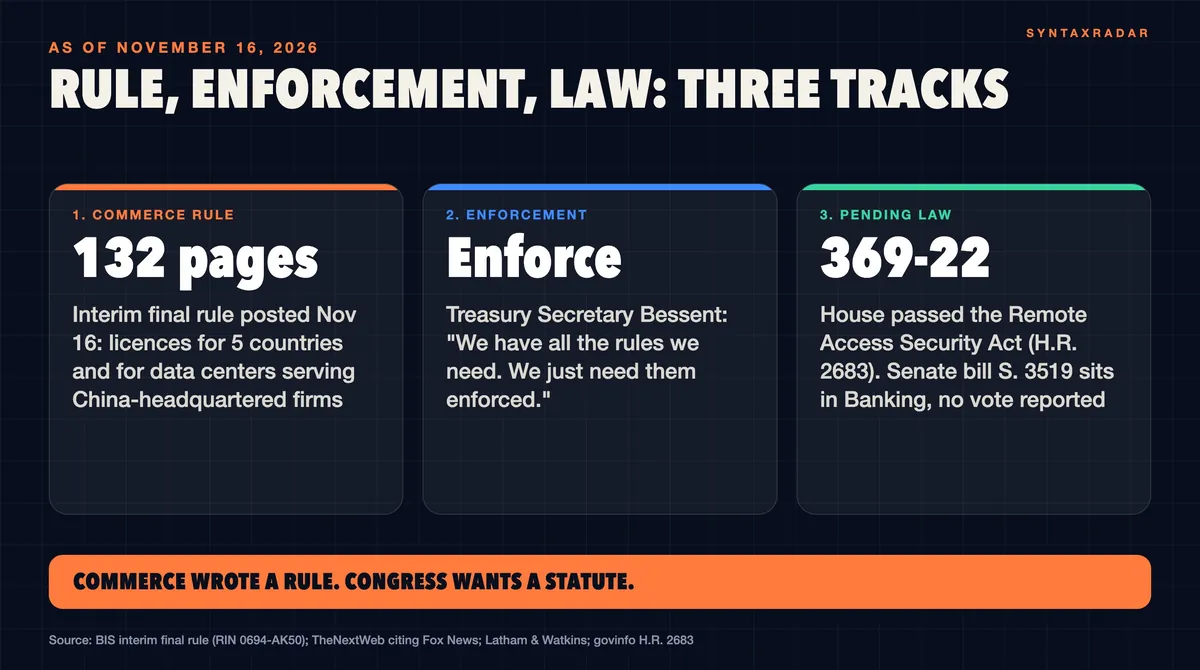
The Remote Access Security Act (H.R. 2683) is a bill that would amend the Export Control Reform Act of 2018 so that a foreign person's remote access to controlled items, including through a cloud service, can be licensed and penalised like an export, according to the bill text on govinfo. Access counts only where the Commerce Secretary determines the item's use could pose a serious risk to US national security or foreign policy. The bill sets no new penalty amounts and lists no exemptions. It also does not say which chips, countries or licence rules apply, because BIS would write those.
It requires Commerce to keep the House Foreign Affairs and Senate Banking committees informed of planned remote-access regulations, and says committee approval is not a precondition for using the authority. The Commerce rule works through licences on chip exports to data centers, not on remote access itself. The bill would make remote access a controlled activity in the statute.
The House passed it on January 12, 2026 by 369-22, after the Foreign Affairs Committee approved it 51-0 in April 2025, per Latham & Watkins. In the Senate, the Remote Access Security Act is S. 3519, introduced in December 2025 by Sens. Dave McCormick (R-Pa.) and Ron Wyden (D-Ore.) with Tom Cotton and Chris Coons as cosponsors, and Latham says it sits in the Banking Committee. We found no report of a Senate vote. Freshfields says it could become law as written, as amended by the Senate, or inside a must-pass bill such as the fiscal 2027 defense bill.
Who wants what on chip export controls in Washington?
Three positions run through the fight: write more rules, enforce the ones that exist, or oppose the new measures. Every entry below is a position reported by the named outlet, and dates are requests that can change.
The defense-bill track is separate from the Remote Access Security Act. Roll Call reports that a proposed manager's amendment to the Senate version of the fiscal 2027 defense bill (S. 4784) would carry chip-security requirements and a ban on exporting certain very powerful chips to countries of concern, while the House version has no similar language. Per Reuters, the Chip Security Act would require location-verification mechanisms to help track covered chips, and the AI Overwatch Act would require licences for certain advanced chip exports to countries of concern and notice to Congress before approvals. Neither source says the Remote Access Security Act is part of that NDAA package.
SyntaxRadar calculation: what the rule text and the votes imply
We took every input from the BIS rule text and the bill text above and did the arithmetic ourselves.
The 571-chip figure is a scale check on a licence-review ceiling: it divides the threshold by the 21,000 TPP ceiling, and chips with higher TPP would reach the threshold sooner. Wccftech, in a single secondary report, puts the threshold at about 760 H100s or 200 B300s. The 30-day gap comes straight from the text: the rule is effective on publication, comments close 60 days later and existing operators need a licence by day 90, so operators will have 30 days between the close of comments and the licence deadline. Whether BIS changes the text in that window is not known.
What we checked. We read all 132 pages of the posted rule and searched the text. It mentions Nvidia zero times, Congress zero times and the Remote Access Security Act zero times. The Nvidia China export angle therefore comes only from the reporting.
The link is indirect: Euronews says the rule follows reports that US investigators examined whether a Singapore-based company helped Chinese clients obtain export-controlled Nvidia chips, which the company rejected. We found no Nvidia statement and no Chinese government statement on the rule. Our piece on H200 chips reportedly in Hong Kong covers the diversion and China-demand side of the story, and our look at H100 rental pricing covers how GPU rental is priced.
What to watch next for AI chip export rules
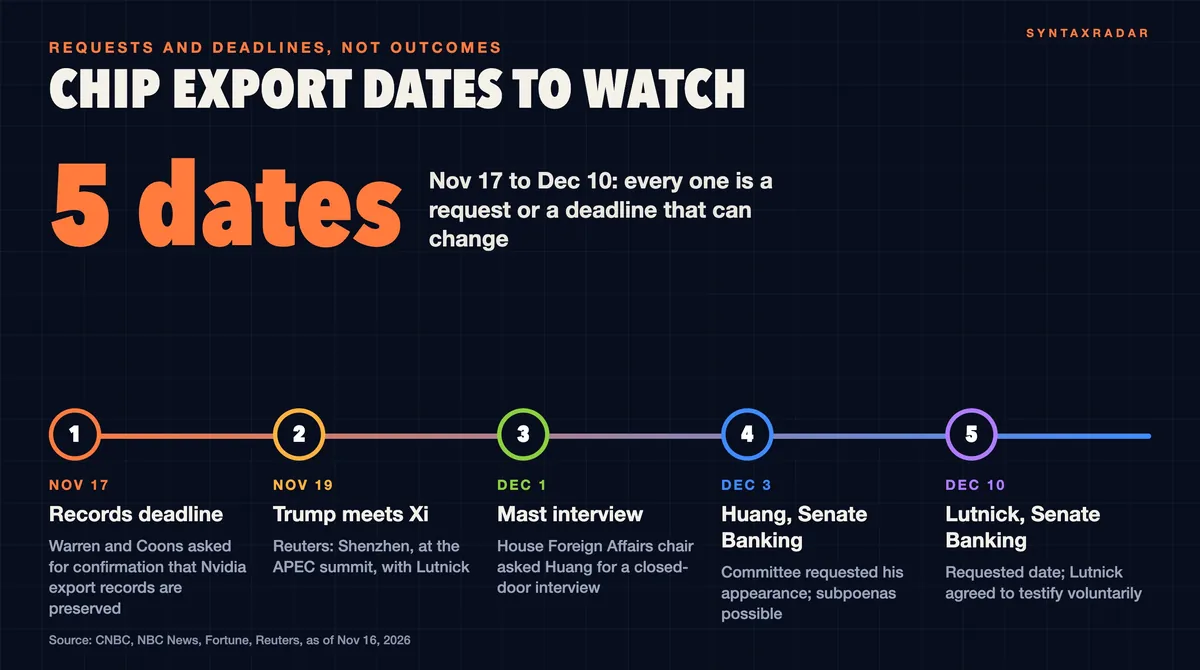
Every date below is a deadline or a request as of November 16, 2026, and this post cannot report what happens on them. Warren and Coons set November 17 as the date to confirm that records are being preserved, Reuters reported on November 16 that Trump was set to meet Xi in Shenzhen on Thursday, November 19, at the APEC summit, with Lutnick accompanying him. Mast asked Huang for a December 1 interview, and Senate Banking asked for December 3 and December 10 appearances (some outlets give December 3 for both).
On the rule itself, the first marker is publication in the Federal Register, which starts the 60-day comment clock and the 90-day operator clock. On the law, the open questions for chip export controls are whether S. 3519 moves out of the Banking Committee and whether the chip bills are included in the Senate defense bill, given the House version lacks them. Our post on what Nvidia's resignation filing says covers the CEO change that runs alongside this fight. The AI chip export rules rest on two unfinished steps: Federal Register publication of the Commerce rule and a Senate vote on the Remote Access Security Act.
Questions readers ask
What are the AI chip export rules?
The US AI chip export regulations include a Commerce interim final rule, posted on November 16, 2026, that requires licences for advanced chips going to Indonesia, Malaysia, Singapore, Thailand and Brazil and for data centers supplying significant compute to China-headquartered companies. It also rescinds the Biden-era AI Diffusion Rule. It takes effect when published in the Federal Register.
Can China rent Nvidia GPUs overseas?
Renting was largely outside export rules, because remote access without an export was generally not controlled, according to Freshfields. The Commerce rule adds a licence for chip exports to data centers that will serve China-headquartered companies above a compute threshold. The rule text does not name Nvidia or any other company.
What is the Remote Access Security Act?
It is H.R. 2683, a bill that would amend the Export Control Reform Act of 2018 to let Commerce license and penalise a foreign person's remote access, including through the cloud, to controlled items. The House passed it 369-22 on January 12, 2026. The Senate companion, S. 3519, is in the Banking Committee.
Which countries need a licence for advanced AI chips under the Commerce rule?
The rule adds a licence requirement for advanced chips going to Indonesia, Malaysia, Singapore, Thailand and Brazil, and lets the Commerce Secretary designate more. Chips for companies headquartered in the United States, or with a US ultimate parent, are exempt if reporting requirements are met. Reviews are case by case.
Has Congress passed the Remote Access Security Act?
No. The House passed it 369-22 on January 12, 2026, and we found no report of a Senate vote on S. 3519. Separate chip bills, including the AI Overwatch Act and Chip Security Act, are reported as slated for possible inclusion in a Senate fiscal 2027 defense-bill package, which the House version lacks.
When does the Commerce remote-access rule take effect?
The rule is effective on its Federal Register publication date, and comments are due 60 days after publication. Both dates are blank placeholders in the posted pre-publication PDF, so no calendar date is known. Existing data centers serving China-headquartered customers need a licence within 90 days of the effective date.
Sources
Written by
Abdul Rehman
Lead Systems Architect and Technical Director at Syntaxradar. More in Future Compute.
Keep reading

Megaspeed: The Nvidia Buyer in the Reported DOJ Chip Probe
On Nov 9, 2026, two law-enforcement sources said the DOJ's National Security Division is investigating Singapore's Megaspeed, Nvidia's largest Southeast Asian buyer, over possible…
Nov 10, 2026 · 8 min read
Why Are Chip Stocks Down? The Data Center Chain, Explained
On November 5, 2026 the SOX chip index fell 12.3% and Nvidia 9.2%, NBC reports, after US midterm results raised fears of slower AI data center building. Memory and storage makers…
Nov 6, 2026 · 7 min read

H200 China: 600,000 Nvidia Chips Reportedly in Hong Kong
Reuters reported on November 5, 2026 that about 600,000 Nvidia H200 chips are stored in Hong Kong because Beijing has not approved large-volume imports. On November 7 the NYT…
Nov 8, 2026 · 7 min read
More in Future Compute
See all
IBM Nighthawk: 1,040 Qubits in 2027 Means Two Linked Chips
On November 11, 2026 IBM said Nighthawk r3 is designed for 520 programmable qubits and 10,000 operations, and that it plans to link two r3 chips into a 1,040-qubit system in 2027.…
Nov 19, 2026 · 6 min read
Jensen Huang Resigned: What Is Confirmed, What Is Only Reported
Nvidia's CEO and director Jensen Huang resigned on November 11, 2026, after apologizing to staff on November 8 and amid press reports and a board investigation. Nvidia gave no…
Nov 14, 2026 · 6 min read

Who Will Replace Jensen Huang? Kress Is Interim, No CEO Named
Nvidia announced on November 12, 2026 that Jensen Huang resigned as president, CEO and director, effective immediately. CFO Colette Kress is interim CEO, Harvey C. Jones is board…
Nov 12, 2026 · 6 min read
Latest stories
Front page
NoisyTCP: The Linux Kernel TCP Flaw and Who Must Patch
Abdul Rehman · Nov 23, 2026 · 7 min read
US Approves AI Chips to China: 879,868 H200 and MI325X Cleared
Abdul Rehman · Nov 22, 2026 · 6 min read

Nothing AI Device: What Is Confirmed Before the Dec 8 Reveal
Abdul Rehman · Nov 22, 2026 · 7 min read
KB5132061: Windows 11 Install Errors Explained, and the Fix
Abdul Rehman · Nov 22, 2026 · 7 min read