


IBM Nighthawk: 1,040 Qubits in 2027 Means Two Linked Chips
On November 11, 2026 IBM said Nighthawk r3 is designed for 520 programmable qubits and 10,000 operations, and that it plans to link two r3 chips into a 1,040-qubit system in 2027. IBM's 2026 quantum advantage claims remain under independent testing.

Abdul Rehman
Lead Systems Architect and Technical Director · · 6 min read
The short version
- 520 programmable qubits
- Nighthawk r3 design
- 1,040 qubits, two r3 chips
- Planned 2027 system
- 10,000 per circuit (IBM design target)
- Nighthawk r3 operations
Why it matters: IBM's 1,040-qubit system for 2027 is a plan to link two 520-qubit chips, and its quantum advantage claim, which PostQuantum.com says rests on earlier Heron experiments, is under test by independent researchers.
On this page
IBM Nighthawk is the quantum processor line IBM introduced in November 2025: a square grid of qubits, with the r2 version offering 120 programmable qubits and the planned r3 version offering 520. IBM's plan to "scale beyond 1,000 qubits in 2027" means linking two r3 chips into a 1,040-qubit system, not building one 1,000-qubit chip. As of November 16, 2026, that system is a plan.
The IBM quantum computer roadmap carries a second claim, separate from Nighthawk's qubit count: that 2026 is the year of quantum advantage. IBM uses the phrase "the year of advantage" in its QDC 2026 blog, but the July experiments behind that claim ran on IBM's older Heron processor, according to PostQuantum.com's analysis. Independent researchers disagree about how settled the case is. Our explainer on quantum computing for normal people covers what a qubit is, so this post sticks to claims and evidence.
What is IBM Nighthawk?
Nighthawk is a family of IBM quantum processors designed to run longer circuits (a circuit is the sequence of operations a quantum computer performs). According to Help Net Security's report on the November 12, 2025 launch, the first Nighthawk had 120 qubits linked by 218 tunable couplers in a square lattice and supported up to 5,000 two-qubit gates. IBM said gate capacity would reach 7,500 in 2026 and 10,000 in 2027.
The r2 version arrived in 2026. IBM's QDC 2026 blog lists 120 programmable qubits (458 physical), circuits of more than 7,500 quantum operations and up to 100,000 samples per second, which IBM describes as a 25 times throughput gain over Heron. IBM also reports that E.ON, Algorithmiq and Q-CTRL ran 34 billion circuits. All of these are IBM's own figures and calculations.
How many qubits does Nighthawk have?
The r2 chip has 120 programmable qubits. The r3 chip, which IBM announced on November 11, 2026, is designed for 520 programmable qubits and 10,000 quantum operations, according to IBM's press release. The release lists 2,034 physical qubits for r3, keeps r2's square-lattice layout and adds 10 chip-to-chip connectors called l-couplers. The sources we read do not explain the gap between programmable and physical counts, so we do not either.
SyntaxRadar calculation: what the Nighthawk numbers add up to
We took the qubit and operation counts from IBM's release, blog and 2025 launch coverage and did the arithmetic ourselves.
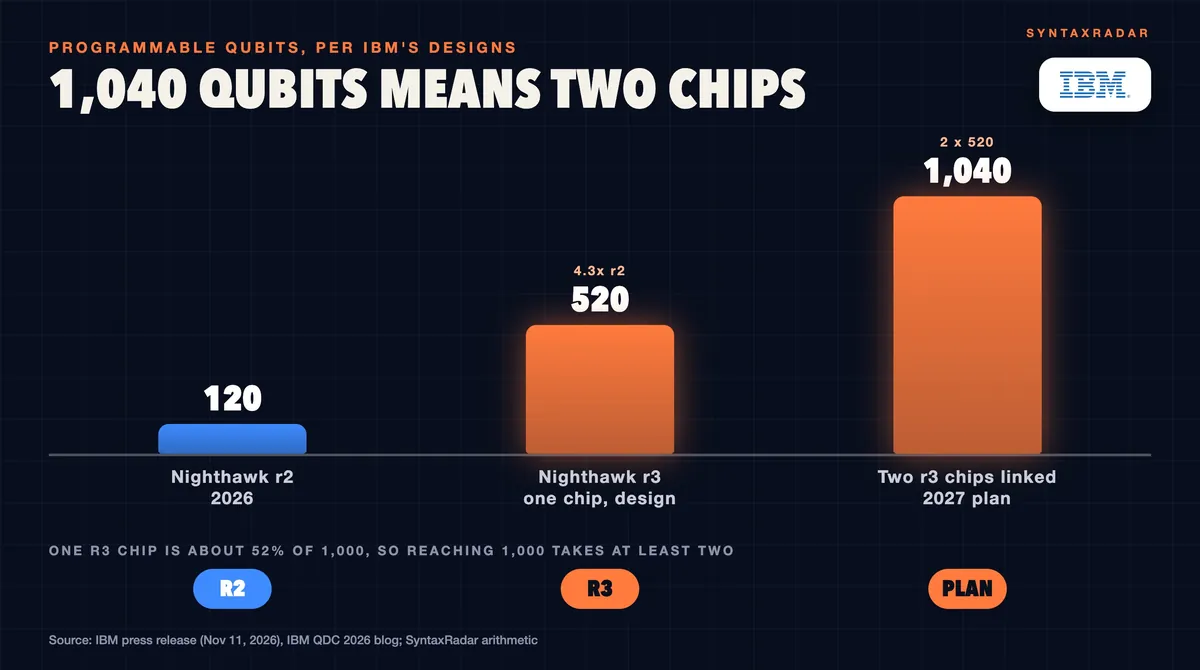
Inputs: 520 / 120 = 4.33, so r3 has about 4.3 times the programmable qubits of r2 (IBM says "more than four times"). Operations rise 50% from 5,000 to 7,500 and another 33% to 10,000, a doubling over the original chip. One r3 chip is about 52% of 1,000 qubits, so reaching 1,000 takes at least two (1,000 / 520 = 1.92). IBM gives no operations figure for the linked system.
Is IBM's 1,000-qubit system in 2027 one chip?
No. IBM's blog says it plans to link two Nighthawk r3 processors into a single 1,040-qubit system in 2027, using the same strategies as its l-coupler demonstration. The press release headline says "more than 1,000", while the body says 1,040. The Register's report describes the same two-chip plan, with 10 l-couplers.
What IBM has shown is smaller. It says four l-couplers linked Nighthawk r1 processors at up to 99.3% quantum state transfer fidelity (how faithfully quantum information crossed between chips; the blog cites a 99% average), against a 99.9% target. Two cryogenic modules were also connected, reached operating temperature in under five days and cooled below 15 millikelvin. These are component demonstrations. No linked 1,040-qubit system has been reported, and we found no commercial availability date.
By our arithmetic, the 99.3% figure is a 0.7% error against 0.1% at target, which is 7 times the target error. That comparison uses four couplers on r1 chips, while the 2027 design uses 10 on r3.
Our reading: in 2025, Help Net Security's coverage tied systems of 1,000 or more qubits to 2028, and the 2026 plan puts a 1,040-qubit system in 2027. That looks like a date one year earlier, though IBM does not make the comparison itself. The Register reports that IBM's fault-tolerant Starling system is planned for 2029, running 100 million operations on 200 logical qubits (error-corrected qubits), and calls that "an ambitious goal".
Has IBM achieved quantum advantage?
IBM says its 2026 results meet the bar for quantum advantage, but the IBM quantum advantage claim has not been settled, and PostQuantum.com reports that the experiments behind it ran on Heron, an earlier IBM chip. In its QDC 2026 blog, IBM says researchers ran computations beyond purely classical methods, with results that "can be rigorously verified."
IBM's July 30, 2026 release with the University of Chicago says one computation "achieves the fundamental criteria for quantum advantage" and quotes IBM's Jay Gambetta saying the field is firmly in the quantum advantage era. The release describes 70 logical qubits and 2,415 logical two-qubit operations, and says leading classical methods "faced prohibitive runtimes" without giving numbers. PostQuantum.com's analysis says the three IBM-linked papers are unreviewed preprints that sit at different evidentiary levels.
On Nighthawk r2, IBM reports speedups against its own earlier runs. The blog says an Algorithmiq experiment runs 8x faster on Nighthawk r2 and estimates that classical tensor-network methods would need 240 times more memory than for the original implementation at fixed accuracy. IBM says that experiment was first demonstrated on Heron as part of its 2026 quantum advantage results. A speedup over Heron compares IBM hardware with IBM hardware and says nothing about the best classical method.
Quantum advantage 2026: what independent researchers say
The independent picture has two parts. In a paper titled "Has quantum advantage been achieved?", Dominik Hangleiter argues that it has, comparing the situation to 1980s Bell-inequality tests that left some loopholes open. He names scalability and verifiability as the remaining gaps. That paper is about advantage experiments in general.
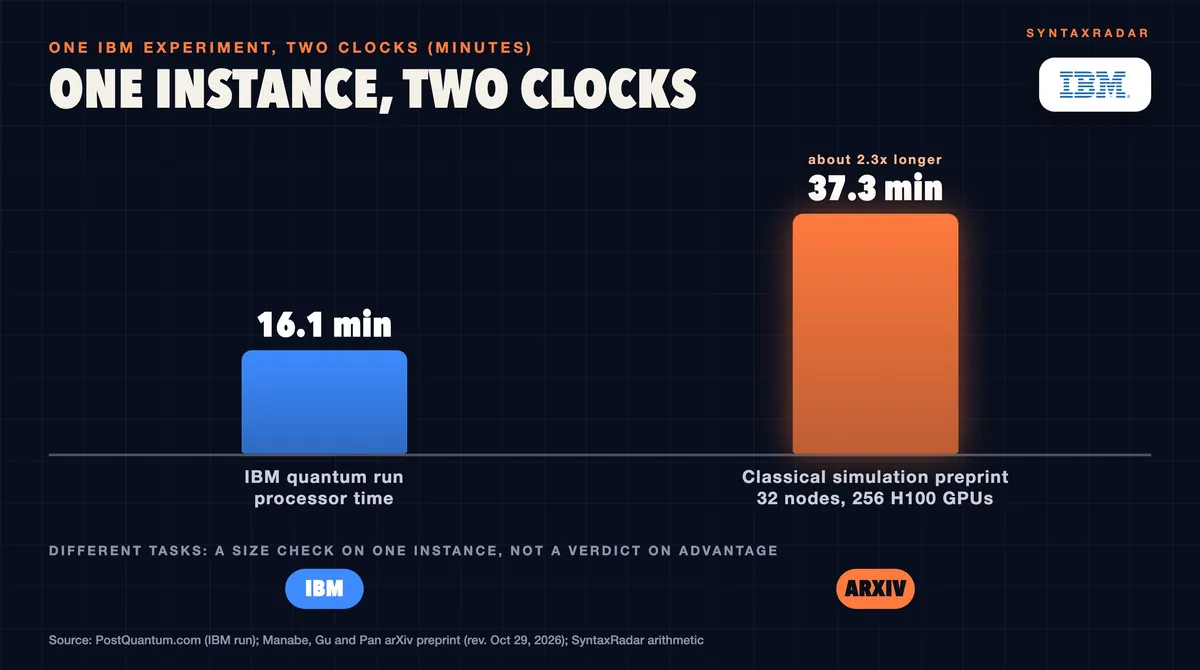
The second part is a challenge to one IBM experiment. Hidetaka Manabe, Hanfeng Gu and Feng Pan posted a preprint on arXiv, revised October 29, 2026, reporting a classical simulation of IBM's 70-qubit doped Clifford sampling experiment. They computed all 2,051 amplitude batches for IBM's published bitstrings in 37.3 minutes on 32 nodes with eight H100 GPUs each, and say the largest intermediate tensor was 256 times smaller than IBM's estimate. Their result covers this specific instance. It is a preprint with no journal reference listed.
SyntaxRadar calculation: one instance, two clocks
The IBM and University of Chicago run used 16.1 minutes of quantum processor time, according to PostQuantum.com (IBM's release says about 15 minutes). The independent classical run took 37.3 minutes on 256 GPUs (32 nodes times 8), about 2.3 times longer. The tasks differ: IBM sampled from a circuit, while the classical team computed amplitudes for IBM's published bitstrings. So this is only a size check on one instance, and it settles nothing about advantage.
The Quantum Advantage Tracker that IBM points to is a community project. Its page uses the labels "active" (credible but awaiting reliable classical benchmarks) and "superseded" (classical progress has closed the gap), and the page, as we read it, names no adjudicated winner. IBM's own November 2025 goal was for community confirmation of the first verified advantage cases by the end of 2026, which left about six weeks when we checked.
What to watch next
As of November 16, 2026, we found no IBM response to the Manabe, Gu and Pan preprint. Four checkpoints to track for the IBM Nighthawk story:
- Whether IBM answers the Manabe, Gu and Pan simulation, and whether that preprint is peer reviewed.
- Whether the tracker moves IBM's advantage entries from "active" to something firmer by December 31, 2026, the end-of-2026 date IBM gave.
- Whether IBM publishes operations and fidelity figures for linked Nighthawk r3 chips before 2027.
- Whether the 2027 link demonstration reaches the 99.9% transfer target IBM names.
Until those land, treat the 1,040-qubit system as a planned two-chip design and the advantage claim as IBM's position, with one independent preprint reporting a classical simulation of one experiment. For readers following other vendor-reported hardware numbers, our look at Google's TPU 8i Max and 8tx covers a launch where every performance figure is the vendor's own, and our explainer on the exponential time hypothesis covers another claim about computing limits that lacked verification.
Questions readers ask
What is Nighthawk r3?
IBM Nighthawk r3 is a planned quantum processor that IBM announced on November 11, 2026. IBM says it is designed to execute 10,000 quantum operations on 520 programmable qubits, within 2,034 physical qubits, and adds 10 chip-to-chip l-couplers. It builds on the 120-qubit Nighthawk r2, which IBM lists at more than 7,500 operations.
Is IBM's 1,040-qubit system one chip?
No. IBM's blog says it plans to link two Nighthawk r3 processors into a single 1,040-qubit system in 2027. Each r3 chip has 520 programmable qubits. This is a plan: IBM has demonstrated chip-to-chip links on r1 processors, but no linked 1,040-qubit system has been reported.
Which IBM chip ran the 2026 quantum advantage experiments?
According to PostQuantum.com's analysis, the three IBM-linked advantage papers from July 2026 ran on IBM Heron. IBM's own blog says Algorithmiq's experiment was first demonstrated on Heron and runs 8x faster on Nighthawk r2. That compares IBM hardware with IBM hardware.
Can classical computers match IBM's advantage experiment?
For one instance, a preprint reports a classical simulation. Manabe, Gu and Pan computed the amplitudes for IBM's published bitstrings from its 70-qubit doped Clifford sampling experiment in 37.3 minutes on 256 H100 GPUs, and say their result applies to that specific instance. It has no journal reference listed, and we found no IBM response.
Sources
Written by
Abdul Rehman
Lead Systems Architect and Technical Director at Syntaxradar. More in Future Compute.
Keep reading
What Is AI Capex? Why Alphabet's $51.4B Bill Spooked Wall Street
Alphabet's Q3 2026 capex hit $51.4B, more than double a year earlier, pushing free cash flow to negative $9.1B for a second straight quarter. Shares fell about 12% on Oct. 29, its…
Oct 30, 2026 · 7 min read

DRAM Price Fixing Lawsuit Survives: What It Means for RAM Prices
On November 14, 2026, Judge Noel Wise (N.D. Cal.) denied Samsung, SK Hynix and Micron's motion to dismiss a proposed class action alleging coordinated DRAM supply cuts, according…
Nov 16, 2026 · 8 min read
Is a Computer Science Degree Worth It? What the 8.1% Drop Means
US undergraduate computer science enrollment at four-year colleges fell 8.1% in fall 2025 and 8.4% in spring 2026, per the National Student Clearinghouse, as overall enrollment…
Oct 29, 2026 · 7 min read
More in Future Compute
See all
AI Chip Export Rules: Commerce Acts, Congress Wants a Law
On November 16, 2026 Commerce posted an interim rule adding chip licences for five countries and curbing data centers serving China-headquartered firms. The House passed the…
Nov 18, 2026 · 9 min read
Jensen Huang Resigned: What Is Confirmed, What Is Only Reported
Nvidia's CEO and director Jensen Huang resigned on November 11, 2026, after apologizing to staff on November 8 and amid press reports and a board investigation. Nvidia gave no…
Nov 14, 2026 · 6 min read

Who Will Replace Jensen Huang? Kress Is Interim, No CEO Named
Nvidia announced on November 12, 2026 that Jensen Huang resigned as president, CEO and director, effective immediately. CFO Colette Kress is interim CEO, Harvey C. Jones is board…
Nov 12, 2026 · 6 min read
Latest stories
Front page
NoisyTCP: The Linux Kernel TCP Flaw and Who Must Patch
Abdul Rehman · Nov 23, 2026 · 7 min read
US Approves AI Chips to China: 879,868 H200 and MI325X Cleared
Abdul Rehman · Nov 22, 2026 · 6 min read

Nothing AI Device: What Is Confirmed Before the Dec 8 Reveal
Abdul Rehman · Nov 22, 2026 · 7 min read
KB5132061: Windows 11 Install Errors Explained, and the Fix
Abdul Rehman · Nov 22, 2026 · 7 min read