


Google TPU 8i Max and 8tx: Double the Chip, Same Rack Space
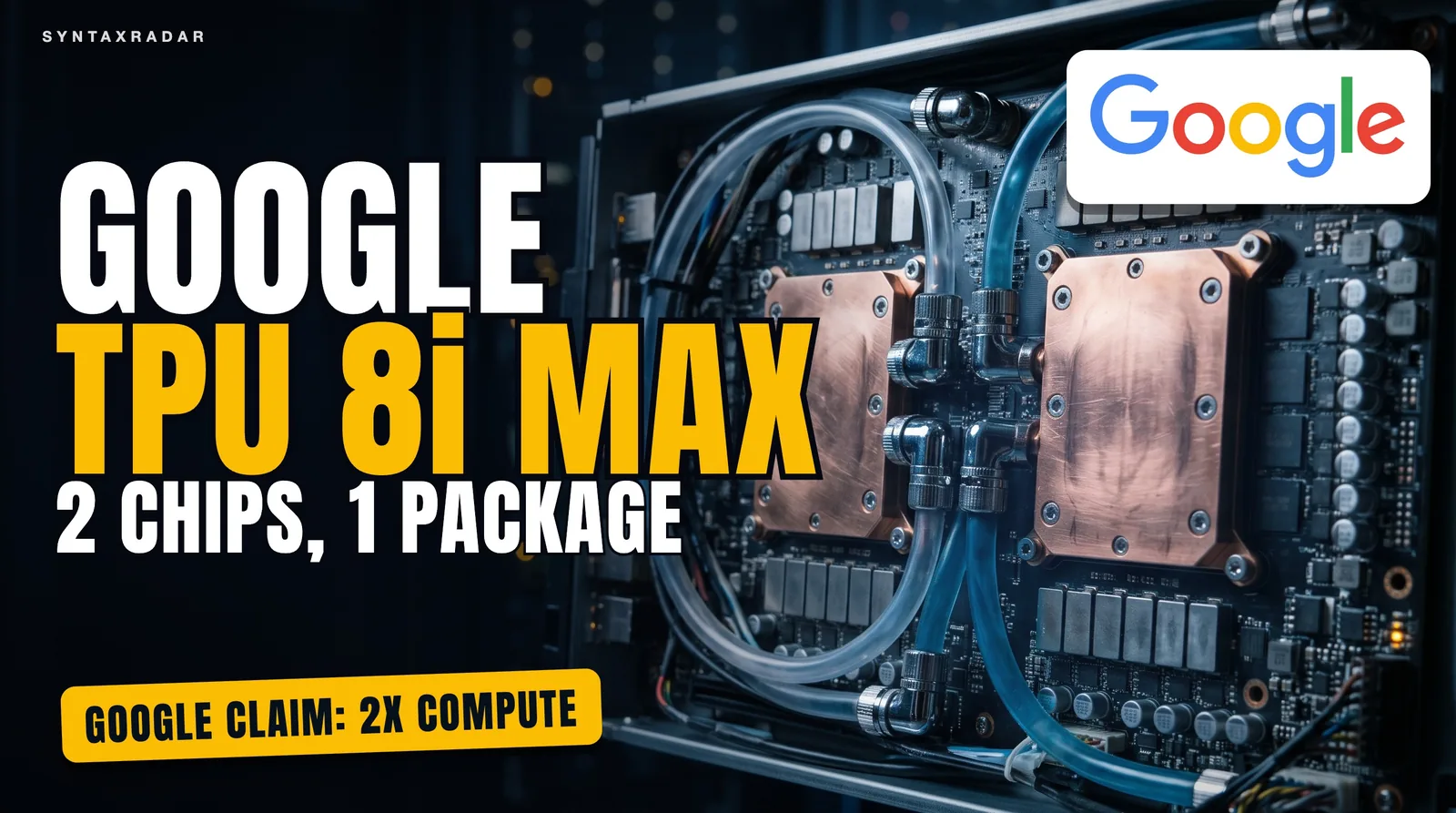
On November 9, 2026 Google announced TPU 8i Max, two TPU 8i chips in one package with 2x compute, SRAM and HBM bandwidth, and TPU 8tx, a TPU 8t-based chip for confidential inference. No price, ship date or Nvidia comparison was given.

Abdul Rehman
Lead Systems Architect and Technical Director · · 7 min read
The short version
- 2x compute, SRAM and HBM bandwidth
- TPU 8i Max vs TPU 8i
- Up to 2x lower
- TPU 8tx latency vs TPU 8t
- More than 90%
- TPU Sync KV transfer latency cut
Why it matters: TPU 8i Max packs two TPU 8i chips into one package and TPU 8tx adds confidential compute; every performance number for both is Google's own claim, with no price or date yet.
On this page
The Google TPU 8i Max and TPU 8tx are two new AI chips Google announced on November 9, 2026. TPU 8i Max puts two TPU 8i chips in one package, for double the compute, SRAM and HBM bandwidth in the same rack space. TPU 8tx is built on Google TPU 8t silicon for confidential inference, with up to 2x lower latency than TPU 8t. Google gave no price and no TPU 8 release date for either chip.
Both chips come from Google's announcement post, written by Amin Vahdat, Google's SVP and Chief Technologist for AI and Infrastructure. They join Google TPU 8t (for training) and TPU 8i (for inference, the work of answering requests once a model is trained), which Google introduced at Google Cloud Next in April 2026. That makes four systems in the Google TPU 8th generation lineup, and Google says it is the first time it has introduced four TPU systems in a single year.
Every performance figure below is a vendor claim from that post. As of November 10, 2026, no independent benchmark of either chip exists in our sources.
What is TPU 8i Max? Two chips in one package
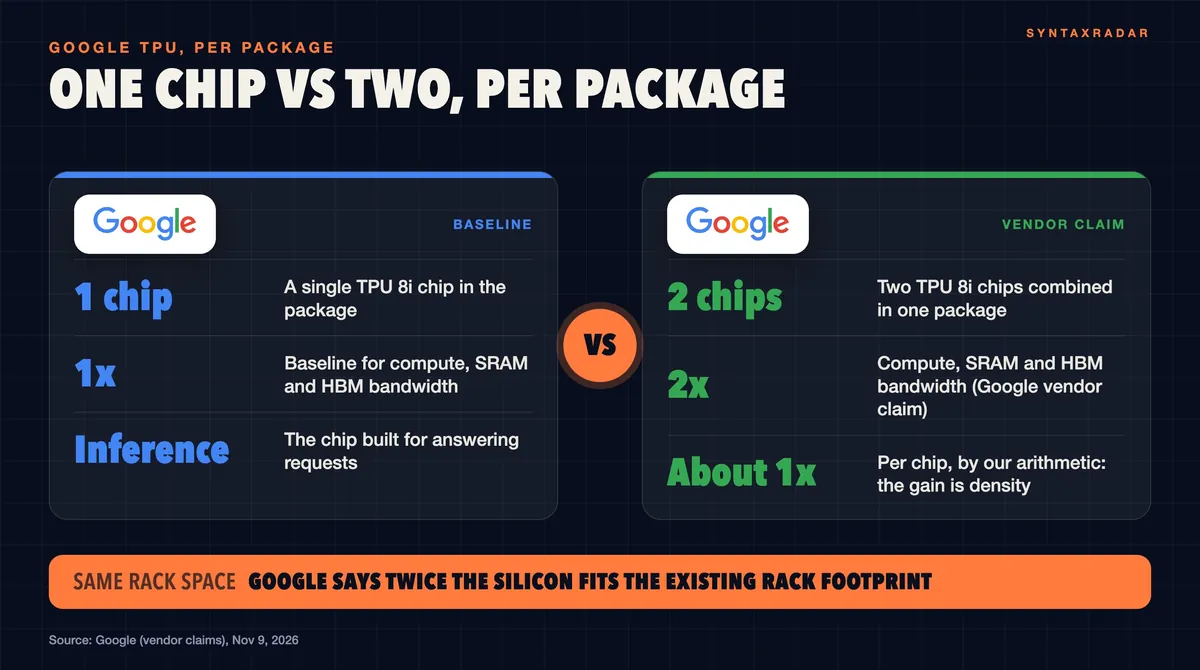
TPU 8i Max is two TPU 8i chips combined onto a single package. According to Google's post, that package has double the compute, double the SRAM (the small, very fast memory built into the chip) and double the HBM bandwidth (how fast data moves to and from the high-bandwidth memory stacked next to the chip) of a single TPU 8i.
The headline detail is where the extra silicon goes. Google says the design fits twice the silicon within the existing rack footprint. In other words, the same rack space holds two chips' worth of hardware instead of one.
Read the doubling carefully. Two chips with twice the compute means that, on Google's ratios, each chip is about as fast as a regular TPU 8i. Each chip runs at about TPU 8i speed, and the package simply holds twice the silicon. Our explainer on why RAM prices are going up covers the memory side of AI hardware, including HBM, which is the part this package doubles.
What is TPU 8tx?
TPU 8tx is a TPU built for secure and confidential inference that Google says also suits small-scale training. It runs on the same silicon as TPU 8t, Google's training chip, and it is paired with 5th Generation AMD EPYC CPU hosts (the regular server processors that sit beside the accelerators and manage them).
Google lists three things TPU 8tx adds:
- Hardware-level confidential compute that keeps data and model weights isolated while they are being used.
- Private fine-tuning, distillation and reinforcement learning (ways of training a model further after its first training run) without moving sensitive data between clusters.
- The Boardfly network, which TPU 8tx shares with the reasoning-focused TPU 8i and which Google says gives it up to 2x lower latency than TPU 8t with a "near-zero performance penalty".
That last phrase is Google's wording, and our sources give no test behind it. They also do not say how the confidential mode is built.
What is confidential computing?
Confidential computing is protection for data while a computer is actively working on it. Data is usually guarded in two states: at rest (stored on a disk) and in transit (moving across a network). The gap is the moment it is loaded into a processor and used. Confidential computing closes that gap in hardware.
For TPU 8tx, Google describes this as keeping data and model weights isolated during use. Model weights are the learned numbers that make up a trained AI model. Google's pitch is that customers can fine-tune, distil or run reinforcement learning on sensitive data without moving that data between clusters.
What our sources do not say: who, if anyone, can independently verify that isolation, or whether TPU 8tx carries any certification. Treat "confidential" as Google's description until those details appear.
Google TPU 8i vs 8t: which chip does what?
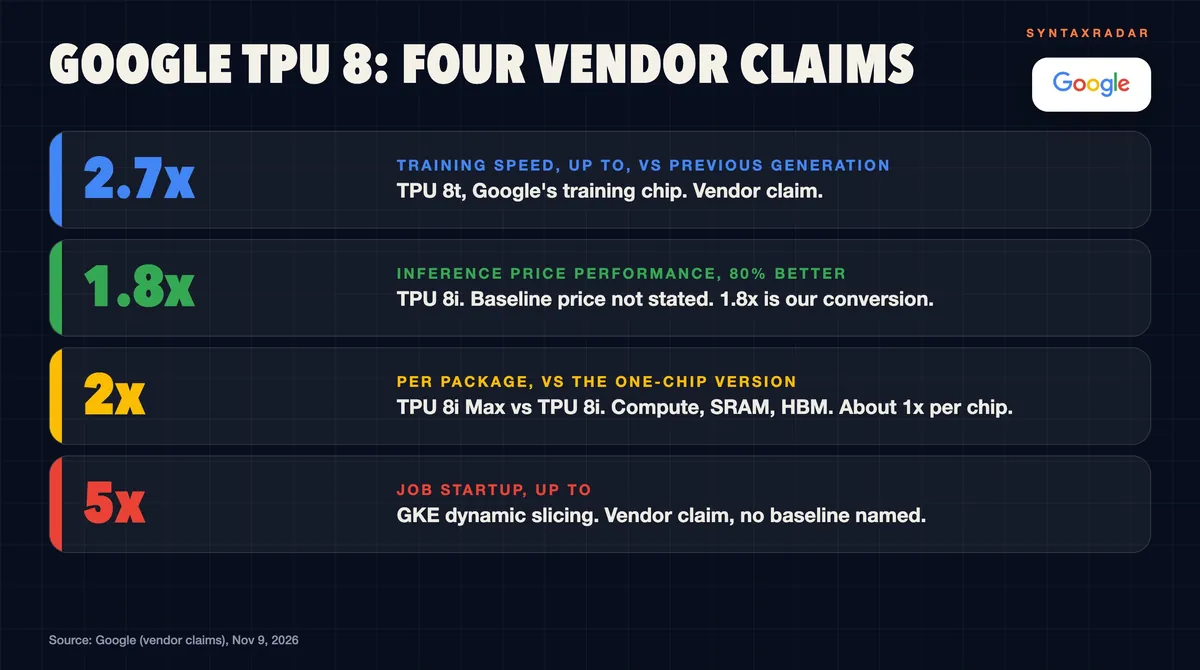
Google TPU 8i vs 8t comes down to the job. Google TPU 8t is the training chip, and Google says it offers up to 2.7 times better training performance than the previous generation. TPU 8i is the inference chip, with what Google calls 80% better inference price performance and inter-chip communication delays cut by up to half.
The two new variants each extend one of those chips:
For background on the April chips, ServeTheHome reported (single secondary report) that TPU 8i pods scale to up to 1,152 chips in the Boardfly topology and pair with Google's Axion Arm CPUs at two TPUs per CPU. ServeTheHome also stated no TPU 8t price, no TPU 8i price and no availability date for either chip. TPU 8tx differs here: Google says it uses AMD EPYC hosts.
On the software side, Google says vLLM and SGLang (two inference-serving tools) get out-of-the-box TPU backends, Hugging Face models run natively on TPUs through the open-sourced TorchTPU, and a TPU agent suite connects to Claude Code, Cursor and Google Antigravity. GKE dynamic slicing, on Google's Kubernetes service, cuts job startup times by up to 5x and speeds fault recovery by up to 4.5x, per the post.
Latency gets its own claim. Google says TPU Sync cuts KV transfer latency and Time to First Token (the wait before the first word of a reply appears) by more than 90%. Our KV cache explained post covers what the KV cache is and why moving it quickly matters.
SyntaxRadar calculation: what Google's multipliers mean
Google publishes ratios and no absolute numbers. So we converted each ratio into a plain before-and-after figure. All inputs come from Google's November 9, 2026 post; the arithmetic is ours.
Two cautions. First, Google does not define the baseline price behind "80% better inference price performance", so the 44% figure only holds under the reading above. Second, the baselines differ: some claims compare with the previous TPU generation, some with TPU 8t or TPU 8i, and our sources name no baseline for the GKE figures. The multipliers in the chart are not a ranking of one chip against another.
Google TPU vs Nvidia GPU: what the post does not say
Google's post does not compare its TPUs with Nvidia. Nvidia is not mentioned at all, so any TPU 8i vs Nvidia verdict you read is not coming from Google's announcement. When heise covered the April launch, it framed the two chips as alternatives to Nvidia's AI accelerators, and no benchmark backs that framing.
The closest thing to a competitive claim is that Google says its vLLM-TorchTPU software stack posted top price-performance on the InferenceX and AgentX benchmarks. That is Google's claim about its own results, and our sources hold no independent confirmation of it. For the Nvidia side of the AI chip market, our report on H200 China covers the reported flow of Nvidia chips into Hong Kong.
The broader TPU vs GPU question also has no answer in the source. Google gives no FLOPs, no HBM capacity and no SRAM size for TPU 8i Max or TPU 8tx, so there is nothing to line up against a GPU spec sheet.
Google TPU 8i price and release date
Here is the full list of what Google does not state, as of November 10, 2026:
- Price: none for TPU 8i Max or TPU 8tx.
- Availability date: none. The announcement gives no Google TPU 8 release date for either variant.
- Absolute specs: no compute, memory size or bandwidth figures for either new chip.
- Head-to-head benchmarks: none against Nvidia or any other vendor.
What Google does share is demand: it says it has nearly 100 TPU customers, including frontier labs and trading firms. Our explainer on what is AI capex covers how much Alphabet is spending on AI infrastructure.
What to watch next
Four details would turn this announcement into something a buyer can compare:
- A Google Cloud price and an availability date for TPU 8i Max and TPU 8tx.
- Absolute specs, especially HBM capacity and SRAM size for TPU 8i Max.
- An outside test of the "near-zero performance penalty" claim for confidential compute on TPU 8tx.
- Independent inference benchmarks that include Google TPU 8i hardware alongside GPUs.
Until then, every number attached to either chip comes from Google.
Questions readers ask
What is TPU 8i Max?
TPU 8i Max is a Google Cloud AI chip package that combines two TPU 8i chips. Google says it delivers double the compute, double the SRAM and double the HBM bandwidth of a single TPU 8i, while fitting twice the silicon into the existing rack footprint. On Google's ratios that is the same speed per chip; the gain is density.
What is TPU 8tx?
TPU 8tx is a TPU built on the same silicon as TPU 8t and paired with 5th Generation AMD EPYC CPU hosts. Google says it is optimized for secure and confidential inference, suits small-scale training, keeps data and model weights isolated during use, and offers up to 2x lower latency than TPU 8t through the Boardfly network.
What is Google TPU 8i and what is it used for?
TPU 8i is the inference chip in Google's TPU 8th generation, built for reasoning workloads and introduced at Google Cloud Next in April 2026. Google says it offers 80% better inference price performance and cuts inter-chip communication delays by up to half. TPU 8i Max combines two of these chips in one package.
What is the Google TPU 8i price and release date?
As of November 10, 2026, Google has not published a price or an availability date for TPU 8i Max or TPU 8tx. Its November 9 announcement also gives no absolute specs, such as memory size or compute figures, for either new chip. TPU 8t and TPU 8i were first introduced at Google Cloud Next in April 2026.
Is Google TPU 8i faster than Nvidia?
Google does not say. Its November 9, 2026 post does not mention Nvidia or include any head-to-head benchmark. The closest claim is that Google's vLLM-TorchTPU software stack posted top price-performance on the InferenceX and AgentX benchmarks, and that is Google's own statement about its results rather than an independent GPU comparison.
Sources
Written by
Abdul Rehman
Lead Systems Architect and Technical Director at Syntaxradar. More in Chips & Hardware.
Keep reading
iPad mini 8 Release Date: Nov 6 From $699, and Is It Worth It?
Apple announced the iPad mini (A20 Pro) on Oct 26, 2026, with an 8.5-inch OLED screen and IP67 body. Pre-orders opened Oct 28; it goes on sale Fri Nov 6 from $699. Engadget scored…
Nov 5, 2026 · 8 min read
Xreal Aura: Should You Buy the $1,099 Android XR Glasses?
Xreal launched the Aura, the first glasses built on Google's Android XR, on October 28, 2026. It costs $1,099 (regular $1,279) through December and ships mid-November to the US,…
Oct 31, 2026 · 7 min read
MacBook Pro M6 vs M5: Who Should Upgrade, and Who Can Skip It
Apple announced the 14-inch MacBook Pro with M6 on October 27, 2026. It claims up to 25% faster on-device AI than M5 and a Neural Engine up to 1.9x faster. Pre-orders opened…
Oct 28, 2026 · 7 min read
More in Chips & Hardware
See all
Googlebook OS Update: November Patch Frees Up to 6GB of RAM
On November 6, 2026, Google began rolling out the first major Googlebook update (build CL3B.260622.286.R2). Gizmodo reports it frees 3GB to 6GB of RAM by slimming on-device AI on…
Nov 9, 2026 · 6 min read
H200 China: 600,000 Nvidia Chips Reportedly in Hong Kong
Reuters reported on November 5, 2026 that about 600,000 Nvidia H200 chips are stored in Hong Kong because Beijing has not approved large-volume imports. On November 7 the NYT…
Nov 8, 2026 · 7 min read
GrapheneOS Motorola: Signature 27 Costs $1,599, No Install Date
Motorola opened US pre-orders for the $1,599 Signature 27 on November 5, 2026, per 9to5Google. It is the first non-Pixel phone GrapheneOS has committed to support, but it ships…
Nov 6, 2026 · 7 min read
Latest stories
Front page
Megaspeed: The Nvidia Buyer in the Reported DOJ Chip Probe
Abdul Rehman · Nov 10, 2026 · 8 min read

Starship Flight 15: The Nov 13 Target and First Ship Catch
Abdul Rehman · Nov 10, 2026 · 6 min read
Claude Fable 5.2: $8 Price, Fast Mode and Whether to Switch
Abdul Rehman · Nov 10, 2026 · 7 min read

Outlook DMARC Requirements: Why Your Email Is Suddenly Bouncing
Abdul Rehman · Nov 9, 2026 · 6 min read