


Quantum Computing Explained Simply: What Qubits Really Do
Google's Willow chip has 105 qubits and showed error rates falling as the system grew. In October 2025 Google reported a 13,000x speedup with its Quantum Echoes algorithm. Practical uses are still unproven.

Abdul Rehman
Lead Systems Architect and Technical Director · · 6 min read

The short version
- 105
- Willow qubits
- 13,000x
- Quantum Echoes speedup, per Google
- About 1 in 1,000 operations
- Error rate of best machines today, per NIST
Why it matters: Quantum computers are real and improving, but no one has yet shown a quantum calculation that is both beyond classical reach and useful in practice.
Quantum computing explained simply: a quantum computer stores information in qubits, which can hold a blend of 0 and 1 until they are measured, and it uses that property to solve a few specific kinds of problems far faster than a normal computer could. Today's machines are small, error-prone and still searching for their first genuinely useful job.
The most talked-about machine is Google's Willow chip, announced in December 2024. Google reports that it has 105 qubits and that it cut errors as the system grew, which researchers had been chasing for roughly three decades. In October 2025 Google followed up with an algorithm it calls Quantum Echoes.
What is a qubit, and how is it different from a bit?
A bit is the unit of information in every phone and laptop. It is either 0 or 1. NIST's explainer compares it to a tiny bar magnet or an electric switch, which is always in one of two positions.
A qubit (quantum bit) can be 0, 1, or a superposition of both. Superposition means a tiny object, such as an atom, behaves as if it has two or more distinct states at once. It stays that way until someone measures it or something disturbs it, and then it collapses to a single state.
NIST describes the scaling this way: two qubits can hold a superposition of four combinations, three qubits eight, and four qubits 16. Each added qubit doubles the number of combinations.
Qubits can also be entangled, which means several of them share a single quantum state. Measuring one causes the others to settle into definite states, even when they are far apart.
Is quantum computing really a computer trying every answer at once?
No. A popular picture says a quantum computer explores every path through a maze at once and simply picks the exit. NIST's explainer rejects that idea: quantum computers do not run an efficient brute-force search of all possible solutions, because the final measurement extracts only a small amount of information from the superposed results.
What the machine does is arrange qubits so that wrong answers cancel each other out and right answers reinforce each other, a wave-like effect called interference. Designing a problem so that this works is hard, which is why quantum computers help with only certain tasks.
NIST also expects the two kinds of machine to work side by side. Quantum computers will probably not sit on desks or in pockets.
Qubits are fragile. NIST lists stray electric or magnetic fields, temperature changes and cosmic rays as things that can destroy a superposition. When that happens, the computation is ruined.
According to NIST, the best quantum computers today contain hundreds of connected qubits and make an error roughly once in every thousand operations. A classical computer makes roughly one error per quintillion (10^18) calculations, and its errors are much easier to correct.
The standard remedy is quantum error correction. Many physical qubits are combined into one more reliable "logical qubit," and the system keeps checking for mistakes and fixing them. More qubits also mean more places for an error to start. If each added qubit introduces more noise than the extra protection removes, building bigger machines makes things worse.
What did Google's Willow chip actually show?
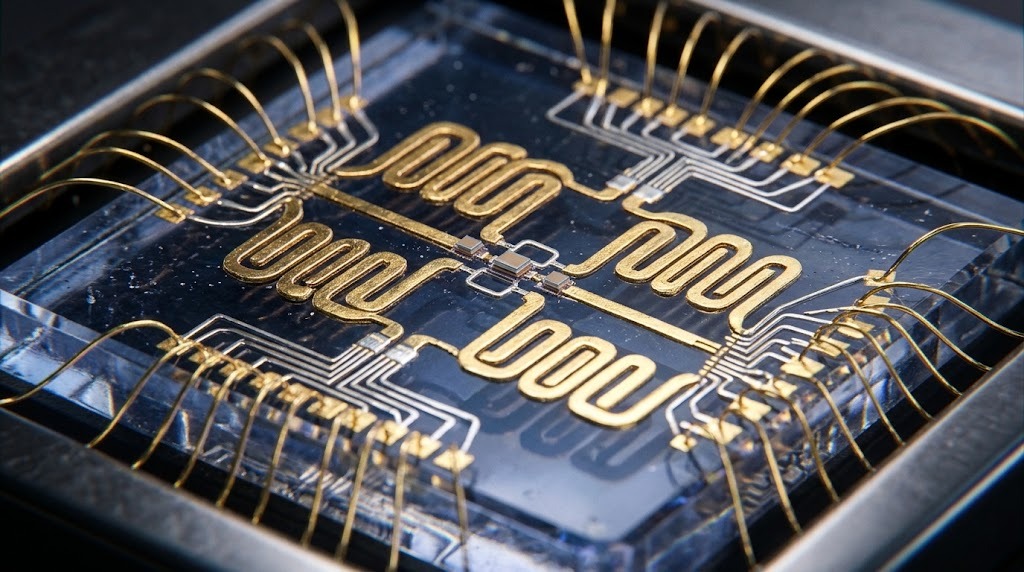
Willow is the first chip Google describes as "below threshold." According to Google's announcement, the team tested grids of 3x3, 5x5 and 7x7 encoded qubits, and each step up cut the error rate roughly in half. That is the point of error correction: adding qubits made the system more reliable.
The underlying paper gives the detail. A 101-qubit code (distance 7) had a logical error of 0.143% per cycle, and the error shrank by a factor of 2.14 each time the code grew by one step. The logical memory lasted 2.4 times longer than the best single physical qubit on the chip, so it passed break-even, the point where the protected qubit outperforms its own ingredients.
Google also reports a speed test. On a benchmark called random circuit sampling, Willow finished a calculation in under five minutes. Google estimates that Frontier, one of the fastest supercomputers, would need about 10 septillion years (10^25) for the same task.
Two caveats come from Google itself. Its Frontier estimate used conservative assumptions that favor the classical machine, and it expects classical computers to keep improving. It also says random circuit sampling has yet to show practical commercial applications.
What did the Quantum Echoes result add in 2025?
Quantum Echoes was Google's attempt to run a more meaningful task. In an announcement dated October 22, 2025, Google said the algorithm ran 13,000 times faster on Willow than the best classical algorithm on a leading supercomputer.
The method sends a signal through the qubits, disturbs one of them, runs the process in reverse and measures the returning "echo." Google says the result can be checked by repeating it on the same machine or on another quantum computer of similar quality. It calls this the first verifiable quantum advantage on hardware.
Google paired the result with a first test of a possible use. Working with UC Berkeley, the team ran the algorithm on two molecules, with 15 and 28 atoms. The results matched those of traditional nuclear magnetic resonance (NMR), a standard lab technique for studying molecules, and added information NMR does not usually provide.
Google labels this a proof of principle. The molecules are small, and drug discovery and materials uses are described as things that "could" follow. The post is a company announcement, so independent assessments matter for judging how far the claim goes.
What are quantum computers good for?
The most credible target is simulating nature. NIST says quantum computers could model the quantum behavior of molecules, chemicals and materials, which classical computers can only approximate with great effort. Possible payoffs it lists include drug development, more efficient fertilizer production and greenhouse gas capture.
NIST also mentions complex optimization problems, such as organizing airplane assembly, as possible targets. On the record so far, it notes that early demonstrations of "quantum advantage" on specific tasks have not yet proven truly useful, and some were later matched by classical computers.
Can quantum computers break encryption?
In 1994 Peter Shor published an algorithm that could factor large numbers quickly, which would put much of today's encrypted data at risk. NIST says running it would likely need millions of error-free qubits, which it describes as probably still far off.
Willow has 105 qubits, so it is nowhere near that scale. The risk is still taken seriously. On August 13, 2024, NIST finalized its first three post-quantum encryption standards, named FIPS 203, 204 and 205, designed to resist quantum attacks. NIST says some experts predict a device capable of breaking current encryption could appear within a decade, and encourages organizations to start adopting the new algorithms.
Software makers, banks and governments are the ones who need to act, and browsers and messaging apps will handle the switch through ordinary updates.
What to watch next
Google's own roadmap names its next target, a long-lived logical qubit that it calls Milestone 3, and the open question is whether the result holds up when other labs repeat it.
A useful, beyond-classical calculation on a real-world problem is the target Google calls "the next challenge for the field", and it says broader applications depend on a full-scale, error-corrected machine.
Classical computing will respond as well. Each new advantage claim invites researchers to look for faster conventional methods, and the claim gains credibility if those fail again and again.
For related reading on compute infrastructure, see our pieces on co-packaged optics and the GPU bandwidth wall, or on Google's Genie 4 world model.
Questions readers ask
What is a qubit in simple terms?
A qubit is the quantum version of a bit. A normal bit is either 0 or 1, while a qubit can be 0, 1 or a superposition of both until it is measured. NIST notes that each added qubit doubles the number of combinations a machine can hold at once.
Are quantum computers faster than normal computers?
Only for certain tasks. NIST says quantum computers will not replace classical ones and do not simply try every answer at once. Google reports Willow beat a supercomputer estimate on a benchmark, but Google also says that benchmark has no proven commercial use yet.
Can quantum computers break encryption today?
No. NIST says Shor's algorithm would likely need millions of error-free qubits, and Willow has 105. NIST finalized three post-quantum encryption standards in August 2024 as a precaution, noting some experts predict a threat could appear within a decade.
What did Google's Willow chip prove?
Google reports Willow is below threshold, meaning error rates roughly halved as it moved from 3x3 to 5x5 to 7x7 grids of encoded qubits. It does not yet run a useful real-world calculation, which Google calls the next challenge for the field.
Written by
Abdul Rehman
Lead Systems Architect and Technical Director at Syntaxradar. More in Emerging Tech.
More in Emerging Tech
See all
AI Bubble Pop? 5 Warning Signs Behind Big Tech's $740B Bet
Alphabet fell 12% on Oct 29, its worst day on record, after a second negative free cash flow quarter. The Nasdaq fell 2.9% the next day, S&P cut Meta's outlook to negative, and…
Oct 31, 2026 · 7 min read
Binance Hacked: How One Laptop May Have Led to a $6.36B Theft
On Oct 29, 2026, attackers drained Binance hot wallets across ten blockchains. TRM Labs counts about $6.36B stolen and links it to North Korea's TraderTraitor; Binance blames a…
Oct 30, 2026 · 8 min read

Is a Computer Science Degree Worth It? What the 8.1% Drop Means
US undergraduate computer science enrollment at four-year colleges fell 8.1% in fall 2025 and 8.4% in spring 2026, per the National Student Clearinghouse, as overall enrollment…
Oct 29, 2026 · 7 min read
Latest stories
Front page
Xreal Aura: Should You Buy the $1,099 Android XR Glasses?
Abdul Rehman · Oct 31, 2026 · 7 min read

Claude Code Extension VSCode Backdoor: How to Check and Clean Up
Abdul Rehman · Oct 31, 2026 · 7 min read

AO3 Outage: Why Is AO3 Down, and Is Your Account Safe?
Abdul Rehman · Oct 30, 2026 · 7 min read
AI for Hacking: CrowdStrike Says ARTEX Targeted 200+ Orgs
Abdul Rehman · Oct 30, 2026 · 7 min read