
Gemini API Pricing: Carbon and Argon Double to $4/$20 Dec 1
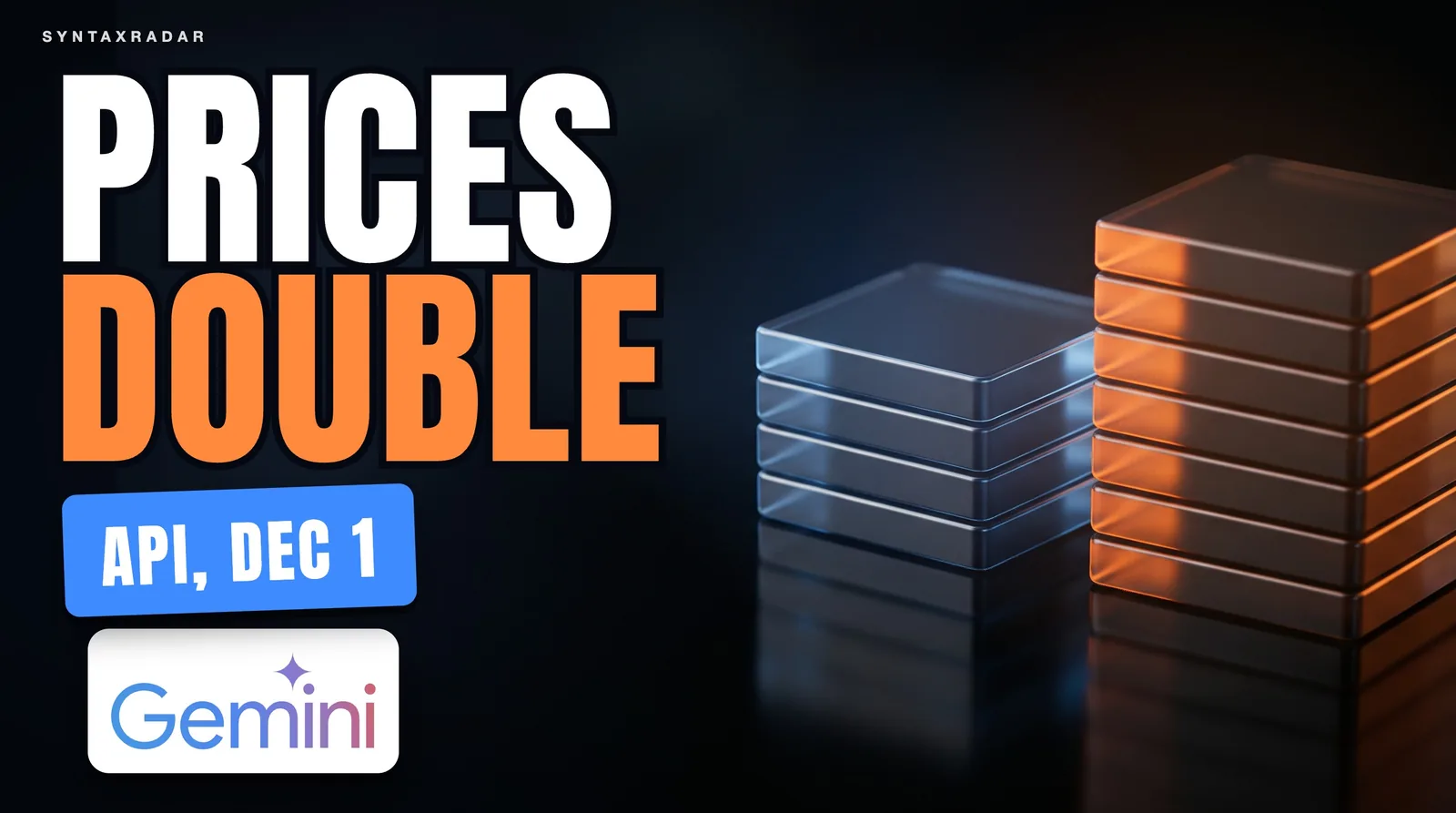
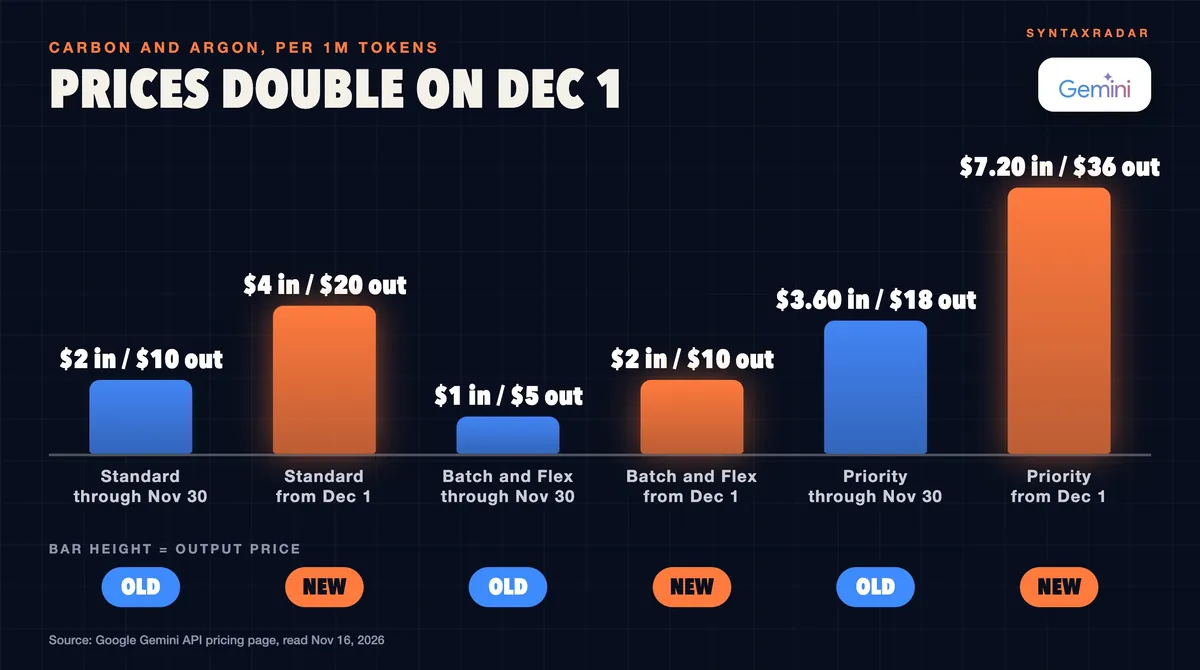
Google's pricing page lists Gemini 4 Carbon and Argon at $2 per 1M input and $10 per 1M output tokens through November 30, 2026, then $4 and $20 from December 1. Batch, Flex, caching and Priority double too.

Abdul Rehman
Lead Systems Architect and Technical Director · · 6 min read
The short version
- $4 per 1M tokens (was $2)
- Carbon and Argon input price from Dec 1, 2026
- $20 per 1M tokens (was $10)
- Carbon and Argon output price from Dec 1, 2026
- November 30, 2026
- Last day at the old rate
Why it matters: Gemini 4 Carbon and Argon double to $4/$20 per million tokens on December 1, 2026, ending Google's introductory rate, while Hydrogen's $1.50/$7.50 lists no end date.
On this page
Gemini API pricing for Gemini 4 Carbon and Gemini 4 Argon goes from $2 per million input tokens and $10 per million output tokens to $4 and $20 on December 1, 2026. The last day at the old rate is November 30, 2026, according to Google's pricing page. Batch, Flex, cached input and Priority rates for both models double on the same date.
Google describes the $2/$10 rate as an introductory price on its Carbon and Argon guides, so this is the end of a discount rather than a surprise hike. As of November 16, 2026, the same page lists no scheduled change for Gemini 4 Hydrogen, which stays at $1.50 input and $7.50 output.
Gemini API pricing for Carbon and Argon: old and new rates
Carbon and Argon share one price list. The table below shows Gemini API pricing per million tokens for every tier Google lists for the two models, as of November 16, 2026. Output prices include thinking tokens (the hidden reasoning a model writes before it answers), and Google says every token is counted and billed.
Source: Google's pricing page, Standard, Batch, Flex and Priority tabs. Neither model is on the free tier.
Gemini 4 Argon pricing and Gemini 4 Carbon pricing match per token. The difference is how much each model thinks. Google says Carbon spends more thinking tokens per turn, which makes it more thorough but raises per-turn token use and latency, while Argon gives faster responses at a lower token spend per turn.
One secondary report, from Apidog, cites Artificial Analysis data of Carbon producing about 1.8 times Argon's output tokens on the same tasks (single secondary report, not checked against the original). Because thinking tokens bill at the output rate, a Carbon task can cost more than an Argon task at identical list prices.
When do Gemini API prices go up?
Three dates matter, all taken from Google's pages.
- November 30, 2026: the last day of the $2/$10 introductory rate for Carbon and Argon. Argon reached general availability on October 13, and Carbon on November 10, according to Google's release notes.
- December 1, 2026: Carbon and Argon move to $4/$20, and two older models are rerouted (covered below). Google does not state a time zone for the switch on the pages we read.
- January 1, 2027: Gemini 3.8 Flash and Gemini 3.6 Flash go from $0.75 input and $3.75 output to $1.50 and $7.50, and their cached-input storage fee goes from $0.50 to $1.00 per million tokens per hour.
How much does the Gemini API cost per month for a real workload?
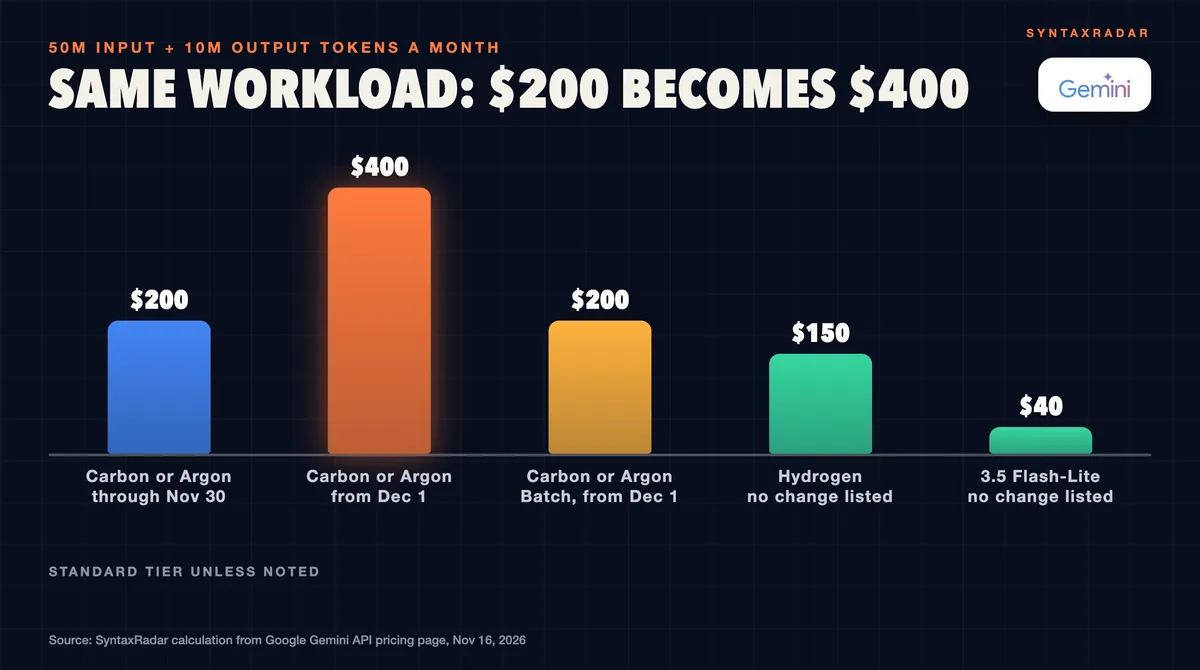
The Gemini API cost per token is fixed by Google's list, but the monthly bill depends on volume, so we priced one workload at Google's listed rates. The inputs are ours: 50 million input tokens and 10 million output tokens a month. Every rate comes from Google's pricing page, and the arithmetic is ours.
SyntaxRadar calculation: 50M input and 10M output tokens a month
Three readings follow from the table. Carbon or Argon standard costs $200 more a month from December 1 on this workload, a 100% rise. Batch at the new rate ($200) equals what standard cost before, so work that can wait for results holds its old bill. And Hydrogen at $150 costs about 62.5% less than Carbon or Argon standard at $400, though it is a different model, so test it on your own prompts.
At request level, one call with 10,000 input and 2,000 output tokens costs $0.04 on Carbon or Argon standard through November 30 and $0.08 from December 1, or $40 versus $80 per 1,000 calls.
Is the Gemini API free?
Part of it is. According to Google's pricing page, the Gemini API free tier covers Gemini 4 Hydrogen, Gemini 3.8 Flash, Gemini 3.6 Flash, Gemini 3.5 Flash-Lite and Gemini 3.1 Flash-Lite. Gemini 4 Carbon and Gemini 4 Argon are not available on the free tier, so every request to them is paid, before and after December 1.
The free tier has a trade-off. The pricing page notes that content sent on the free tier is used to improve Google's products. Paid use also adds tool charges: Google Search grounding is billed at $14 per 1,000 requests after 5,000 free requests a month, with no scheduled change on the page.
What changes on December 1 for gemini-2.5 users?
Google's reroute of two older models takes effect on December 1, 2026, per its deprecations page. Requests to gemini-2.5-pro automatically route to Gemini 3.8 Flash and are billed at Gemini 3.8 Flash rates. Requests to gemini-2.5-flash route to Gemini 3.5 Flash-Lite at Gemini 3.5 Flash-Lite rates. Google also says gemini-2.5-pro is deprecated and its API access is limited to developers who have actively used it, while gemini-2.5-flash-lite is not deprecated and stays available.
Both listed 2.5 Flash and 3.5 Flash-Lite prices are $0.30 input and $2.50 output, so that reroute changes which model answers, not the per-token rate. For 2.5 Pro, the listed legacy rate is $1.25 input and $10 output for prompts up to 200,000 tokens. On our 50M/10M workload that is $162.50 a month, against $75 on Gemini 3.8 Flash through December 31 and $150 from January 1, 2027. Google tells developers to read the migration guides for breaking API changes before December 1.
How to keep your Gemini API bill flat
Use this checklist before November 30, 2026.
- Measure your monthly tokens. Count input and output tokens per model, then multiply by the December rates. Thinking tokens sit in the output count.
- Route by task. Keep Carbon for the tasks where its extra thinking pays off, send routine requests to Argon, and test Hydrogen or Flash-Lite on the rest. Our Gemini 4 Hydrogen pricing breakdown covers who should switch and what Google reports for its benchmarks.
- Move waiting work to Batch. For Carbon and Argon, Batch from December 1 costs what standard cost before.
- Test a lower thinking level. Google lists three thinking levels for these models: low, medium (the default) and high, per its Carbon guide. Thinking tokens bill at the output rate, so check whether a lower level holds quality on your own prompts.
- Budget two dates. Plan for December 1 on Carbon and Argon and January 1, 2027 on the Flash rows.
Our Gemini 4 Carbon explainer covers what the model was built for (written October 29, before Google's November 10 general availability). Our LLM API pricing guide, written October 25, tracks how API prices have moved across vendors. Video models have their own rate table, which our Veo pricing post walks through.
What to watch next for Gemini API pricing
As of November 16, 2026, the dated timeline is clear: $2/$10 holds through November 30, 2026, Carbon and Argon go to $4/$20 on December 1, and the Flash rows follow on January 1, 2027. Google's pricing page and its release notes are where any change to those dates would appear, and Hydrogen's $1.50/$7.50 listing shows no end date on the page. Re-check Google's pricing page on December 1 against the figures in this post before you set a budget.
Questions readers ask
What will Gemini 4 Argon cost per million tokens after November 30?
According to Google's pricing page, Gemini 4 Argon costs $4 per million input tokens and $20 per million output tokens starting December 1, 2026, up from $2 and $10. Batch and Flex are $2 and $10, cached input is $0.20, and Priority is $7.20 and $36. Argon is not on the free tier.
Can I use Gemini 4 Carbon on the free tier?
No. Google's pricing page says Gemini 4 Carbon is not available on the free tier, and every token it processes is billed, including thinking tokens. The free tier does list Gemini 4 Hydrogen, Gemini 3.8 Flash, Gemini 3.6 Flash and the two Flash-Lite models, though free-tier content may be used to improve Google's products.
Does Gemini 4 Hydrogen get the same December 1 increase?
As of November 16, 2026, Google's pricing page lists Gemini 4 Hydrogen at $1.50 per million input tokens and $7.50 per million output tokens with no end date or scheduled change. The scheduled increases on the page are for Carbon and Argon on December 1, 2026, and for Gemini 3.8 Flash and 3.6 Flash on January 1, 2027.
What happens to gemini-2.5-pro requests on December 1?
Per Google's deprecations page, all API requests to gemini-2.5-pro automatically route to Gemini 3.8 Flash on December 1, 2026 and are billed at Gemini 3.8 Flash rates, which are $0.75 input and $3.75 output through December 31. Google advises reading the migration guide for breaking API changes before that date.
Is Argon cheaper than Carbon at the same price?
Their list prices match, but cost per task can differ. Google says Carbon spends more thinking tokens per turn than Argon, and thinking tokens bill at the output rate. One secondary report from Apidog cites about 1.8 times the output tokens for Carbon, which we have not verified against the original data.
Sources
Written by
Abdul Rehman
Lead Systems Architect and Technical Director at Syntaxradar. More in AI & Models.
Keep reading
Gemini 4 Hydrogen: $1.50 Agent Model and Who Should Switch
Google released Hydrogen, a Gemini 4 model, on November 12, 2026: a fast agent model priced at $1.50 per 1M input and $7.50 per 1M output tokens, with a 1M-token window, a new…
Nov 13, 2026 · 6 min read
What Is Gemini 4 Carbon? Google's Bug-Hunting AI, Explained
On October 28, 2026, Google DeepMind announced Gemini 4 Carbon, a frontier model built to find, exploit and patch software vulnerabilities. It goes first to a small group of cyber…
Oct 29, 2026 · 7 min read
Gemini 4 Carbon: Why Google's New AI Goes to Defenders First
Google announced Carbon on Oct 28, 2026, a security-focused Gemini 4 model that scores 88.2% on SEC-bench Pro and 0.0% prompt-injection success. It goes to a subset of cyber…
Oct 29, 2026 · 6 min read
More in AI & Models
See all
OpenAI Usage Policies: Gateway Approval and Training Ban
OpenAI's usage policies took effect November 20, 2026. Services that give third parties direct model access need prior approval, and OpenAI outputs cannot train substitute models.…
Nov 22, 2026 · 7 min read
Meta AI Muse Spark: What Privacy Reports Say, Meta's Reply
As of November 20, 2026, Reuters (via TechCrunch) reports Meta employees flagged Muse mixing up accounts. Meta calls them isolated incidents and says users can turn off AI…
Nov 21, 2026 · 7 min read

Anthropic Stock Price: $83 IPO, $111.50 Open, $97.17 Close
Anthropic (ANT) priced its IPO at $83 on November 18, 2026, first traded at $111.50 on November 19 and closed at $97.17. On November 20 it traded near $87 intraday, as low as…
Nov 21, 2026 · 6 min read
Latest stories
Front page
NoisyTCP: The Linux Kernel TCP Flaw and Who Must Patch
Abdul Rehman · Nov 23, 2026 · 7 min read
US Approves AI Chips to China: 879,868 H200 and MI325X Cleared
Abdul Rehman · Nov 22, 2026 · 6 min read
Nothing AI Device: What Is Confirmed Before the Dec 8 Reveal
Abdul Rehman · Nov 22, 2026 · 7 min read
KB5132061: Windows 11 Install Errors Explained, and the Fix
Abdul Rehman · Nov 22, 2026 · 7 min read