
Gemini 4 Hydrogen: $1.50 Agent Model and Who Should Switch
Google released Hydrogen, a Gemini 4 model, on November 12, 2026: a fast agent model priced at $1.50 per 1M input and $7.50 per 1M output tokens, with a 1M-token window, a new xhigh thinking level and 2.5x faster tasks than Gemini 3.8 Flash.

Abdul Rehman
Lead Systems Architect and Technical Director · · 6 min read
The short version
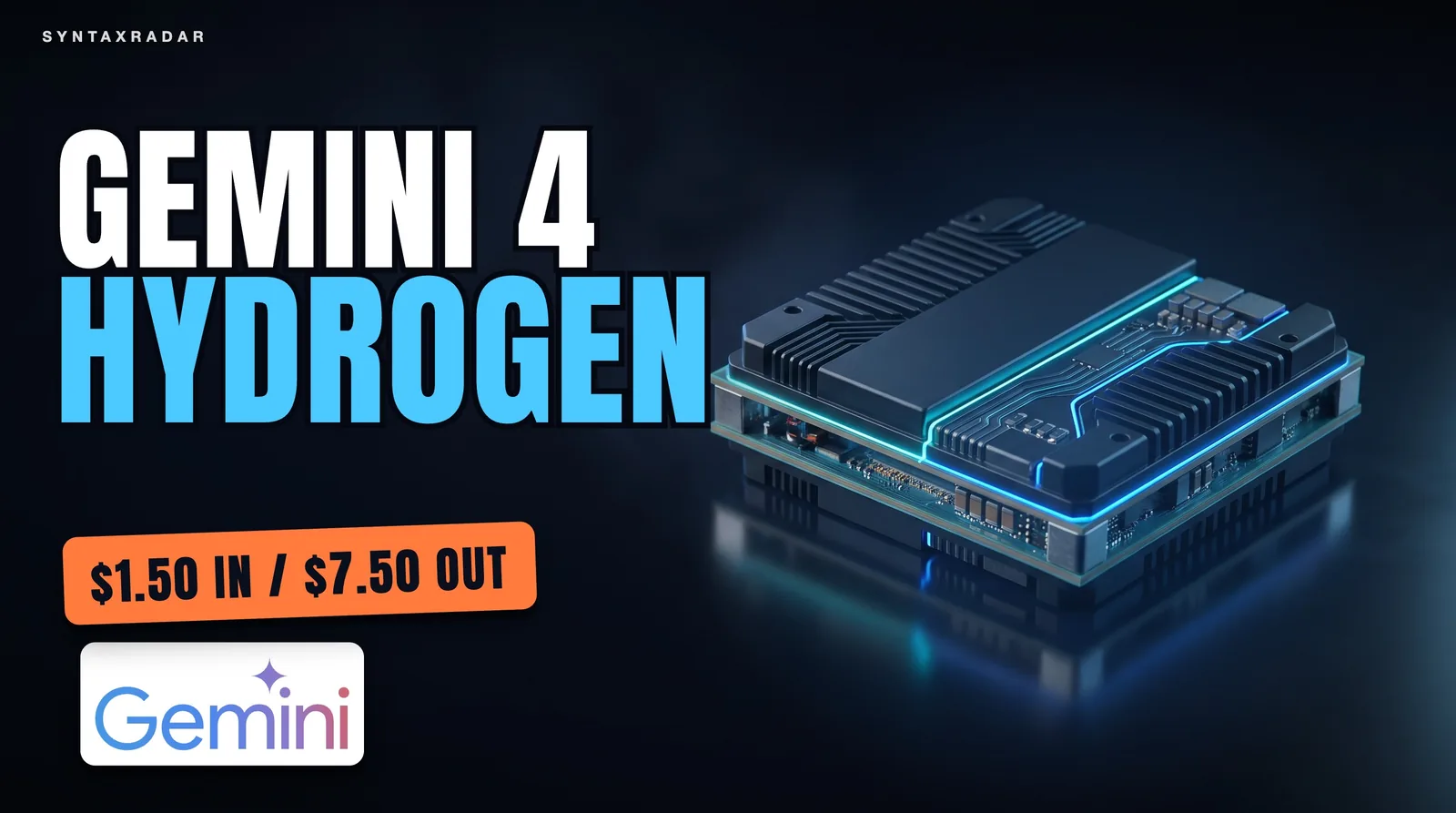
- $1.50 in / $7.50 out
- API price per 1M tokens
- 57% vs 18.2%
- Terminal-Bench 4.1 vs 3.8 Flash
- 2.5x faster
- Speed vs 3.8 Flash (high)
Why it matters: Hydrogen is a clear step up from Gemini 3.8 Flash on Google's own numbers at a flat, published price, but cost comparisons with Argon and Carbon wait on prices Google has not listed.
On this page
Gemini 4 Hydrogen is Google's new fast model for AI agents (software that works through multi-step tasks on its own), released on November 12, 2026. As of November 13, 2026, Gemini 4 Hydrogen pricing is $1.50 per million input tokens and $7.50 per million output tokens, the same rate across the full 1 million token context window, according to Google's launch post. Tokens are the small chunks of text a model reads and writes, and you pay for both directions.
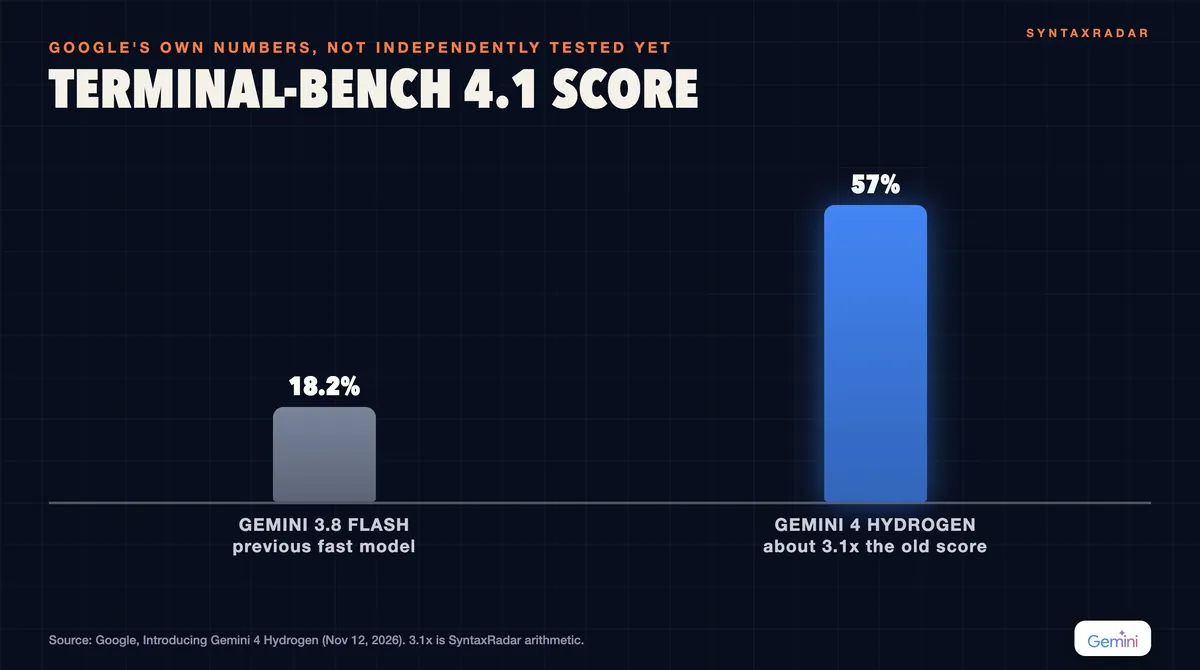
The headline gain is over Google's previous fast model. Against Gemini 3.8 Flash, Google says tasks finish 2.5x faster and the Terminal-Bench 4.1 score jumps from 18.2% to 57%. Nearly every benchmark figure in this post comes from Google itself, so read them as the vendor's numbers until independent testers publish their own.
What is Gemini 4 Hydrogen?
Hydrogen is the speed-focused member of Google's Gemini 4 family, aimed at agent work. Most of the tests Google reports for it are agent tasks: working in a command-line terminal, tax and legal research, and multi-step jobs. It reads up to 1 million input tokens and can write up to 1 million output tokens in a response.
It also brings a new dial. Hydrogen has four thinking levels (how much reasoning the model does before it answers): low, medium, high and a new xhigh tier, according to the Google Antigravity announcement. High is the default. The levels let you choose, request by request, how much effort the model spends.
Google shipped it everywhere at once on November 12, 2026: AI Studio, the Gemini API, Gemini for business, the Gemini app, Google Search, Google Sheets and Google Antigravity.
How much does the Gemini 4 Hydrogen API cost?
The Gemini API price for Hydrogen is $1.50 for every million tokens you send and $7.50 for every million tokens it writes back. Output costs 5x input, which matters for agents: a model that writes long plans, code and tool calls spends more of your budget on the expensive side.
The flat rate is the part worth noticing. Google says the price holds across the full 1M-token window, so a huge prompt does not move you onto a higher tier.
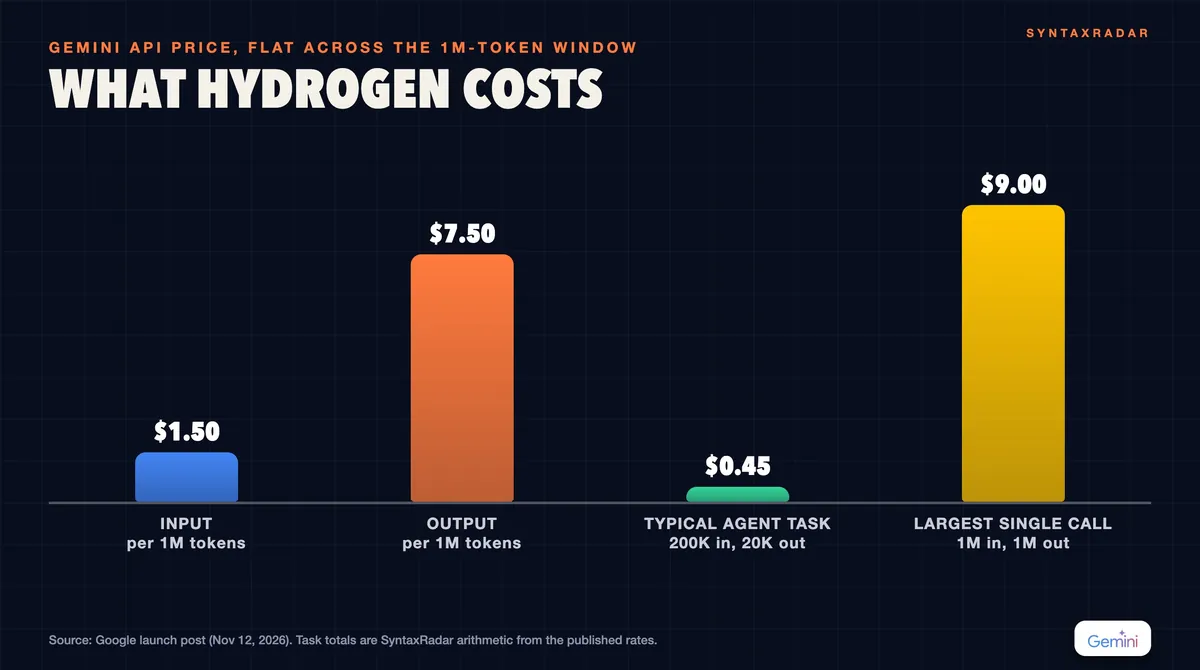
SyntaxRadar calculation: Gemini API cost of a real task
We took Google's two prices and ran them through three job sizes. The inputs are only the published rates; the totals are our arithmetic.
Two things fall out of the table. In the typical task, output is a tenth of the tokens but a third of the bill. And the ceiling for one maxed-out call is $9.00, which gives teams a hard number for worst-case budgeting.
What we could not calculate: a price comparison with Argon, Carbon or 3.8 Flash. Neither Google page in our sources lists those prices, so any "cheaper than" claim would be a guess. If you price models for a living, our Claude Fable 5.2 price breakdown shows how another lab sets its fast-mode rates, which helps when you put Hydrogen next to a rival.
Gemini 4 Hydrogen vs Gemini 3.8 Flash
For anyone already on Google's previous fast model, this is the comparison that matters, and Google's numbers show a large gap.
- Speed: tasks finish 2.5x faster at the high thinking setting.
- Terminal-Bench 4.1: 57%, up from 18.2%. That is a 38.8-point rise, or about 3.1x the old score (our arithmetic from Google's figures). Terminal-Bench tests whether a model can complete real tasks in a command-line terminal.
- Partner runs: early partners saw complex workflows run 2x to 2.8x faster and use 12% to 23% fewer tokens.
- Accuracy: fabricated claims (statements the model makes up) drop by more than 5x.
The token figure is easy to skip and should not be. Fewer tokens per job means a smaller bill at the same per-token rate. We cannot turn that into a dollar saving, because the sources do not give 3.8 Flash's price.
Google also reports safety gains. It says agentic overreach (an agent doing more than it was asked) down by up to 81%, under-service (doing less than asked) down by up to 79%, and 2.3x more resilience on the Gray Swan IPI benchmark, a test of indirect prompt injection, where hidden instructions are planted in content an agent reads.
Gemini 4 Hydrogen vs Argon, Carbon and xhigh
On the one shared scoreboard Google cites, the Artificial Analysis Intelligence Index, Hydrogen scores 51 at its default high setting. Argon, another Gemini 4 model, scores 50. Switch Hydrogen to its xhigh thinking level and it reaches 54. Treat xhigh as a setting for the hardest jobs.
That is the clearest case for the xhigh tier: 3 points over its own default and 4 over Argon, on Google's reporting of the index. We found no independent confirmation of those scores in our sources. And because no Argon price is published there, the fair reading of Hydrogen vs Argon is "slightly higher on one index", not "better value".
Carbon is the other Gemini 4 model in this story. Our Gemini 4 Carbon explainer covers that model and who gets it first, and what is Gemini 4 Carbon explains the basics if you are new to the family. In Antigravity, Gemini 4 Hydrogen works as a pair with Carbon: the Antigravity Orchestrator combines Hydrogen with Carbon and, according to Google, reaches near-Carbon task success on Terminal-Bench 4.0 while using 24% less quota and running 19% faster on average.
Gemini 4 Hydrogen benchmarks Google reports
Each test measures something different, so a higher percentage on one does not make it a harder or more important test than another. All figures come from Google's announcement.
Is Gemini 4 Hydrogen free?
Yes, for some people, through Google's consumer products, and no for developers. On the API you pay the per-token rates above. Here is who gets it without an API bill, as of November 13, 2026:
- Gemini app: free users get Hydrogen through automatic model selection, meaning the app picks it for you rather than offering it as a fixed choice.
- Google Search: available to all users.
- Google Sheets: AI Pro and Ultra subscribers, with output Google says is over 30% faster than previous models.
- Antigravity: paid AI Pro and Ultra subscribers. The Orchestrator, which pairs Hydrogen with Carbon, is for AI Ultra subscribers only.
Carbon launched in Antigravity shortly before Hydrogen with a /swarm command, and Google says tens of thousands of swarms were launched within a couple of days.
Who should switch to Hydrogen?
If you run agents on Gemini 3.8 Flash, Hydrogen is the obvious test. Google's own numbers point the same way on speed, terminal tasks, token use and made-up claims, and the price is published and flat across the window. Run your own workload at the default high setting first, then try xhigh only on the jobs where the extra quality is worth the extra effort.
If you are choosing between Hydrogen and Argon or Carbon, the sources do not give you enough to decide on cost. Hydrogen edges Argon on one index, and Carbon's clearest published role is as Hydrogen's partner in the Orchestrator. For a sense of how Google prices its other new models, our Veo pricing breakdown shows the per-clip costs on the video side.
What to watch next
Three open questions decide how good Gemini 4 Hydrogen really is outside Google's own tests. First, independent benchmark runs: almost every number here is Google's. Second, published Argon and Carbon API prices, which would make a real value comparison possible. Third, whether partners outside Google's launch list see the same 12% to 23% token savings on their own workflows. When those land, the case against 3.8 Flash will rest on more than one company's post.
Questions readers ask
What is Gemini 4 Hydrogen?
Hydrogen is Google's fast model for AI agents, released on November 12, 2026. It reads up to 1 million input tokens, can write up to 1 million output tokens, and offers four thinking levels: low, medium, high (the default) and a new xhigh tier. Google says it finishes tasks 2.5x faster than Gemini 3.8 Flash.
How much does Gemini 4 Hydrogen cost on the Gemini API?
As of November 13, 2026, Gemini API pricing for Hydrogen is $1.50 per million input tokens and $7.50 per million output tokens, flat across the full 1M-token window. By our arithmetic, a task with 200,000 input and 20,000 output tokens costs $0.45, and one call that fills the window both ways costs $9.00.
Is Gemini 4 Hydrogen free to use?
Partly. Free Gemini app users get it through automatic model selection, and Google Search uses it for all users. Sheets access needs AI Pro or Ultra, and Antigravity access needs a paid AI Pro or Ultra plan, with the Orchestrator for Ultra only. Developers on the Gemini API pay the per-token rates.
What does Gemini 4 Hydrogen's xhigh thinking level do?
xhigh is the highest of Hydrogen's four thinking levels, above the default high setting. On the Artificial Analysis Intelligence Index, as reported by Google, Hydrogen scores 51 at high and 54 at xhigh, against 50 for Argon. Test it on the jobs where quality matters most before making it your default.
What is the Gemini 4 Hydrogen release date?
Google released Gemini 4 Hydrogen on November 12, 2026, across AI Studio, the Gemini API, Gemini for business, the Gemini app, Google Search, Sheets and Antigravity. Hydrogen is one model in the Gemini 4 family, alongside Argon and Carbon, and Carbon launched in Antigravity shortly before it.
Sources
Written by
Abdul Rehman
Lead Systems Architect and Technical Director at Syntaxradar. More in AI & Models.
Keep reading
Gemini API Pricing: Carbon and Argon Double to $4/$20 Dec 1
Google's pricing page lists Gemini 4 Carbon and Argon at $2 per 1M input and $10 per 1M output tokens through November 30, 2026, then $4 and $20 from December 1. Batch, Flex,…
Nov 17, 2026 · 6 min read

Veo Pricing: Veo 3.1 Preview Is Gone, Omni's 15s Clip Costs $1.05
Google's Gemini API docs list the Veo 3.1 preview models as shut down on October 22, 2026. On November 5, 2026 Google made Gemini Omni 1.2 Flash generally available at about $0.07…
Nov 8, 2026 · 6 min read
What Is Gemini 4 Carbon? Google's Bug-Hunting AI, Explained
On October 28, 2026, Google DeepMind announced Gemini 4 Carbon, a frontier model built to find, exploit and patch software vulnerabilities. It goes first to a small group of cyber…
Oct 29, 2026 · 7 min read
More in AI & Models
See all
OpenAI Usage Policies: Gateway Approval and Training Ban
OpenAI's usage policies took effect November 20, 2026. Services that give third parties direct model access need prior approval, and OpenAI outputs cannot train substitute models.…
Nov 22, 2026 · 7 min read

Meta AI Muse Spark: What Privacy Reports Say, Meta's Reply
As of November 20, 2026, Reuters (via TechCrunch) reports Meta employees flagged Muse mixing up accounts. Meta calls them isolated incidents and says users can turn off AI…
Nov 21, 2026 · 7 min read

Anthropic Stock Price: $83 IPO, $111.50 Open, $97.17 Close
Anthropic (ANT) priced its IPO at $83 on November 18, 2026, first traded at $111.50 on November 19 and closed at $97.17. On November 20 it traded near $87 intraday, as low as…
Nov 21, 2026 · 6 min read
Latest stories
Front page
NoisyTCP: The Linux Kernel TCP Flaw and Who Must Patch
Abdul Rehman · Nov 23, 2026 · 7 min read
US Approves AI Chips to China: 879,868 H200 and MI325X Cleared
Abdul Rehman · Nov 22, 2026 · 6 min read
Nothing AI Device: What Is Confirmed Before the Dec 8 Reveal
Abdul Rehman · Nov 22, 2026 · 7 min read
KB5132061: Windows 11 Install Errors Explained, and the Fix
Abdul Rehman · Nov 22, 2026 · 7 min read