


Meta AI Muse Spark: What Privacy Reports Say, Meta's Reply
As of November 20, 2026, Reuters (via TechCrunch) reports Meta employees flagged Muse mixing up accounts. Meta calls them isolated incidents and says users can turn off AI training and delete Muse data.

Abdul Rehman
Lead Systems Architect and Technical Director · · 7 min read
The short version
- September 8, 2026
- Muse agent launch
- 10 million+
- Downloads (per Reuters via TechCrunch)
- On, per Meta's help page
- Training setting at first use
Why it matters: As of November 20, 2026, the privacy reports about Meta's Muse agent are employee accounts, a disputed columnist claim and critics' analysis, while Meta's help page offers controls for training, memory and deletion.
On this page
Meta AI Muse Spark is the family of models behind Meta's Muse agent app, and as of November 20, 2026 the privacy criticism is aimed mostly at the app. Reuters, as relayed by TechCrunch on November 19, reports that Meta employees flagged Muse mixing up accounts, and EPIC, Malwarebytes, Gizmodo and others argue it collects heavily. Meta says the cases were isolated incidents and that its help page lets you turn off AI training and delete what Muse stores.
The privacy concerns below are each attributed to the outlet or researcher who raised it. None of it is a finding by SyntaxRadar, and nothing here shows that your own data has leaked.
What is Meta AI Muse Spark, and how is it different from Muse?
Muse Spark is a model. Fortune reported on April 9, 2026 that Meta introduced the Meta AI model Muse Spark in early April as the first model of the Alexandr Wang era and that it powers Meta AI. The Muse agent is a separate product. CNBC reported on September 8, 2026 that the Muse Spark family powers a personal agent app called Muse, which can book appointments and complete forms. It has a free tier and plans at $20 or $100 a month, and it is open to US consumers on iOS, Android and the web.
Our reading is that the app draws the scrutiny because it is the part that connects to your messages, email and accounts. TechCrunch, citing Reuters, says the app passed 10 million downloads after its September launch.
Is Meta Muse safe? What outlets and researchers report
Whether Muse is safe has no single answer, and the reports differ in strength. The table sorts them by who made the claim and what Meta replied.
The strongest caveat sits in the first row. Reuters could not establish, according to The Next Web's summary, whether the bank balances were real data about someone else or invented text. Meta told 9to5Mac they were hallucinations. In the Aten case, TechCrunch says it is still disputed whether Full Disk Access was off, and Meta's Singleton said the AI gave an incorrect explanation of how it knew about the messages.
The security claim is the narrowest. Wardle says a social-engineering trick could take over the Mac app through one undocumented setting, according to heise. Meta removed the setting and says the attack was not remote, because it needs the user to be tricked into running commands.
Meta Muse privacy: what does Muse keep, and what does Meta promise?
The data side splits into what Muse keeps and what Meta promises. On the first, Gizmodo says Wired's reporting shows an hourly process that tells Muse to keep "a page for every person in the user's life," holding names, connections, recurring topics and dates. Malwarebytes adds that, per TIME, Muse reviews your conversations each night, and that Surfshark found 31 of 35 data types declared in App Store disclosures. Malwarebytes notes that a declared type does not mean every user has it collected. EPIC argues Muse is built to gather as much personal data as possible and lacks clear safeguards for bystanders. That is EPIC's reading.
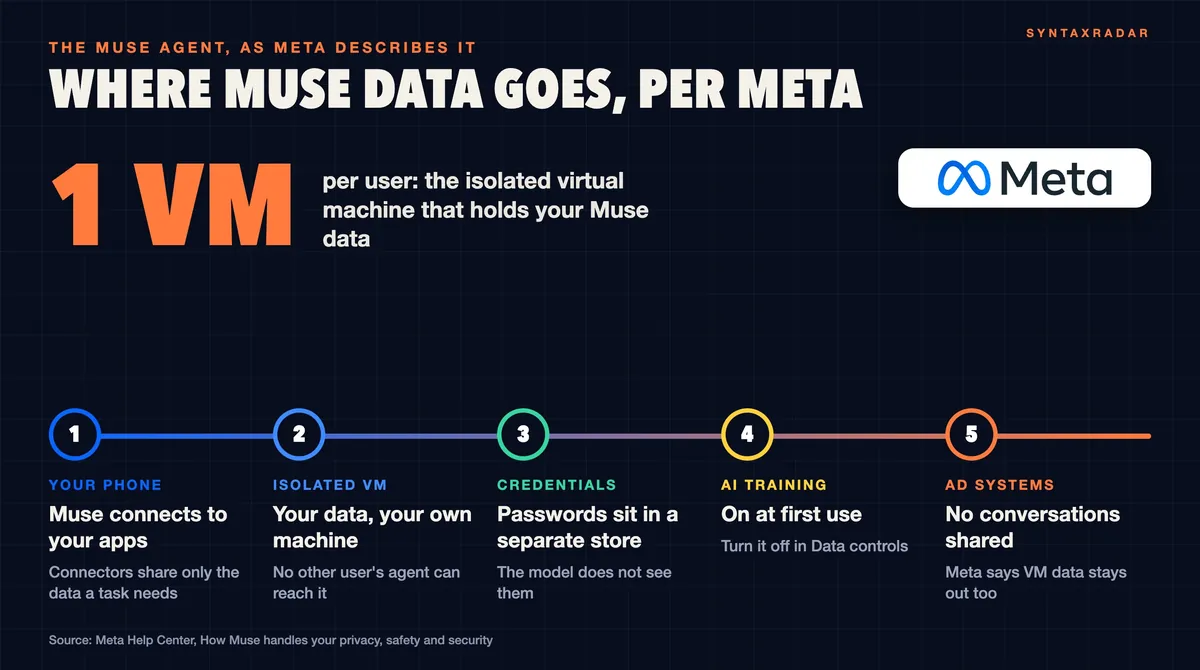
On the second, Meta's help page says each user's data sits in an isolated virtual machine that no other user's agent can reach, and that Muse does not share conversations or virtual machine data with Meta ad systems. It says credentials live in a separate store so the model does not see passwords, and that Muse asks you to confirm certain actions, such as sending an email or making a purchase. The page also describes a future Muse Confidential VM meant to keep information private even from Meta. Malwarebytes, citing TIME, says that option is not available yet.
One setting needs care. Meta's page says the training setting is on when you first use Muse. When it is on, Meta says names, emails, phone numbers and Social Security numbers are removed first, which matches what Meta's David Singleton told CNBC about removing "critical personally identifying information." We read Meta's page through summaries rather than verbatim, so the exact menu wording may differ in your app.
SyntaxRadar calculation: how fast the reports arrived
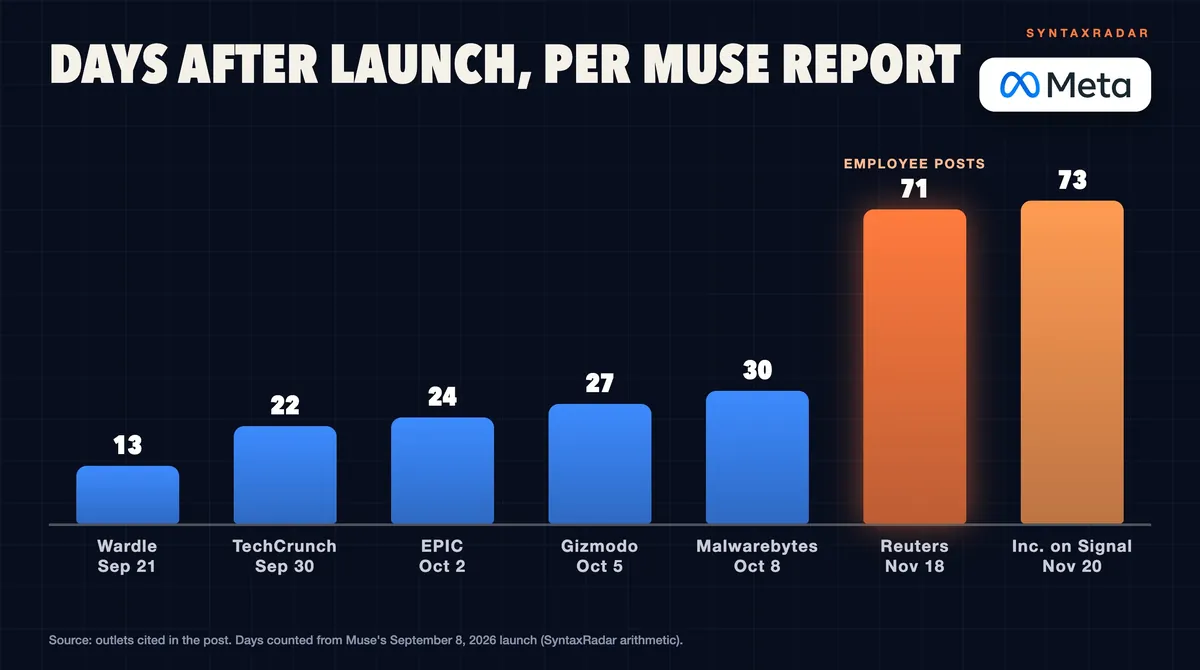
We counted the days between Muse's September 8, 2026 launch and each dated report in this article. The inputs are the publication dates named in the table below.
Two derived figures sit beside it. An hourly refresh, as TIME and Wired are reported to describe it, means 24 updates a day and 168 a week for each contact page. And 31 of 35 data types is about 89 percent, which describes what is declared, not what any one person has shared. The pattern in the dates is that outside critics and researchers spoke within 30 days, while the employee-post reporting took 71 days.
How to turn off Meta Muse or limit what it keeps
There is no single off switch in Meta's help page as we read it, but the privacy settings it describes cover training, memory, deletion and connections. These are Meta's own descriptions, so confirm the menu names in the app.
- Turn off training. Under Data controls in Settings, switch off the training toggle, which Meta's page and press coverage label "Help improve our AI models" (the wording may differ in your app). Meta says changes also apply to past interactions.
- Check what it remembers. Meta says you can ask Muse what it remembers or view files such as MEMORY.md, and use its forget skill to ask it to drop a topic. Meta calls that best effort.
- Delete or reset. You can delete messages, Side Chats and virtual machine files, or reset Muse to erase all Muse data. Meta warns that deleted information may still be remembered, so forget first.
- Trim connections. Meta's page says you can manage whether Muse automatically reads new email, and that connectors share only the data a task needs.
- Check device permissions. Meta told 9to5Mac that Android notification access is an opt-in setting for all apps and that on a Mac you must allow accessibility and screen recording. The Next Web, summarising Reuters, says the Android permission was on by default for Muse, so check it either way. Our reading is that reviewing those system permissions is the direct way to limit what an agent can see.
Canada's privacy commissioner, quoted by Global News, advises limiting the personal information you share with agents. Signal's response is also a device-side step: on November 20, 2026 it said it is restricting screenshots on iPhone and Android, according to Inc.. If you use any agent that can act on a Mac, our guide to Gemini for Mac and how to stop computer use covers the same permission checks. For how another assistant handles retention, our Google Gemini privacy explainer is the closest comparison, and the ChatGPT Wallet piece shows how approval steps work when an agent pays with a real card.
What to watch next for Meta AI Muse Spark
As of November 20, 2026, three questions are open. Meta has not given a count of the incidents, and Reuters could not tell whether the bank balances were real. The Aten dispute over Full Disk Access is unresolved in the coverage we read. And the Confidential VM that Meta's page describes as a future option has no date in the sources.
On the model side, Fortune says Muse Spark was planned for Meta's other apps beyond the Meta AI assistant it already powers, so Meta's data-handling wording for those apps is worth reading when it appears. The sources do not say whether that changes what Muse keeps. The most reliable facts about Meta AI Muse Spark are the dated ones: who reported what, and what Meta said back.
Questions readers ask
What is the difference between Muse Spark and Muse?
Muse Spark is Meta's model family, introduced in early April 2026 according to Fortune, and it powers Meta AI. Muse is the separate personal agent app launched September 8, 2026, which CNBC says the Muse Spark family powers. The privacy reporting is about the agent app, because that is the part that connects to your accounts and messages.
Did Muse read Signal messages?
Reuters, as summarised by The Next Web, says it reproduced Signal message access with Signal staff and the AI Now Institute, on Android through the notification permission and on Mac through accessibility and screenshot tools. Meta says Muse reaches other apps only through permissions users grant and calls the employee cases isolated incidents.
Does Meta use Muse chats to train its AI?
Meta's help page says the training setting is on when you first use Muse and can be changed under Data controls in Settings. Meta says that when it is off, your interactions are not used for future development, and that when it is on, names, emails, phone numbers and Social Security numbers are removed first.
How to turn off Meta Muse and delete its data?
Meta's help page, as we read it, has no single off switch, so turning Muse off means changing settings: the training toggle under Data controls, memory, and connections. To delete data, Meta says you can delete messages, Side Chats and virtual machine files, or reset Muse to erase all Muse data. Meta warns that deleted information may still be remembered, so it suggests the forget skill, which works on a best-effort basis. You can also ask Muse what it remembers or view files such as MEMORY.md.
Can Muse collect information about people who never use it?
Critics say it can. Gizmodo, citing Wired, reports an hourly process that keeps a page on every person in a user's life, and Malwarebytes says messages sent to a Muse user may be read. EPIC argues bystander safeguards are unclear. Meta told Gizmodo agents need context about contacts and that the data stays in each user's own virtual machine.
Is Meta Muse safe?
There is no single answer. As of November 20, 2026, the reports are employee accounts relayed by Reuters through TechCrunch, a columnist's claim that Meta disputes, and critics' analysis such as EPIC's. Meta calls the account mix-ups isolated incidents and says its agents run in isolated virtual machines. Read the table in the section above before deciding, and review the settings listed in the how-to section.
Sources
Written by
Abdul Rehman
Lead Systems Architect and Technical Director at Syntaxradar. More in AI & Models.
Keep reading

Google Gemini Privacy: Who Reads Your Chats and for How Long
Google's Gemini help pages say a subset of chats is read by human reviewers and kept up to three years even after you delete activity, and that chats train its AI while Keep…
Nov 11, 2026 · 7 min read

Is Claude Code Safe? It Put Some Users' Email in Web Requests
GitHub issue #107757 (opened 2026-11-05) reports Claude Code putting a user's account email in the User-Agent of web requests. Version 2.1.317 adds an ask-first check; an engineer…
Nov 7, 2026 · 7 min read

OpenAI Usage Policies: Gateway Approval and Training Ban
OpenAI's usage policies took effect November 20, 2026. Services that give third parties direct model access need prior approval, and OpenAI outputs cannot train substitute models.…
Nov 22, 2026 · 7 min read
More in AI & Models
See all
Anthropic Stock Price: $83 IPO, $111.50 Open, $97.17 Close
Anthropic (ANT) priced its IPO at $83 on November 18, 2026, first traded at $111.50 on November 19 and closed at $97.17. On November 20 it traded near $87 intraday, as low as…
Nov 21, 2026 · 6 min read
Gemini for Mac: What Computer Use Can Do and How to Stop It
On November 19, 2026 Google began rolling out computer use in the Gemini app for Mac, in English in the U.S., for Google AI Plus, Pro and Ultra on Apple Silicon Macs with macOS…
Nov 20, 2026 · 7 min read

How to Buy Anthropic Stock: Brokers, IPO Access, Lock-Up
As of November 16, 2026, Anthropic's SEC filing names six US platforms for retail IPO requests, with no allocation guaranteed. CNBC reports pricing on November 18 and a first…
Nov 19, 2026 · 8 min read
Latest stories
Front page
NoisyTCP: The Linux Kernel TCP Flaw and Who Must Patch
Abdul Rehman · Nov 23, 2026 · 7 min read

US Approves AI Chips to China: 879,868 H200 and MI325X Cleared
Abdul Rehman · Nov 22, 2026 · 6 min read
Nothing AI Device: What Is Confirmed Before the Dec 8 Reveal
Abdul Rehman · Nov 22, 2026 · 7 min read

KB5132061: Windows 11 Install Errors Explained, and the Fix
Abdul Rehman · Nov 22, 2026 · 7 min read