


ChatGPT Wallet: How OpenAI's Dots Pay With Your Real Card
On November 13, 2026 OpenAI announced a Wallet that lets its dots AI agents pay with Amex, Mastercard or Visa cards via transaction-specific tokens and a per-purchase security check, per CNBC. Rollout is limited to US ChatGPT Pro users aged 18+.

Abdul Rehman
Lead Systems Architect and Technical Director · · 6 min read
The short version
- November 13, 2026
- Launch date (per CNBC)
- US Pro subscribers, 18+
- Who can use it
- Amex, Mastercard, Visa
- Card networks
Why it matters: OpenAI's agents can pay with your real card without ever seeing its number, but only US Pro users get it and there are no spending limits at launch.
On this page
ChatGPT Wallet is a payment feature that lets OpenAI's "dots" AI agents buy things for you with your own American Express, Mastercard or Visa card, approved one purchase at a time through a security check such as Face ID or a fingerprint. OpenAI announced it on November 13, 2026, according to CNBC, and as of November 16, 2026 it is limited to US ChatGPT Pro subscribers aged 18 and older. Plus and Free users cannot use it.
OpenAI's announcement page returned an access error (HTTP 403) when we tried to open it, so nothing below comes from reading it directly. Every launch detail is attributed to OpenAI as reported by CNBC, PPC Land and Decrypt.
What is ChatGPT Wallet?
It is a way for agents to pay with your existing card, not a new kind of money. OpenAI built it with American Express, Mastercard and Visa, per CNBC, so that a dot (OpenAI's name for its AI agents) can buy items for you.
Decrypt spells out what it is not. It holds no cryptocurrency and no cash balance, so it is not a ChatGPT digital wallet in the sense of stored money. It also works only inside dots conversations, not in ordinary ChatGPT chats.
OpenAI introduced dots at its developer conference on September 29, 2026, Fortune reported. The Wallet is the piece that lets those agents complete a purchase with your card.
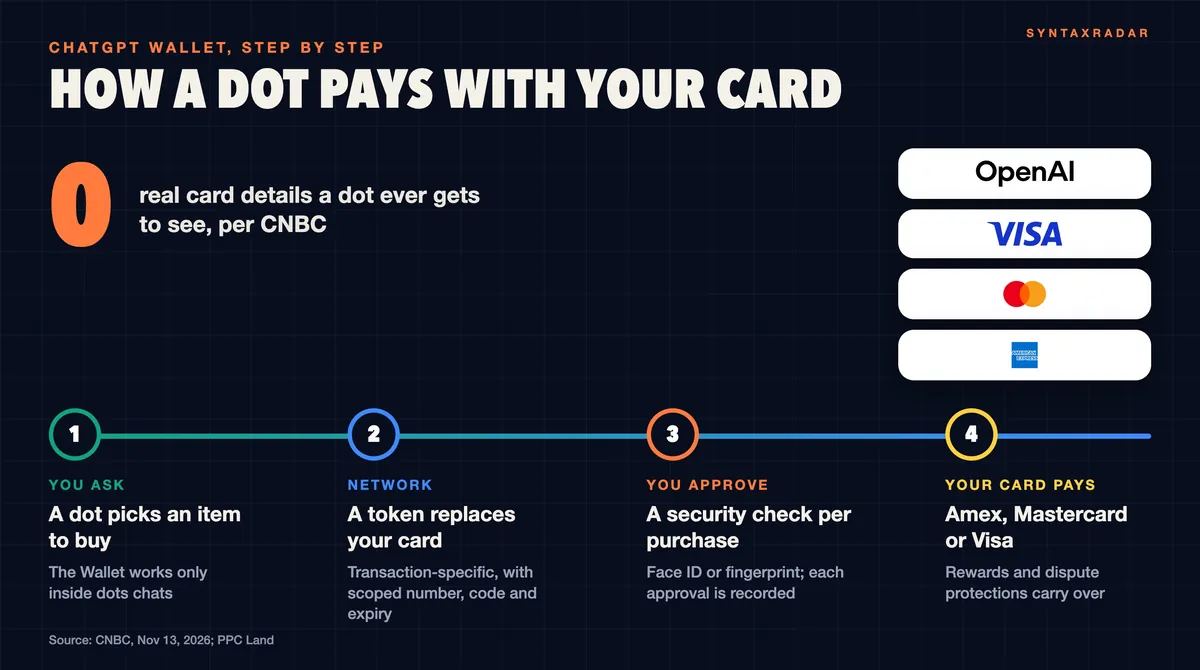
How does an AI agent pay without seeing your card number?
Dots never access your real card details. According to CNBC, the payment network gives the dot a transaction-specific payment token (a stand-in for the card) containing a scoped card number, security code and expiration date.
Approval is the second layer. PPC Land reports that every purchase needs a security check, with Face ID or a fingerprint given as examples, and each approval creates a record of what you authorised. The agent does the buying, but each purchase still needs your approval.
Your card's existing protections carry over. CNBC reports that cardholders keep their rewards and dispute protections, and that OpenAI is not taking a cut of transactions to start. Under OpenAI's terms, as Decrypt reports them, the merchant stays responsible for delivery and returns, and billing disputes generally go to your card issuer, not to OpenAI.
Who can use ChatGPT Wallet?
Only a narrow group, as of November 16, 2026. PPC Land reports the rollout began on November 13 for US ChatGPT Pro subscribers aged 18 and older with eligible US-issued cards. No expansion date, fees or non-US plans were stated.
OpenAI's pricing page marks dots as unavailable on the Free, Go and Plus plans, per PPC Land, and the Wallet lives inside dots. So the short answer to "does it work with Plus or free plans" is no.
The only OpenAI dots pricing we found comes from secondary blog roundups, not from OpenAI. Implicator, a blog roundup (single secondary report), reports Pro tiers at $100, $200 and $500 a month, with the first dot included in Pro and dots not offered in the EEA, Switzerland or the UK. Treat those numbers as unverified until OpenAI's own page can be read.
Is ChatGPT Wallet safe?
The design has two safeguards: the agent never gets your real card details (per CNBC), and each purchase needs a security check (per PPC Land).
Two card companies commented on the launch. Mastercard's Sherri Haymond told Decrypt that an agent's purchase should strengthen, not bypass, the trust built into payments. American Express's Luke Gebb called the limited rollout the right approach, per CNBC.
Three questions remain open:
- No spending limits at launch. PPC Land reports OpenAI plans pre-authorised purchases within limits, categories or time windows, with no date announced. Until then, the per-purchase approval is the only check the reporting describes.
- Token reuse is unexplained. PPC Land does not say whether a token is single-use or reusable.
- Merchants may say no. OpenAI itself warns that shops may block shopping agents or flag a legitimate Wallet purchase as fraud, Decrypt reports.
A short checklist before you let a dot spend:
- Read what the approval screen shows before you approve. That approval creates your record of the purchase.
- Use a card whose dispute process you already know, since billing disputes generally go to the issuer.
- Be ready for declines or fraud flags at some shops, and check your card app after the first few agent purchases.
- Keep big or unusual purchases manual until spending limits exist.
If your worry is the chat side rather than the card side, our explainer on is ChatGPT safe covers how three small bugs could expose private chats, a different question from card payments.
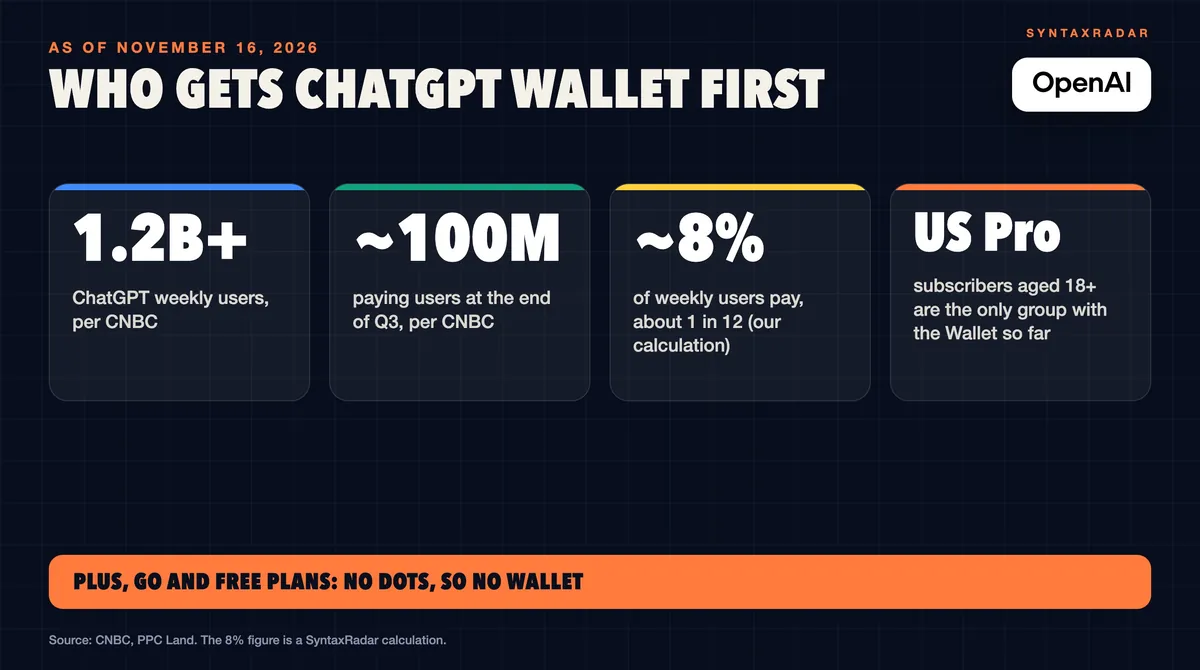
SyntaxRadar calculation: how small the first Wallet audience is
We derived these figures ourselves from numbers in the reporting. CNBC puts ChatGPT at over 1.2 billion weekly active users and nearly 100 million paying users as of the end of Q3.
The point of the first row: even before the Pro filter, more than 9 in 10 weekly users do not pay at all. The Wallet starts with a small slice of ChatGPT's user base.
OpenAI agentic commerce: what changed, and how it differs from x402
OpenAI's agentic commerce push did not start here. Instant Checkout, built with Stripe, launched in September 2025, Fortune reports, and it only covers participating merchants. The Wallet is the card-network route: the payment network supplies the token, and the agent spends your existing card.
Some merchants have said no. CNBC reports that United Airlines said on November 11, 2026 that it will block agents from booking tickets, and that Amazon prevents agents from buying on its platform. We also opened OpenAI's Commerce Partner Playbook for merchants; as of November 16, 2026 it does not mention the Wallet.
ChatGPT agent payments through the Wallet run on cards, but not every agent payment does. Our explainer on what is x402 shows an agent paying per call in stablecoin, with no card involved. And for a related question about trusting AI with financial data, our guide to is Plaid safe to use shows what Claude can see in a bank account.
What to watch next
Four open items to track on ChatGPT Wallet:
- Spending limits. OpenAI's planned limits, categories and time windows have no date.
- Plus and international access. No expansion date or non-US plan has been stated as of November 16, 2026.
- Merchant response. Watch whether more retailers follow United and Amazon in blocking agents.
- OpenAI's own page. The announcement could not be opened for this post, so token reuse and eligibility stay as reported by CNBC, PPC Land and Decrypt.
Questions readers ask
What does ChatGPT Wallet do, in simple terms?
It is a way for OpenAI's dots AI agents to pay for things with your own Amex, Mastercard or Visa card. The agent gets a transaction-specific token instead of your card details, and each purchase needs a security check such as Face ID or a fingerprint. Decrypt reports it holds no crypto and no cash balance, and it works only inside dots conversations.
Does the Wallet work with ChatGPT Plus or free plans?
No. As of November 16, 2026 it is limited to US ChatGPT Pro subscribers aged 18 and older with eligible US-issued cards, according to PPC Land. OpenAI's pricing page marks dots as unavailable on Free, Go and Plus, and the Wallet only works inside dots. No date for wider access has been announced.
Can a dot see my real card number?
No, according to CNBC. The payment network gives the dot a transaction-specific token containing a scoped card number, security code and expiration date, so the real card details never reach the agent. PPC Land does not say whether each token is single-use or can be reused.
Who handles refunds and disputes for agent purchases?
Under OpenAI's terms as reported by Decrypt, the merchant stays responsible for delivery and returns, and billing disputes generally go to your card issuer. CNBC reports you keep your existing card rewards and dispute protections, and that OpenAI is not taking a cut of transactions to start.
Are there spending limits on ChatGPT Wallet?
Not at launch. PPC Land reports there are no spending limits, though OpenAI plans pre-authorised purchases within set limits, categories or time windows. No date has been given. Until then, the per-purchase approval is the only check the reporting describes, so read every approval screen before confirming.
What is the ChatGPT Wallet release date, and when does it reach more people?
OpenAI announced it on November 13, 2026, and a limited rollout began the same day for US ChatGPT Pro subscribers aged 18 and older, per CNBC and PPC Land. No expansion date, fees or non-US plans were stated, so nothing confirms that ChatGPT Wallet is coming soon to Plus, Free or other countries.
Sources
Written by
Abdul Rehman
Lead Systems Architect and Technical Director at Syntaxradar. More in AI & Models.
Keep reading
Is ChatGPT Safe? How Three Small Bugs Could Expose Your Chats
Parameter researchers chained three ChatGPT web flaws so injected code ran in a signed-in session and could read up to 20 recent private chats. Reported Oct 18, fixed Oct 26,…
Nov 1, 2026 · 7 min read
OpenAI Usage Policies: Gateway Approval and Training Ban
OpenAI's usage policies took effect November 20, 2026. Services that give third parties direct model access need prior approval, and OpenAI outputs cannot train substitute models.…
Nov 22, 2026 · 7 min read

LLM API Pricing Fell Up to 80%: Why, and How to Pay Less
Between June and September 2026, OpenAI cut its small Luna model by 80% and both OpenAI and Anthropic launched cheaper flagships: GPT-6.1 Sol at $2/$10 and Claude Opus 5.5 at…
Oct 26, 2026 · 7 min read
More in AI & Models
See all
Meta AI Muse Spark: What Privacy Reports Say, Meta's Reply
As of November 20, 2026, Reuters (via TechCrunch) reports Meta employees flagged Muse mixing up accounts. Meta calls them isolated incidents and says users can turn off AI…
Nov 21, 2026 · 7 min read
Anthropic Stock Price: $83 IPO, $111.50 Open, $97.17 Close
Anthropic (ANT) priced its IPO at $83 on November 18, 2026, first traded at $111.50 on November 19 and closed at $97.17. On November 20 it traded near $87 intraday, as low as…
Nov 21, 2026 · 6 min read
Gemini for Mac: What Computer Use Can Do and How to Stop It
On November 19, 2026 Google began rolling out computer use in the Gemini app for Mac, in English in the U.S., for Google AI Plus, Pro and Ultra on Apple Silicon Macs with macOS…
Nov 20, 2026 · 7 min read
Latest stories
Front page
NoisyTCP: The Linux Kernel TCP Flaw and Who Must Patch
Abdul Rehman · Nov 23, 2026 · 7 min read
US Approves AI Chips to China: 879,868 H200 and MI325X Cleared
Abdul Rehman · Nov 22, 2026 · 6 min read
Nothing AI Device: What Is Confirmed Before the Dec 8 Reveal
Abdul Rehman · Nov 22, 2026 · 7 min read
KB5132061: Windows 11 Install Errors Explained, and the Fix
Abdul Rehman · Nov 22, 2026 · 7 min read