
What Is x402? How AI Agents Pay Brave $0.005 per Search
On November 12, 2026, Brave said its Search API accepts payments through the open x402 protocol: an AI agent with a USDC wallet on Base pays $0.005 per request, with no account or API key needed.

Abdul Rehman
Lead Systems Architect and Technical Director · · 8 min read
The short version
- $0.005
- Brave price per request (x402)
- $5
- Brave price per 1,000 requests
- $0.01
- Tavily x402 price per call
Why it matters: x402 turns an HTTP 402 response into a price tag an AI agent can pay on the spot, and Brave says its Search API now sells queries this way at $0.005 each in USDC on Base, half Tavily's per-call price.
On this page
What is x402? It is an open payment standard that lets software pay for something over plain HTTP, the same protocol your browser uses to load this page, with no account and no API key. On November 12, 2026, Brave announced that its Search API now accepts x402 payments, and Brave says the price is $0.005 per request ($5 per 1,000), paid in USDC (a dollar-pegged stablecoin) on the Base blockchain.
That makes Brave's search index something an AI agent can buy one query at a time. The agent asks, gets told the price, pays, and gets results. No signup form, no credit card on file, no key to leak. This explainer walks through how the x402 payment protocol works using Brave's real numbers, what an agent needs to use it, how Brave's price compares with the one other search provider in our sources, and the caveats Brave's own post leaves open.
One note on sourcing before we start. Brave's announcement is the only report of this launch we could find; we did not find independent coverage. Every Brave detail below comes from Brave's post and is attributed that way.
What is x402 and what did Brave change?
According to x402.org, x402 is "an open, neutral standard for internet-native payments" over HTTP. In plain English: a website or API can say "this costs money" inside the normal web conversation, and the client can pay right there instead of going off to create an account first.
Brave's change applies that to search. Brave says the Search API "now accepts agentic payments" (payments made by AI agents, programs that act on a person's behalf) through x402. As of November 14, 2026, Brave lists these prices on the x402 route:
- LLM Context: $0.005 per request ($5 per 1,000)
- Web, news, image, video and local search endpoints: the same $0.005 per request
The old way to use most paid APIs is a human chore. Someone signs up, adds a card, generates an API key (a secret password for programs), and pastes it into the agent's settings. Brave says pay-per-request through x402 needs none of that: no account and no API key.
What is the x402 protocol?
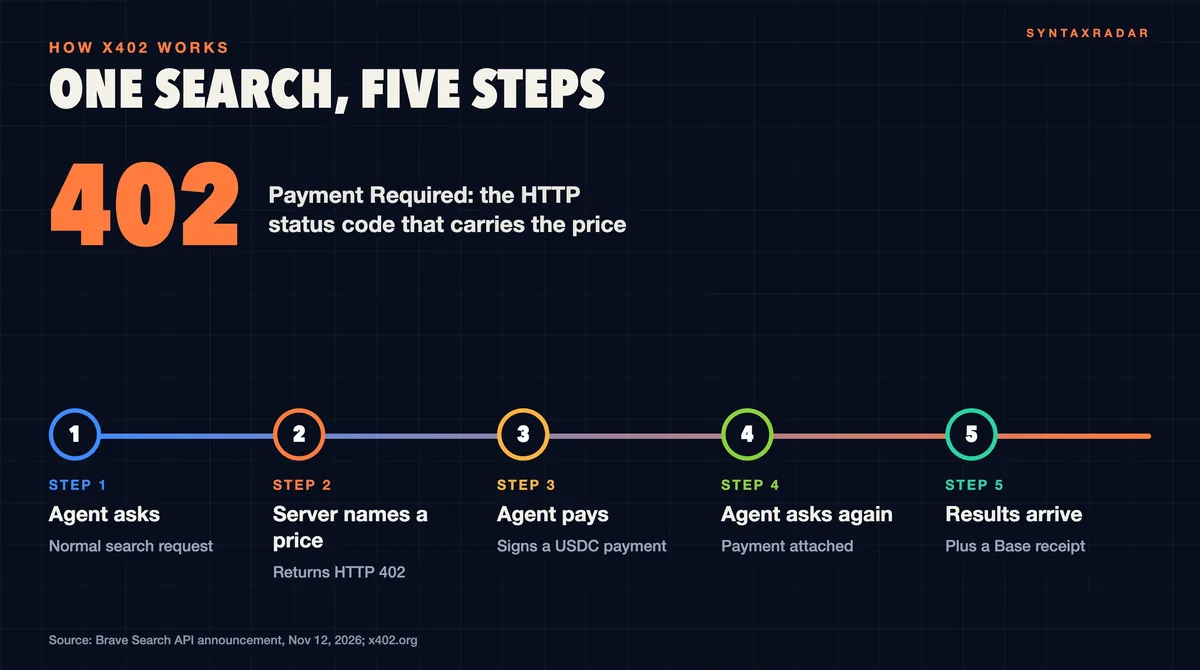
The x402 protocol is a pay-and-retry loop built on an HTTP status code that already exists: 402 Payment Required. Here is the flow as Brave describes it for its Search API, step by step:
- The agent asks without paying. It sends a normal search request.
- The server answers with a price. Instead of results, it returns HTTP 402 Payment Required, and the response states what the request costs.
- The agent pays. It signs a USDC payment from its wallet.
- The agent asks again. It retries the same request with the payment attached.
- The server checks and delivers. After verification, Brave says the search runs and the results come back with a transaction receipt on the Base blockchain.
The x402.org site describes the same shape in general terms: a request without payment gets a 402, and the client pays and retries. That is the whole trick. Nothing about the search request itself changes. The payment rides along with it.
Two words in that flow are worth unpacking. A "facilitator" is the service that checks and settles the payment; Brave runs its own. "Gas" is the network fee a blockchain charges to record a transaction. Brave says its facilitator accepts USDC on Base only for now, and that it covers Base gas fees for a limited time. Brave does not say how long that limited time lasts.
How do AI agents pay for APIs?
AI agents pay for APIs in one of two ways. The familiar one is a human-made account: a person signs up, attaches a card or prepaid credit, and hands the agent an API key. The agent spends against that account, and the person reviews the bill later.
The x402 way removes the human from each purchase. The agent holds its own wallet, and every request is paid for individually at the moment it is made. Brave's post spells out what an agent needs to do this:
- A wallet the agent can use. Brave recommends Purl, a command-line wallet developed by Stripe.
- Money in it, in the right form. Brave says the wallet should be funded with Base-native USDC, meaning USDC that lives on the Base network, not on some other chain.
- Support for the 402 flow. The agent's code has to recognise a 402 response, sign the payment and retry.
The trade-off is easy to state. An API key ties spending to an account you can top up, cap and audit in one place. A wallet ties spending to a balance the agent controls directly, so whatever sits in that wallet is what the agent can spend. Brave's post does not discuss spending limits, so if you try this, how much you put in the wallet is your control.
If you are weighing what agents cost to run in the first place, our explainer on Strands Decider covers a different lever: Amazon's report of labelling tickets 44x cheaper by changing how the agent works, not how it pays.
What is x402 used for?
x402 is used for small, per-use payments between programs, and stablecoins are the main use case, according to x402.org. Search is a natural fit because each query is a separate, tiny purchase.
Brave is not first here. Tavily announced x402 search on May 27, 2026, at $0.01 per call in USDC on Base, also with no signup or API key. So two search providers in our sources now sell queries this way, on the same network and the same stablecoin.
Beyond search, x402.org makes broader claims for the x402 protocol. It says it is blockchain-agnostic, working with EVM chains (blockchains compatible with Ethereum's software) and Solana. It says it charges zero protocol fees, while network fees still apply.
The site also says it has processed "millions" of transactions, without giving an exact count. And under a "Trusted by" heading it shows logos for Alchemy, AWS, Cloudflare, Messari, Nansen, Quicknode, Stripe, Vercel and World. A logo on a page tells you a company is associated in some way; the site does not say what each one built or uses.
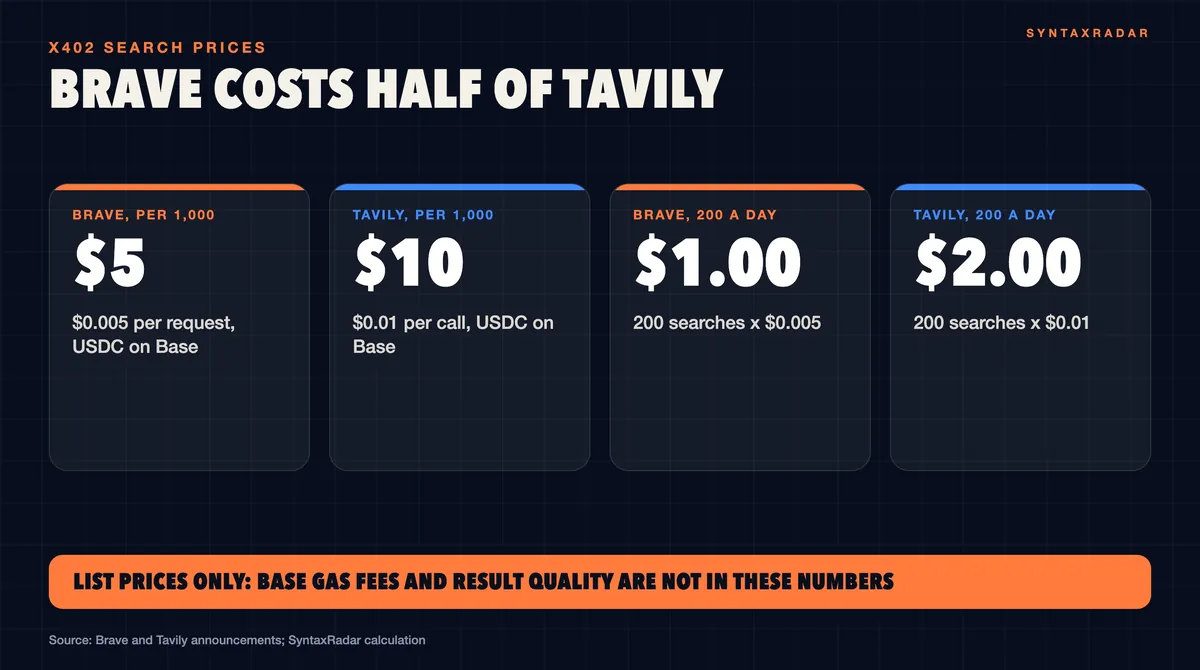
SyntaxRadar calculation: x402 payments at Brave vs Tavily
Both providers publish a flat per-request price, so the comparison is simple arithmetic. These figures are derived by us from the two companies' posts; the inputs are shown in each row.
What the table shows: on list price alone, Brave's x402 route costs half of Tavily's. An agent making 200 searches a day would spend $1.00 a day at Brave and $2.00 at Tavily.
What the table does not show matters as much. These are list prices for a request, not a measure of result quality, and the two services may return different things for the same query. Network fees are also outside the table: Brave says it covers Base gas for a limited time, and x402.org says network fees still apply. Once Brave's subsidy ends, the real cost per search could sit above $0.005. Brave has not said when that happens.
The timing is the other number worth noting. Tavily's x402 launch on May 27, 2026 came 169 days before Brave's on November 12, 2026, by our count, so Brave arrived about five and a half months later at half the per-call price.
Is x402 crypto?
Yes, in practice x402 runs on crypto rails, though the payments are designed to be in stablecoins, not in coins whose price swings. Brave's version takes USDC on Base only for now, and x402.org says stablecoins are the main use case. Brave says other networks and stablecoins are "incoming soon," without dates.
So if your question is "do I need a crypto wallet to use this?", the answer for Brave's x402 route is yes: Brave points you to a wallet funded with Base-native USDC. This post explains how the system works; it is not a view on whether to hold USDC or any other token.
There are also a few gaps worth knowing before you build on it:
- No free tier mentioned. Brave's post does not mention a free tier for the x402 route.
- One network, one coin. USDC on Base is the only option Brave lists for now.
- A subsidy with no end date. The gas coverage is time-limited, and the duration is not given.
What we checked: who created x402. We read Brave's announcement and the x402.org homepage, and neither page names the protocol's creators. Google's autocomplete suggests "x402 protocol coinbase" as a search, but we did not find that link stated on the pages we read, so we are not asserting it here.
A wallet that an agent controls is also a new thing to protect, and our explainer on what are botnets shows what can happen to devices left running on their own: 1.3 million Android TV boxes ended up in one network. And if you are deciding whether to trust any AI tool with access to your accounts, our piece asking is Notion secure looks at what one AI company's breach exposed.
What to watch next
Whether the x402 protocol becomes the normal way AI payments happen between agents and APIs, or stays a demo, will show in four places:
- More networks and stablecoins. Brave says these are "incoming soon." Watch for the first one beyond USDC on Base.
- The end of the gas subsidy. When Brave stops covering Base fees, the real per-search cost becomes visible.
- A free tier, or not. Brave's post is silent on one for x402. Any change will show up on Brave's API pages.
- Independent coverage. As of November 14, 2026, every Brave detail here rests on Brave's own post. Reports from developers who actually run agents on the x402 route will show whether the flow holds up outside the announcement.
So what is x402 today? Going by Brave's post and x402.org, it is a working pay-per-request option at two search providers, with the open questions listed above.
Questions readers ask
Does x402 need an API key?
No, not for Brave's pay-per-request route. Brave says an agent needs no account and no API key. Instead the agent sends a request, receives an HTTP 402 Payment Required response with the price, signs a USDC payment from its wallet and retries with the payment attached. The wallet balance takes the place of the account.
How much does the Brave Search API cost with x402?
As of November 14, 2026, Brave says it charges $0.005 per request, which is $5 per 1,000 requests, for LLM Context. Web, news, image, video and local search endpoints cost the same $0.005 per request. Brave covers Base network fees for a limited time, so the real cost may change when that ends.
What wallet do I need to pay with x402 on Brave?
Brave recommends Purl, a command-line wallet developed by Stripe, funded with Base-native USDC. Brave's facilitator accepts USDC on the Base blockchain only for now. Brave says other networks and stablecoins are coming soon but gives no dates, so for the moment the wallet must hold USDC on Base.
Is there a free tier for Brave Search API through x402?
Brave's announcement does not mention a free tier for the x402 route. Every request on that route is paid at $0.005, according to Brave's post. The announcement covers only the pay-per-request x402 option, so treat a free allowance on this route as unconfirmed until Brave states one on its own pages.
What is the x402 payment protocol?
According to x402.org, x402 is an open, neutral standard for internet-native payments over HTTP. A request without payment gets an HTTP 402 response, and the client pays and retries. Stablecoins are the main use case, and the site says there are no protocol fees, though network fees still apply.
Sources
Written by
Abdul Rehman
Lead Systems Architect and Technical Director at Syntaxradar. More in Systems.
Keep reading
Postgres 19 Release Date: Why AI Bug Hunters Pushed It Back
PostgreSQL committer Robert Haas says Postgres 19 will most likely ship in November, not the usual mid-September to mid-October window, because people using LLMs are reporting far…
Nov 3, 2026 · 7 min read

GraphRAG vs Vector RAG: What Each Does Best for AI Agents
Microsoft Research's GraphRAG builds a knowledge graph and community summaries before answering. Its authors report better comprehensiveness and diversity than baseline RAG on…
Oct 25, 2026 · 6 min read
ChatGPT Wallet: How OpenAI's Dots Pay With Your Real Card
On November 13, 2026 OpenAI announced a Wallet that lets its dots AI agents pay with Amex, Mastercard or Visa cards via transaction-specific tokens and a per-purchase security…
Nov 16, 2026 · 6 min read
More in Systems
See all
NoisyTCP: The Linux Kernel TCP Flaw and Who Must Patch
NoisyTCP (CVE-2026-99288) is a Linux kernel TCP flaw that lets an unauthenticated attacker crash a server through an open port. The fix merged November 3, 2026 and the advisory…
Nov 23, 2026 · 7 min read
KB5132061: Windows 11 Install Errors Explained, and the Fix
KB5132061, released November 10, 2026, failed on some Windows 11 PCs that had the October preview KB5127936, with errors 0x80070306, 0x800f0989 or 0x800f0993. Microsoft began an…
Nov 22, 2026 · 7 min read

Chase Data Breach: Vendors Hit, Names and Emails at Risk
On November 19, 2026 JPMorgan Chase said third-party vendors were hit by a cyberattack and that marketing data, which may include some customer names and email addresses, was…
Nov 20, 2026 · 7 min read
Latest stories
Front page
US Approves AI Chips to China: 879,868 H200 and MI325X Cleared
Abdul Rehman · Nov 22, 2026 · 6 min read

Nothing AI Device: What Is Confirmed Before the Dec 8 Reveal
Abdul Rehman · Nov 22, 2026 · 7 min read
OpenAI Usage Policies: Gateway Approval and Training Ban
Abdul Rehman · Nov 22, 2026 · 7 min read
When Will SSD Prices Drop? TrendForce Says 2027, Retail Lags
Abdul Rehman · Nov 21, 2026 · 8 min read