


Is Notion Secure? What the Fireworks AI Breach Exposed
Fireworks AI, a model provider Notion used for Notion AI, had a security incident. As of Nov 10, 2026 Notion's help page says under 1% of workspaces may be affected and only unlabelled AI chat transcripts used for its Insights feature may have been exposed.

Abdul Rehman
Lead Systems Architect and Technical Director · · 9 min read
The short version
- Under 1%
- Workspaces that may be affected (Notion)
- As of Nov 3, 2026
- Notion says it had disconnected from Fireworks
- Nov 8, 2026
- Fireworks confirmed the dataset to Notion
Why it matters: Notion says no other data from within a workspace was affected and only unlabelled AI chat transcripts may have been exposed through its vendor Fireworks AI, so the action that matters is rotating any key or password you pasted into Notion AI.
On this page
Is Notion secure? As of November 10, 2026, Notion says fewer than 1% of its workspaces may have been affected by a security incident at Fireworks AI, a vendor it used for Notion AI. What may have been exposed is some unlabelled Notion AI chat transcripts. Notion says no other data from within a workspace is affected.
The part to act on is the words themselves. Notion's help page on the incident says the transcripts carry nothing tying a chat to a user beyond what the chat text itself contains, recommends treating the data as exposed, and advises rotating (replacing) any password or API key pasted into Notion AI during the affected timeframe, which its page does not define.
What happened: a dated timeline of the Fireworks AI incident
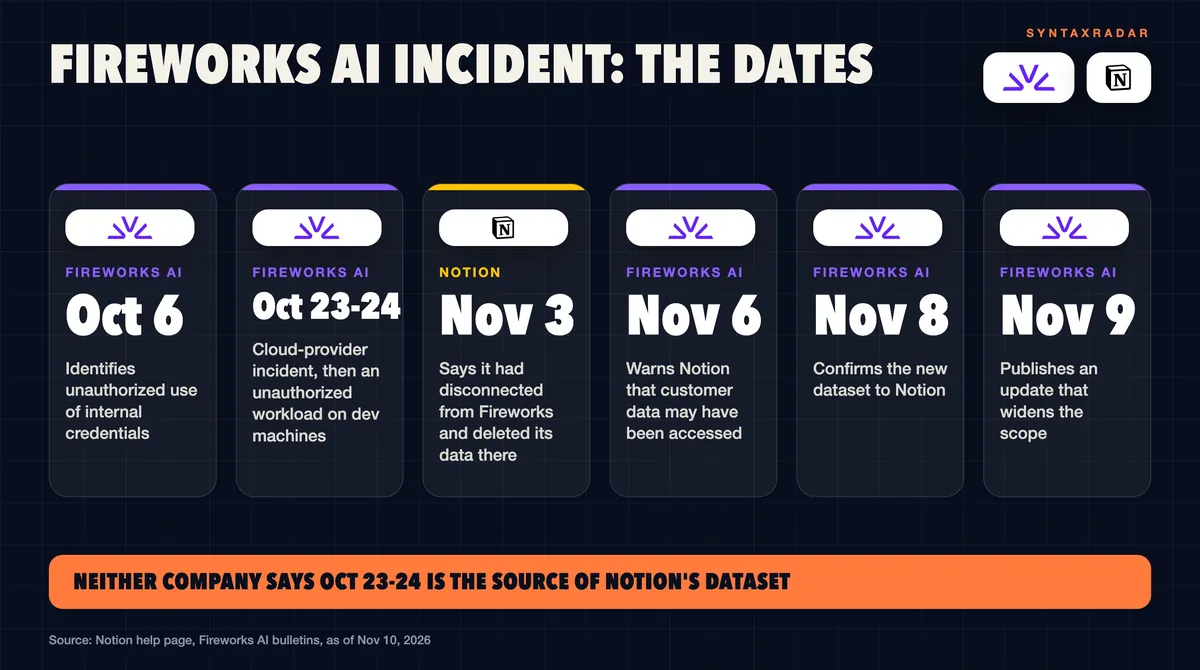
The story starts at Fireworks AI, a company that runs AI models for other businesses. Its original October bulletin says Fireworks identified a security incident involving unauthorized use of internal credentials on October 6, 2026 at 9am PDT. It rotated employee API keys on October 9, notified identified affected customers that day and published the bulletin at 10pm PDT. On October 10 it revoked more user API keys and rotated service-account tokens.
At that stage Fireworks described a narrow problem. Environment variables (settings handed to a program when it starts, often including secrets) used in evaluation jobs in a limited number of customer accounts were accessed, and API keys and tokens stored as secrets were believed captured. Fireworks said it had not detected evidence of unauthorized access to customer models, datasets, training data, personal information or inference traffic within its security perimeter or control.
The November 9 update, marked "Active monitoring", widened that picture. Fireworks says a third-party cloud provider that hosted its R&D machines had a security incident on October 23. On October 24 an unauthorized third party used that access to reach Fireworks development machines and run an unauthorized workload that led to additional customer data impact. Fireworks says it detected this the same day.
The update lists the categories of information that an affected internal application gave access to: resource metadata (identifiers, display names, descriptions, creation times) and billing information (billing and shipping addresses, invoice and payment history, account balance, credit usage). For certain customers, a subset of incomplete model weights and datasets were accessed, and the update separately says a limited set of accounts had secrets affected. Fireworks says it does not store payment card numbers, so those were not impacted.
Notion's own account runs alongside. Its page says it "learned from Fireworks about potential incidents earlier this month" and shut down all connections to Fireworks' systems. The page carries no date, so we cannot pin down which day that was. It also says that as of November 3, Notion had disconnected its systems from Fireworks, deleted all data in the Fireworks system, stopped sending data and traffic, and halted all training runs.
On November 6, Fireworks told Notion that malicious actors may have accessed potential customer data. On November 8, Fireworks confirmed this new dataset to Notion. Notion then contacted affected workspace owners; its help page was live when we checked it on November 10.
What does Notion AI do?
Notion's incident page is not a product tour, so we stick to what it says about the part of Notion AI involved. Does Notion use AI models from outside companies? According to that page, it did. Notion used Fireworks for two jobs: classification jobs (automatically sorting text into categories) that feed a feature called Insights, which Notion says helps customers understand their own AI usage, and as a general inference provider (the service that runs a trained model to answer a request) serving open-weight models, meaning models whose weights are published so anyone can host them.
The exposed material came from the Insights work. Notion describes it as "unattributable" chat transcripts: not labelled with who wrote them or which workspace they came from. The transcripts also did not contain tool call results, which Notion gives as examples such as Notion page content or external data pulled in by Notion AI.
Notion has switched Insights off during the investigation and says it is no longer serving open-weight models through Fireworks. The page adds one more use: members of Notion's Learning and Early Access Program (LEAP) volunteer their data to help Notion test new AI technology, and Notion says it used that data in the past to experiment with training task-specific models on Fireworks.
SyntaxRadar calculation: what we checked in the timeline
Neither company gives one tidy timeline, so we lined up the dates their pages state and counted the gaps with a script (Python date arithmetic, run on November 10, 2026). These figures are ours, built only from those dates.
Three things stand out. First, Notion says that as of November 3 it had cut Fireworks off, at least three days before Fireworks told it on November 6 that customer data may have been reached. Second, in the 34 days between October 6 and the November 9 update, Fireworks' own description widened from environment variables in a limited number of accounts to billing information, datasets and incomplete models. Third, the 15-day gap only measures time. Neither company says the October 23 to 24 cloud-provider event is the source of the dataset Notion confirmed, and Fireworks' bulletins do not name Notion at all.
On the size of the problem: Notion gives a share and no absolute count. As an illustration of Notion's own bound, under 1% means fewer than 10 workspaces in every 1,000. Notion published no such count; the figure is our arithmetic on its ceiling.
We also read for what the pages leave open. Notion says the transcripts carry no information tying them to a workspace, user or company, and that its annotated CSV adds metadata such as the user for each transcript, which "were not exposed as part of the incident". It does not explain how it matched transcripts to workspaces. Fireworks says it has not detected any impact to Inference, Training SDK and Nexus, which are zero data retention (ZDR, meaning no customer data is kept) by default, and adds that this is based on its investigation to date. Notion's page does not say which Fireworks product handled the Insights jobs.
Is Notion AI safe?
Whether to keep using it is your call, and the pages give these facts. Notion says it has disconnected from Fireworks, deleted all data in Fireworks' system, stopped sending traffic and disabled Insights while it investigates, and that it continues to monitor the incident. What remains is a design question: words typed into an AI chat inside one product can pass to a vendor behind it.
Here is how the claims sort, as of November 10, 2026:
- Stated by Notion: under 1% of workspaces may be affected; only unattributable Notion AI chat transcripts used for Insights; no other data from within a workspace affected; disconnected from Fireworks as of November 3.
- Stated by Fireworks: the October 6 incident, the October 23 to 24 cloud-provider event, and the widened list of categories involved.
- Not confirmed: who did it. Fireworks says its evidence "indicates links" to a financially motivated cybercriminal group, and that its investigation "is ongoing and may reveal additional information". It has notified law enforcement and brought in Palo Alto Networks Unit 42.
- Not stated by either company: any link between the cloud-provider event and Notion's data.
Was my workspace affected, and what should I rotate?
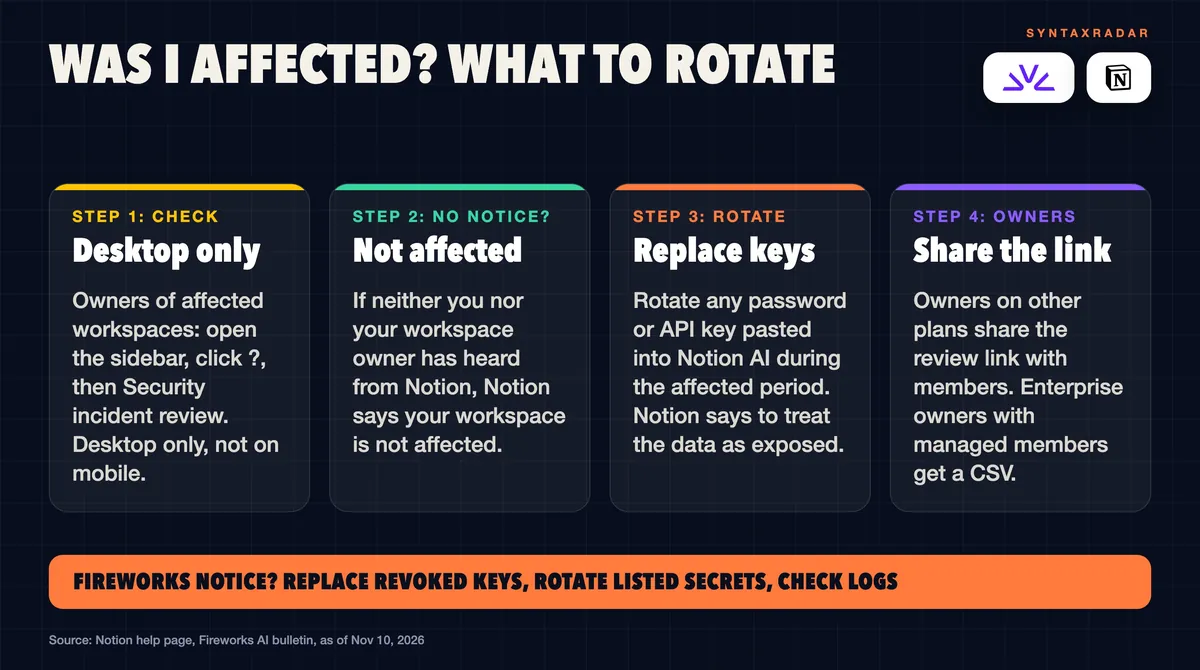
Notion's help page gives a simple test: if neither you nor your workspace owner has heard from Notion, your workspace is not affected and no action is needed, as of the page we read on November 10, 2026. Owners of affected workspaces can check directly.
- On a desktop browser with the latest Notion version, open the workspace sidebar, click ? and choose Security incident review. It is not available on mobile.
- Enterprise owners with managed members can download a CSV of affected data plus an annotated CSV. Owners on other plans get a page with a link to share with affected members, who then see a CSV of only their own data.
- If you or anyone on your team pasted credentials or API keys into Notion AI during the affected timeframe (Notion does not define it), rotate them right away. Notion says to treat the data as exposed.
If Fireworks sent you an affected-customer notice, its original bulletin gives these steps. Create a new Fireworks AI API key to replace any that were revoked, and update the applications that used the old ones. Rotate or revoke third-party credentials with the services that issued them, because removing a stored secret does not invalidate it. Review those providers' logs for unauthorized reads, downloads or changes, and rotate even if nothing looks wrong. Then check your API keys, users, evaluators, training jobs and datasets for anything you do not recognise.
That bulletin also says that customers who received no notice had no incident-specific action currently required. That was the position when it was last edited on October 10; the November 9 update says Fireworks is notifying customers whose data was impacted. It lists no new step-by-step actions: affected customers get recommended actions in their notification email and can write to [email protected].
One more piece of context for key hygiene. Fireworks' update says the evidence indicates links to a financially motivated group that aims to sell tokens from unauthorized access to large language models to illicit routing gateways, a practice it calls "LLMJacking", and it points to a November 2 blog post on the topic by Google Threat Intelligence Group and Mandiant. We found no statement from either company that any key exposed in this incident has been used that way.
Is Notion secure after the Fireworks AI breach?
Notion says the exposure came through a vendor and was limited to unlabelled AI transcripts, with no other data from within a workspace affected. Our reading is that the weak point was the vendor chain behind one AI feature, not the pages you store, and any product that sends your text to an outside model provider has that kind of dependency. For Notion security beyond this incident, its page points to its Security page and Trust Center, which we have not audited; this post covers only this incident.
If you want to compare, our explainer is ChatGPT safe covers how three small bugs could expose private chats, so you can judge whether this case is worse or milder. Our KV cache explained piece covers a Cloudflare bug that leaked users' prompts through infrastructure behind an AI product. If your next question is who sees your chats and for how long, our Google Gemini privacy guide covers retention and human review. For a separate security case in the same category, our what are botnets explainer shows how 1.3 million Android TV boxes were turned into one.
What to watch next
Two pages decide what happens from here: Notion's help page, which shows no last-updated date, and Fireworks' bulletin, which says the investigation is ongoing and may reveal additional information. Watch for a confirmed attacker identity, any change to the under 1% figure, an explanation of how Notion matched unattributable transcripts to workspaces, and whether Insights returns and with which provider.
Is Notion secure enough to keep your notes in? As of November 10, 2026, Notion's position is that no other data from within a workspace was affected. The habit worth keeping is older than this incident: never paste a live key or password into an AI chat, in Notion or anywhere else.
Questions readers ask
Was my Notion workspace affected by the Fireworks AI breach?
Notion says that if neither you nor your workspace owner has heard from Notion, your workspace is not affected. Owners can confirm on a desktop browser with the latest Notion version: open the sidebar, click the question mark and choose Security incident review. The review is not available on mobile. Notion puts the affected share at under 1% of workspaces.
How secure is Notion after the Fireworks AI breach?
Notion says the exposure came through a vendor and was limited to unattributable Notion AI chat transcripts, with no other data from within a workspace affected. Our reading is that the weak point was the vendor chain behind one AI feature. Notion's Security page and Trust Center are not audited in this post. As of November 10, 2026.
Were my Notion pages leaked?
According to Notion, no other data from within a workspace is affected. Its help page says only some unattributable Notion AI chat transcripts used for the Insights feature may have been exposed: not labelled with an author or workspace, and with no tool call results such as page content. Anything pasted into a chat is part of its transcript. As of November 10, 2026.
What should I rotate after the Notion AI exposure?
Notion recommends treating the data as exposed and rotating, right away, any credentials or API keys pasted into Notion AI chats during the affected timeframe, which Notion does not define. If Fireworks sent you an affected-customer notice, replace revoked Fireworks API keys, rotate third-party secrets with their issuers (removing a stored secret does not invalidate it), and review provider logs for unauthorized activity.
Who is behind the Fireworks AI breach?
Nobody has been confirmed. Fireworks says its evidence indicates links to a financially motivated cybercriminal group, and that its investigation is ongoing and may reveal additional information. It has notified law enforcement and engaged Palo Alto Networks Unit 42. Neither Fireworks nor Notion says the October 23 to 24 cloud-provider incident is the source of Notion's exposed dataset.
Do I need a new Fireworks AI API key?
Fireworks' original bulletin says to create a new Fireworks API key to replace any that were revoked and to update the applications that used the old ones. It also says customers who received no notice had no incident-specific action currently required, which was the position when it was last edited on October 10. The November 9 update says affected customers get recommended actions in their notification email.
Sources
Written by
Abdul Rehman
Lead Systems Architect and Technical Director at Syntaxradar. More in Systems.
Keep reading

Is Lovable Safe? Passport Data Sat in Apps Without a Login
Crissy Field scanned 159,041 Lovable projects and found 24,664 sites sending Supabase records without login, 7,403 with emails, including passport numbers and 200,000+ chat…
Nov 15, 2026 · 7 min read
Is ChatGPT Safe? How Three Small Bugs Could Expose Your Chats
Parameter researchers chained three ChatGPT web flaws so injected code ran in a signed-in session and could read up to 20 recent private chats. Reported Oct 18, fixed Oct 26,…
Nov 1, 2026 · 7 min read

Is Plaid Safe to Use? What Claude Sees in Your Bank Account
Anthropic launched Personal Finance in Claude on Nov 5, 2026, a US beta for Pro, Max and Ultra users. Accounts link through Plaid with read-only access: Claude sees balances,…
Nov 6, 2026 · 6 min read
More in Systems
See all
NoisyTCP: The Linux Kernel TCP Flaw and Who Must Patch
NoisyTCP (CVE-2026-99288) is a Linux kernel TCP flaw that lets an unauthenticated attacker crash a server through an open port. The fix merged November 3, 2026 and the advisory…
Nov 23, 2026 · 7 min read
KB5132061: Windows 11 Install Errors Explained, and the Fix
KB5132061, released November 10, 2026, failed on some Windows 11 PCs that had the October preview KB5127936, with errors 0x80070306, 0x800f0989 or 0x800f0993. Microsoft began an…
Nov 22, 2026 · 7 min read

Chase Data Breach: Vendors Hit, Names and Emails at Risk
On November 19, 2026 JPMorgan Chase said third-party vendors were hit by a cyberattack and that marketing data, which may include some customer names and email addresses, was…
Nov 20, 2026 · 7 min read
Latest stories
Front page
US Approves AI Chips to China: 879,868 H200 and MI325X Cleared
Abdul Rehman · Nov 22, 2026 · 6 min read
Nothing AI Device: What Is Confirmed Before the Dec 8 Reveal
Abdul Rehman · Nov 22, 2026 · 7 min read
OpenAI Usage Policies: Gateway Approval and Training Ban
Abdul Rehman · Nov 22, 2026 · 7 min read

When Will SSD Prices Drop? TrendForce Says 2027, Retail Lags
Abdul Rehman · Nov 21, 2026 · 8 min read