


Chase Data Breach: Vendors Hit, Names and Emails at Risk
On November 19, 2026 JPMorgan Chase said third-party vendors were hit by a cyberattack and that marketing data, which may include some customer names and email addresses, was accessed. Chase gave no customer count, vendor names or attack date and said it is unconnected to that week's outage.

Abdul Rehman
Lead Systems Architect and Technical Director · · 7 min read

The short version
- November 19, 2026 (statement on X)
- Chase disclosure date
- Some names and email addresses (marketing data)
- Data Chase says may be exposed
- None disclosed by Chase
- Customer count and vendors named
Why it matters: Chase confirms only that vendors were attacked and marketing data with some names and email addresses may be exposed, so treat unexpected messages as possible phishing and contact Chase only through channels you know are real.
On this page
The Chase data breach, as the bank describes it, is a cyberattack on outside companies that provide services to Chase. JPMorgan Chase said on November 19, 2026 that attackers accessed marketing data held by those vendors, which may include some customer names and email addresses, according to ABC News. As of November 19, 2026, the bank has not said how many customers are affected, named the vendors or said when the attack happened.
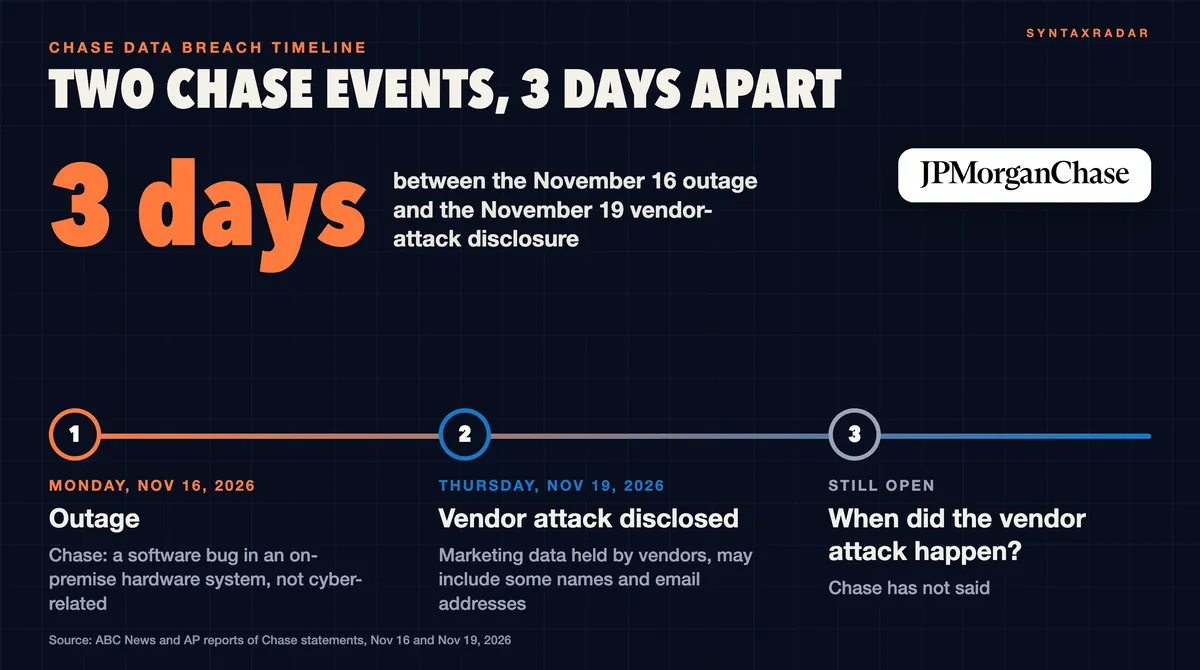
Chase says it will contact affected customers directly and offer support, including complimentary credit monitoring, where appropriate. It also says the attack has no connection to the service disruptions some customers had earlier that week, which included the Monday, November 16 outage. Chase attributes that outage to a software bug, and this post keeps the two events apart.
Chase data breach: what JPMorgan said on November 19
Chase announced the attack in a post on X, according to the outlets that reported it. Gizmodo's report quotes the bank saying third parties who provide services to the firm "were the target of a cyber attack". The statement hedges on scope: Chase says that, based on its investigation so far, it believes the attackers accessed marketing data held by the vendors, and that this data "may include" some customer names and email addresses. The National News Desk reports the same wording and lists what is unknown: the number of customers, the vendors, the timing and the attacker.
Chase has not said which services the vendors provide or what the marketing data contains beyond possible names and email addresses.
IBTimes' summary of the statement notes that Chase did not report passwords, payment card numbers or customer funds as compromised. That is an absence in the statement, which is a weaker signal than a bank saying those items were safe. Chase also says there is no disruption to its services.
Did Chase have a data breach? What is confirmed and what is only claimed
Yes, in the sense that Chase itself says vendors serving it were attacked and customer contact data may have been reached. What Chase confirmed is narrow: a cyberattack on third parties, marketing data, possibly some names and email addresses. Everything below that line is a claim from someone else.
Reuters, as relayed by Gizmodo, reported that a cyber-extortion group calling itself "n0n" claimed responsibility. Data the group posted appeared to contain more than 16,000 customer email addresses, some with phone numbers and postal codes. Reuters could not verify that the data is authentic. Chase's statement mentions neither the group nor the figure, so the 16,000 is a claim about a leak and says nothing certain about how many Chase customers are affected.
The Wall Street Journal, as summarized by IBTimes, reported that a ransomware group leaked information tied to thousands of customers of JPMorgan, Visa and Mastercard. The same summary says that reporting does not establish a single source for the three companies. Mastercard told Gizmodo that a third-party provider exposed a limited number of email addresses from a small subset of cardholders in one benefit program, and that the exposure has been contained. Visa said its systems were not involved and no payments data such as card numbers was affected. Those statements cover Visa and Mastercard only.
This is not the first JP Morgan Chase data breach on record. In an 8-K filing dated October 2, 2014, JPMorgan Chase reported that user contact information (names, addresses, phone numbers and email addresses) for about 76 million households and 7 million small businesses had been compromised, and said it had no evidence that account numbers, passwords or Social Security numbers were compromised. That was a separate incident from the November 2026 vendor attack.
Chase bank data breach and the November 16 outage: two separate events
A Chase bank data breach disclosed three days after a Chase outage looks like one story. Chase says it is two. On Monday, November 16, 2026, spokesman Joe Evangelisti told the AP the bank "has experienced a temporary issue related to a software bug in an on-premise hardware system" and that the issue "is not cyber-related", according to AP's report via OPB. Thousands of Chase customers reported trouble reaching online accounts, and the problems also hit customers of other banks sending money to Chase. Zelle's operator, Early Warning Services, said the network was fully operational and that an issue at the financial institutions may be delaying some payments.
On November 19, Chase said the vendor attack has no connection to those service problems. ABC News adds that top Trump administration officials said there is no evidence the wider run of November tech outages was caused by cyberattacks. We cannot confirm or rule out anything beyond what Chase and those officials said. Our look at the Microsoft 365 outage and the FAA outage covers two of the other November failures.
SyntaxRadar calculation: eight questions, four answers
We took the questions a Chase customer would ask and checked each against the statement as reported by ABC News, Gizmodo and The National News Desk.
Inputs: 4 answered out of 8 is 50%. The gap between the outage (November 16) and the disclosure (November 19) is 3 days, but that is the gap between two announcements, since Chase has not said when the vendor attack itself happened. The only figure in circulation, "more than 16,000" emails, comes from the unverified claim above, and with no Chase figure there is no ratio to compute.
Why vendor breaches reach banks, in JPMorganChase's own words
JPMorganChase's own security chief has called the bank's reliance on outside software providers a risk. He made the argument in an open letter to suppliers dated April 26, 2025. Chief Information Security Officer Patrick Opet wrote that heavy reliance on a small set of providers creates single points of failure, that a breach at one major provider can ripple through its customers and that providers have put fast feature releases ahead of security.
The letter also says JPMorganChase's third-party providers had "a number of incidents" over the previous three years and gives no count. It predates this incident and does not mention it. Chase has named no vendor and no method, so we do not know whether any weakness the letter describes played a part here.
For a similar vendor-side exposure, our report on the Fireworks AI breach and Notion shows how data held by one company can surface through another.
What to do after a data breach: steps for Chase customers
Chase has not said which customers are affected, so these steps apply to anyone with a Chase account who wants to be careful. They come from the FTC, the CFPB and Chase's own guidance and are not legal or financial advice.
- Treat unexpected messages as suspect. The FTC lists the signs of phishing: an unexpected message from a bank, a claim of suspicious activity or an account problem, a request to confirm personal details, an unexpected refund or offer, a generic greeting and pressure to click. Exposed names and emails make that kind of message easier to write, as IBTimes notes.
- Use official channels only. If you have an account, contact the company with a phone number or website you know is real, and ignore the details in the message, according to the FTC. IBTimes suggests checking accounts only through Chase's official website or app. Chase's own phishing page says to contact it through its Security Center for unauthorized charges or a compromised account.
- Be careful with credit monitoring offers. Chase says it will contact affected customers directly, and the FTC lists an unexpected refund or free offer among phishing signs. A message asking you to claim monitoring or a payout through a link is a case for the previous step.
- Report phishing. Forward phishing emails to [email protected], forward texts to 7726 (SPAM) and report to ReportFraud.ftc.gov, according to the FTC.
- Know the credit freeze option. None of the coverage we read says Chase advises one. The CFPB says a freeze is free at Equifax, Experian and TransUnion, that you contact each bureau separately, and that one placed online or by phone takes effect within one business day. The FTC adds that a freeze does not affect your credit score and lasts until you lift it. The FTC also describes a fraud alert, which lasts one year, needs only one bureau and makes lenders verify your identity before granting new credit.
- If you already clicked or replied. The FTC points to IdentityTheft.gov if you shared sensitive information, and says to update security software and run a scan if you opened a link or attachment.
What to watch next
Four open questions set the scope of the breach: how many customers Chase says were affected, which vendors were attacked, when the attack happened and whether Chase confirms or disputes the leak that Reuters reported. Chase said that, where appropriate, it will contact affected customers directly and offer complimentary credit monitoring.
On the Chase data breach settlement question, none of the coverage we read mentions a lawsuit or settlement over the vendor incident. An unexpected message promising a payout or refund fits the FTC's description of phishing, so check it with Chase through its official app or website, or a phone number you know is real. For more on how bank data reaches third parties, our explainer on whether Plaid is safe to use covers a different route into the same kind of account information.
Questions readers ask
What data did Chase say the vendor attack exposed?
Chase says attackers accessed marketing data held by its vendors, which may include some customer names and email addresses, according to ABC News. Chase did not report passwords, card numbers or funds as compromised, and it has not said how many customers are affected or which vendors were attacked.
Did Chase bank get hacked?
Chase says third parties that provide services to the bank were the target of a cyber attack, and that marketing data held by those vendors may include some customer names and email addresses. Its statement, as reported by ABC News, does not describe access to Chase's own systems, and Chase has named no vendors.
Is the Chase breach connected to the November 16 outage?
Chase says there is no connection. On November 16, 2026 the bank attributed the outage to a software bug in an on-premise hardware system and said it was not cyber-related, per AP. The vendor attack was disclosed on November 19, three days later, and Chase has not said when it happened.
What to do after a data breach if you bank with Chase?
The FTC advises contacting the company through a phone number or website you know is real, not details in a message, and reporting phishing to [email protected] or 7726. The CFPB says a credit freeze is free at Equifax, Experian and TransUnion. Chase has not said customers must freeze credit.
Is there a Chase data breach settlement?
None of the coverage we read from ABC News, Gizmodo, The National News Desk or IBTimes mentions a lawsuit or settlement over the vendor attack. A message offering a payout or refund fits the FTC's phishing signs, so verify it with Chase through its official app or website.
Who is behind the Chase vendor attack?
Chase has not named an attacker. Reuters, as relayed by Gizmodo, reported that a group calling itself n0n claimed responsibility and posted data that appeared to hold more than 16,000 customer email addresses. Reuters could not verify the data, and Chase's statement mentions neither the group nor the figure.
Sources
Written by
Abdul Rehman
Lead Systems Architect and Technical Director at Syntaxradar. More in Systems.
Keep reading

Is Lovable Safe? Passport Data Sat in Apps Without a Login
Crissy Field scanned 159,041 Lovable projects and found 24,664 sites sending Supabase records without login, 7,403 with emails, including passport numbers and 200,000+ chat…
Nov 15, 2026 · 7 min read
Is Notion Secure? What the Fireworks AI Breach Exposed
Fireworks AI, a model provider Notion used for Notion AI, had a security incident. As of Nov 10, 2026 Notion's help page says under 1% of workspaces may be affected and only…
Nov 11, 2026 · 9 min read

LTO Tape: Why Fujifilm Wants 5x More Capacity for AI Archives
On October 29, 2026, Fujifilm said it will invest about 10 billion yen at its Odawara Site to raise data storage tape production capacity about five times versus fiscal 2025 by…
Nov 5, 2026 · 6 min read
More in Systems
See all
NoisyTCP: The Linux Kernel TCP Flaw and Who Must Patch
NoisyTCP (CVE-2026-99288) is a Linux kernel TCP flaw that lets an unauthenticated attacker crash a server through an open port. The fix merged November 3, 2026 and the advisory…
Nov 23, 2026 · 7 min read
KB5132061: Windows 11 Install Errors Explained, and the Fix
KB5132061, released November 10, 2026, failed on some Windows 11 PCs that had the October preview KB5127936, with errors 0x80070306, 0x800f0989 or 0x800f0993. Microsoft began an…
Nov 22, 2026 · 7 min read
Google Project Zero Disclosure Policy: 90 Days Now, 30 by 2028
On November 13, 2026 Google Project Zero replaced its 90+30 rule with Full X: bug details go public X days after the vendor gets the report, fixed or not. X is 90, falls to 60 on…
Nov 16, 2026 · 6 min read
Latest stories
Front page
US Approves AI Chips to China: 879,868 H200 and MI325X Cleared
Abdul Rehman · Nov 22, 2026 · 6 min read
Nothing AI Device: What Is Confirmed Before the Dec 8 Reveal
Abdul Rehman · Nov 22, 2026 · 7 min read
OpenAI Usage Policies: Gateway Approval and Training Ban
Abdul Rehman · Nov 22, 2026 · 7 min read

When Will SSD Prices Drop? TrendForce Says 2027, Retail Lags
Abdul Rehman · Nov 21, 2026 · 8 min read