


Is Lovable Safe? Passport Data Sat in Apps Without a Login
Crissy Field scanned 159,041 Lovable projects and found 24,664 sites sending Supabase records without login, 7,403 with emails, including passport numbers and 200,000+ chat messages. The cause: badly configured databases, not a hack of Lovable.

Abdul Rehman
Lead Systems Architect and Technical Director · · 7 min read
The short version
- 159,041
- Lovable projects scanned
- 24,664
- Sites sending records without login
- 7,403 (30% of open sites)
- Sites exposing email records
Why it matters: Lovable itself was not hacked: the exposure sits in Supabase databases that builders left without working row level security, which builders can check and fix themselves.
On this page
Is Lovable safe? Thousands of apps built with Lovable leave their data open, and the platform itself was not breached. Researchers at Crissy Field scanned 159,041 Lovable projects and found 24,664 websites that sent Supabase database records the moment they loaded, with no login and no click. On 7,403 of those sites the records included email addresses. These gaps trace back to how builders set up their app databases, so the answer to "is Lovable secure" depends on whether the builder locked the database.
Some of what sat in the open was sensitive. According to the Crissy Field research, one service provider exposed more than 1,000 records with passport numbers, expiration dates and nationalities. A German lifestyle forum exposed more than 80,000 profiles and more than 200,000 chat messages, and another provider's 280,000 sent customer emails were accessible.
Handelsblatt reported on the research on November 2, 2026, according to the Crissy Field page, and reached the Hacker News front page on November 14 with 295 points.
What did the Lovable security scan find?
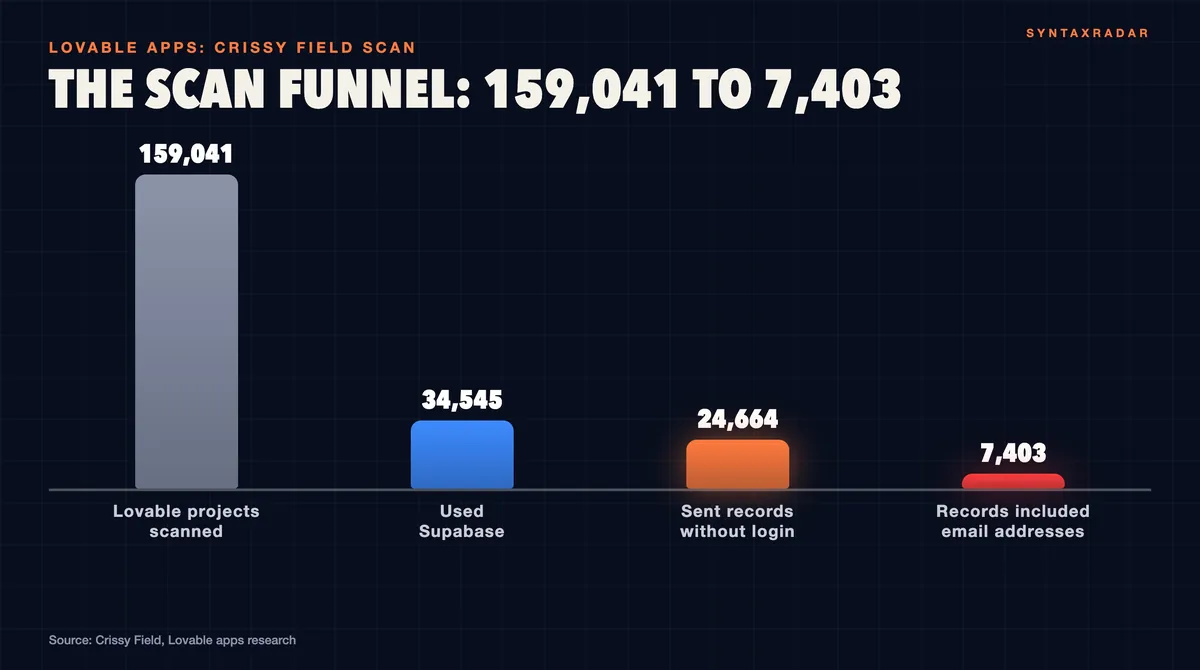
The scan covered 159,041 Lovable projects collected from Common Crawl (a public archive of crawled web pages) for December 2025 to September 2026. Of those, 34,545 used Supabase, the hosted database service the researchers focused on.
Then they checked what each site sent to a visitor's browser. 24,664 websites delivered Supabase records on page load, before anyone signed in. Records containing email addresses turned up in 10,560 tables across 7,403 of those sites, which the authors give as 30%.
Beyond emails, the Crissy Field report lists names, dates of birth, phone numbers, postal addresses, payment information, contracts, invoices and personal photo albums among the exposed data types.
Two limits matter. The authors say the sample is not representative of all Lovable applications and that only parts of the datasets were retrieved. And according to Techzine's write-up, Lovable's own database functions, available since late 2025, were not part of the investigation. These Lovable security issues apply to apps wired to Supabase, not every Lovable app.
What is Supabase row level security?
Supabase row level security (RLS) is a per-table switch, plus a set of rules called policies, that decides which rows of data a given visitor may read or change. Picture an apartment building where the lobby key is printed on the front door: RLS is the lock on each flat.
That matters because of how Supabase treats a table with the switch off. The Supabase RLS documentation says a table in an exposed schema without RLS is readable and writable by any role that has a grant on it. On projects with default grants, a new public table gives the anon role (the role used by the anon key) every privilege. In plain English: with RLS off and defaults left alone, anyone using that key can read and change the table, which fits what the scan saw, records sent to browsers before any login.
Turning RLS on fails closed. Per the docs, once it is enabled, no data is reachable through the API with a publishable key until you write policies that allow it. Supabase recommends separate policies for select, insert, update and delete, and revoking the default grants from the anon and authenticated roles, then granting back only what the app needs.
This is why the researchers point to poorly configured Supabase databases as the cause, according to Techzine. The lock exists; on these sites it was not used, or not used well enough.
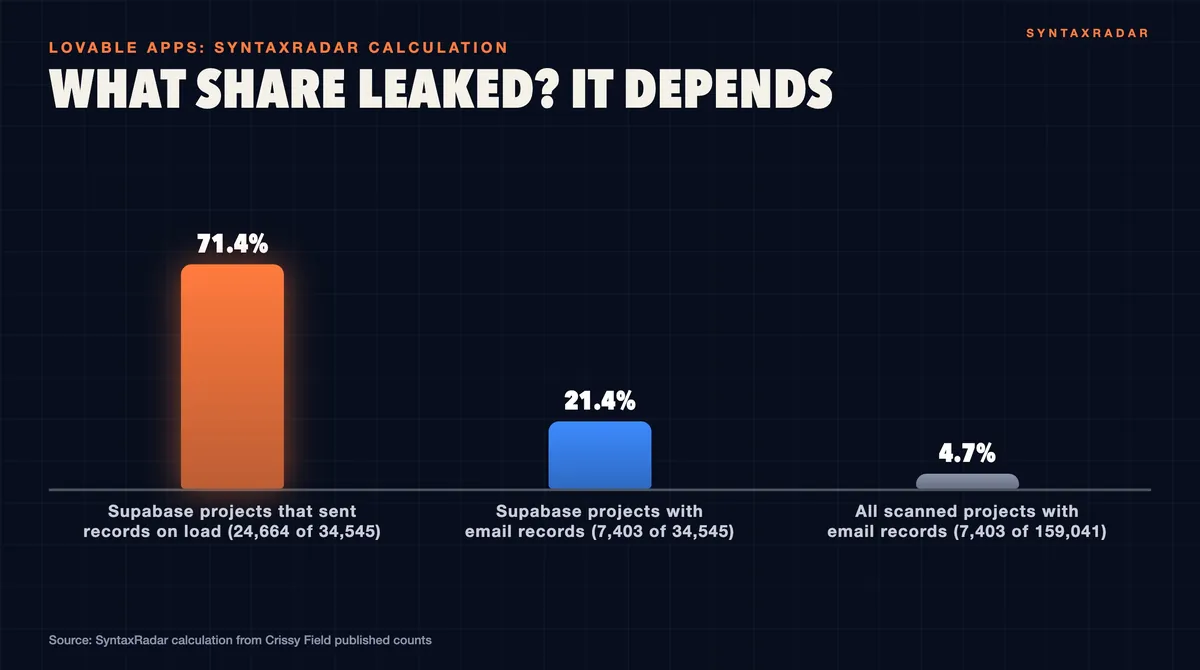
Lovable security risks by the numbers: what the 30% means (SyntaxRadar calculation)
The 30% figure is easy to misread as "30% of Lovable apps leak data." The figure is 7,403 divided by 24,664, so it describes the share of already-open sites whose records included emails. We divided the same Crissy Field counts by the other totals to show the scale at each step.
Three cautions keep these numbers honest. First, the authors say 30% is not a confirmed leak rate. Second, Techzine notes some of the records served on load may be meant for public display, so "sent records without login" does not always mean a mistake. Third, the sample is not representative, so none of these shares can be stretched to all Lovable apps.
What the table does show: among the Supabase-backed projects in this sample, roughly seven in ten handed data to an anonymous browser, and roughly one in five handed over records with email addresses. That is a setup problem big enough to check for in any app you run.
Is this a Lovable security breach? The 2025 precedent
No, not in the sense of someone breaking into Lovable. The researchers blame poorly configured Supabase databases, not a hack of Lovable, per Techzine. It is an exposure: data left readable by default settings and missing rules. The sources we read do not say whether anyone other than the researchers pulled the data.
The pattern is not new. Under CVE-2025-48757, security researcher Matt Palmer reported missing RLS to Lovable on March 21, 2025. A follow-up scan found 303 endpoints across 170 projects lacking proper RLS, and the issue was disclosed publicly on May 29, 2025 after a 45-day window, according to Superblocks (a company blog, so a secondary source).
Superblocks also reports that Lovable's April 24, 2025 "security scan" only checked that RLS existed, not that it worked, and that as of October 2026 a basic scan runs on every publish and admins can block publishing on critical findings (single secondary report). We could not confirm either point from a Lovable source.
By our count, the public CVE disclosure (May 29, 2025) and the Handelsblatt article (November 2, 2026) are 522 days apart. The same class of mistake showed up again at a much larger scale.
The Crissy Field page reports no reply from Lovable, and Techzine's article carries no Lovable statement. We found no Lovable response in the sources we checked.
Is Lovable data secure?
Lovable data is as secure as the database rules each builder writes. Lovable hosts the tools; the builder decides who can read each table. When RLS is on and the policies are tight, a visitor sees only what they should. When it is off on a default project, the table is open to anyone who loads the page.
For people who signed up to an app built this way, the exposed data types in the Crissy Field list (passport details, chat messages, invoices, photo albums) show what is at stake. Our advice, not the researchers': share with a new, small service only what you would be comfortable seeing in public.
If you weigh AI coding tools on safety more broadly, our look at whether Claude Code is safe covers a different kind of slip, where user data ended up in outbound web requests. And our explainer on whether Notion is secure walks through what a third-party breach exposes when the platform itself holds the data.
Is Lovable safe to use? A checklist for builders
Lovable is safe to use for shipping an app if you own the database setup yourself. Before you publish, run through these steps, all drawn from the Supabase docs and the failure the researchers measured:
- List every table in your exposed schema (usually
public) and confirm RLS is on for each. The Supabase docs give the command:alter table public.reports enable row level security;with your own table name. - Write separate policies for select, insert, update and delete.
- Revoke the default grants from the
anonandauthenticatedroles, then grant back only what the app needs. - Test as a stranger. Open your live site logged out, with your browser's developer tools on the Network tab, and look for database records arriving on page load. That is exactly what the Crissy Field scan detected, and it is the quickest check you can run yourself.
- Do not treat a passing scan as proof. Superblocks reports the 2025 Lovable check only confirmed RLS existed, not that the rules worked. Your logged-out test is the real check.
If you want to rehearse cloud setups before anything goes live, our piece on the AWS emulator LocalStack rival shows how developers test infrastructure locally first.
What to watch next
- A Lovable statement. As of November 15, 2026 we found none in the sources.
- Lovable's own database functions. They were left out of this study, so a follow-up that covers them would show whether the newer setup avoids the same gap.
- The full dataset. The authors retrieved only parts of the data and call the sample unrepresentative; a fuller scan would firm up the numbers.
Until then, the honest answer to "is Lovable safe" is: the weak point in this study is the database settings. Check yours with a logged-out browser before your users find out for you.
In code
-- Turn on row level security (from the Supabase docs)
alter table public.reports enable row level security;

-- Remove the default grants, then grant back only what the app needs
revoke all on table public.reports from anon, authenticated;Questions readers ask
Is Lovable safe to use?
Lovable is safe to use if you secure the database yourself. The Crissy Field scan blamed poorly configured Supabase databases, not a hack of Lovable. Turn on row level security for every table, write separate policies for reading and writing, revoke default grants, and test your live site while logged out to see whether any records load without a login.
Was Lovable hacked?
No. According to the researchers, as reported by Techzine, the exposure came from app databases that builders configured poorly, not from a break-in at Lovable. Of 159,041 projects scanned, 24,664 websites sent Supabase records on page load without login. The Crissy Field page reports no reply from Lovable, and we found no Lovable statement in the sources.
What is Supabase row level security?
Row level security is a Supabase setting that decides which rows of a table each visitor may read or change. Per the Supabase docs, a table without it can be read and written by any role with a grant, and default grants give the public anon role every privilege. Once enabled, no data is reachable until you write policies.
Do 30% of Lovable apps leak data?
No. The 30% is 7,403 sites with email records out of 24,664 sites that already sent data without login. Against all 159,041 projects scanned it is about 4.7%. The authors say it is not a confirmed leak rate, the sample is not representative, and some records served on load may be meant to be public.
Is Lovable app safe for customer data?
The Crissy Field scan did not find a hack of Lovable. It found that 24,664 of the 34,545 Supabase-backed projects it checked sent database records without a login. An app is only as safe as its database rules, so turn on row level security for every table and test your live site while logged out.
Sources
Written by
Abdul Rehman
Lead Systems Architect and Technical Director at Syntaxradar. More in Developer Tools.
Keep reading
Is Notion Secure? What the Fireworks AI Breach Exposed
Fireworks AI, a model provider Notion used for Notion AI, had a security incident. As of Nov 10, 2026 Notion's help page says under 1% of workspaces may be affected and only…
Nov 11, 2026 · 9 min read
Is ChatGPT Safe? How Three Small Bugs Could Expose Your Chats
Parameter researchers chained three ChatGPT web flaws so injected code ran in a signed-in session and could read up to 20 recent private chats. Reported Oct 18, fixed Oct 26,…
Nov 1, 2026 · 7 min read

Is Claude Code Safe? It Put Some Users' Email in Web Requests
GitHub issue #107757 (opened 2026-11-05) reports Claude Code putting a user's account email in the User-Agent of web requests. Version 2.1.317 adds an ask-first check; an engineer…
Nov 7, 2026 · 7 min read
More in Developer Tools
See all
Android Sideloading: Verification Goes Global in January 2027
On November 19, 2026 Google said Android developer verification starts rolling out globally in January 2027, beginning with seven app distributors. Unregistered apps can still…
Nov 20, 2026 · 7 min read

GPT-5 Deprecation: What Breaks on Dec 11 and What Replaces It
As of November 16, 2026, OpenAI's deprecations page lists December 11, 2026 as the shutdown date for gpt-5, gpt-5-mini, gpt-5-nano, gpt-5-pro, o3 and o3-pro, with gpt-6.1-sol,…
Nov 19, 2026 · 7 min read

Mapbox Alternative: Host Protomaps for $5 a Month Plus Bandwidth
A November 15, 2026 blog post priced a self-hosted Protomaps map at about $5 a month in storage and $0.00005 per city view, against Mapbox's $5 per 1,000 loads after 50,000 free.…
Nov 18, 2026 · 7 min read
Latest stories
Front page
NoisyTCP: The Linux Kernel TCP Flaw and Who Must Patch
Abdul Rehman · Nov 23, 2026 · 7 min read

US Approves AI Chips to China: 879,868 H200 and MI325X Cleared
Abdul Rehman · Nov 22, 2026 · 6 min read
Nothing AI Device: What Is Confirmed Before the Dec 8 Reveal
Abdul Rehman · Nov 22, 2026 · 7 min read

KB5132061: Windows 11 Install Errors Explained, and the Fix
Abdul Rehman · Nov 22, 2026 · 7 min read