


AWS Emulator LocalStack Rival? Amazon's Free 200-Service Copy
On November 11, 2026, Amazon released the AWS Emulator, a free CC0-licensed local copy of more than 200 AWS services built from 400+ API models, written and tested by coding agents. It needs no AWS account and is not for production or security testing.

Abdul Rehman
Lead Systems Architect and Technical Director · · 8 min read
The short version
- 200+
- AWS services emulated
- 400+
- API models it is built from
- 9.9k
- GitHub stars (Nov 22, 2026)
Why it matters: The AWS Emulator gives developers and coding agents a free, no-account local copy of 200+ AWS services. LocalStack's own pricing page shows a free non-commercial Hobby plan and paid plans from $39 per license per month, but only your own tests show which copy matches AWS better.
On this page
The AWS Emulator LocalStack comparison comes down to price, license and fidelity. Amazon launched the AWS Emulator on November 11, 2026: a free local copy of more than 200 AWS services, with no AWS account and no additional service fee, released under CC0. LocalStack pricing, from its own page, starts with a free Hobby plan for non-commercial use and moves to paid plans from $39 per license per month. The emulator exists so coding agents can test against something that behaves like AWS without touching the real cloud, and it is built from more than 400 API models.
The agent angle is the news. According to the launch post on All Things Distributed, a guest post by Swami Sivasubramanian on Werner Vogels' blog, agents wrote and tested all of the emulator's code. The aws/aws-emulator GitHub repo showed 3.2k stars and 53 open issues on November 12, 2026, one day after the announcement. By November 22, 2026 it showed 9.9k stars and 557 open issues.
If you build on AWS, the question is practical: can you point your tests at this instead of a paid sandbox account or a paid LocalStack plan? This post uses Amazon's repo and user guide for one side and LocalStack's own pricing page, read on November 12, 2026, for the other.
What is the AWS Emulator?
The AWS Emulator is a program that pretends to be AWS. Your code sends the same API calls it would send to Amazon's cloud, and the emulator answers locally. Amazon's user guide describes a local program that serves an AWS API endpoint, with no graphical interface. After you start it, you set environment variables so the AWS CLI or an SDK points at it, then run your code as usual.
The guide lists three uses: local testing, including calls that go across services; continuous integration (CI) runs with no AWS account and no AWS resources; and prototyping with AI coding agents. The emulator keeps what you create. Make an S3 bucket (Amazon's object storage) and a later list call returns it. Ask for a DynamoDB table named "ab" and it rejects the call with the same validation error AWS gives, because table names need at least 3 characters.
An API model is the formal description of a service's requests and responses. Amazon says the emulator is built from more than 400 of them, covering more than 200 services. Because everything runs on your machine, running the AWS Emulator locally lets a test create a queue or a bucket, check the result and throw it all away, with no bill and no cleanup in a real account.
How agents built the open source AWS Emulator
The idea came from Matt Goldberg, a Senior Principal Engineer on AWS Developer Tools, according to the launch post. One prompt to Kiro, the coding agent the post names, produced a passable first emulator for SQS (Amazon's message queue service) in about 15 minutes.
The process was test-first. Fidelity tests are end-to-end customer scenarios, and agents correct each one until it passes against real AWS. Then agents build the emulator until it passes the same test. The real cloud is the answer key.
Every change also has to clear a merge gate, a set of automated checks. The post says the gate includes several security agents doing adversarial reviews (deliberately trying to break or abuse the change), a general code reviewer, and deterministic checks that stop agents touching code they should not. An internal version came together over a weekend and gained adoption within a month.
The post adds one more data point from a different project. Alf, a Paxos-based lock service (a system that lets many machines agree on who holds a lock), had a replication engine that took about four months to build the first time. A rebuild with Kiro took about two hours, once the agent had a spec and a test environment.
Our calculation: four months of calendar time is 24 hours x 30 days x 4 = 2,880 hours, and 2,880 divided by 2 is 1,440, so roughly 1,400x faster. That figure mixes calendar time with what may have been focused working time, and it describes Alf, not the emulator. The narrower point holds: the speed came after the spec and tests existed.
Is the AWS Emulator free?
Yes. The repo states that no AWS account is needed and there is no additional service fee. The user guide adds that you pay only for AWS resources if you later deploy on AWS. The code is licensed CC0-1.0, a public-domain dedication that lets anyone copy, modify and reuse it without asking permission. One exception applies: the vendor/ directory is under the Apache License 2.0.
Free does not mean silent. Telemetry (usage data sent to AWS) is on by default. The repo says it is collected with strict data minimization, that records never include what is in your requests or responses, your code, your credentials or personal data, and that AWS does not share it with third parties. The user guide calls what is sent by default anonymous usage and error data. To send none, you have four options:
- pass
--telemetry off(short form-t) on the command line, which applies to that process only - set the environment variable
EMULATOR_TELEMETRY=off(falseand0also work) - set
enabled = falseunder[telemetry]inconfig.toml - use
Telemetry::Offwhen you run it in embedded mode
The repo does not accept pull requests. If you find a bug, you report it through GitHub Issues. That makes the AWS Emulator GitHub project open in license but closed to outside code.
How to install the AWS Emulator
There are three main install paths, plus an embedded mode and a source build.
1. As an agent skill
If your coding agent works through the AWS CLI, add the emulator as a skill. This needs AWS CLI 2.35.0 or later:
aws agent-toolkit add-skill --skill-name aws-emulator --region us-east-12. As a Linux package
On Linux, install the RPM or Debian package, then start it with the aws-emulator command. The user guide says packages exist for x86_64 and aarch64.
3. With Docker on Windows and macOS
On Windows and macOS, you run the AWS Emulator in Docker: a container built from a short Dockerfile in the repo, so you need a container runtime installed first.
Embedded mode for Rust tests
Rust projects can add the emulator as a dev-dependency. In this embedded mode each test gets its own isolated instance, so tests do not share state with each other.
Building from source
A source build needs Linux on x86_64 or aarch64 and at least 100 GB of free disk. Built from source, the emulator listens on 127.0.0.1:9297 over HTTPS with a self-signed certificate, so your client may need to be configured to accept that certificate.
What the AWS Emulator cannot do yet
The user guide is direct about limits, which matter more than the service count:
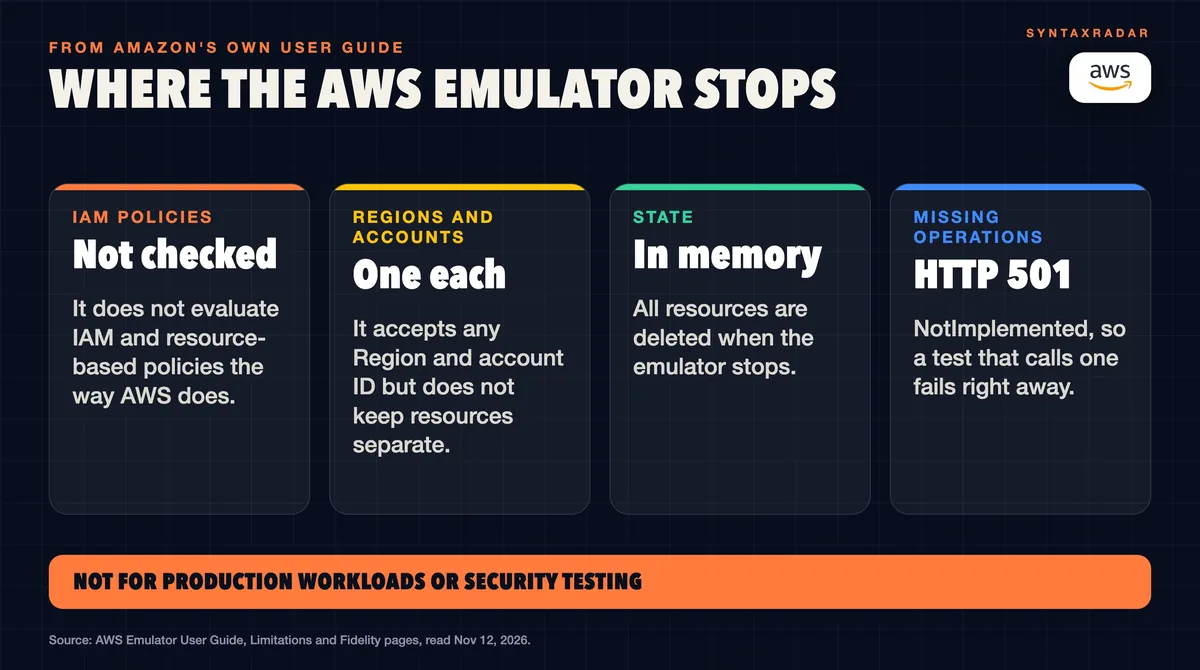
- IAM policies. It does not evaluate IAM and resource-based policies the way AWS does, so do not use it to test security.
- One Region, one account. It accepts any Region and account ID but does not keep resources separate by either. Use one of each, or run a separate emulator per Region on its own port.
- Checked in one Region. Amazon verifies behavior against AWS in us-west-2 only, except global services in us-east-1.
- Memory only. Resources live in memory and are deleted when it stops. Amazon says it has not tested long-running use or load testing.
- Missing operations fail loudly. An operation not implemented yet returns HTTP 501 with the error code NotImplemented, so the test fails right away.
- Uneven fidelity. It matches AWS most closely for control plane APIs (create, read, update, delete, list). Data plane behavior and support for CloudFormation, Terraform and the AWS CDK vary by service.
Amazon publishes a fidelity score for each service with every release: the number of fidelity tests passed out of the total for that service, such as 40 of 50 in its own example. The tests are public in the aws-emulator-evaluation-suite repo, including ones the emulator does not pass yet. The launch post also points to the repo's "things-that-do-not-work" folder for behaviors that do not yet match real AWS.
AWS Emulator vs LocalStack: price, license and coverage
What is LocalStack?
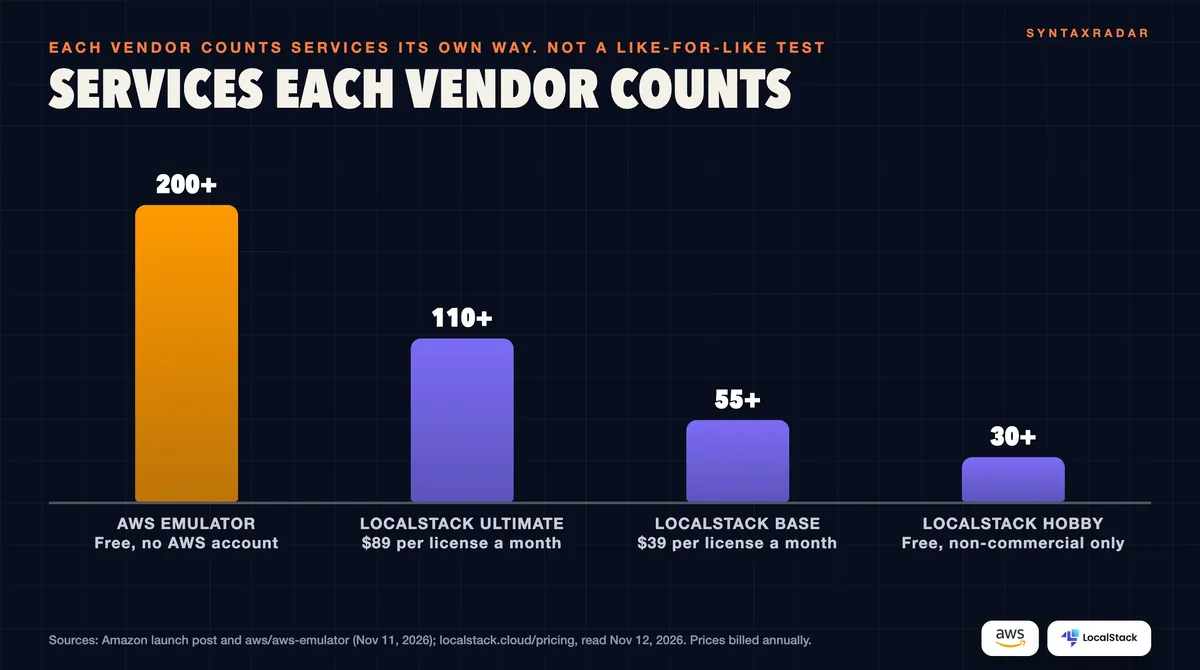
LocalStack for AWS is a local AWS emulator that runs AWS services on your machine, according to its pricing page. It is now an account-based product that uses a single image and plan entitlements. Like the AWS Emulator, it answers AWS API calls locally, so the difference is packaging and price. Amazon's repo and launch post do not mention LocalStack, so the LocalStack column below comes only from LocalStack's own pricing page. We did not run either product, and the two count services differently (Amazon counts services with an API model, LocalStack counts emulated services per plan), so the service numbers are not a like-for-like benchmark.
LocalStack pricing, the Community Edition and Ultimate
LocalStack says its free Hobby plan gives comparable core emulation to the legacy LocalStack Community Edition, but limits it to non-commercial use. The Community Edition itself gets no further product updates, CVE patches included. A company that wants LocalStack for work therefore lands on a paid plan: Base at $39 adds basic IAM policy enforcement, and LocalStack Ultimate at $89 adds advanced IAM policy testing.
Our calculation, for ten developers at list price billed annually: Base is $39 x 12 months x 10 licenses = $4,680 a year, and Ultimate is $89 x 12 x 10 = $10,680 a year. The AWS Emulator has no service fee. This assumes one license per developer, ignores trials, promotions and Enterprise pricing, and leaves out the cost of the machines and CI minutes you run either tool on. The price gap says nothing about which tool matches AWS more closely on the services you use. Only your own test suite can show that.
What to watch next: the AWS Emulator LocalStack comparison
Do not use the AWS Emulator for production workloads, and do not use it to test security. Those are the repo's own words, and they mark where a local copy stops and the real cloud starts.
If you let a coding agent install and drive an emulator, our report on whether Claude Code is safe shows how an agent tool can send data you did not expect, which is a good reason to decide on emulator telemetry deliberately rather than by accident.
Three things to track:
- Open issues. 53 on November 12, 2026. How fast that number moves will show whether the issues-only model keeps up.
- Fidelity scores. Each release publishes them per service, so you can watch the gaps close or widen. Amazon also says it will share more about this work at re:Invent.
- Side-by-side runs. The AWS Emulator LocalStack question will be settled by teams running the same suite against both and publishing the results.
Our explainer on the Strands Decider covers another Amazon agent result reported as a single headline ratio, and it deserves the same careful reading as the Alf figure above. If you also test .NET services locally, our guide to .NET end of life lists which runtime versions are still supported.
In code
aws agent-toolkit add-skill --skill-name aws-emulator --region us-east-1export EMULATOR_TELEMETRY=off
aws-emulator --telemetry offQuestions readers ask
What is the AWS Emulator?
The AWS Emulator is Amazon's local copy of AWS, launched on November 11, 2026. It is built from more than 400 API models covering more than 200 AWS services and runs on your own machine. It has no graphical interface and is meant for building and testing, especially by coding agents that need a safe place to try infrastructure code.
Is the AWS Emulator free?
Yes. According to the aws/aws-emulator repo, it needs no AWS account and has no additional service fee. The code is licensed CC0-1.0, except the vendor directory, which is under the Apache License 2.0. Telemetry is on by default, and you can turn it off with --telemetry off or EMULATOR_TELEMETRY=off, among other options.
How do I install the AWS Emulator?
There are three main paths. Add it as an agent skill with the AWS CLI (version 2.35.0 or later), install the RPM or Debian package on Linux and run aws-emulator, or use a container built from the repo's short Dockerfile on Windows and macOS. Rust projects can also embed it as a dev-dependency, with one isolated instance per test.
Is the AWS Emulator better than LocalStack?
No source settles that. Amazon's repo and launch post do not mention LocalStack. LocalStack's pricing page lists a free Hobby plan for non-commercial use, then Base at $39 and Ultimate at $89 per license per month billed annually. The AWS Emulator has no service fee. Both vendors count services differently, so run your own tests on the services you use.
Is LocalStack free?
Partly. LocalStack's pricing page lists a free Hobby plan with 30+ emulated services, for hobbyists and other non-commercial use only, and its terms prohibit commercial use. Paid plans start at $39 per license per month billed annually. Non-commercial open-source projects can apply for a free Ultimate license, and trials of Base and Ultimate need no credit card.
Sources
Written by
Abdul Rehman
Lead Systems Architect and Technical Director at Syntaxradar. More in Developer Tools.
Keep reading
DeepSeek Harness vs Claude Code: Is the Free Rival Ready?
DeepSeek released DeepSeek Harness (dsh), an MIT-licensed open-source coding agent, as a developer preview on August 13, 2026, added desktop apps on October 2, and starts billing…
Nov 1, 2026 · 7 min read
Linux Kernel Vulnerability CVE-2026-98432: Are You Exposed?
CVE-2026-98432, a use-after-free in how Linux handles IPv4 options during the TCP handshake, was published on October 15. The kernel CNA and Red Hat score it 9.8 Critical. Fixed…
Nov 2, 2026 · 6 min read

Mapbox Alternative: Host Protomaps for $5 a Month Plus Bandwidth
A November 15, 2026 blog post priced a self-hosted Protomaps map at about $5 a month in storage and $0.00005 per city view, against Mapbox's $5 per 1,000 loads after 50,000 free.…
Nov 18, 2026 · 7 min read
More in Developer Tools
See all
Android Sideloading: Verification Goes Global in January 2027
On November 19, 2026 Google said Android developer verification starts rolling out globally in January 2027, beginning with seven app distributors. Unregistered apps can still…
Nov 20, 2026 · 7 min read

GPT-5 Deprecation: What Breaks on Dec 11 and What Replaces It
As of November 16, 2026, OpenAI's deprecations page lists December 11, 2026 as the shutdown date for gpt-5, gpt-5-mini, gpt-5-nano, gpt-5-pro, o3 and o3-pro, with gpt-6.1-sol,…
Nov 19, 2026 · 7 min read

Microsoft Ignite 2026: Keynote Time, Copilot and Azure Prices
As of November 16, 2026, Microsoft Ignite 2026 opens November 17 in San Francisco with a keynote listed for 10:00 a.m. Pacific. Microsoft has not published its announcements, but…
Nov 17, 2026 · 7 min read
Latest stories
Front page
NoisyTCP: The Linux Kernel TCP Flaw and Who Must Patch
Abdul Rehman · Nov 23, 2026 · 7 min read
US Approves AI Chips to China: 879,868 H200 and MI325X Cleared
Abdul Rehman · Nov 22, 2026 · 6 min read

Nothing AI Device: What Is Confirmed Before the Dec 8 Reveal
Abdul Rehman · Nov 22, 2026 · 7 min read
KB5132061: Windows 11 Install Errors Explained, and the Fix
Abdul Rehman · Nov 22, 2026 · 7 min read