


Mapbox Alternative: Host Protomaps for $5 a Month Plus Bandwidth
A November 15, 2026 blog post priced a self-hosted Protomaps map at about $5 a month in storage and $0.00005 per city view, against Mapbox's $5 per 1,000 loads after 50,000 free. It had 429 points on Hacker News as of November 16.

Abdul Rehman
Lead Systems Architect and Technical Director · · 7 min read

The short version
- 139 GB, about $5 a month storage
- Planet file to host (blog, November 15, 2026)
- about $0.00005
- Bandwidth per city-sized view (blog's 5 MB example)
- $5.00 per 1,000 loads after 50,000 free
- Mapbox first paid tier (pricing page)
Why it matters: Self-hosting Protomaps PMTiles costs about $5 a month in storage plus bandwidth at the blog's estimate, which beats Mapbox's per-load tiers above 50,000 loads a month but not below it.
On this page
Protomaps is a Mapbox alternative you host yourself, and a November 15, 2026 write-up prices it at about $5 a month for storage plus roughly $0.00005 for one city-sized map view. Mapbox's pricing page, as read on November 16, 2026, lists $5.00 per 1,000 map loads once you pass 50,000 free loads a month. PMTiles, the file format behind Protomaps, packs all map tiles into one file that browsers read piece by piece, so you need no tile server.
The cost figures come from a personal blog post that was submitted to Hacker News on November 15 and had 429 points and 75 comments as of November 16. It is a single secondary report, so we checked its arithmetic against Mapbox's and Protomaps' own pages and flag one inconsistency below.
What is PMTiles?
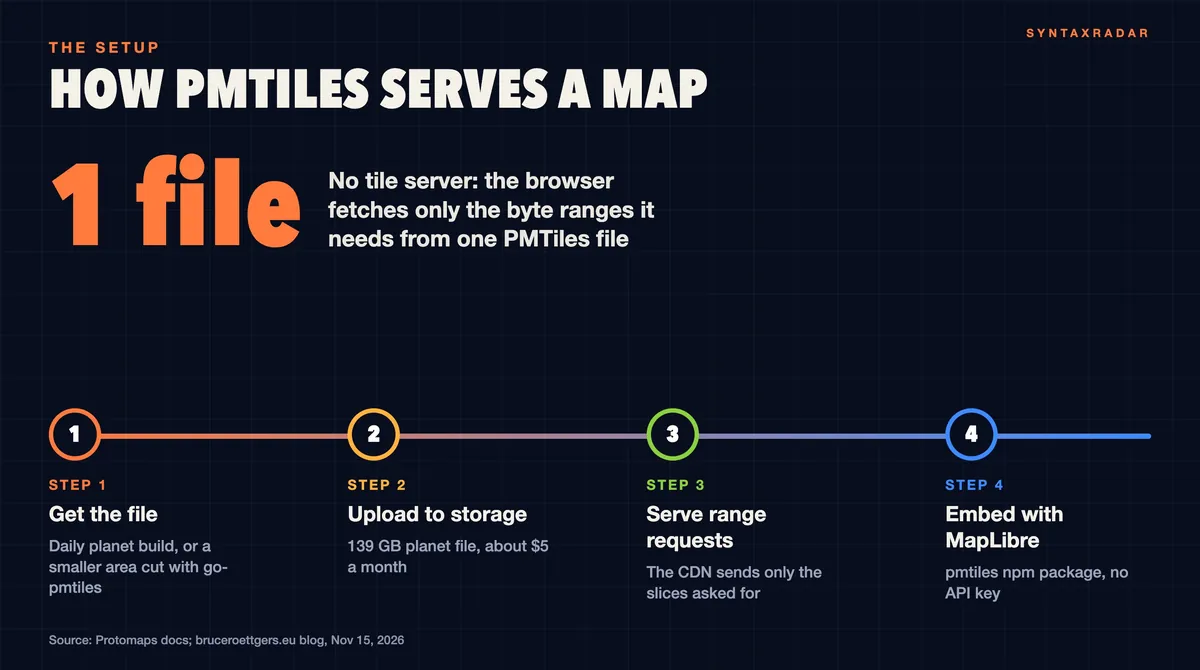
PMTiles is, in Protomaps' words, "an open archive format for pyramids of tile data". A tile pyramid is the stack of small map squares a web map draws, with more detailed squares at each zoom level. PMTiles stores the whole stack in a single file, and the Protomaps docs say it is accessed with HTTP Range Requests. A range request asks a server for only a slice of a file, so the browser downloads the few tiles on screen instead of the full archive.
That is why no tile server is needed. You put the file on ordinary static storage, such as an S3-style bucket, and the visitor's browser does the picking. Protomaps describes itself as an open source system with three parts: PMTiles, a set of tools and libraries, and a basemap (the ready-made map drawing) built from OpenStreetMap data and delivered as one big PMTiles archive. The docs cover MapLibre GL, Leaflet and OpenLayers for showing PMTiles in a browser (the About page notes that Mapbox GL v2 carries a restricted source-available license), and hosting guides for AWS, Cloudflare, Google Cloud, Azure and a plain server.
Is Protomaps free?
Protomaps is free to self-host, which makes it an open source replacement for Mapbox with no per-load bill. The docs say the project is released under BSD and ODbL licenses, and the Protomaps About page says it is unmetered, with no API keys and no third party to depend on, so you pay only for your own storage and bandwidth. The full planet file can be downloaded for free, and the CLI can cut out any area you need.
There is also a hosted option. According to the same page, Protomaps runs a basemap tiles API that is free for noncommercial use. Commercial use requires becoming a GitHub Sponsor, and the soft limit is 1,000,000 tile requests a month, with no automatic shutdown if you pass it. Mapbox is the opposite model: a metered API where every load is billed.
How much does Mapbox cost?
Mapbox is free for the first 50,000 web map loads a month, then billed per load, and the price per load falls as volume rises. As of November 16, 2026, Mapbox pricing for Map Loads for Web, per its pricing page, runs in these tiers:
- Up to 50,000 loads a month: free.
- 50,001 to 100,000: $5.00 per 1,000.
- 100,001 to 200,000: $4.00 per 1,000.
- 200,001 to 1,000,000: $3.00 per 1,000.
- 1,000,001 to 5,000,000: $2.50 per 1,000.
- Above 5,000,000: contact sales.
Mobile apps are priced separately by monthly active user: free up to 25,000 users, then $4.00 per 1,000 for the next 100,000. A real example of how fast this bites: the team behind Pinball Map wrote in November 2024 that it hit 50,000 loads by the 20th of a month and paid about $20 a month, with a discount, at 56,000 to 60,000 loads.
The blog also contains an inconsistency. It quotes Mapbox at $5 per 1,000 loads, then says Mapbox charges a flat fee per visit. Those are two different billing units. We use the per-load tiers on Mapbox's own page.
Mapbox alternative cost: a SyntaxRadar calculation
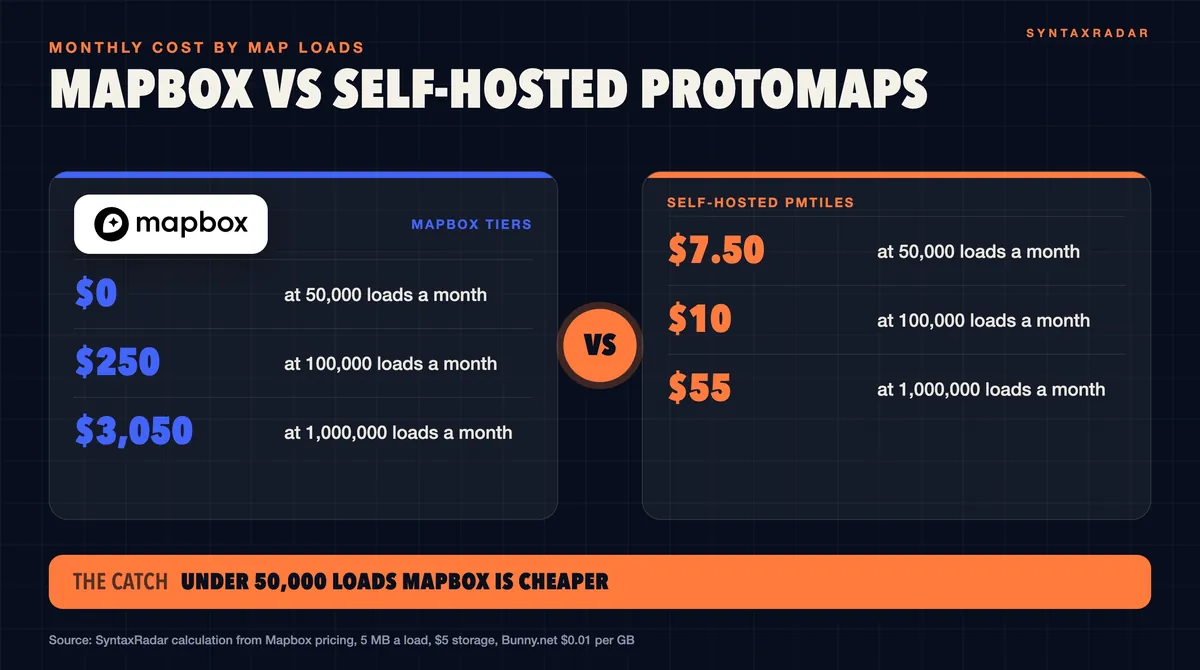
The blog's inputs are a 139 GB planet file, about $5 a month in storage, and a city-sized view that moves about 5 MB. It prices bandwidth at $0.01 per GB for Europe and North America, a rate Bunny.net's pricing page confirms for its standard network. Five megabytes is 0.005 GB, so one view costs 0.005 x $0.01 = $0.00005, or $0.05 per 1,000 loads. Against $5.00 per 1,000, that is the blog's 100x gap, and it only holds for Mapbox's first paid tier. At the $2.50 tier the gap is 50x.
The table applies those inputs to monthly load counts. The Mapbox column assumes each band is billed at its own rate. The self-hosted column adds $5 of storage and leaves out request fees, a domain and bandwidth prices outside Europe and North America, which the sources do not give.
Source: SyntaxRadar calculation from Mapbox's tier table, the blog's 5 MB and $5 storage figures (single secondary report) and Bunny.net's $0.01 per GB. All inputs as of November 16, 2026.
Three readings follow. Below 50,000 loads, Mapbox's free tier is cheaper than self-hosting. The gap then widens fast because the self-hosted bill grows by $0.05 per 1,000 loads while Mapbox's grows by $2.50 to $5.00. And the 5 MB figure is the author's example: the post says heavy users might transfer tens of MB, and at 20 MB a load the cost is $0.0002, or $0.20 per 1,000, which is still 25x below Mapbox's first paid tier. The blog's storage rate range of $0.01 to $0.055 per GB a month works out to $1.39 to $7.65 for 139 GB, so $5 sits inside it.
What does it take to self-host the file?
To self-host map tiles, the blog walks through one setup on Bunny.net, a CDN (a network of servers that caches files near visitors), and it carries an affiliate link to Bunny, so read the vendor choice with that in mind. The steps and their catches:
- Get the file. Download the daily planet build from the Protomaps builds page or cut a smaller area with the go-pmtiles command line tool, by bounding box or zoom level.
- Upload it. The author's upload through Bunny's HTTP API timed out after 15 minutes, so the post recommends an S3-compatible storage zone and rclone with a 256 MB chunk size, run from tmux or a temporary VPS.
- Make range requests cacheable. On Bunny, "Optimize for large object delivery" must be switched on. On Cloudflare, the author says an edge function is needed to turn x/y/z tile paths into range requests. Our explainer on a Cloudflare caching bug that leaked prompts shows why cache rules deserve a second look before you put them in front of users.
- Lock it down. Set allowed referrers so other sites cannot embed your file, and throttle downloads. The author caps a single request at 10 kB/s after the first 10 MB.
- Embed it. Use MapLibre GL with the pmtiles npm package, following the official guide.
Pinball Map's November 2024 move shows the end state. It stored about 111 GB of PMTiles on Cloudflare R2 and reported a first-month bill of $1.67, all storage. That is one team's account from an older, smaller planet build, not a current price list. Teams that test cloud setups locally before paying for them may also like our look at an AWS emulator that rivals LocalStack.
Is Protomaps a Google Maps API alternative too?
Protomaps replaces the map picture, not the whole Google or Mapbox toolbox. Protomaps' About page says its basemap design is less advanced than Mapbox's, that its basemaps come mainly from OpenStreetMap while Mapbox blends several data sources, and that tiled formats like PMTiles are usually not enough for geocoding (turning addresses into points) and routing. It points to separate open tools for those jobs, including Valhalla, OpenTripPlanner, Nominatim, Photon and Pelias.
For a Google Maps API alternative, the pricing comparison is harder because we could not read Google's pay-as-you-go rate per 1,000 loads. Google's pricing page lists subscription plans that include Dynamic Maps: Starter at $100 a month for 50,000 calls, Essentials at $275 for 100,000 and Pro at $1,200 for 250,000. Dividing price by included calls gives $2.00, $2.75 and $4.80 per 1,000 calls if you use every call (our arithmetic). Check Google's own calculator before comparing.
The planet size is a second thing to verify. The blog says 139 GB, while Pinball Map reported a 115 to 120 GB build in November 2024. Treat the file as growing, and size a regional extract for your own users. The same metered-versus-owned question applies to AI services, and our LLM API pricing guide covers how those prices moved and how to pay less.
What to watch next for this Mapbox alternative
As of November 16, 2026, the evidence for a self-hosted replacement is one personal blog, Protomaps' own documentation and one team's 2024 bill, and the savings are real mainly above Mapbox's 50,000 free loads a month. Before you move, measure what a real page view transfers in your browser's network panel, check the current planet size on the Protomaps build page, and re-read Mapbox's tiers, which can change.
Also confirm the storage rate with your CDN, because we could verify Bunny's bandwidth price but not its storage price. If you only need a basic map and have no geocoding or routing, Protomaps with PMTiles is worth a weekend test. If you rely on Mapbox's cartography or its other APIs, Protomaps' own comparison suggests Mapbox may remain the better fit. Developers weighing other paid-tool swaps can also see how we vet a replacement in our Postman alternative check.
Questions readers ask
What is PMTiles?
PMTiles is an open archive format for pyramids of tile data, according to the Protomaps docs. It stores all map tiles in one file on static storage, and a browser fetches only the slices it needs with HTTP range requests, so no tile server is required. Protomaps' basemap, built from OpenStreetMap, ships as one PMTiles archive.
Is Protomaps free?
Self-hosting is free of license or metering fees: Protomaps says its basemap download is free and unmetered, so you pay only your own storage and bandwidth. Its hosted tiles API is free for noncommercial use. Commercial use of that API requires becoming a GitHub Sponsor, with a soft limit of 1,000,000 tile requests a month.
How much does Mapbox cost?
As of November 16, 2026, Mapbox's pricing page lists 50,000 free web map loads a month, then $5.00 per 1,000 for loads 50,001 to 100,000, $4.00 up to 200,000, $3.00 up to 1,000,000 and $2.50 up to 5,000,000. Above that you contact sales. Mobile SDK usage is billed separately by monthly active user.
Can Protomaps replace Mapbox geocoding and routing?
No. Protomaps' About page says tiled formats like PMTiles are usually not sufficient for geocoding and routing, and lists separate tools such as Valhalla, OpenTripPlanner, Nominatim, Photon and Pelias. It also says its basemap design is less advanced than Mapbox's, so check the look against your needs.
How big is the Protomaps planet file?
The November 15, 2026 blog post says the world map is 139 GB. Pinball Map reported a 115 to 120 GB build in November 2024, so the file has grown. Protomaps also lets you extract a smaller area with its command line tool, which is what most single-region apps would host.
Sources
Written by
Abdul Rehman
Lead Systems Architect and Technical Director at Syntaxradar. More in Developer Tools.
Keep reading

Postman Alternative? First Check What It Put in Claude Code
A GitHub issue from Oct 25 reports Postman plugins appearing in Claude Code and Codex after opening Postman Desktop 12.33.4 on one Mac, and an installer that tries to trust its…
Nov 5, 2026 · 8 min read

Veo Pricing: Veo 3.1 Preview Is Gone, Omni's 15s Clip Costs $1.05
Google's Gemini API docs list the Veo 3.1 preview models as shut down on October 22, 2026. On November 5, 2026 Google made Gemini Omni 1.2 Flash generally available at about $0.07…
Nov 8, 2026 · 6 min read

Android Sideloading: Verification Goes Global in January 2027
On November 19, 2026 Google said Android developer verification starts rolling out globally in January 2027, beginning with seven app distributors. Unregistered apps can still…
Nov 20, 2026 · 7 min read
More in Developer Tools
See all
GPT-5 Deprecation: What Breaks on Dec 11 and What Replaces It
As of November 16, 2026, OpenAI's deprecations page lists December 11, 2026 as the shutdown date for gpt-5, gpt-5-mini, gpt-5-nano, gpt-5-pro, o3 and o3-pro, with gpt-6.1-sol,…
Nov 19, 2026 · 7 min read

Microsoft Ignite 2026: Keynote Time, Copilot and Azure Prices
As of November 16, 2026, Microsoft Ignite 2026 opens November 17 in San Francisco with a keynote listed for 10:00 a.m. Pacific. Microsoft has not published its announcements, but…
Nov 17, 2026 · 7 min read

Is Lovable Safe? Passport Data Sat in Apps Without a Login
Crissy Field scanned 159,041 Lovable projects and found 24,664 sites sending Supabase records without login, 7,403 with emails, including passport numbers and 200,000+ chat…
Nov 15, 2026 · 7 min read
Latest stories
Front page
NoisyTCP: The Linux Kernel TCP Flaw and Who Must Patch
Abdul Rehman · Nov 23, 2026 · 7 min read

US Approves AI Chips to China: 879,868 H200 and MI325X Cleared
Abdul Rehman · Nov 22, 2026 · 6 min read
Nothing AI Device: What Is Confirmed Before the Dec 8 Reveal
Abdul Rehman · Nov 22, 2026 · 7 min read
KB5132061: Windows 11 Install Errors Explained, and the Fix
Abdul Rehman · Nov 22, 2026 · 7 min read