


Android Sideloading: Verification Goes Global in January 2027
On November 19, 2026 Google said Android developer verification starts rolling out globally in January 2027, beginning with seven app distributors. Unregistered apps can still install through a one-time advanced flow with a 24-hour wait.

Abdul Rehman
Lead Systems Architect and Technical Director · · 7 min read
The short version
- January 2027
- Global rollout begins
- 24 hours, then 7 days or indefinitely
- Advanced flow wait
- $25 (limited accounts free, 50 devices)
- Full distribution fee
Why it matters: Google's global developer verification plan keeps sideloading available, but from January 2027 apps from unregistered developers need a one-time advanced flow with a 24-hour wait.
On this page
Android sideloading, which means installing apps from outside an app store, stays allowed under Google's plan to take developer verification global. As of November 19, 2026, Google says the rollout begins in January 2027. Apps from registered developers install the same way as before, and apps from unregistered developers need a one-time advanced flow that includes a 24-hour wait.
Google's announcement on the Android Developers Blog gives no exact day in January and no country order, and none of the Google pages we read names a later full-enforcement date.
What are the Google Android app sideloading changes?
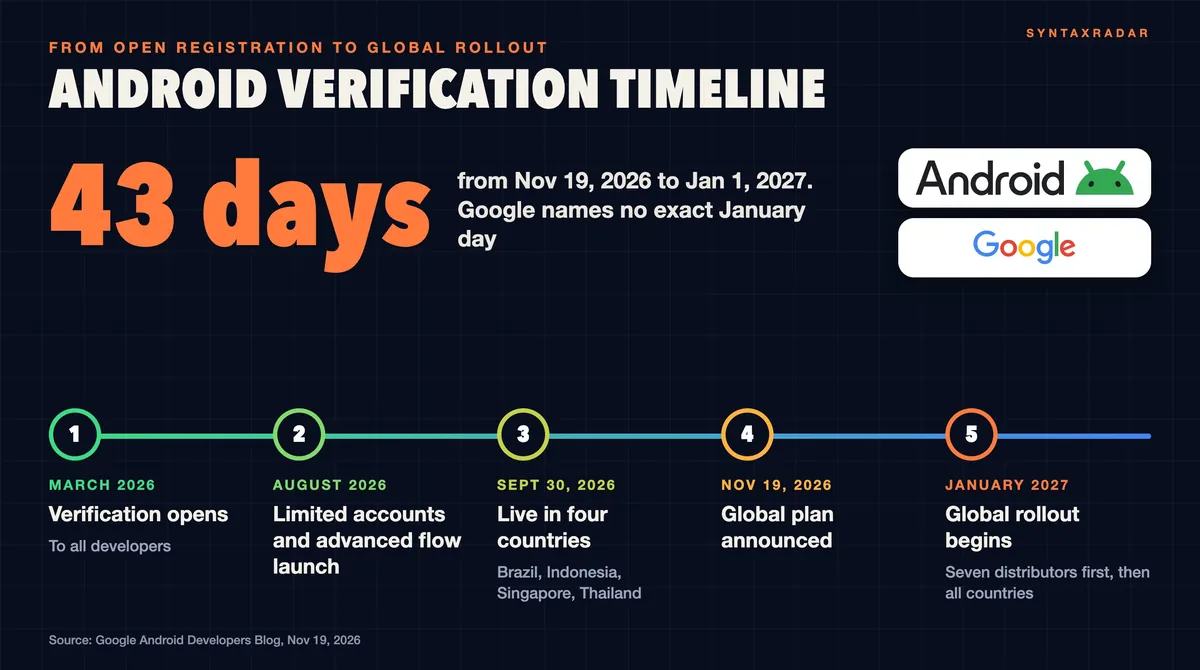
The Google Android app sideloading changes come down to one rule: apps must be registered by a verified developer before they install through the normal path on certified Android devices. In the post, Matthew Forsythe, Director of Product Management for Android App Safety, says the global rollout begins in January 2027 with seven app distributors: Google Play, Galaxy Store, Honor, Oppo, Xiaomi, Transsion and Vivo. Protections then expand gradually to all countries and cover "all installation sources" over several months.
Those are the same seven stores that were checked when verification went live on September 30, 2026 in Brazil, Indonesia, Singapore and Thailand, according to Google's verification guide. By our reading, January is first a geographic step, with the wider set of sources following. Our reading too: the phrase "all installation sources" would cover APKs downloaded from websites and from stores outside the seven, but the post does not say which arrive first.
The rules target certified devices, the same class Google used when it banned a TV box maker from them: our report on the XCPE botnet covers that case.
On scope, Google's FAQ says enforcement applies to certified Android devices running Android 8 (API level 26) or higher. Android Authority's November 19 report says Android 7.0, and we follow Google's FAQ because it is the primary source. Google also says millions of apps have been registered since verification opened to everyone in March 2026, and that they account for over 99% of Android app installs.
Is this an Android sideloading ban?
No, according to Google. Its FAQ answers "Does this mean Android is becoming a closed system?" with a no and says developers can keep distributing through app stores and direct website downloads as long as their apps are registered. The restrictions fall on one group: apps whose developers have not registered.
Verification has a narrow job. Google's FAQ says it is focused on the developer's identity and does not collect information about app content or functionality. So the search "is Android sideloader safe" has no yes-or-no answer in Google's pages: registration adds an accountable identity, and nothing Google publishes says it adds a safety review of the code. F-Droid, covered below, argues it does little against malware.
How to sideload apps on Android after verification
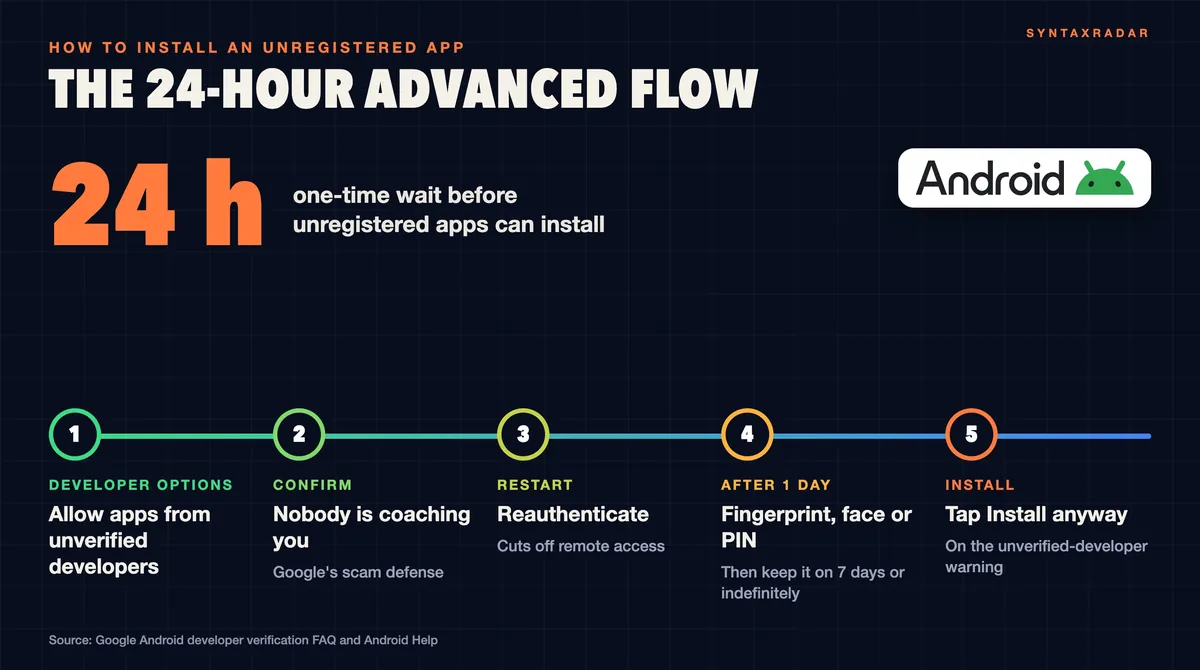
To sideload apps on Android after verification, an unregistered app needs the advanced flow, a one-time setup that Google says takes 24 hours to complete. The steps follow Google's FAQ and its advanced flow help page:
- Turn on developer mode in system settings. Google says this prevents the one-tap bypasses used in high-pressure scams.
- Open Settings, System, Developer options, turn on "Allow apps from unverified developers" and confirm that nobody is coaching you.
- Restart the phone and reauthenticate. Google says this cuts off remote access or a live call a scammer might be using.
- Wait one day, return, and confirm with fingerprint, face unlock or your device PIN.
- Choose to allow unregistered apps for seven days or indefinitely, install the app, and tap "Install anyway" on the warning.
Three details matter after setup. Developer options do not need to stay on. The flow covers updates too: if it is switched off, updates to unregistered apps fail until it is back on. And ADB works as usual, with no waiting period. Android Authority's August 18, 2026 report, citing Google comments on Reddit, adds that turning the flow off briefly leaves a 10-minute window to turn it back on without a new 24-hour wait (single secondary report). The same report said in August that the setting was rolling out gradually; Google has not said whether it reaches every device by January.
Our reading: because the wait is built in, anyone who relies on unregistered APKs can start the 24 hours before they need an app, so the delay does not surprise them on install day.
Android developer verification: what developers must do
The Android developer verification requirements depend on one of three paths, according to Google's guides for full distribution and limited distribution.
The $25 fee comes from Google's FAQ, which calls it similar to Play's $25 registration fee and does not say whether it recurs. The 50-device cap comes from the November 19 post, which raised it from 20. Some older Google pages still show 20.
Registration links a package name to your signing key. Google says it takes less than ten minutes per app, Play developers can check status in Play Console, and developers who only ship outside Play use the Android Developer Console. Teams can automate it with the Android Developer ID Status API (checks eligibility and status) and the Android Developer Console API (registers packages and manages keys). Per the FAQ, a lost signing key means you cannot register that package. Developers in comprehensively sanctioned countries cannot complete verification, and the checks do not run on certified devices located there.
For developers who track platform deadlines, our GPT-5 deprecation table uses the same dated-checklist format for a different December deadline.
What does Android verification mean for F-Droid and open-source apps?
Google's open-source registry guide says registering is not required to keep distributing on open-source repositories, but it lets users keep the install experience they have. A repository that integrates with the Console API can register package names and keys on a developer's behalf, though the developer still needs a verified account. If a repository re-signs apps with its own key, the developer adds that key's fingerprint to the registration. The guide does not name F-Droid, and we found no F-Droid statement on whether it will integrate.
F-Droid opposes the program. In its July 1, 2026 post, it argues verification does not stop malware distribution beyond slowing a repeat offender, says "malware" is undefined in the Android Developer Console Terms, and lists open questions it put to Google, including what happens when someone in an affected region installs or launches F-Droid. Those are F-Droid's claims, and we have not checked them independently. The post cites an open letter from over 70 organizations, and the Keep Android Open campaign counts 72 organizations from 23 countries on its open letter (the campaign's own count) and tells developers "Do not sign up."
SyntaxRadar calculation: the January 2027 clock
We counted days from Google's dates and the 28-day D-U-N-S lead time. Google gave only "January 2027", so the table brackets it.
The 99% figure is Google's own claim and Google does not break it down by country or channel. The December 4 date assumes a January 1 start, which is the earliest day Google's wording allows.
What to watch next
Four open points would settle what Google left unanswered:
- Whether Google names a day in January and a country order for the expansion.
- Which sources join first once the rollout covers "all installation sources", and whether APKs from websites are among them.
- Whether F-Droid or other registries say they will integrate the Console API, or keep their position that developers should not register.
- Whether Google updates its older pages that still show a 20-device cap and three-country lists.
Until Google publishes those details, Android sideloading remains available: registered apps install as usual, unregistered apps need the 24-hour flow, and ADB is untouched. For another Google policy that arrives in dated phases, see our explainer on the Google Project Zero disclosure policy, which steps down on February 2, 2027 and January 3, 2028.
Questions readers ask
What is Android sideloading?
It means installing an app from a source other than an app store, such as an APK file from a website or a third-party store. Google says sideloading is not ending under developer verification. Apps from registered developers install as usual, and apps from unregistered developers need a one-time advanced flow with a 24-hour wait.
When does the Android developer verification rollout start worldwide?
Google's November 19, 2026 Android Developers Blog post says the global rollout begins in January 2027 with seven distributors: Google Play, Galaxy Store, Honor, Oppo, Xiaomi, Transsion and Vivo. Protections then expand to all countries and all installation sources over several months. Google gave no exact day and no country order.
Is Android sideloader safe?
Developer verification does not answer that. Google's FAQ says verification focuses on the developer's identity and does not collect information about app content or functionality. A registered developer is accountable, but that step is not a code review. Apps from unregistered developers still show an unverified-developer warning, so read it before tapping Install anyway.
How much does Android developer verification cost?
A full distribution account in the Android Developer Console has a $25 fee, per Google's FAQ, and individuals submit a government photo ID and proof of address. Limited distribution accounts for students and hobbyists are free, need no government ID, and share apps with up to 50 authorized devices.
Does ADB still work for unverified apps?
Yes. Google's FAQ says there are no changes to how ADB works, developers can install apps without verification using ADB, and the 24-hour waiting period does not apply to ADB installs. Unregistered apps can only be installed or updated with the advanced flow switched on or through ADB.
Sources
Written by
Abdul Rehman
Lead Systems Architect and Technical Director at Syntaxradar. More in Developer Tools.
Keep reading

Google Gemini Privacy: Who Reads Your Chats and for How Long
Google's Gemini help pages say a subset of chats is read by human reviewers and kept up to three years even after you delete activity, and that chats train its AI while Keep…
Nov 11, 2026 · 7 min read
Gemini for Mac: What Computer Use Can Do and How to Stop It
On November 19, 2026 Google began rolling out computer use in the Gemini app for Mac, in English in the U.S., for Google AI Plus, Pro and Ultra on Apple Silicon Macs with macOS…
Nov 20, 2026 · 7 min read
Is Lovable Safe? Passport Data Sat in Apps Without a Login
Crissy Field scanned 159,041 Lovable projects and found 24,664 sites sending Supabase records without login, 7,403 with emails, including passport numbers and 200,000+ chat…
Nov 15, 2026 · 7 min read
More in Developer Tools
See all
GPT-5 Deprecation: What Breaks on Dec 11 and What Replaces It
As of November 16, 2026, OpenAI's deprecations page lists December 11, 2026 as the shutdown date for gpt-5, gpt-5-mini, gpt-5-nano, gpt-5-pro, o3 and o3-pro, with gpt-6.1-sol,…
Nov 19, 2026 · 7 min read

Mapbox Alternative: Host Protomaps for $5 a Month Plus Bandwidth
A November 15, 2026 blog post priced a self-hosted Protomaps map at about $5 a month in storage and $0.00005 per city view, against Mapbox's $5 per 1,000 loads after 50,000 free.…
Nov 18, 2026 · 7 min read

Microsoft Ignite 2026: Keynote Time, Copilot and Azure Prices
As of November 16, 2026, Microsoft Ignite 2026 opens November 17 in San Francisco with a keynote listed for 10:00 a.m. Pacific. Microsoft has not published its announcements, but…
Nov 17, 2026 · 7 min read
Latest stories
Front page
NoisyTCP: The Linux Kernel TCP Flaw and Who Must Patch
Abdul Rehman · Nov 23, 2026 · 7 min read

US Approves AI Chips to China: 879,868 H200 and MI325X Cleared
Abdul Rehman · Nov 22, 2026 · 6 min read
Nothing AI Device: What Is Confirmed Before the Dec 8 Reveal
Abdul Rehman · Nov 22, 2026 · 7 min read
KB5132061: Windows 11 Install Errors Explained, and the Fix
Abdul Rehman · Nov 22, 2026 · 7 min read