


LTO Tape: Why Fujifilm Wants 5x More Capacity for AI Archives
On October 29, 2026, Fujifilm said it will invest about 10 billion yen at its Odawara Site to raise data storage tape production capacity about five times versus fiscal 2025 by fiscal 2028, mainly for LTO Ultrium10, citing AI and cloud archiving demand.

Abdul Rehman
Lead Systems Architect and Technical Director · · 6 min read
The short version
- About 10 billion yen (about $64M per The Register)
- Fujifilm investment
- About 5x vs FY2025 shipment capacity
- Tape capacity increase by FY2028
- 30TB or 40TB per cartridge, 400 MB/s
- LTO-10 native capacity
Why it matters: Fujifilm is betting that AI and cloud archives, plus ransomware fears, will keep cheap offline LTO tape growing, even though LTO-10 drives no longer read older cartridges.
On this page
LTO tape, the cartridge format that big data centres use for long-term archives, is getting its biggest factory bet yet. On October 29, Fujifilm announced it will spend about 10 billion yen to raise its tape data storage production capacity roughly five times by fiscal 2028, and it named generative AI and cloud services as the reason.
That sounds odd if you think of magnetic tape storage as something from an old office basement. For the companies building AI, though, tape storage solutions offer cheap long-term space and a copy that sits physically off the network, where ransomware cannot reach it.
Below: what this tape actually is, what the newest drive can and cannot do, how long the format stays readable, and where tape fits next to hard drives and SSDs.
What is LTO tape?
It is a standard cartridge of magnetic tape, plus the drive that writes and reads it, built for storing large amounts of data that nobody needs to open every day. According to The Register, the format is led by HPE, IBM and Quantum, and it is the only non-proprietary tape format still standing.
The format has a long history. Fujifilm says it launched its first LTO Ultrium1 cartridge in 2000. In 2011 it became the first company to sell tape coated with barium ferrite (BaFe, a type of magnetic particle that holds the recorded data). Fujifilm also says it holds the top global share of the magnetic tape market, though that is the company's own claim.
Cartridges come in numbered generations. Each new generation holds more data per cartridge, and the current one is LTO-10. Fujifilm's version, LTO Ultrium10, launched in 2025 and is the main product this expansion is for.
Why is Fujifilm making five times more tape now?
Fujifilm is expanding because demand for data archiving from generative AI and cloud services is growing, according to its press release. Fujifilm's pitch is that tape offers low-cost long-term storage for that growing archive.
The details of the plan, from Fujifilm:
- Money: about 10 billion yen, which The Register converts to roughly $64 million and The Next Web to about EUR 56 million.
- Place: its Kanagawa Factory, Odawara Site, in Japan.
- Timing: fiscal 2026 to fiscal 2028.
- Size: about five times more production capacity, measured as shipment capacity against fiscal 2025.
- Scale: Fujifilm calls it its largest investment to date in dedicated facilities for LTO.
One precise point: the "5x" is a capacity target, describing how much tape Fujifilm will be able to ship compared with fiscal 2025. Actual sales will depend on demand.
Fujifilm gives a second reason too. It says tape's physical isolation from networks is drawing attention as protection against ransomware (malicious software that encrypts a company's files and demands payment). A cartridge sitting on a shelf has no network connection, so an attacker inside the network cannot encrypt it, which is what makes an offline tape backup attractive.
What can an LTO 10 tape drive do?
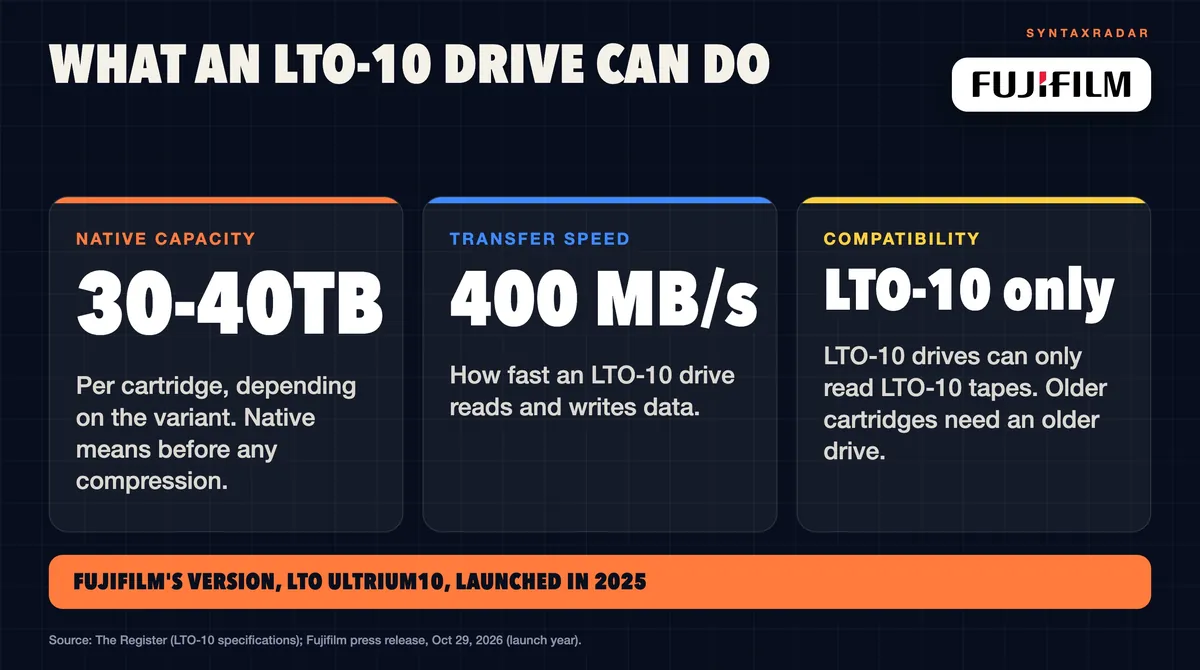
It writes 30TB or 40TB of native data to a single cartridge, depending on the variant, and moves data at 400 MB/s, according to The Register. "Native" means the raw capacity before any compression is applied, which is the fairest number for comparing cartridges.
There is a catch for anyone with an existing archive, because older cartridges are no longer backwards compatible with the newest drive: LTO-10 drives can only read LTO-10 tapes. Earlier LTO tape drives could read cartridges from past generations, and The Register reports that this backward reading ended with LTO-10. In practice, an LTO 9 tape will not play in a new LTO-10 drive, so a company upgrading has to keep an older LTO tape drive around or copy its archive onto new cartridges.
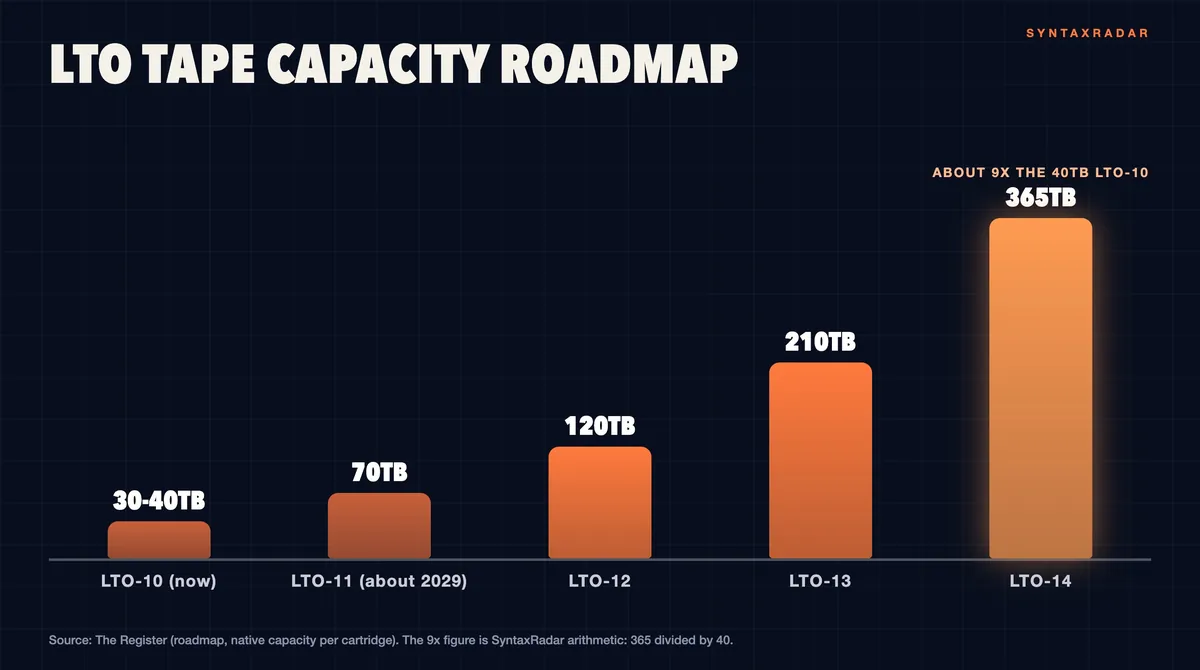
Capacity is set to keep growing. The Register lists the published LTO roadmap like this:
That last figure is a little over nine times the largest LTO-10 cartridge (our arithmetic: 365 divided by 40). The Register says four more generations are defined and that the format updates roughly every four years.
How long does LTO tape last?
The sources behind this story give no shelf-life figure for LTO-10 cartridges, so there is no sourced number to quote. Fujifilm describes tape only as low-cost, long-term storage.
The news does clarify one part of LTO tape lifespan: the drives. New generations arrive about every four years. Older drives used to read past-generation cartridges, which gave archives some breathing room during upgrades. Now that LTO-10 drives read only LTO-10 tapes, the useful life of a cartridge is tied more tightly to the life of the drives that match it.
For anyone planning an archive, that turns into a simple rule. Treat tape as something you migrate on a regular cycle. Keep at least one working drive for each generation you still hold, and budget for copying older cartridges forward when you retire those drives.
Is tape storage still used?
Yes, and by large operators. Fujifilm says cloud providers and data centre operators increasingly use tape for long-term storage, as The Next Web reports. Fujifilm's own spending plan is the clearest signal it expects that use to grow.
The shipment numbers are bumpier than the headlines suggest. LTO shipments fell 9% in 2025, to 160.3 exabytes, from a record 176.5 exabytes in 2024, according to The Next Web. (An exabyte is a million terabytes.) The LTO Program told The Register that sales picked up strongly in the second half of 2025 and predicts record sales in 2026.
The Next Web also reports, citing The Register, that shipments rose 57% in the first quarter of 2026. We could not find that figure in the Register article we read, so treat it as The Next Web's number until the LTO Program publishes its full-year report.
So the picture is a dip in 2025, a recovery that started late that year, and a manufacturer betting heavily that the recovery holds.
Tape vs HDD vs SSD: where does each one fit?
Tape's niche is low-cost, long-term, offline storage. Per Fujifilm and The Next Web, that is where LTO tapes are strongest: a cartridge on a shelf is cheap to keep and sits offline, out of a ransomware attacker's reach. Neither source gives price or speed figures against hard drives or SSDs, and the one speed number we have is LTO-10's 400 MB/s transfer rate. Fujifilm points to archive demand as the reason for its expansion, which makes tape drive storage an archive tier in its pitch rather than a place for data in daily use.
Pressure on other storage is part of the context. Flash has become more expensive as AI datacenters buy it up, which we covered in why SSD prices are rising, and memory is under similar pressure, as explained in why RAM prices are going up. Fujifilm itself does not cite flash or memory prices as a reason for its expansion. It points to archive demand and ransomware protection, so any link between those price rises and tape demand is our reading, not the company's.
What to watch next
Four things will show whether the LTO tape revival is real or just a good press cycle:
- The LTO Program's 2026 shipment report. It will confirm or deny the predicted record year and the 57% first-quarter figure The Next Web reported.
- Fujifilm's Odawara build-out. The expansion runs through fiscal 2028, so watch for updates on whether the added capacity comes online on time.
- The LTO-10 compatibility break. Since new drives no longer read older cartridges, see how archive owners handle migration from LTO 9 tape and earlier.
- LTO-11 around 2029. The Register lists it at 70TB native. Its timing will show whether the roughly four-year cadence holds.
Questions readers ask
What are LTO tapes used for?
They are used for low-cost, long-term storage. Fujifilm says cloud providers and data centre operators increasingly use tape for that job, and it highlights two strengths: low cost over the long term and physical isolation from networks, which keeps offline cartridges out of reach of ransomware and other network attacks.
How much data does an LTO 10 tape hold?
An LTO-10 cartridge holds 30TB or 40TB of native, uncompressed data depending on the variant, and the drive transfers data at 400 MB/s, according to The Register. The published roadmap goes to 70TB with LTO-11 around 2029, then 120TB, 210TB and finally 365TB per cartridge with LTO-14.
Are LTO tapes backwards compatible?
Not with LTO-10. According to The Register, LTO-10 drives can only read LTO-10 tapes. Earlier drives could read cartridges from past generations, but that backward compatibility ended with LTO-10. Anyone with an LTO 9 tape archive needs to keep a matching older drive or copy the data onto new cartridges.
Are LTO tapes still used?
Yes. Fujifilm says cloud providers and data centre operators increasingly use tape for long-term storage. Shipments were uneven: LTO shipments fell 9% to 160.3 exabytes in 2025 from a record 176.5 exabytes in 2024, The Next Web reports, and the LTO Program predicts record sales in 2026.
What is magnetic tape storage?
Magnetic tape storage keeps data on tape coated with magnetic particles, housed in a cartridge and read by a drive. LTO is the only non-proprietary tape format still standing, led by HPE, IBM and Quantum, per The Register. Fujifilm was first to sell tape coated with barium ferrite, in 2011.
Sources
Written by
Abdul Rehman
Lead Systems Architect and Technical Director at Syntaxradar. More in Systems.
Keep reading

Outlook DMARC Requirements: Why Your Email Is Suddenly Bouncing
Since November 5, 2026, Outlook.com, Hotmail, Live and MSN have been rejecting some mail from domains with no DMARC record, per MailRoute. Microsoft has not confirmed it; its…
Nov 9, 2026 · 6 min read

Apple Knowledge Graph: What Your Mac Learns About Your Family
An 8rank.ai write-up dated October 28, 2026 found macOS builds an on-device knowledge graph in 51 plaintext SQLite databases, with two classifiers scoring which contacts are…
Nov 9, 2026 · 8 min read

Supermarket Fridges Hacked: How Freezers Were Set to 50C
On October 11 to 12, 2026, attackers reached internet-exposed refrigeration controllers in about 700 French supermarkets and, per reports, apparently forced a 50C defrost. In…
Nov 8, 2026 · 8 min read
More in Systems
See all
Why Is Discord Using So Much RAM? The Rust App Shown at 290MB
On November 5, 2026 Discord CTO Stanislav Vishnevskiy said on X, as quoted by The Verge, that the desktop app is dropping Electron for Rust. A Discord-supplied, unverified…
Nov 7, 2026 · 8 min read

OpenSSH Vulnerability 2026: The Alpine Login Bug and the Fix
OpenSSH 10.6p2 shipped on November 5, 2026 to work around a password bypass on musl Linux systems without PAM. Alpine says an attacker who can reach the SSH port can log in…
Nov 6, 2026 · 8 min read

What Are Botnets? How 1.3 Million Android TV Boxes Became One
Google and partners dismantled XCPE, a botnet that Google says TV box maker Videostrong preloaded on more than 1.3 million set-top boxes to sell proxy access and run ad fraud.…
Nov 4, 2026 · 8 min read
Latest stories
Front page
Megaspeed: The Nvidia Buyer in the Reported DOJ Chip Probe
Abdul Rehman · Nov 10, 2026 · 8 min read

Starship Flight 15: The Nov 13 Target and First Ship Catch
Abdul Rehman · Nov 10, 2026 · 6 min read

Claude Fable 5.2: $8 Price, Fast Mode and Whether to Switch
Abdul Rehman · Nov 10, 2026 · 7 min read
Googlebook OS Update: November Patch Frees Up to 6GB of RAM
Abdul Rehman · Nov 9, 2026 · 6 min read