


Vulcan Rocket Failure: 40 Satellites Lost, Cause Unknown
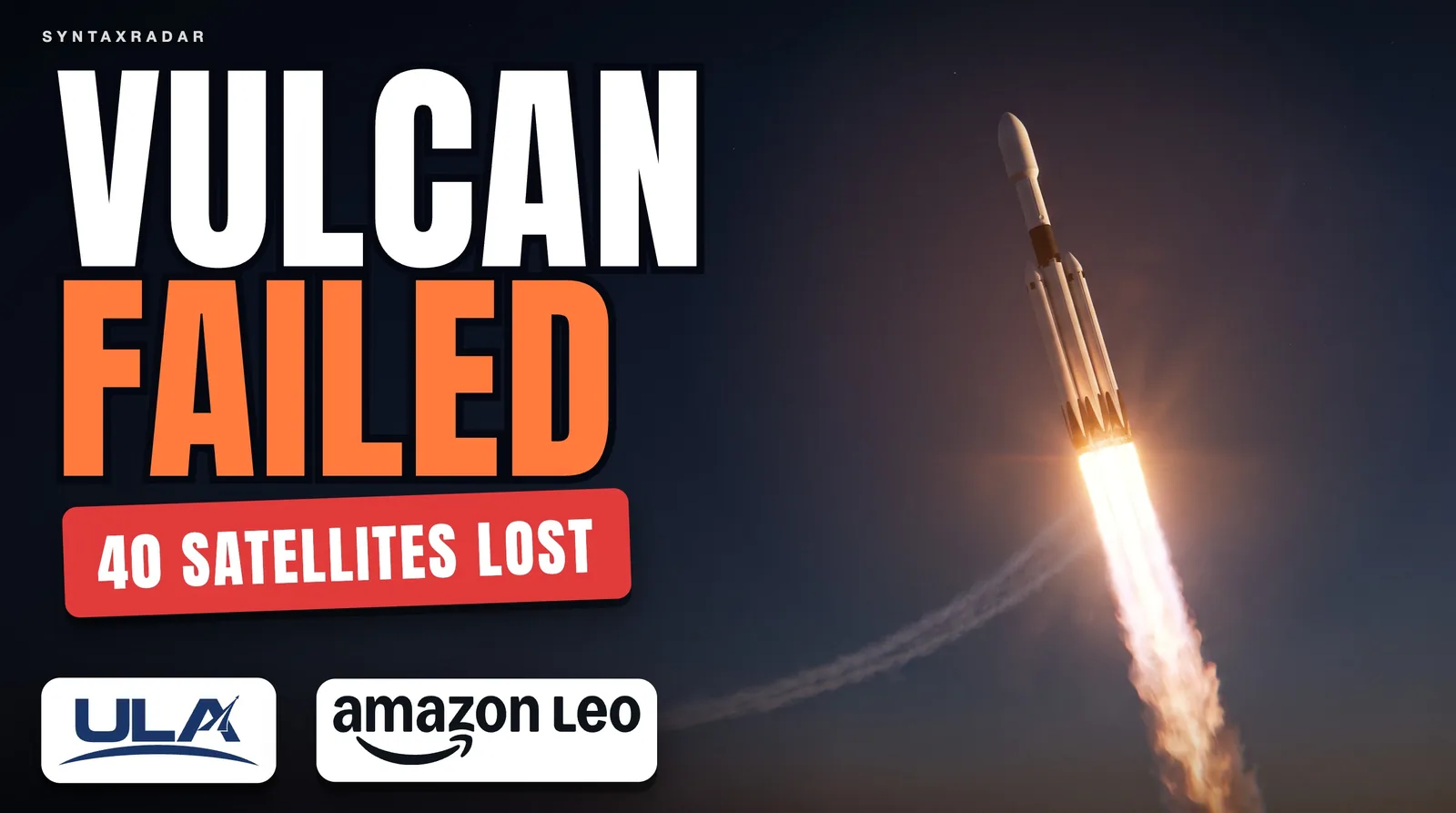
On November 15, 2026, a ULA Vulcan carrying 40 Amazon Leo satellites failed about 10 minutes after liftoff from Cape Canaveral and never reached orbit. As of November 16, 2026, ULA has not named a cause.

Abdul Rehman
Lead Systems Architect and Technical Director · · 7 min read
The short version
- 40
- Satellites lost
- About 10 minutes after liftoff
- Time of failure
- About 396 of 3,232
- Leo satellites launched before LV-01
Why it matters: The 40 lost satellites are about 1.2% of Amazon Leo's 3,232-satellite network, but the grounded Vulcan was planned to carry close to half of it.
On this page
The Vulcan rocket failure on November 15, 2026 cost Amazon all 40 of the Leo satellites riding on it. ULA's Vulcan lifted off from Cape Canaveral at 12:40 p.m. ET and, about 10 minutes into the flight, suffered an anomaly and never delivered the satellites to orbit, according to Spaceflight Now and CBS News.
As of November 16, 2026, ULA has not named a cause or given a return-to-flight date. It is the company's first outright launch failure since it was formed in 2006, and it comes while Blue Origin's New Glenn, the other big US rocket Amazon booked, is also grounded.
That leaves Amazon's Starlink rival with about 396 satellites launched out of the 3,232 its FCC license requires, and its largest launch contract waiting on an investigation.
What happened in the ULA Vulcan failure?
The mission was called LV-01, the first of 38 Vulcan launches Amazon bought, according to Amazon's own launch page. It flew ULA's six-booster VC6L configuration: about 214 feet tall, with six Northrop Grumman solid boosters, two BE-4 engines built by Blue Origin on the first stage and a Centaur V upper stage on top (Spaceflight Now).
The countdown was rough. Attempts on November 13 and November 14 slipped, first over a nitrogen plant power interruption and then over network problems between the rocket and ground systems. On November 15, controllers held the count at T-minus 20 seconds for an unexplained technical issue that ULA cleared. Spaceflight Now says it is not known whether that hold has anything to do with the failure.
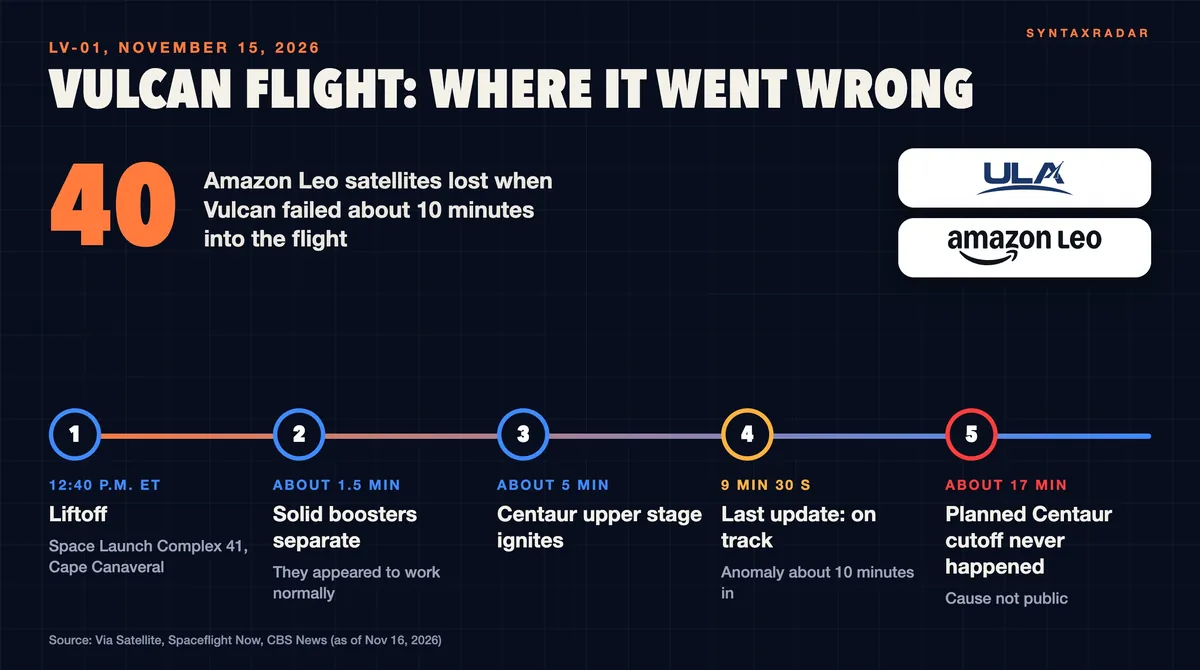
The flight itself, per Via Satellite's live coverage:
- About 1.5 minutes: the solid boosters separated.
- About 5 minutes: the Centaur upper stage ignited.
- About 9 minutes 30 seconds: the last status update showed the mission on track.
- About 17 minutes: the Centaur's first main engine cutoff, expected at that point, never happened.
ULA said the vehicle "suffered an anomaly 10 minutes into the flight" and failed to deliver the Amazon mission to orbit, in a statement CBS reports came about 50 minutes after liftoff. The satellites were due to start separating roughly 70 minutes after liftoff at about 285 miles altitude, so none had been released.
Why did the Vulcan rocket fail?
Nobody has said publicly. ULA said it will work closely with its customer and other organizations to find the cause, and The Next Web quotes a ULA post on X saying it had no specific data yet.
What the webcast showed, according to Spaceflight Now and CBS, was this: the first stage appeared to burn longer than the pre-launch timeline called for and separated from the Centaur later than expected, and the Centaur made unusual orientation adjustments early in its burn. The six solid boosters appeared to work normally. These are observations, not findings.
There is also unconfirmed reporting. The Next Web, citing Ars Technica's sources, says the problem was in the booster stage rather than the Centaur or the solid boosters, and that the two BE-4 engines kept firing at least 30 seconds past their planned shutdown. We could not open the Ars Technica article, and ULA has not confirmed any of it. Reuters, as relayed by The Next Web, said it was unclear whether the BE-4 engines played a role. Treat all of this as anonymous-source reporting until ULA publishes its own findings.
Vulcan's earlier trouble was a different part of the rocket. A solid-booster nozzle problem hit its October 2024 flight, and a nozzle burned through about 20 seconds after liftoff on the USSF-87 mission on February 12, 2026, though the payloads still reached orbit. Before this launch, ULA CEO Mark Peller said the company had identified three credible causes of the nozzle issue and mitigated all three, and Blue Origin fitted a retrofit to the BE-4 engines. On LV-01 the boosters appeared normal and the failure came after they had separated.
What is Amazon Leo?
Amazon Leo is Amazon's satellite internet constellation in low Earth orbit, the program previously known as Project Kuiper (Aviation Week). It is built to compete with SpaceX's Starlink, and its first-generation network covers 3,232 satellites that the FCC license expects in orbit by July 30, 2029.
Before LV-01, about 396 Amazon Leo satellites had launched, on 14 missions since April 2025 using Atlas V, Falcon 9 and Ariane 6 rockets, with no launches since July, per Spaceflight Now and CBS. The 40 lost satellites were never counted in that 396. Amazon's page says an initial service rollout was planned for later in 2026, and that the company built its 1,000th satellite in early September 2026, with hundreds of finished satellites waiting to launch. Our reading: the bottleneck is rocket availability, not satellite production.
SyntaxRadar calculation: how big a hole are 40 satellites?
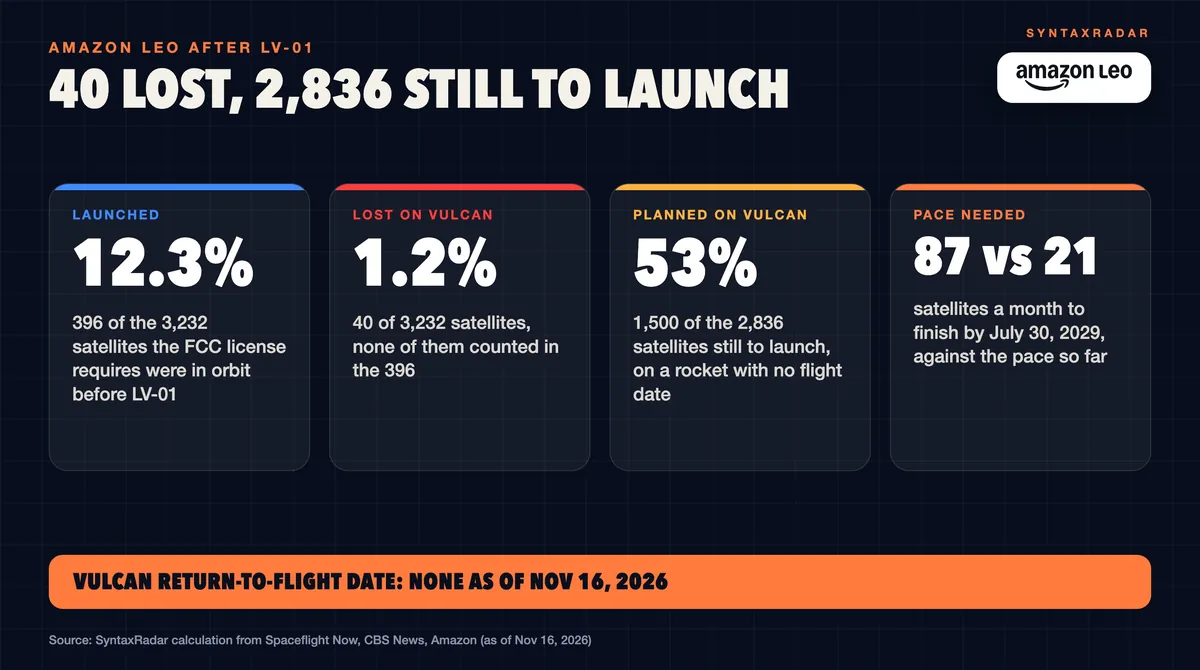
The loss is small next to the whole constellation. The dependence on Vulcan is what makes it matter. We worked this out from the figures above: 396 launched, 3,232 required, 1,500 planned on Vulcan and the July 30, 2029 FCC date.
Two readings follow. First, the 40 satellites are 1.2% of the network, and Amazon says hundreds more are built and waiting. Second, Amazon's own plan puts about 53% of the remaining satellites on a rocket with no flight date, and finishing on time needs roughly four times the launch pace Amazon has managed so far. The 1,500 figure is a plan from Amazon's launch page, where Amazon says Vulcan will launch close to half the first-generation constellation, not a guarantee. The FCC has already waived one milestone for Amazon, and nothing in our sources says whether the 2029 date would move.
Amazon Leo vs Starlink: what does the failure change?
Starlink is the benchmark. Our Starlink prices explainer cites a single secondary report of 12 million Starlink subscribers, while Amazon's launch page, updated November 14, 2026, says its initial service rollout is planned for later in 2026.
The failure also hits a schedule that was already tight. Amazon was due to have half its constellation launched by July 30, 2026. The FCC waived that milestone on June 5, 2026, on condition that satellites launched after July 30, 2026 lose spectrum priority until March 30, 2028 or until the halfway mark is reached, according to Via Satellite. The final July 30, 2029 deadline did not change.
Amazon's launch contracts show where the pain sits: 38 on Vulcan, 24 on New Glenn, 24 on Ariane 6 and 13 on Falcon 9. Two of those families are on the ground at once. New Glenn has been grounded since a May 2026 on-pad explosion tied to an oxygen valve problem in one of its seven BE-4 engines, and The Next Web reports its return to flight slipped to January. The other two contracted families are Ariane 6, whose next Leo launch (LE-04) is targeted for no earlier than November 23, 2026, and Falcon 9, which SpaceX builds.
When will Vulcan fly again?
There is no ULA Vulcan return to flight date as of November 16, 2026. Spaceflight Now says Amazon Leo must wait for ULA's investigation before flying Vulcan again, and ULA told The Next Web it would return to flight as quickly as possible. Amazon's launch page, updated November 14, said the second mission, LV-02, was expected within weeks of a successful LV-01. That plan pre-dates the failure.
The Space Force had already paused Vulcan national security launches after the February nozzle problem, and the Pentagon had not cleared them to resume pending this flight, according to Reuters as relayed by The Next Web. CBS reports that the Space Force has not said whether the failure adds restrictions or how long its review will take. SatNews reported on November 3, citing SpaceNews, that military officials had reassigned six national security launches to SpaceX while Vulcan was grounded.
NASA Administrator Jared Isaacman offered NASA's help with the investigation, writing on X that Artemis, Moon Base and the nation need ULA, as quoted by CBS.
What to watch next after the Vulcan rocket failure
Four open questions will decide how long this setback lasts, and as of November 16, 2026 none has an answer:
- Whether ULA names a cause, and whether it sits in the booster stage, the Centaur or somewhere else.
- Whether the Space Force adds restrictions on top of its existing national security hold.
- Whether Ariane 6 flies the next Amazon Leo launch on or after November 23, 2026 as targeted.
- Whether New Glenn returns in January as reported, which would give Amazon a second heavy rocket.
For the competing heavy-lift story, our Starship catch explainer covers SpaceX grabbing Ship 42 from orbit and losing the booster, and our Starship Flight 15 piece covers the November 13 target and the first ship catch. Until ULA publishes findings, the Vulcan rocket failure stays a story of observations and open questions.
Questions readers ask
When did the Vulcan rocket fail?
ULA's Vulcan lifted off from Cape Canaveral at 12:40 p.m. ET on November 15, 2026, on mission LV-01. About 10 minutes into the flight it suffered an anomaly and failed to deliver its payload to orbit, according to ULA's statement as reported by Spaceflight Now and CBS News. It was ULA's first outright launch failure since 2006.
Did any of the 40 Amazon Leo satellites survive?
None reached orbit. The satellites were scheduled to begin separating about 70 minutes after liftoff at roughly 285 miles altitude, but the rocket failed about 10 minutes into the flight, per Spaceflight Now and ULA's statement. ULA said the vehicle failed to deliver the Amazon mission to orbit, so all 40 satellites were lost.
How many Amazon Leo satellites are in orbit?
About 396 Amazon Leo satellites had launched before LV-01, according to CBS and Spaceflight Now, and SatNews described fewer than 400 as operational on November 3, 2026. The 40 lost satellites were never part of that count. The FCC license covers 3,232 first-generation satellites, due by July 30, 2029.
Is the Space Force still pausing Vulcan national security launches?
Yes, as of November 16, 2026. The Space Force paused Vulcan national security launches after the February 12 nozzle problem, and the Pentagon had not cleared them to resume pending this flight, per Reuters as relayed by The Next Web. CBS reports the Space Force has not said whether the failure adds restrictions.
Is Blue Origin's New Glenn flying?
As of November 16, 2026, no. CBS reports New Glenn has been grounded since a May 2026 on-pad explosion tied to an oxygen valve problem in one of its seven BE-4 engines. The Next Web reports its return to flight slipped to January. Amazon has 24 New Glenn launches booked, so the grounding compounds the Vulcan setback.
Sources
Written by
Abdul Rehman
Lead Systems Architect and Technical Director at Syntaxradar. More in Emerging Tech.
Keep reading
Starlink Prices: $55 to $130 a Month, Now Set by Address
Starlink Residential lists at $55, $85 and $130 a month, and reports from Oct 29-30 say some Kansas and Missouri customers now see about 10% to 20% more or less by service…
Nov 4, 2026 · 7 min read
Nothing AI Device: What Is Confirmed Before the Dec 8 Reveal
On November 4, 2026 Carl Pei said Nothing's first AI-native product ships in December with no new screen. Nothing's November 20 post set a December 8 reveal. The name, price and…
Nov 22, 2026 · 7 min read

The Economist 2027 Cover: What the Issue Says About AI and Debt
The Economist released the cover and a preview of The World Ahead 2027 on November 16 to 17, 2026. Outlets summarising it say the AI trend covers backlash, debt-funded spending,…
Nov 20, 2026 · 7 min read
More in Emerging Tech
See all
Anthropic IPO Price: $70-$78 Range, Ticker ANT and Key Dates
Anthropic's November 10, 2026 filing sets an IPO range of $70 to $78 per Class A share for 825 million shares, ticker ANT on Nasdaq. CNBC and Bloomberg report pricing on November…
Nov 18, 2026 · 7 min read
Starship Catch: SpaceX Grabs Ship 42 From Orbit, Loses Booster
On Nov 14, 2026, SpaceX's launch tower caught Ship 42 about 22.5 hours after Flight 15 lifted off, after roughly 14 orbits. Reports call it the first catch of an orbital upper…
Nov 15, 2026 · 6 min read
Tesla Cybercab Price: $29,990 Plus a $299 Fee You Can't Skip
On November 13, 2026, Bloomberg and Teslarati reported that Tesla opened Cybercab orders to select invited customers for personal use at $29,990, with a mandatory $299 monthly…
Nov 14, 2026 · 6 min read
Latest stories
Front page
NoisyTCP: The Linux Kernel TCP Flaw and Who Must Patch
Abdul Rehman · Nov 23, 2026 · 7 min read
US Approves AI Chips to China: 879,868 H200 and MI325X Cleared
Abdul Rehman · Nov 22, 2026 · 6 min read
KB5132061: Windows 11 Install Errors Explained, and the Fix
Abdul Rehman · Nov 22, 2026 · 7 min read
OpenAI Usage Policies: Gateway Approval and Training Ban
Abdul Rehman · Nov 22, 2026 · 7 min read