


Starship Catch: SpaceX Grabs Ship 42 From Orbit, Loses Booster
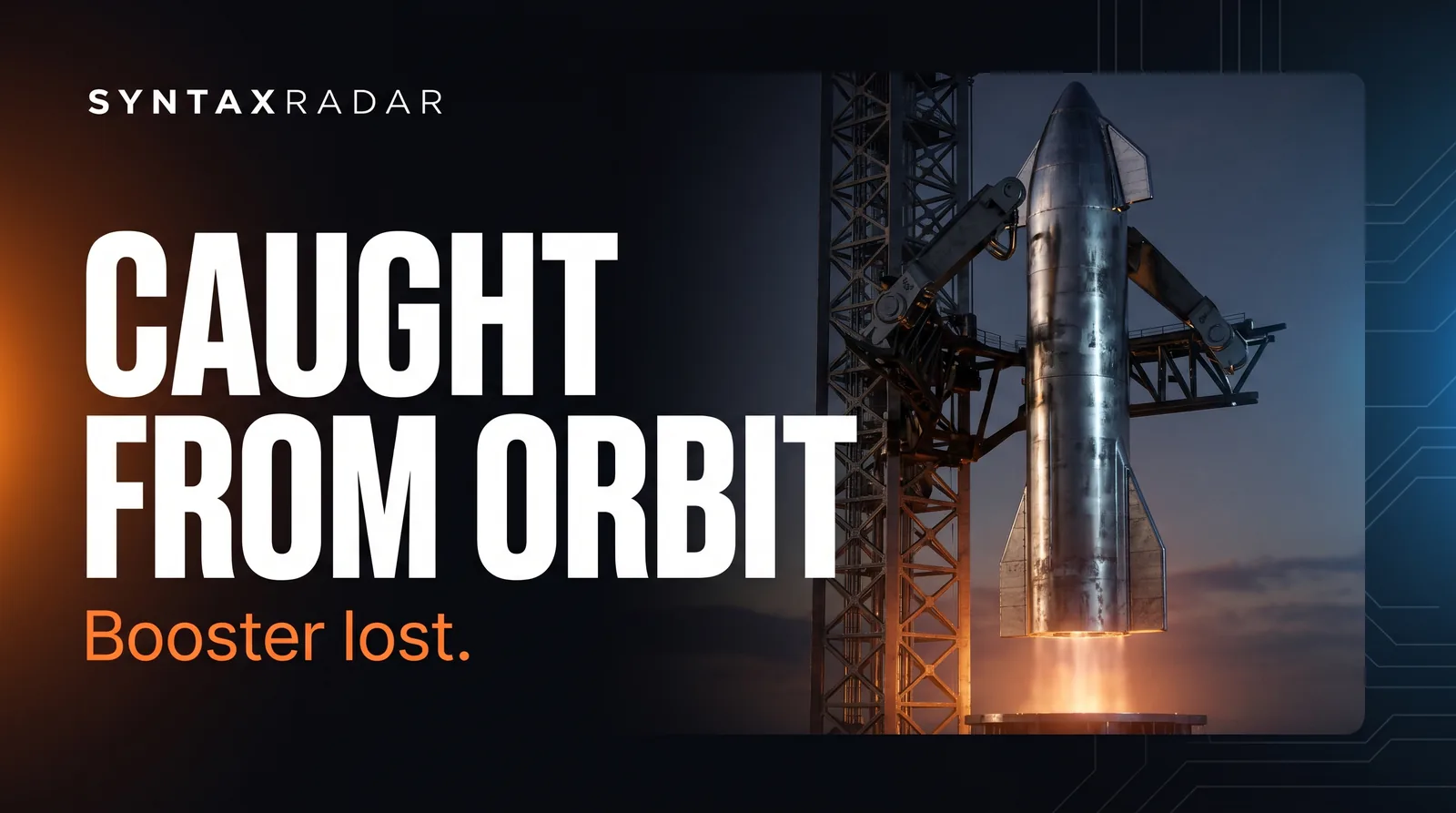
On Nov 14, 2026, SpaceX's launch tower caught Ship 42 about 22.5 hours after Flight 15 lifted off, after roughly 14 orbits. Reports call it the first catch of an orbital upper stage. Booster 22 was lost over the Gulf of Mexico.

Abdul Rehman
Lead Systems Architect and Technical Director · · 6 min read
The short version
- About 22.5 hours
- Launch to tower catch
- About 14
- Orbits completed by Ship 42
- 26
- Starlink V3 satellites deployed
Why it matters: SpaceX brought an orbital upper stage back to its tower for the first time, but losing Booster 22 means the full reuse loop of catching both stages on one flight is still unproven.
On this page
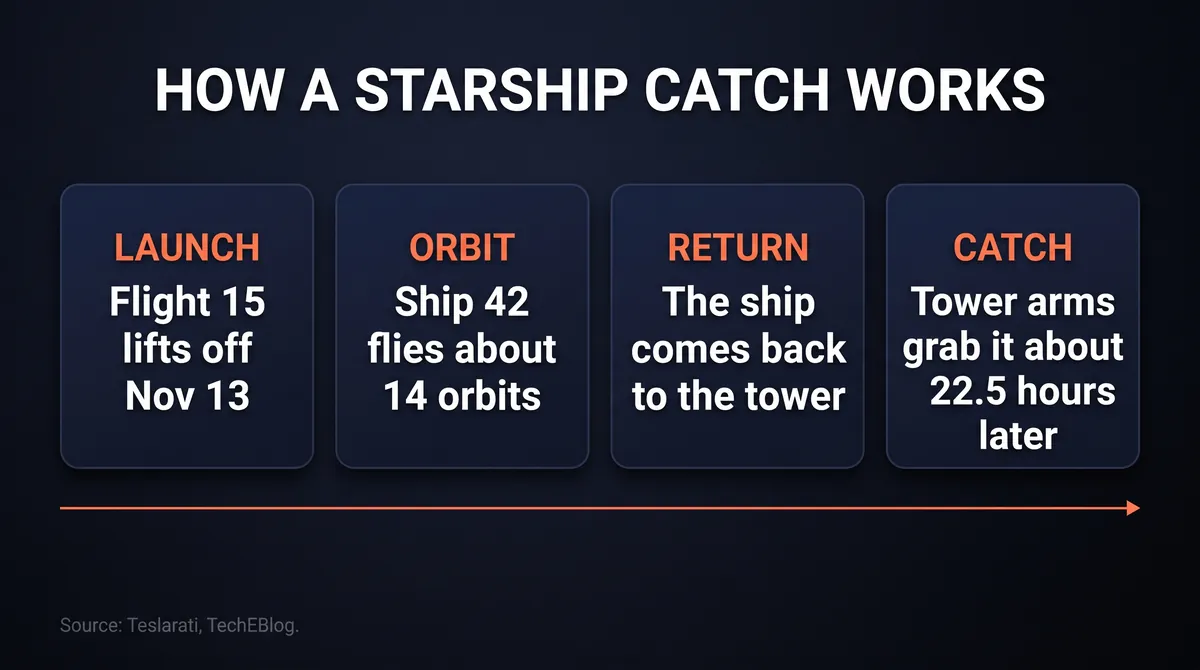
Yes. In the Starship catch on Flight 15, SpaceX's launch tower grabbed the Ship 42 upper stage out of the air on November 14, 2026 at about 3:20 p.m. local time, roughly 22.5 hours after liftoff and after about 14 orbits, according to TechEBlog and Teslarati. Teslarati reports it is the first time any company has caught an orbital rocket's upper stage on its way home.
The other half of the plan failed. Booster 22, the Super Heavy first stage, was lost over the Gulf of Mexico, so the double catch SpaceX wanted (booster and ship both back on the tower from one flight) did not happen.
We previewed this attempt in our Starship Flight 15 explainer, which laid out the November 13 target and the first ship catch plan; this post covers what actually happened. One sourcing note up front: SpaceX's own Flight 15 page returned no readable content when we opened it on November 15, 2026. Every figure below comes from news reports that agree on the launch date, the catch date and the satellite count.
Did SpaceX catch the ship?
SpaceX did catch the ship, and the launch went off inside its window. Flight 15 lifted off on Friday, November 13, 2026 at about 4:47 p.m. CT from Pad 2 at Starbase, two minutes into a 75-minute window that opened at 4:45 p.m. CT, according to the KeepTrack SpaceX brief. The same brief notes the FAA issued the Flight 15 license on November 13, the same day the rocket flew, only hours ahead of liftoff.
About 40 minutes into the flight, Ship 42 released 26 Starlink V3 satellites. Three of them carried cameras and turned them back on the ship to photograph its heat shield (the layer of tiles that protects the vehicle from the heat of re-entry).
Teslarati reports that SpaceX said the heat shield imagery looked good, so flight controllers passed on the backup plan, a splashdown at sea, and chose to bring the ship back to land. Ship 42 then spent its time at about 275 km, completing about 14 orbits before coming home to the tower's arms.
Going in, the outcome was far from certain. Daily Galaxy reported that Elon Musk, speaking on the Q3 earnings call, rated a first-try ship catch as "more likely than not". That is a coin flip with a slight lean.
What is a Starship catch?
A catch is when a returning stage of the rocket is grabbed in mid-air by two arms on its launch tower instead of falling into the ocean. The two arms on the Starship catch tower carry the nickname Mechazilla.
Until Flight 15, only the bottom half of the rocket had done this. KeepTrack counts three Super Heavy booster catches before this flight. Flight 15 was the first Starship catch attempt on an upper stage, and Ship 42 is the first upper stage reported caught after a trip to orbit, which is why the reports treat this flight as a first for the whole industry.
A caught ship is reusable in principle, because it comes back intact enough to grab. The reports we read do not say whether Ship 42 itself will fly again, or how much work it needs first, so reuse remains the goal this catch makes possible, and Flight 15 has not shown it yet.
Starship flight 15 results: what went wrong with Booster 22?
The Starship flight 15 results split cleanly in two: a historic success for the ship and a loss for the booster. According to TechEBlog, Booster 22 ran into guidance and navigation problems (the systems that tell a rocket where it is and steer it), drifted off course, and its flight termination system (a safety system that destroys a vehicle heading somewhere it should not) fired over the Gulf of Mexico.
That ended Booster 22's half of the Starship catch attempt before it reached the tower. The outlets describe it differently: some call it an abort for a guidance problem, others a safety call-off. Either way the pad catch was not completed, and the double catch was off.
There was more riding on Booster 22 than a routine landing. KeepTrack notes it was the first V3 Super Heavy (the newest version of the booster) to try a catch, so the attempt carried more weight than a routine fourth catch.
Musk offered an explanation, as reported by Teslarati: the booster ran short on propellant because its engines slightly underperformed, and the planned fix is to shut the engines down about one second earlier. Teslarati describes that suspected cause as unconfirmed, and SpaceX has not published a formal finding that we could read. So the one-second fix has not been confirmed.
SyntaxRadar calculation: how big a jump was Flight 15?
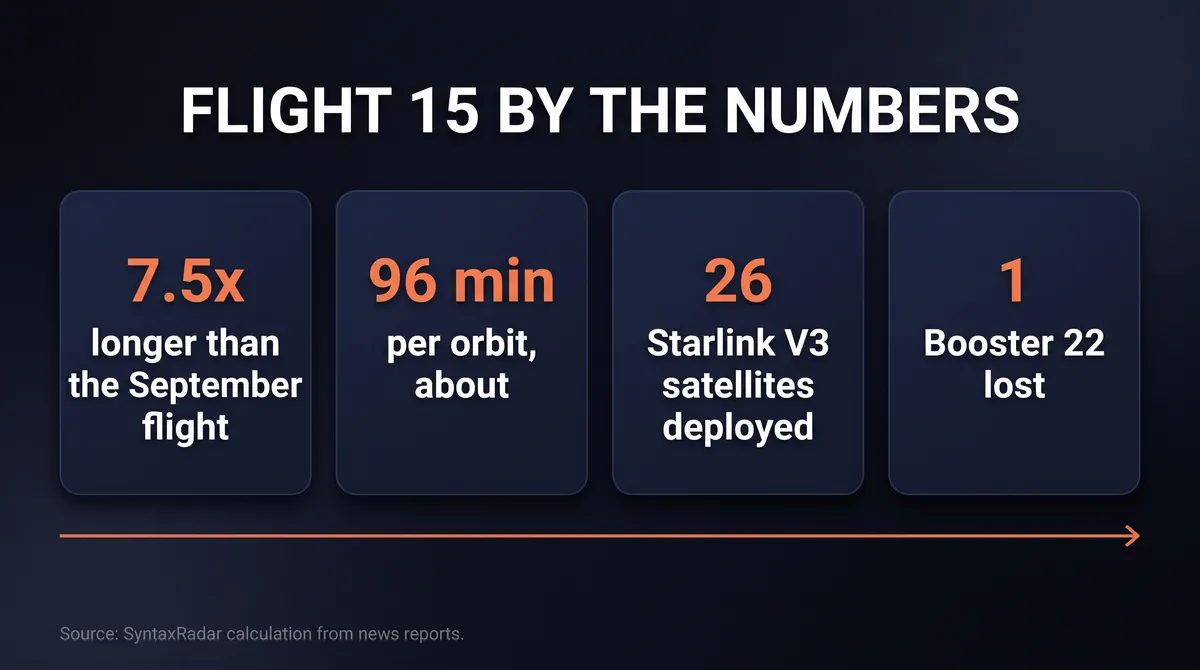
The best way to see what changed is to compare Flight 15 with the flight before it. Teslarati reports that the previous flight, in September 2026, reached orbit but ended after about three hours with a Pacific splashdown, short of its planned 10 hours. We worked out the ratios below from the reported figures. All inputs are rounded (the sources say about), so the results are approximate.
The second row is the headline. In September the ship managed about three hours and missed its own target. Two months later it stayed up 7.5 times as long, flew 2.25 times that old 10-hour goal, and came back to a tower.
Only 3 of the 26 satellites were inspectors, and they were the ones photographing the heat shield. SpaceX said the heat shield imagery looked good before it skipped the splashdown.
What the catch means for Starlink V3 and reuse
For Starlink, one launch is a modest addition. KeepTrack lists 13,096 Starlink satellites launched, 11,193 in orbit and 11,179 working as of November 13, 2026, so 26 new satellites move the total by a fraction of a percent. The V3 satellites are big: KeepTrack says each one's solar arrays span 60 meters. If you pay for the service, our explainer on Starlink prices covers what the network costs by location, the part of the story launches do not change overnight.
For reuse, the catch proves the return leg works at least once: a ship can go to orbit, pass a camera check, come back and be held by the tower. What it does not yet prove is the full loop, booster and ship both caught and flown again. None of the reports we read gave dates for later Moon missions either, so we are not guessing at one.
We could not find SpaceX's own starship catch video: its Flight 15 page showed nothing but its title when we checked on November 15, 2026. The BBC live page that tracked the catch as it happened is the most reliable public record we found. For another Musk company story where the headline figure and the fine print differ, our breakdown of the Tesla Cybercab price is worth a read.
What to watch next
The next Starship catch attempt to watch is the one Flight 15 skipped: ship and booster back on the tower from the same flight. Four things will tell you how close SpaceX is.
- SpaceX's own account. Whether the company publishes Flight 15 data and footage on its launch page, which would let us replace secondary reports with a primary source.
- The booster fix. Whether the next flight uses the engine cutoff about one second earlier, and whether SpaceX confirms the propellant explanation Musk gave.
- A second flight for a caught ship. Reuse only counts once Ship 42, or a later caught ship, launches again.
- The V3 booster record. Booster 22 was the first V3 Super Heavy to try a catch. The next one will show whether the problem was a one-off or a pattern.
Questions readers ask
Did SpaceX catch the ship on Starship Flight 15?
Yes. The launch tower's arms caught Ship 42 on November 14, 2026 at about 3:20 p.m. local time, roughly 22.5 hours after launch and after about 14 orbits. Teslarati reports it was the first time any company has caught an orbital rocket's upper stage on return. The Super Heavy booster from the same flight was lost.
What happened to Booster 22?
Booster 22 hit guidance and navigation problems, drifted off course, and its flight termination system fired over the Gulf of Mexico, according to TechEBlog. Outlets word it differently, as a guidance abort or a safety call-off. Musk said the engines slightly underperformed and left it short on propellant; one outlet calls that cause unconfirmed.
How long was Ship 42 in space on Flight 15?
About 22.5 hours from liftoff on November 13 to the tower catch on November 14, 2026, flying at about 275 km for roughly 14 orbits. By our calculation that is about 96 minutes per orbit and 7.5 times longer than the previous flight in September 2026, which ended after about three hours with a Pacific splashdown.
Where can I watch the Flight 15 catch video?
SpaceX's Flight 15 launch page is where the company normally posts its own footage. When we opened it on November 15, 2026 it returned no readable content beyond its title. The BBC ran a live page covering the catch as it happened, which is the most reliable public record we found while writing this post.
How does SpaceX catch Starship with the tower?
The returning stage is grabbed in mid-air by two arms on the launch tower, nicknamed Mechazilla, instead of landing in the ocean. Ship 42 was caught this way on November 14, 2026, about 22.5 hours after launch. Super Heavy boosters had been caught three times before Flight 15, but Ship 42 was the first upper stage.
Sources
Written by
Abdul Rehman
Lead Systems Architect and Technical Director at Syntaxradar. More in Emerging Tech.
Keep reading

Starship Flight 15: The Nov 13 Target and First Ship Catch
SpaceX VP of Launch Kiko Dontchev named November 13, 2026 as the target for Starship's 15th flight, which would attempt the first tower catch of the ship and booster on one…
Nov 10, 2026 · 6 min read

AI Video Generation in 2026: Sora Is Gone, Kling 4.0 Is Here
OpenAI announced on 24 March 2026 that it was shutting down Sora, and Kuaishou launched Kling 4.0 on 15 October 2026. Creators still stitch short AI clips together to make longer…
Oct 25, 2026 · 6 min read
Nothing AI Device: What Is Confirmed Before the Dec 8 Reveal
On November 4, 2026 Carl Pei said Nothing's first AI-native product ships in December with no new screen. Nothing's November 20 post set a December 8 reveal. The name, price and…
Nov 22, 2026 · 7 min read
More in Emerging Tech
See all
The Economist 2027 Cover: What the Issue Says About AI and Debt
The Economist released the cover and a preview of The World Ahead 2027 on November 16 to 17, 2026. Outlets summarising it say the AI trend covers backlash, debt-funded spending,…
Nov 20, 2026 · 7 min read

Anthropic IPO Price: $70-$78 Range, Ticker ANT and Key Dates
Anthropic's November 10, 2026 filing sets an IPO range of $70 to $78 per Class A share for 825 million shares, ticker ANT on Nasdaq. CNBC and Bloomberg report pricing on November…
Nov 18, 2026 · 7 min read
Vulcan Rocket Failure: 40 Satellites Lost, Cause Unknown
On November 15, 2026, a ULA Vulcan carrying 40 Amazon Leo satellites failed about 10 minutes after liftoff from Cape Canaveral and never reached orbit. As of November 16, 2026,…
Nov 17, 2026 · 7 min read
Latest stories
Front page
NoisyTCP: The Linux Kernel TCP Flaw and Who Must Patch
Abdul Rehman · Nov 23, 2026 · 7 min read

US Approves AI Chips to China: 879,868 H200 and MI325X Cleared
Abdul Rehman · Nov 22, 2026 · 6 min read
KB5132061: Windows 11 Install Errors Explained, and the Fix
Abdul Rehman · Nov 22, 2026 · 7 min read
OpenAI Usage Policies: Gateway Approval and Training Ban
Abdul Rehman · Nov 22, 2026 · 7 min read