


Rust 1.100: Never Type Is Stable After 10 Years. Will It Break?
Rust shipped version 1.100.0 on November 12, 2026. It stabilizes the never type after 10 years and 5 failed attempts, stabilizes the Allocator trait, and adds opt-in Cargo dependency cooldowns. Older editions get a new never type fallback that can rarely break code.

Abdul Rehman
Lead Systems Architect and Technical Director · · 6 min read
The short version
- November 12, 2026
- Release date
- 10 years, 5 failed stabilization attempts
- Never type history
- global-min-publish-age = "3 days"
- Example cooldown
Why it matters: Upgrade with rustup update stable, test crates on editions 2015 to 2021 for the new never type fallback, and opt in to a Cargo cooldown if supply-chain safety matters to you.
On this page
The Rust 1.100 release date was November 12, 2026. As of November 13, 2026, version 1.100.0 is the latest version of Rust, and you can install it with rustup update stable. Three changes lead the release: the Rust never type ! is finally stable, the core Allocator trait is stable, and Cargo gains a setting called min-publish-age that holds back freshly published crate versions for a period you choose. Most projects will upgrade cleanly. Code on the 2015, 2018 or 2021 editions can hit rare type-inference errors, and the fix is usually small.
The never type has the longest backstory. According to the official release announcement, it took 10 years and 5 failed stabilization attempts to get here. The Cargo setting answers a separate concern, supply-chain safety: a delay between a crate version appearing on the registry and your project accepting it.
What is new in Rust 1.100, the latest version of Rust?
The new features come down to three stabilizations, one new Cargo warning and a batch of smaller library APIs, per the GitHub release notes and the announcement.
- The never type.
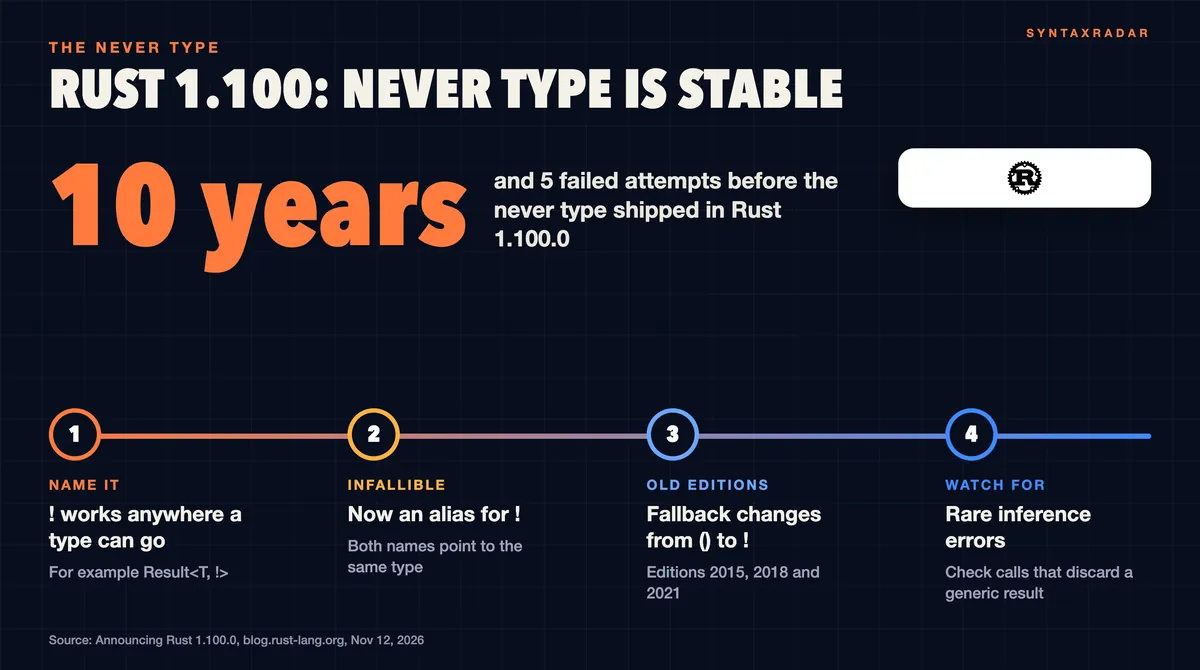
!can now be named anywhere a type can go, for exampleResult<T, !>. The standard library'sInfalliblebecomes an alias for!(PR #155499, "Stabilize never type"). - The `Allocator` trait. PR #156882, "Stabilize custom allocators", brings allocator-aware APIs to
Box,Vec,GlobalandSystem, such asVec::new_inandBox::new_in. - Dependency cooldowns. Cargo's min-publish-age (RFC 3923, Cargo PR #17335) lets you refuse crate versions younger than a set age.
- Unused dependency warnings. Cargo now flags dependencies you declare but never use, through the
[lints.cargo]table, which defaults to warn. - Smaller APIs.
Box::take,Box::map,Rc::map,Arc::map,bool::toggle,Vec::from_fn,str::trim_prefix,str::trim_suffixandcore::mem::DropGuard.
If you only read one part, read the fallback section below. The rest is additive: new things you can use, nothing you have to change.
What is the never type in Rust?
The never type in Rust, written !, is the type of something that never produces a value. As of 1.100.0 it is stable and, per the announcement, can be named anywhere a type can go, for instance inside a generic like Result<T, !>.
Here is why that matters in practice. A signature like fn parse() -> Result<u32, !> tells both the reader and the compiler that the error branch cannot happen. Library authors used Infallible (the standard library's "this cannot fail" error type) for that job. The release notes make Infallible an alias for !, so the two now name the same type.
The road here was long. LWN's September 2026 report on stabilizing the never type was written before release and pointed at Rust 1.99, while the feature shipped in 1.100.0. The main compatibility risk the announcement flags is the fallback change covered further down.
Is the Rust allocator trait stable now?
The Allocator trait describes where a block of memory comes from and how it is handed back. With the trait stable, collections can be built on a chosen allocator without a nightly compiler.
The change is PR #156882. According to the release notes, Box and Vec gain allocator-aware constructors such as Box::new_in and Vec::new_in, and the built-in Global (the default allocator) and System (the operating system's allocator) come with allocator-aware APIs as well.
use std::alloc::System;

let mut buf = Vec::new_in(System);
buf.push(42u8);
The people who gain the most are authors of collections and libraries that want to accept an allocator from the caller, which they can now do on stable Rust.
Does Rust 1.100 break my code? The never type fallback change
Most of the changes in this release are additive, with one exception worth five minutes of your time: never type fallback.
When the compiler meets an expression that never returns and cannot work out its type from context, it has to pick one. That pick is called fallback. In editions 2015, 2018 and 2021 the fallback used to be () (the unit type, Rust's empty value). From this release it is !. The announcement describes the resulting breakage as rare and names one pattern to look for: ignoring the result of a function whose return type is a generic parameter.
A second change will show up as noise rather than errors. Cargo's new unused dependency lint warns by default. It does not check dev-dependencies, and it stays quiet on single-target builds such as cargo check --bin foo, so run a full build if you want the complete list.
A short upgrade checklist:
- Run
rustup update stable. - Check the
editionfield in eachCargo.toml. Crates on 2015, 2018 or 2021 get the new fallback. - Build and test the whole workspace. If a type error appears, look first at calls to generic functions whose result you discard.
- Read the new unused dependency warnings and remove what you do not need.
- Decide whether to turn on a dependency cooldown (next section).
How do I set a Cargo dependency cooldown?
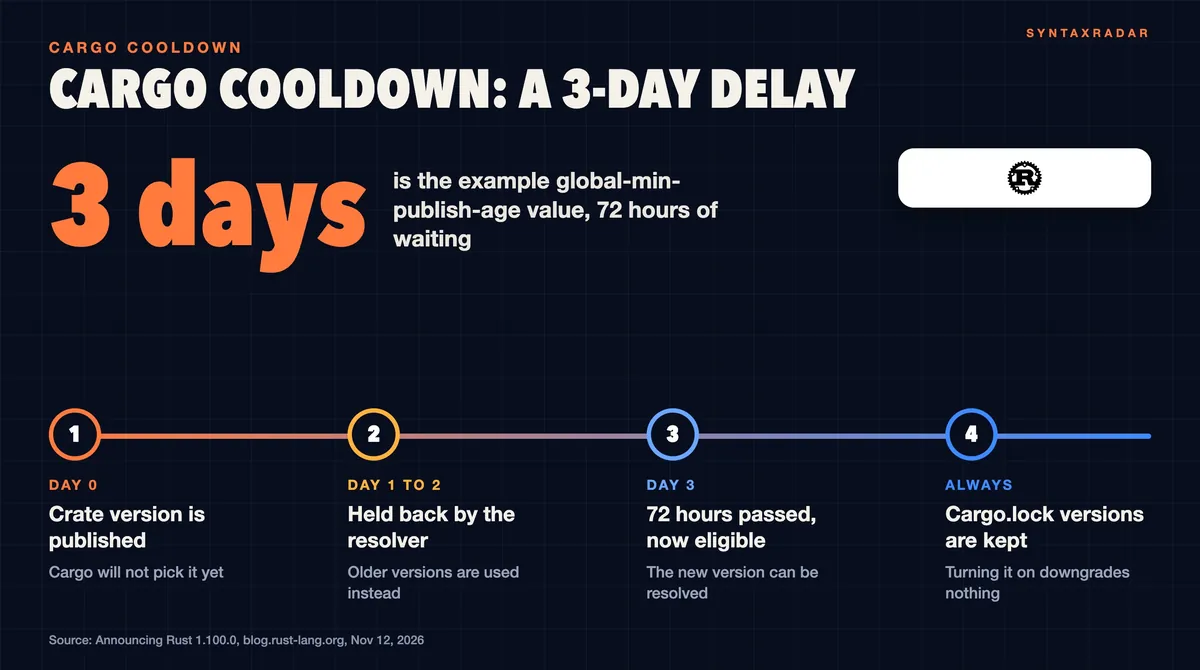
You set a Cargo dependency cooldown by adding global-min-publish-age under [registry] in .cargo/config.toml. The announcement's example uses three days:
[registry]
global-min-publish-age = "3 days"
With that in place, Cargo's resolver skips crate versions published less recently than the age you set. A few rules from the announcement decide how it behaves:
- Your lockfile is safe. Versions already in
Cargo.lockare kept, so turning the setting on does not downgrade anything. - You can override it once. Setting
CARGO_RESOLVER_INCOMPATIBLE_PUBLISH_AGE=allowlifts the cooldown for a single update. - `cargo install` ignores it. Tools installed that way are not held back.
- Old index entries pass through. Versions without a
pubtimefield in the registry index are never held back.
Upgrading Rust alone does not switch this on. Cargo's default minimum publish age is zero, according to Cyber Security News (single secondary report), so the cargo min publish age only applies once you configure it.
If you manage more than one language runtime, our .NET end of life guide covers the same upgrade-or-wait decision on the Microsoft side.
SyntaxRadar calculation: the numbers behind the release
We took three figures from the primary pages and did the arithmetic. Every result below is derived by us; the inputs come from the Rust announcement and the GitHub release page.
What the numbers tell you: a crate version published on a Monday morning would become eligible for a project with a 3-day cooldown on Thursday morning. That window is the whole point of the feature. The 80-day gap shows the never type was merged well ahead of the release that carried it.
What to watch next
Rust 1.100 is on the stable channel as of November 13, 2026, and these changes are worth tracking from here. Three things to follow:
- Fallback reports. Watch issue trackers for crates on older editions that hit the new never type fallback, and whether maintainers publish fixes.
- `Result<T, !>` in public APIs. Library authors can now say "this cannot fail" in the type itself; check whether the crates you depend on start doing it.
- Cooldown adoption. The default stays at zero, so the protection only works for teams that opt in. A project's
.cargo/config.tomlwill tell you whether it has.
For more on Rust in shipping software, our piece on why Discord is using so much RAM looks at a Rust app measured on the desktop. And if your team is tightening its local dev setup, our look at the free AWS emulator that rivals LocalStack covers Amazon's own local copy of its services.
In code
[registry]
global-min-publish-age = "3 days"fn parse() -> Result<u32, !> {
Ok(42)
}Questions readers ask
What is the Rust 1.100 release date?
It was released on November 12, 2026, and you can update with `rustup update stable`. The release stabilizes the never type and the Allocator trait and adds opt-in Cargo dependency cooldowns. Editions 2015, 2018 and 2021 also get a new never type fallback that can rarely break code.
What is the never type in Rust, and is it stable?
Yes. The release on November 12, 2026 stabilizes the never type `!`, so you can name it anywhere a type goes, for example `Result<T, !>`. The official announcement says it took 10 years and 5 failed stabilization attempts. The standard library's `Infallible` type becomes an alias for `!`, so the two now name the same type.
Does upgrading Rust turn on dependency cooldowns automatically?
No. You opt in by adding `global-min-publish-age` under `[registry]` in `.cargo/config.toml`, for example "3 days". A secondary report says the default minimum publish age is zero, so upgrading the toolchain alone does not delay new dependency versions. Versions already in your `Cargo.lock` are kept either way.
How do I skip the Cargo cooldown for one update?
Set the environment variable `CARGO_RESOLVER_INCOMPATIBLE_PUBLISH_AGE=allow` for that one update and Cargo will accept versions younger than your configured age. The setting does not affect `cargo install`, which ignores the cooldown, and versions without a `pubtime` field in the registry index are never held back.
Why is Cargo warning about unused dependencies after the upgrade?
Cargo now ships an unused dependency lint in the `[lints.cargo]` table, and it defaults to warn. It flags dependencies you declare but do not use. It does not check dev-dependencies, and it does not run for single-target builds such as `cargo check --bin foo`, so run a full build to see every warning.
Where do I find the Rust release notes for 1.100?
The Rust release notes for 1.100.0 are in the announcement on the official Rust blog, dated November 12, 2026. The Rust changelog sits on the GitHub release page for 1.100.0, which lists each change with its pull request number, such as #155499 for the never type and #156882 for custom allocators.
Sources
Written by
Abdul Rehman
Lead Systems Architect and Technical Director at Syntaxradar. More in Developer Tools.
Keep reading
Postgres 19 Release Date: Why AI Bug Hunters Pushed It Back
PostgreSQL committer Robert Haas says Postgres 19 will most likely ship in November, not the usual mid-September to mid-October window, because people using LLMs are reporting far…
Nov 3, 2026 · 7 min read

GPT-5 Deprecation: What Breaks on Dec 11 and What Replaces It
As of November 16, 2026, OpenAI's deprecations page lists December 11, 2026 as the shutdown date for gpt-5, gpt-5-mini, gpt-5-nano, gpt-5-pro, o3 and o3-pro, with gpt-6.1-sol,…
Nov 19, 2026 · 7 min read

.NET End of Life: .NET 8 and 9 Ended Nov 10. Move to 10 or 11?
Microsoft released .NET 11 on November 10, 2026, the same day .NET 8 and .NET 9 reached end of support. Their apps keep running, but servicing updates, security fixes and…
Nov 11, 2026 · 8 min read
More in Developer Tools
See all
Android Sideloading: Verification Goes Global in January 2027
On November 19, 2026 Google said Android developer verification starts rolling out globally in January 2027, beginning with seven app distributors. Unregistered apps can still…
Nov 20, 2026 · 7 min read

Mapbox Alternative: Host Protomaps for $5 a Month Plus Bandwidth
A November 15, 2026 blog post priced a self-hosted Protomaps map at about $5 a month in storage and $0.00005 per city view, against Mapbox's $5 per 1,000 loads after 50,000 free.…
Nov 18, 2026 · 7 min read

Microsoft Ignite 2026: Keynote Time, Copilot and Azure Prices
As of November 16, 2026, Microsoft Ignite 2026 opens November 17 in San Francisco with a keynote listed for 10:00 a.m. Pacific. Microsoft has not published its announcements, but…
Nov 17, 2026 · 7 min read
Latest stories
Front page
NoisyTCP: The Linux Kernel TCP Flaw and Who Must Patch
Abdul Rehman · Nov 23, 2026 · 7 min read

US Approves AI Chips to China: 879,868 H200 and MI325X Cleared
Abdul Rehman · Nov 22, 2026 · 6 min read
Nothing AI Device: What Is Confirmed Before the Dec 8 Reveal
Abdul Rehman · Nov 22, 2026 · 7 min read
KB5132061: Windows 11 Install Errors Explained, and the Fix
Abdul Rehman · Nov 22, 2026 · 7 min read