


Seagate Hybrid Drive: FireCuda Forge Costs $699, SSD Not Included
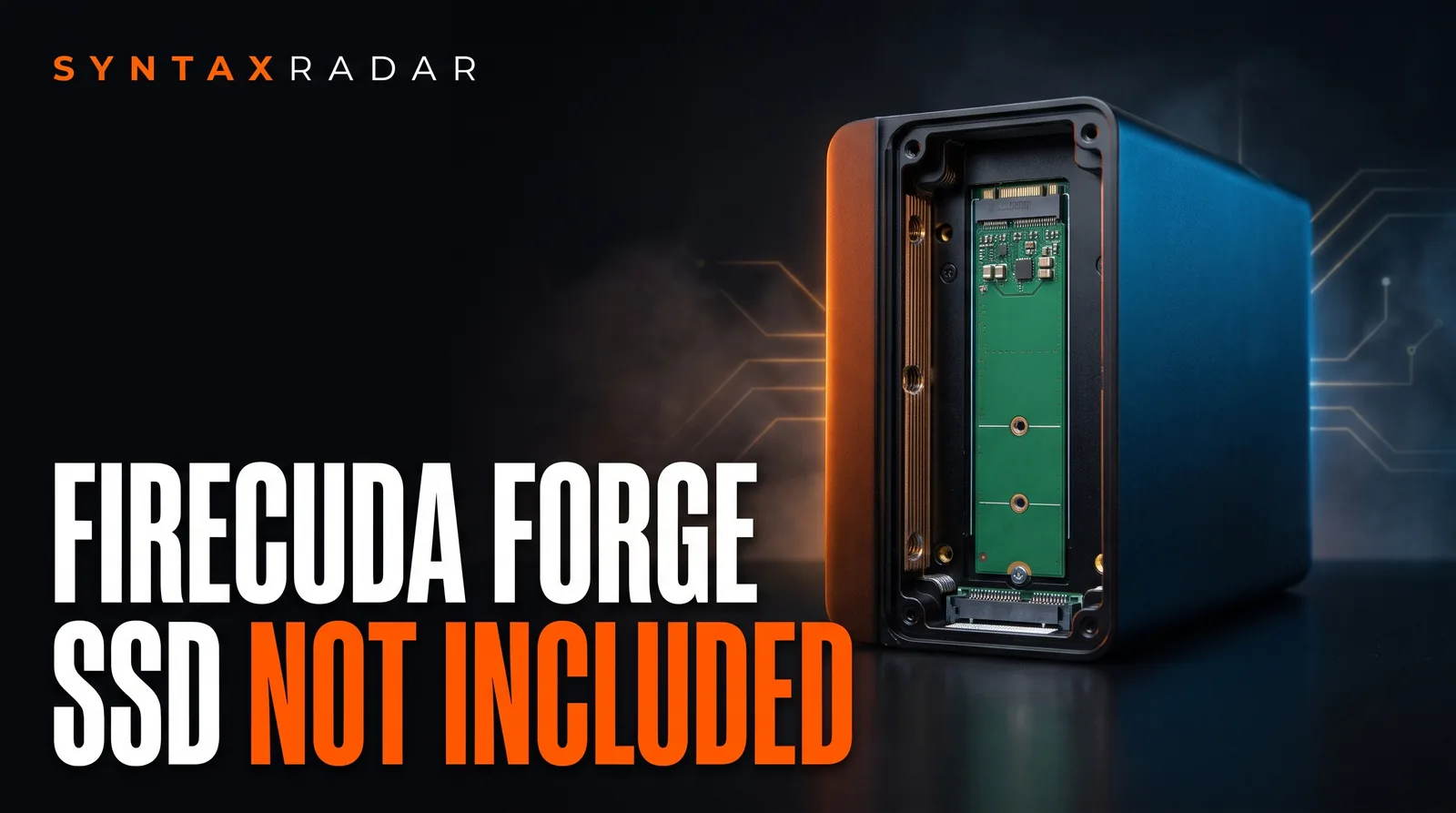
On November 10, 2026, Seagate launched the FireCuda Forge, an 8TB ($699) or 20TB ($899) external hybrid drive built on its Alkemi platform. You supply the NVMe SSD; Seagate quotes up to 2,500 MB/s reads over USB4.

Abdul Rehman
Lead Systems Architect and Technical Director · · 7 min read
The short version
- $699 (8TB) / $899 (20TB)
- Starting prices (SSD not included)
- 2,500 / 2,000 MB/s
- Peak read / write over USB4
- Up to 1TB
- SSD space used (Blocks & Files)
Why it matters: The FireCuda Forge suits people with big libraries and a small daily working set who have USB4 and will buy and fit their own 1TB NVMe SSD; everyone else is better served by a plain SSD or hard disk.
On this page
The Seagate hybrid drive is back as the FireCuda Forge, an external desktop drive that pairs a hard disk with an NVMe SSD you buy and fit yourself. As of November 15, 2026, Seagate's launch release prices the 8TB model from $699 and the 20TB model from $899, and neither price includes the SSD. Seagate quotes up to 2,500 MB/s reads and 2,000 MB/s writes over USB4.
That makes the Seagate FireCuda Forge an odd product to price. The sticker is only part of the bill, the SSD slot is yours to fill, and a software layer called Alkemi decides which of your files get the fast storage. Below: how this Seagate hybrid hard drive works, what it really costs per terabyte, and who should buy one instead of a plain SSD or hard disk.
What Seagate announced with the FireCuda Forge
Seagate announced the FireCuda Forge on November 10, 2026, in a press release distributed by Business Wire. The company calls it the first Seagate hard drive built on Alkemi, which it describes as an intelligent storage platform. Ars Technica covered it on November 14 under the headline "Seagate resurrects the SSD-HDD hybrid drive." We could not open that article, so we cite only its headline.
The launch facts, from Seagate's release:
- Capacities: 8TB and 20TB.
- Prices: from $699 (8TB) and $899 (20TB).
- Peak speed: up to 2,500 MB/s read and 2,000 MB/s write over USB4, on compatible systems.
- Availability: Seagate says the drive is on sale through its online store and authorized partners, with availability varying by market. Availability can differ by region, so check the listing before you order.
- Upgrades: the SSD is user-supplied, and the internal hard disk can be replaced later.
Lance Ohara, Seagate's VP of Edge IoT Marketing, framed the pitch around the old storage trade-off: people should not have to pick between speed and capacity, and, in his words, "Forge is built on the idea that they shouldn't have to."
What is a hybrid hard drive?
A hybrid hard drive combines fast flash storage with a spinning hard disk in one device, so the files you use often load at flash speed while the bulk of your data sits on cheaper magnetic platters. Seagate sold internal hybrid drives for years under the SSHD label, including FireCuda models, where a small flash cache was sealed inside the drive and could not be changed.
The Forge keeps the idea and changes the hardware. According to Blocks & Files, the flash half is a standard M.2 NVMe SSD you slot into the base of the enclosure. Seagate Alkemi then tracks how often each file is accessed and uses machine learning to place it. Frequently used files go to the SSD, which acts as a dynamic cache (a fast holding area that refills as your habits change). Less-used files, and any single file over 1TB, live on the hard disk.
Your computer sees none of this juggling. Blocks & Files reports that the pair shows up as one 8TB or 20TB volume on Windows 11 or later and macOS 26 or later.
Does the Seagate FireCuda Forge include an SSD?
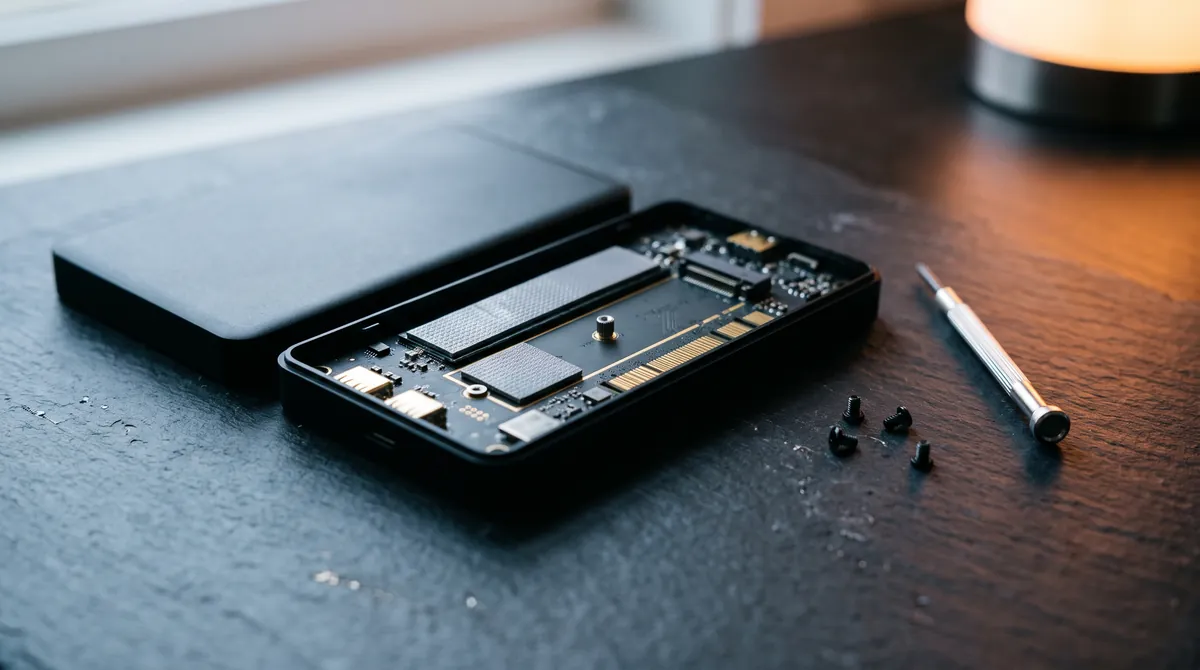
No. The Seagate FireCuda Forge does not include an SSD, and it needs one to work. Seagate's release says users supply their own NVMe drive, so the $699 and $899 prices cover the enclosure, the hard disk and the Alkemi software only.
Blocks & Files lists what the SSD has to be:
- Form factor: M.2 2280 NVMe.
- Capacity: 1TB minimum recommended.
- Features: a DRAM cache and PCIe Gen3 or newer.
- Certified models: Samsung 990 Pro, Sandisk SN850X/GX Pro 850X and Sandisk SN710/GX7100.
Installation is a screwdriver job. The SSD slot opens after removing four screws on the base, and Seagate supplies thermal pads but no heatsink. Swapping the hard disk later takes six more screws.
One limit matters for buying decisions. Per Blocks & Files, the Forge uses no more than 1TB of SSD space, even if you install a larger drive. A 2TB or 4TB SSD buys you nothing extra here, so a quality 1TB model is the sensible fit. Seagate's release does not spell out this cap, so treat it as reported by Blocks & Files rather than confirmed by Seagate.
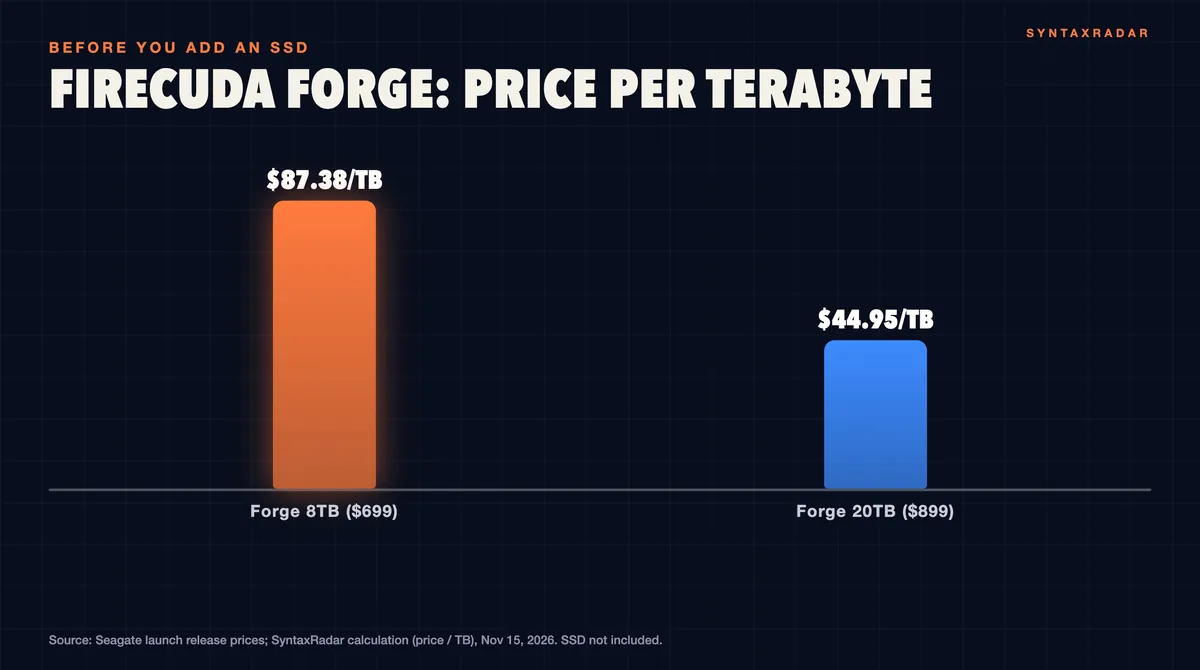
SyntaxRadar calculation: Seagate hybrid drive cost per TB and speed gap
We ran the numbers from Seagate's prices and the Blocks & Files comparison. Every figure below is derived from those two sources, with the inputs shown.
Three things stand out:
- The 20TB model is the value pick. It costs $200 more than the 8TB model for 12TB more space, about $16.67 for each extra terabyte ($200 / 12).
- Your real price is the sticker plus an SSD. Budget $699 or $899 plus whatever a 1TB NVMe drive with DRAM costs where you shop. We have not put an SSD price here because none of our sources gives one.
- The speed gap is large on paper. Blocks & Files compares the Forge with a 20TB Seagate Exos X24 hard drive, whose bandwidth is below 300 MB/s. Seagate's 2,500 MB/s peak read is more than 8 times that (2,500 / 300 = 8.3).
That last number comes with a caveat. The 2,500 MB/s figure is a peak over USB4, and Blocks & Files lists the read speed as 2,400 MB/s, so expect "roughly 2,400 to 2,500 MB/s" at best. Seagate's release does not say how fast files read once Alkemi has moved them to the hard disk side.
Hybrid drive vs SSD: which should you buy?
In the hybrid drive vs SSD choice, the Forge wins on capacity and an SSD wins on simplicity. A plain external SSD gives flash speed to every file you store. The Forge gives flash speed only to the 1TB of files Alkemi judges you use most, and in exchange you get 8TB or 20TB in a single volume.
The hybrid hard drive vs SSD question comes down to how your data behaves:
- Choose the Forge if you keep a large library (video projects, photo archives, game installs) but work on a small slice of it at a time. That slice fits the 1TB cache, and the rest waits on the hard disk.
- Choose an SSD if everything you store fits on one, or if you jump between many large files at random. A cache only helps when your habits repeat.
- Choose a plain hard disk if you mostly archive files and rarely open them. Speed you never use is wasted money.
Game storage is a good test case. Our GTA 6 preload storage guide shows how much space one big title can claim, which is why a large library plus a fast cache for the game you are playing suits this design. For data you almost never touch, our explainer on LTO tape for AI archives covers the cold-storage end of the market that the Forge does not try to serve.
Is the Seagate FireCuda Forge worth it?
The Seagate FireCuda Forge is worth it for a narrow buyer: someone with a desktop that has USB4, more data than a single SSD can hold at a sane price, and a working set (the files you use day to day) under 1TB. For that person it puts speed and capacity in one volume, with Alkemi deciding what goes where.
It is harder to justify in three cases:
- Your computer lacks USB4. Seagate's peak speeds apply over USB4 on compatible systems.
- You run an older OS. Blocks & Files lists Windows 11 or later and macOS 26 or later.
- You want one price, one box. You have to buy, fit and cool the SSD yourself.
The upgrade path is the most interesting part of this Seagate FireCuda hybrid drive. Because both the SSD and the hard disk can be swapped, the enclosure and Alkemi software can outlive the drives inside them. The old sealed SSHDs never offered that.
If you are pricing the SSD, our explainer on why RAM prices are going up covers the AI memory squeeze behind current memory prices. Check current SSD prices before you add up the total.
What to watch next
The Seagate hybrid drive story now turns on testing. Three questions are open as of November 15, 2026:
- Real-world speed. Independent reviews will show how close the Forge gets to 2,500 MB/s, and how it behaves when a file is not in the cache.
- The 1TB cap. Seagate's own documentation should confirm or correct the Blocks & Files report that SSD space beyond 1TB goes unused.
- The certified SSD list. Watch whether Seagate adds drives beyond the Samsung 990 Pro and the Sandisk models it certifies at launch.
Until those answers arrive, treat the Forge as a smart enclosure with a bring-your-own SSD, and budget for both parts.
Questions readers ask
Does the Seagate FireCuda Forge include an SSD?
No. Seagate's release says users supply their own NVMe SSD, and the drive needs one to work. Blocks & Files reports the requirement as an M.2 2280 NVMe drive, 1TB minimum recommended, with a DRAM cache and PCIe Gen3 or newer. Seagate certifies the Samsung 990 Pro and several Sandisk models, and includes thermal pads but no heatsink.
What is a hybrid hard drive?
A hybrid hard drive pairs fast flash storage with a spinning hard disk so frequently used files load quickly while bulk data sits on cheaper platters. Seagate's older SSHDs sealed a small flash cache inside the drive. The FireCuda Forge uses a swappable M.2 SSD instead, and the Seagate Alkemi software decides which files sit on it.
Hybrid hard drive vs SSD: which is faster?
An SSD gives flash speed to every file it stores. The FireCuda Forge reaches Seagate's quoted peak of up to 2,500 MB/s read over USB4 for files in its SSD cache, which per Blocks & Files holds at most 1TB. Seagate has not published how fast files read once they sit on the hard disk side.
How much SSD space does the Seagate hybrid drive use?
According to Blocks & Files, the FireCuda Forge uses no more than 1TB of SSD capacity, even if you install a larger drive. That makes a quality 1TB NVMe SSD with DRAM the sensible match. Seagate's own release does not state the cap, so watch for official documentation to confirm it before buying a bigger SSD.
Sources
Written by
Abdul Rehman
Lead Systems Architect and Technical Director at Syntaxradar. More in Chips & Hardware.
Keep reading
When Will SSD Prices Drop? TrendForce Says 2027, Retail Lags
On November 19, 2026 TrendForce forecast NAND contract prices falling 0% to 5% in 1Q27 and all categories declining from 2Q27, after cutting its 4Q26 rise to 8% to 13%. German…
Nov 21, 2026 · 8 min read

SSD Prices: Why AI Datacenters Are Making Storage Cost More
The contract price of a 256GB TLC SSD hit about $134.20 in Q3 2026, up 303% from $33.30 a year earlier, as AI cloud buildouts absorb NAND flash. TrendForce expects NAND contract…
Oct 29, 2026 · 7 min read
Black Friday PC Parts: Which 2026 Deals Are Real, Which Are Thin
As of November 16, 2026, TrendForce data and buying guides point to thin Black Friday discounts on RAM and GPUs, mixed signals on SSDs, and more normal ones on CPUs, cases and…
Nov 19, 2026 · 9 min read
More in Chips & Hardware
See all
US Approves AI Chips to China: 879,868 H200 and MI325X Cleared
On November 19, 2026 the House Foreign Affairs Committee released BIS records: 879,868 Nvidia H200 and AMD MI325X chips approved for Chinese buyers as of May 11, 2026, out of…
Nov 22, 2026 · 6 min read
Colette Kress: Nvidia's Interim CEO, $115.8B Quarter, $130B Guide
On November 12, 2026 Nvidia named CFO Kress interim CEO after Jensen Huang resigned, giving no reason. On November 17 she reported $115.8B of revenue and guided Q4 to $130.0B,…
Nov 21, 2026 · 6 min read
GTA 6 Release Time: Midnight Nov 19, West Coast Unconfirmed
Rockstar's support page says GTA 6 releases at midnight local time on November 19, 2026 on PS5 and Xbox Series X|S. Sony describes a rolling launch by country. No US time-zone…
Nov 18, 2026 · 6 min read
Latest stories
Front page
NoisyTCP: The Linux Kernel TCP Flaw and Who Must Patch
Abdul Rehman · Nov 23, 2026 · 7 min read
Nothing AI Device: What Is Confirmed Before the Dec 8 Reveal
Abdul Rehman · Nov 22, 2026 · 7 min read
KB5132061: Windows 11 Install Errors Explained, and the Fix
Abdul Rehman · Nov 22, 2026 · 7 min read
OpenAI Usage Policies: Gateway Approval and Training Ban
Abdul Rehman · Nov 22, 2026 · 7 min read